What's the difference?
Australian EV buyers seem to be missing the point of the Mustang Mach-E.
Yes, Ford’s exorbitant early pricing did not help – which the mid-sized EV has yet to recover from. And the V8-muscle-car image – and baggage – that the Mustang prefix brings no doubt confuses and even repels some people. Especially eco-conscious ones.
But it’s not that complicated. The Mach-E is merely meant to be a sporty, stylish and attainable family car, albeit with electric power.
Five years on from its US launch, does the 2026 Series II facelift keep up with newer and fresher electric SUV alternatives? And is it worth the premium that the Mustang badge commands?
When it comes to Mazda’s luxury aspirations, the CX-90 is it. The big Kahuna. Seven seats of what should be the Japanese brand’s exceptionalism amongst its mainstream rivals.
But does this more than five-metre-long Mazda have what it takes to elevate the brand beyond the likes of Toyota, Hyundai, Nissan and Kia?
Importantly, is this base version - which is closer to Mazda’s traditional price point - a bit of a luxury seven-seat SUV bargain?
We drove a CX-90 G50e Touring (the most affordable CX-90 of the lot) for a week to find out.
EV buyers who don’t or won’t see the point of the Mustang Mach-E are missing out.
This is a sporty and fun-to-drive electric SUV in the same way that the Ranger is the sporty and fun-to-drive ute. In other words, a lot of what makes Fords brilliant is alive and well here, without compromising functionality. The opposite of so many Chinese electric SUVs that shine brightest on the showroom floor, then.
Yes, a base Select that is around $10K cheaper to start with might help punters see the light even more clearly (and that's our choice), and it is starting to look dated inside and out, but overall, the Mach-E is an enjoyable, fulfilling and practical family proposition.
There are many reasons I quite like this CX-90. It sells the plush luxury promise when it comes to its interior and design, it feels big and purposeful, and has a refreshingly minimalist approach to its cabin tech. As a seven-seat SUV it’s particularly impressive, with plenty of amenity and a third row that can genuinely fit an adult in comfort.
However, there are areas where it could use more polish, from the drivetrain to the ride, and it ultimately strikes an odd point for price and ownership which feels lost between the premium segment and the mainstream rivals.
If you’re a long-term Mazda owner, I still think you’ll love it, and this Touring grade is definitely the best value in the range. It offers the lion’s share of equipment at a price more comparable to Mazda’s traditional mainstream rivals.
So, what's changed with the facelift? Not much, meaning that the Mach-E – unveiled all the way back in late 2019 is beginning to look dated. Maybe that’s another classic Mustang trait.
The base Select gains the upper-series’ trick LED headlights. The Premium adopts some plastic body cladding. The grille treatments vary between the grades, with the GT boasting a unique look. Genuinely fresh new colours abound. And the alloys have been restyled.
Otherwise, it's still the same, Porsche Macan-esque small to medium-sized SUV crossover on the outside, down to the Hyundai Tucson-like vertical tail-light motif that barely seems like the regular Mustang muscle car’s, despite Ford’s intentions.
Inside, changes are largely limited to a repositioning of the gear selector from a rotary dial to a column shifter, Mercedes-style. That big portrait touchscreen could be straight out of a Ranger ute.
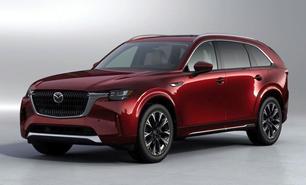
The CX-90 is an impressive car to behold. Moving things onwards and upwards from its CX-9 predecessor, the CX-90 is bigger and even more refined in a lot of ways.
Mazda’s signature design language has evolved into something a bit beefier, trading out the delicate sharp angles and chromes of its front-wheel-drive predecessors for something a bit more upright, with a wide stance and tough proportions.
The long bonnet and expansive body panels stress the long-engined, fluid nature of this car’s design language. It certainly gives it a more premium vibe than the boxy American-influenced style of the Hyundai Palisade, and leans more European than the science-fiction styling of something like the Kia Sorento.
If anything, there’s some clear BMW influence in the shape of the tail and light fittings. Light lashings of chrome keep it in-line with Mazda’s previous design language, and on this base model at least, plastic claddings over the arches toughen it up a bit.
Inside is plush. In fact, it’s treading on Lexus territory when it comes to the design and feel of the seats, dash, doors and there are even padded leather touches down the sides of the centre console for your knees to rest against. Even the standard leather seats are nice (with softer Nappa leather available on higher grades), and I actually find the somewhat monochrome interior treatment on our test car to be the most modest option. It’s off-set by silver trims and a touch of chrome in the steering wheel and doors.
The dash is in a more traditional style (again, it feels influenced by BMW here) with a padded insert across the front, inset vents and a climate control panel leading down to a nice wide console with tasteful patterned trims, and an electronic shifter. The screen in this base car is of modest dimensions compared to most cars today, but those who aren’t sold on giant touchscreens will love it.
Even the digital dash elements are tastefully executed, although they’re not particularly customisable, which is a shame.
As we’ve said before, the Mach-E is closer to something like, say, a BMW X4 than the boxier X3 from a proportions perspective, making it a classic coupe SUV.
Once you get over using the endlessly-annoying push-button door release, in lieu of a handle (why redesign the wheel?), that’s particularly noticeable entering/egressing the rear seat for larger people, though the front is fine.
While the interior is also clearly from an earlier era (and embarrassingly reminiscent of a Tesla), at least Ford finished engineering it for easy, seamless use.
The front seats are really comfy, ahead of a super-clear instrument pod, helping make for a great driving position, while the 15.5-inch display in the centre with Ford’s friendly SYNC4A operating system is simple to navigate once time is taken to familiarise. Current Ranger and Everest owners will feel right at home. The audio sound is superb too.
There’s a thoughtful amount of storage options, including for devices that require access to the handy USB outlets, ventilation is ample and the fit and finish in these Mexican-made Mustangs appears to be first class.
A big thumbs up, too, for the new column shifter and integrated central volume knob in the touchscreen that also allows adjustment of the climate control.
On the other hand, eyes must leave the road to dig into sub menus to change driving modes, side and rear vision is tight (those standard surround-view cameras sure come in handy), there are no paddle shifters to control regenerative braking, the glass roof neither opens nor completely blocks out sunlight due to there being no shade screen, and the overall ambience is more Ranger XLT than Ford LTD.
The back seat is surprisingly spacious given the coupe SUV dimensions, though the roofline may ruffle a few loose wigs. The backrests and cushions provides decent support, and most expected amenities are present, including air vents, USB outlets, overhead lighting/grab handles, coat hooks, cup/small bottle holders and centre armrest. And that glass ceiling does shower the cabin with light on a cloudy day.
Further back, the Mach-E offers 402 litres of cargo capacity that balloons out to 1420L with the split-fold back seats dropped, and there’s some hidden storage under the floor for smaller items. As mentioned earlier, the spare wheel is AWOL.
Existing owners will also notice a noticeably smaller ‘frunk’ area under the bonnet, where storage has plummeted from 134L to just 49L. That’s due to the newly-fitted heat pump that, at least helps boost efficiency in what is a spacious and practical family SUV.
The CX-90 is enormous, but despite its long bonnet, it feels on the inside like it makes good use of its dimensions.
Up front, it’s easy to find a seating position thanks to an array of adjustability, from the seats to the telescopic adjust for the wheel, and the cabin is wide and tall enough to accommodate pretty much anyone with ease.
Unlike some Mazdas which have a strange zoom-factor on their rear vision mirrors, the CX-90 doesn't have this problem, and visibility generally out the windows is impressive. I can see the long, tall bonnet and cosy dash design creating visibility issues for shorter drivers, however.
Padded materials are everywhere they should be (and more), and when it comes to storage there’s a large bottle holder in each front door, two more cupholders in the centre console (with a flip-out cover), a split-opening centre console box (which hides USB-C connections, great for cable management) and a wireless charging bay up front below the climate unit.
It’s rare these days to see a full array of physical buttons and toggles for a dual-zone climate set-up, but the Mazda has the whole lot. It’s a breeze to adjust on the fly and integrates into the design in a subtle way.
It’s also worth calling out the multimedia screen isn’t a touch unit. Instead, you need to control it through a handful of buttons and a rotary dial on the centre console. It’s nice to have a physicality to it, and it works well for the relatively simple base operating system, but it’s a clumsy way to interact with phone mirroring.
In my experience Apple CarPlay has simply too many icons and menu features to work around with a dial-operated system, to the point where it’s distracting to use on-the-go (thus, defeating the purpose of having physical controls).
The second row is a real highlight. Set to its default position, I have leagues of legroom behind my own driving position (at 182cm tall). Again, heaps of width and headroom here, and even the huge rear doors open nice and wide, which should make loading luggage and fitting child seats easy.
The seat trim is just as good as it is in the front, with decent side bolstering, and top-notch amenities, with shades built into the windows, decent-sized bottle holders in each door, a further two in the drop-down armrest, soft pockets on the backs of each front seat, and a separate climate zone with independent temperature and fan speed controls.
There are two adjustable air vents with a lock-off, as well as two USB-C ports for power. Top marks.
The third row is usually where things get tricky for SUVs like this, but the CX-90 isn’t out of tricks yet.
Access isn’t the easiest. The second row can fold forward, but the left over aperture for clambering in, even though the doors are quite large, isn’t great, which will make it a no-go for anyone with mobility issues.
However, once you’re back there, I was surprised to find a full-sized adult like me can fit in relative comfort. With the second row set as far back as it can go, my knees are hard up against the back, but when rolled forward for more third-row space, there's still plenty of room in the middle. I was left with ample room for my knees and feet in the back seats. The seat trim also offers decent padding and comfortable trims, which is rare for most three-row SUVs, and while you wouldn’t want to be too much taller than me, the roof was just tall enough to have a little airspace above.
The armrests are hard plastic, unfortunately, but offer two large bottle holders on each side, as well as a USB-C port, and vents with decent air flow, which is again, quite rare for a three-row SUV.
I’d go so far as to say this is one of the best SUV third rows I’ve been in when it comes to space, comfort and amenity.
Now for the luggage space. I was pleased to find, even with the third row up, I could fit the largest (124 litre) CarsGuide luggage case with room to spare on either side. Officially, space here is 257L, but it’s rare to fit a case this size in a three-row SUV.
With the third row folded down, space comes in at 608 litres, which is on-par for this segment, and with the second and third row down, it tops out at 2025L.
With such space on offer it’s probably worth keeping in mind the payload, which is 580kg, and for those who want to add a trailer to the mix, the maximum towing capacity is 2500kg braked or 750kg unbraked for the 50e petrol straight-six versions like the one we’re testing here.
Here's a worrying fact. The Mustang Mach-E is the cheapest new Ford passenger car you can buy in Australia that isn't based on a diesel-powered ute. And it still ain’t cheap!
When launched in Australia back in mid-2023, prices started north of $80,000 – all prices are before on-road costs – and then were swiftly slashed twice since then, as buyers basically stayed away.
Today, the well-equipped Select Single Motor RWD kicks off from $65,990. A grand more than before, but it does gain a heat pump to boost efficiency (though WLTP range remains steady at 470km), while also scoring more muscle, faster charging and – at last – softer suspension.
This is no stripped-back edition, with adaptive cruise control, dual-zone climate control, a 15.5-inch touchscreen, 360-degree-view camera, a glass roof, wireless Apple CarPlay/Android Auto, 10-speaker premium audio, a wireless charger, synthetic leather upholstery, powered and heated front seats, a powered tailgate and 19-inch alloys. Note that there is no spare wheel. Just a tyre-repair kit.
Meanwhile, the Premium Extended Range jumps $500 from $80,490 and continues with a bigger battery with an unchanged 600km of range, while it’s a near-$20K stretch from there for the flagship GT from $98,490.
Justifying a $1100-plus price hike is a more-powerful dual-motor set-up as well as a five-per cent range improvement at 515km, while retaining all-wheel drive (AWD), adaptive dampers, bolstered sports seats, 20-inch alloys and more.
Every grade includes advanced driver-assist systems (ADAS) tech from automatic braking and lane-support systems to 10 airbags – except in the GT, which only has nine. More on that in the safety section later on.
Against the stunning Polestar 4, swanky Kia EV6 and timeless Hyundai Ioniq 5, the Mach-E’s pricing is ballpark competitive, but is largely undercut by the sporty Cupra Tavascan, Skoda Enyaq, VW ID.4 and ID.5 cousins from Europe, as well as ubiquitous Tesla Model Y from China.
Speaking of which, the Ford seems downright unaffordable compared to the striking BYD Sealion 7, Deepal S07, Zeekr 7X, XPeng G6 and IM6 by MG. Game over then, you might think.
But, with names that sound like Cold War missile codes, none of these cheaper Chinese alternatives can match the rock-and-roll attitude that the evocative Mustang connection does.
And, damn it, the Mach-E’s calculated emotional play only heightens with exposure, which partly explains why it’s one of America’s best-selling EVs. Love it or hate it, even the comically contrived styling works.
We’ve reported on Mazda’s march upmarket at CarsGuide for quite some time, and while the brand has always led the charge on the pricing front, it’s sometimes surprising how quickly rivals catch up, following Mazda into pricing territory.
Remember when premium mid-size SUVs started at $74,550? It doesn’t feel that long ago, and yet here we are on the eve of 2025 with Mazda asking this price (before on-road costs) for its CX-90, and for a base model Touring G50e no less.
Honestly, this base version is the pick of the range. You still get the big powerful inline six engine, but with a more modest trim on the inside, free of luxuries you might not actually need when you think about it.
And yes, $74,550 before on-roads used to be BMW X5 territory, and it surprised us when the CX-90 launched. But now some of its key rivals are playing in the same space, although their ambition isn’t quite as stratospheric as Mazda in the seven-seat SUV space.
The new-generation Land Rover Discovery-aping Hyundai Santa Fe, for example, has crept up to this price point, although you can have the very plush top-spec Calligraphy for $75,000 and it’s a real hybrid too (as opposed to this Mazda’s sort-of hybrid drivetrain - more on this later), you can also get the Kia Sorento hybrid in top-spec AWD GT-Line form at $73,330, or even a Toyota Kluger hybrid in mid-spec GXL grade at a significantly more affordable $70,990.
Finally of course, and closer on a size and price basis, is Hyundai’s other seven-seat SUV, the more American-styled Palisade, which comes in at $75,900 in petrol six-cylinder 2WD form (also in top-spec guise). In terms of premium rivals, you could also step into a size-down seven-seater like a Mercedes-Benz GLB or a Land Rover Discovery Sport, but they’re nowhere near as big as this giant Mazda family hauler.
At this price you can also shop in the off-road 4x4 segment, which in the mid-to-late $70,000 mark offers anything from GWM’s Tank 500 to Ford’s Everest.
Even though this Touring version of the CX-90 is a base model, it’s packed with standard equipment. Key highlights include the 19-inch wheels, 10.25-inch multimedia screen with wireless Apple CarPlay and Android Auto connectivity, built-in sat-nav, a 7.0-inch info display in the dash, a wireless phone charger, tri-zone climate control, auto-dimming rear-vision mirror, leather seat trim with power adjust and heating for the front two positions and memory settings for the driver, LED headlights, front and rear parking sensors, and a power tailgate.
There’s even some rare stuff, like a 150W full-size power outlet, and if you look further up the spec tree the additional equipment you gain is mainly luxuries like larger wheels, larger screens, additional heated seats, premium audio and a sunroof.
I’d even say some things on this grade, like the smaller wheels which improve ride quality, are an improvement over the higher specs.
Is it a lot of money for a seven-seat family SUV? Still yes, but I can understand the allure of the Mazda against its rivals, especially with the way it looks and feels.
Though employing Ford’s Global Electrified One (GE1) platform that is a variation of the tragically discontinued Focus small car and Escape mid-sized SUV’s modular C2 platform, the Mach-E is basically a rear-motor, rear-wheel-drive EV, with the main traction unit now an in-house design. Previously that was outsourced.
A permanent magnet synchronous electric motor, it delivers 212kW of power and 525Nm of torque to the rear wheels via a single-speed reduction gear transmission.
Tipping the scales at 2086kg in the (albeit bigger-battery) Premium and 2100kg in the Select, its power-to-weight ratio is nearly 102kW per tonne and 101kW/tonne respectively. The latter needs 6.2s to streak from 0-100km/h, which is just 0.1s shy of the former. Top speed for both is 180km/h.
Meanwhile, with an electric motor added on to the front axle, the 2276kg, 434kW/955Nm GT’s 190kW/tonne slices acceleration down to just 3.8s, on the way to 200km/h, and relies on AWD, adaptive dampers and performance tyres to help keep things under control. Suspension consists of MacPherson struts up front and a multi-link rear end arrangement.
The CX-90 gets a bit exciting under the bonnet with its big 3.3-litre in-line six-cylinder turbocharged petrol engine. It produces a whopping 254kW/500Nm, well above par compared to its mainstream rivals.
This engine is mated to an eight-speed automatic transmission. This is no run-of-the-mill transmission though. Instead of the usual smooth hydraulic coupling this style of transmission is known for, the Mazda uses a hybridised single clutch set-up instead.
This is in the name of efficiency. A single-clutch plate has less loss, and is therefore more fuel efficient, with a small electric motor helping to push things along as part of the mix.
The catch is, like the sometimes-derided dual-clutch automatics, it’s not as smooth to operate. More on this in the driving section.
Efficiency – What is its fuel consumption? What is its driving range? 8/10
As a result of this unusual transmission set-up, fuel efficiency isn’t bad for such a big and powerful engine, and for such a large vehicle.
The official combined fuel consumption for the CX-90 G50e is 8.2L/100km, which is already impressive, and in my week with the car over a few hundred (mostly urban) kilometres it landed close, at just 8.9L/100km.
It’s seriously impressive and runs rings around the six-cylinder Hyundai Palisade (10.7L/100km combined) while producing significantly more power than the more efficient Toyota Kluger Hybrid (5.6L/100km). On the flipside, you’ll need to fill its massive 75L fuel tank with mid-shelf 95RON fuel.
If your idea of a Mustang is a big, heavy and rousing grand touring machine, then the Mach-E certainly lives up to the image.
And, in some ways, exceeds it, because – among the electric SUV fraternity – this one’s the driver’s choice, with a level of control and finesse that the muscle machines of yesteryear could only dream about.
Let's start with the performance. The 212kW Select and Premium are certainly fast enough. Sprightly off the mark, their acceleration is very smooth yet very determined, packing plenty of instantaneous punch when some extra squirt is required. Really, this is all the speed you’ll ever need.
Ford’s dynamic DNA force is very strong in these EVs, with steering that feels light yet precise, and naturally connected to the road, providing comparatively agile, flowing handling and decent body control. This is backed up by nicely nuanced traction intervention that – in true rear-drive Pony car tradition – allows for some playful rear-end breakaway.
After years of testing dreary, remote EVs – especially from but not just limited to China, the Mach-E’s willingness to interact with the driver is like enjoying a long, cold drink after hours in the hot sun.
With twin electric motors making 434kW and nearly 1000Nm, the GT turns the amp – if not quite the volume – up to 11, with tremendous response and terrific thrust right from the get-go. It’s actually quite astounding how contained and controlled the AWD flagship’s performance is delivered, given how brazenly fast it is down a straight road.
Jumping out of one of the other Mach-E models, the GT’s extra heft is immediately obvious around the bends, since it doesn’t quite have their lightness of touch. Grip is phenomenal, yet the driver can break traction even momentarily if desired, and there’s a sense that, in the right hands, few rivals with similar performance could keep up with the Ford in full flight. It’s fast everywhere all the time. But it’s just not quite as athletic or fun as the Select and Premium.
Note that, since we were on busy public roads, most of this assessment was carried out using the normal and not sport driving mode.
The driver assist safety systems are also really well tuned, sparing the driver the distraction and frustration of needless intervention, even when piloted enthusiastically.
The previous Mach-E was widely criticised for delivering a hard ride, even with the GT’s adaptive dampers. While you’d never call the suspension supple, the 2026 model’s ability to better absorb bumps is a welcome development, allowing the driver to better enjoy all the other benefits on offer. There are softer and more isolated alternatives, but few rivals are as rewarding dynamically.
Downsides include too much road noise intrusion over certain surfaces, the lack of paddles for the regenerative braking, and the fact that to switch that on or off requires the driver to resort to diving into a touchscreen menu. The same goes for switching between the cringy Whisper (eco), Active (normal) and Untame (sport) modes. How difficult would it be to fit a simple button to activate these?
Finally, thick pillars and small side/rear windows can make vision out difficult in tight spaces.
The Mach-E may be getting on to its sixth year in production, but there’s a welcome, non-EV analogue connection to the way this otherwise electrifying SUV goes, steers, handles and grips the road. Like many of the best Fords, the engineers have gone to the very real effort of prioritising driver enjoyment, without sacrificing everyday functionality.
Like we said earlier, the more time you spend in the Mach-E, the more enjoyable it gets.
For all its clever, efficient drivetrain, the CX-90 has a bit of a mixed drive experience. Initially, it comes off as impressive. It’s plush and quiet from behind the wheel, and the primarily rear-drive nature of its drivetrain gives it the big premium steering response missing from its mostly front-drive rivals.
The flaws with its tricky transmission quickly become evident, though. The clutch constantly needing to engage in stop-start scenarios makes for a slightly jerky and uneven experience, similar to the feel of a dual-clutch auto, particularly in traffic, while the at-speed gear shifts, which in a dual-clutch tend to be much smoother are telegraphed more physically by this Mazda system.
As evidenced by the actual fuel consumption, it’s clear this system does what it sets out to, and it even feels like it could be significantly better, but Mazda will need to invest some time in calibration. For what it’s worth, it feels better than its original implementation I drove at the launch of the CX-60, which was the first car to get this system.
A subsequent software update has solved some issues, but it still can’t compare to a regular auto when it comes to smoothness.
However, the engine is immensely satisfying. The big six has a low roar when pushed, and motivates the big CX-90 with ease when you step on it. It pairs nicely with the weighty steering to make for a car which feels purposeful and satisfying to steer when it gets going.
In this sense it nails the brief of elevating Mazda out of the regular crop of front-drive seven-seat SUVs, giving it a distinct and more premium edge.
As also noted with the CX-60 though, the CX-90 has the same issue with its ride quality. It’s a little too hard to give it the kind of refined response to road imperfections we’ve come to expect from brands like Lexus and BMW. The firm response to the road helps this big heavy SUV feel controlled in the corners, but it doesn’t deal with suburban bumps how it should.
Larger hits in particular are often communicated to the cabin. The CX-90 is better than its smaller CX-60 sibling, which went so far as to have its rear dampers recalled, but the brand is even considering similar updates to this large SUV, so keep an eye out.
While this version of the CX-90, the base Touring with its smaller alloys and larger tyres, is more comfortable than any other Mazda on this new platform I’ve driven, it still leaves room for improvement.
It’s a shame, because otherwise the CX-90 is a lovely and luxurious SUV to drive, with a quiet, plush interior and a satisfying engine. It’s so close to greatness that it’s frustrating.
Tested by ANCAP back in 2021, the Mach-E Select and Premium models managed a five-star ANCAP crash-test rating. The GT version remains unrated.
There’s a fairly comprehensive list of ADAS tech, including autonomous emergency braking (AEB) with intersection assist, reverse brake-assist, post-impact braking, lane-keep aid, lane-departure warning, evasive-steer assist, blind-spot monitoring, cross-traffic alert, adaptive cruise control with full stop/go functionality, traffic-sign recognition and tyre pressure monitors.
Select and Premium have 10 airbags (dual front, front-centre, a driver’s knee, front-side, rear-side and full-length curtain/head), but the GT misses out on the others’ front-centre airbag due its space-impeding bolstered sports seats, dropping the airbag count to nine.
The AEB tech operates between 5km/h to 80km/h in pedestrian, cyclist and back-over scenarios day or night, and between 5-187km/h car-to-car. The lane support systems work between 65km/h to 187km/h.
A pair of ISOFIX latches are fitted to the outboard rear seats, along with a three top-tether anchorage points.
Speaking of kids, while unnecessarily fiddly, the hidden door ‘buttons’ do have an anti-snag function that stops an opening door from slamming shut on venerable fingers.
Safety equipment is mostly standard across the CX-90 range. Even this base Touring grade scores auto emergency braking with cross traffic assist, lane keep assist, blind spot monitoring, front and rear cross-traffic alert, front and rear parking sensors, driver attention alert, traffic sign recognition, and a 360-degree parking camera.
The mid-spec GT gains adaptive LED headlights, while the top-spec Azami grade scores a stop-and-go function for the cruise (dubbed cruising and traffic support), and a see-through function for the 360-degree parking cameras. Like the rest of the CX-90 range, these are purely luxury items which I don’t consider to be dealbreakers either way.
Eight airbags feature (dual front, side, and curtain, with a far side and knee airbag for the driver), with the curtain set extending the whole way to the third row.
The CX-90 is yet to be rated by ANCAP, but its smaller CX-60 relation secured a maximum five-star rating in 2022.
A five-year/unlimited kilometre warranty applies to the Mach-E, along with seven years of roadside assistance, activated annually if serviced at a Ford dealer.
Service intervals are every 12 months or 15,000km, whichever occurs first.
Prices for the 2026 facelift weren’t available at the time of publishing, but last year’s model alternated between costing $140 and $185 per service for the first 10 years. And the Mach-E can be maintained at any one of the 180-or-so Ford dealers network Australia-wide.
Ford says the EV Traction Battery is covered by an eight-year/160,000km warranty.
The usual five-year and unlimited kilometre warranty applies to the CX-90 range, with a matching five years of roadside assistance.
Servicing is required once every 12 months or 15,000km, whichever occurs first, and a schedule of costs on Mazda’s website extends to seven years. Over the first five years, prices fluctuate between $469 and $1304 annually, with an average yearly cost of $693.30. The price puts this big-engined Mazda up the premium end of mainstream automakers when it comes to service costs.