What's the difference?
Five-cylinder fury is still kicking!
Audi has just launched the mid-life updated version of its RS3 hatch and sedan in Australia.
With new looks inside and out, the German carmaker has also made a number of subtle tweaks under the skin via software updates. Thankfully, however, the five-cylinder beast lurking under the bonnet remains untouched.
As the viability of pure internal combustion engines in the hot hatch segment dwindles in the age of ever-tightening emissions regulations, will this be the last hurrah for the five-banger RS3?
Read along to see how this latest version stacks up.
Half a decade on, the current-generation Mazda 3 has weathered a world of change.
Cheap cars have vanished. Electric vehicles are commonplace and the small car class it belongs to has been decimated by SUVs. Big names like the Ford Focus, Holden Astra and Mitsubishi Lancer are history.
But while it looks identical to the car unveiled at the 2018 LA Auto Show, today’s Mazda 3 has also evolved, albeit gently.
Let’s see how competitive the latest and improved (as well as more expensive) version is.
The Audi RS3 is a special hot hatch and sedan I’m so glad I experienced before its five-cylinder engine is inevitably retired due to emissions regulations. Full of character and charisma, this car is far from a rational purchase, pitched at boy racers who don’t want to grow up just yet.
From a value perspective, too, while the asking price has crossed the six-figure threshold and the option prices add thousands, it’s still much cheaper than the Mercedes-AMG A45 S. Make of that what you will.
Note: CarsGuide attended this event as a guest of the manufacturer, with meals provided.
Given how effortlessly it traverses the mainstream and premium small car classes, the Mazda 3 might be the best value small car on the planet.
With racy styling, sports car handling, classy interior presentation and impressive, intelligent efficiency, there’s plenty to sink your teeth into here.
Poor rear vision, a dark back-seat area and smallish boot aside, it doesn’t have any glaring faults.
In a world overrun with SUVs, props to Mazda for evolving the small car so brilliantly to mask a half-decade of existence. Continuous improvements have made the 2024 G25 Evolve SP Vision an essential small car shortlist proposition, regardless of price.
Audi has made some subtle tweaks to the RS3 that has somehow made this snarling hot hatch look even angrier.
Up front there’s a new fascia featuring more open sections, which in turn improves air flow. A black styling package is now standard so it almost looks like the entire front is open and ready to eat you alive.
The matrix LED headlights now have a darkened finish which adds to the menacing look. There are new signatures, including a special chequered flag one for the RS3 which looks top notch.
Around the side it surprises me just how much wider the front is compared to the rear. Both have big, muscular haunches, but it shows this hot hatch is a bit of a bulldog. I’m a big fan.
These haunches stand out even more when you opt for the new Daytona Grey Matte exterior paint. While the extra $11,400 for the privilege makes me wince, it looks sexy on this car.
The standard 19-inch ‘Y-spoke’ alloy wheel design remains unchanged from the pre-update car, though there’s a new, optional ‘cross-spoke’ design that looks delicious (and tricky to clean).
At the back there’s still the classic RS dual exhaust tip motif which looks mean and it’s surrounded by a new black rear diffuser with a motorsport-inspired vertical red reflector in the centre.
The new LED tail-light signature with the vertical slats is so clean and neat. It looks particularly great in low-light situations or at night.
Inside, the biggest change is the new RS steering wheel with the flat top and bottom. As standard it’s wrapped in perforated leather, but with the optional RS Design package it’s wrapped in 'Dinamica' synthetic suede. I much prefer the standard leather-wrapped unit as the Dinamica likely won’t last in the long run, especially if you’ve got clammy hands.
Other changes include more interior ambient lighting on the door cards through small slits, as well as a new shift-by-wire gear selector. The digital instrument cluster and touchscreen multimedia system set-up remains unchanged which is no bad thing because they look fantastic.
It’s disappointing Audi has stuck with an extensive use of piano black on the centre console because this gets dusty and grimy very quickly, and then can get scratched easily when wiped clean. It now also features on the steering wheel buttons, which are frequent touchpoints.
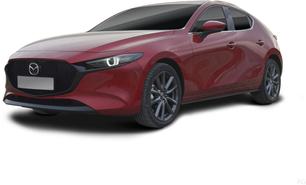
How is it that the current Mazda 3 is already five years old? This hatchback is still stunning, the sort of car you look back at when walking away.
The shape is sleek and almost coupe-like, with a shark-like nose, cab-backward-style long bonnet, upswept shoulder line and a fastback silhouette.
More importantly, it’s the way the light dances across the sculptured sides that draw the eyes in. Bereft of clutter, it makes you wish all mainstream manufacturers had the courage to be so daring.
We’ve said it before – the 'BP'-generation Mazda 3 (Axela in Japan) is the brand’s boldest C-segment hatch since the 1993 'BA' 323 (Astina/Lantis/323F).
But there’s a price to pay for such timeless beauty…
The RS3’s standard sport front seats are deliciously comfortable and offer plenty of electric adjustment. This means people of any size and stature should be able to find their desired seating position.
Thanks to the electric lumbar there’s also a massage function for the front seats. This is pretty cool to flick on and relax into, but I wish the massage was a little stronger.
While the new steering wheel looks cool interacting with the buttons on it can be a bit of a hassle. They’re touch-sensitive but do have a satisfying click if pressed harder.
There were moments where I accidentally clicked on the buttons during intensive track driving as my hands were at the nine and three o’clock positions. Not the best thing when you’re meant to be focussing.
The digital instrument cluster offers so much configuration you won’t know what to do with yourself. There’s even a new rev counter design especially for the RS3 which looks very cool.
Moving across, the touchscreen multimedia system is classic Audi. It’s easy to navigate around and hard to get lost in the sub-menus. There’s also wireless Apple CarPlay and Android Auto connectivity which is virtually a given now.
While you need to use the touchscreen for a number of features, I appreciate how Audi has retained so much physical switchgear up front. It’s particularly handy to have physical toggle switches and a small digital display that’s separate from the touchscreen for the climate control.
Another piece of physical switchgear I like up front is the rotary dial for the media controls on centre console. It’s much like an iPod, allowing you to change the volume if you rotate your finger on it like a click-wheel. Major throwback vibes.
In terms of storage up front, it’s decent but not outstanding. There are two cupholders, a wireless phone charger, a centre console box as well as a lockable glove box.
Moving to the second row, it’s clear it’s more for the sake of it, rather than having a space you’d want to use all the time. At a leggy 182cm tall, I have minimal legroom behind my own driving position.
With headroom, it’s adequate in the hatchback and not great in the lower-slung sedan. I need to kink my neck in the latter to fit, which isn’t comfortable.
The second-row bench seat is comfortable, offering enough support for short-to-medium trips. I wouldn’t want to get stuck back there for too long, however.
In terms of amenities, there are air vents mounted on the back of the centre console with a dedicated third zone of climate control, two USB-C ports, nets on the seat backs as well as a fold-down centre armrest with cupholders.
At the back there’s a power tailgate for the hatchback, however the sedan only has a power-opening boot lid. This means you need to manually shut it, which isn’t uncommon for sedans.
Boot space in the RS3 is a weak spot due to all the componentry for the all-wheel drive system and the tricky rear clutch set-up. There’s only 282L for the hatch and 321L for the sedan, which isn’t much.
In reality, however, the boot space is still usable. It’s fairly square and there’s barely any boot lip, meaning you can slide things in and out with ease.
Boot-related amenities include a netting system to keep things from sliding around, a light, some hooks and a 12V socket. There’s also a parcel cover for the hatchback.
Unfortunately there’s no spare wheel of any kind under the boot floor in the RS3 as this is where the 12V battery lives. Instead there’s a tyre repair kit. This isn’t uncommon in performance cars, though it’s disappointing if you frequently travel in the country, away from tyre repair shops.
There is a price to pay for all this quasi-coupe styling flair, and that’s a comparatively snug-feeling interior, though you’d never call it cramped.
Actually, the Mazda 3 is no less spacious than most of its competition in all but one area, with enough room even for 200cm drivers, along with sufficient shoulder width and ceiling height to match.
If you’re really tall, maybe that missing sunroof isn’t such a bad thing, after all.
Sat so low-down on cushy, enveloping front seats that offer plenty of comfort and support, this is the anti-SUV. Maybe Mazda should have called this the MX-3.
Sporty and spot-on, the driving position is a laid-back affair, with an emphasis on better ergonomics, as emphasised by the thoughtful placement of switchgear that’s all within easy reach, ahead of a beautifully flowing and layered dash. Proudly Japanese in flavour, it brings to mind functional minimalism.
Drilling into some of the 3’s finer interior details, the analogue-look digital instrumentation is super-legible, ultra-classy and gorgeously lit at night. As previously mentioned, the dials and surrounding air vents are reminiscent of the later Porsche 944 and 968.
It’s not just all for the sake of aesthetics, either.
Yes, it’s lovely, but the thinned-rim three-spoke steering wheel feels great to grip, with nifty little paddle shifters that are a delight to prod.
Same goes for the physical volume knob and climate-control buttons, sidestepping the need to get distracted and frustrated by virtual sub-menus.
And having a conventional gear lever with old-school Tiptronic-style shifts suits the 3’s athletic vibe.
Plus, forward vision is A-OK, ventilation is faultless, storage is better than you might expect, and the fit and finish is as good if not better than any of this 3’s German premium opponents.
Out back, the split-fold rear backrest is set at a comfortable angle, the cushion is well padded, and you’re provided with USB ports, air vents, and an armrest with two cupholders. More thoughtfulness.
But while knee room is fair, rear headroom isn’t great if you’re tall or wear a beehive, as the falling ceiling line reveals.
Vision out is limited by that rising window line and fat pillars. Getting in and out of the back requires some contortionist moves. And the small windows mean it can be gloomier in the back than a Smiths album.
Finally, at just 295 litres, the 3’s cargo capacity is disappointing. Sure, it eclipses the Corolla hatch’s 217L cubby, but other rivals are far larger back there.
At least the floor is wide and flat and there are 60/40-split backrests for cabin access for longer items.
Note that a space-saver spare wheel lurks underneath. Mazda argues there’s always the closely-related CX-30 if you need (slightly) more space (317L).
Meanwhile, at the other end of the 3…
This facelift for the Audi RS3 has seen the price tag rise beyond six figures for the first time.
It’s now priced from $104,800, before on-road costs for the hatchback or $107,800, before on-road costs for the sedan. This is between $9000 and $9500 more expensive than the pre-update version, depending on body style.
While this may seem like a considerable amount of money for a hot hatch it’s worth noting the Mercedes-AMG A45 S is well over $120,000, before on-roads.
As standard there are 19-inch alloy wheels, darkened matrix LED headlights, a black exterior styling package, 12.3-inch digital instrument cluster, 10.1-inch touchscreen multimedia system with wireless Apple CarPlay and Android Auto, 15-speaker Sonos audio and RS sport seats with Nappa leather upholstery.
There’s a new RS steering wheel with a flat top and bottom, as well as touch-sensitive and shortcut buttons for the 'RS Performance' drive modes. There’s also more interior ambient lighting and a panoramic glass sunroof as standard.
Optional extras include a 'Carbon Package' ($7400 hatch, $6300 sedan), 'RS Design Package Plus' ($2150) in either red or green, ceramic front brakes ($10,800) and a new 'Daytona Grey Matte' exterior paint colour ($11,400). The latter is the first time matt paint has been offered on an RS3 locally.
While there’s a considerable amount of standard kit in the RS3, it’s easy to add tens of thousands to the asking price with the options list, but as a result you can personalise the car exactly how you’d like.
Mazda has rationalised the MY24 3 range, with fewer grades and no more manuals, sadly.
The pretty little piece of automotive industrial design you see here is the mid-range Evolve SP Vision, which sounds less like a car and more like a posh hairdryer from Vidal Sassoon.
Priced from $36,520 before on-road costs (or about $41K drive-away before you start haggling), this Mazda 3 is a sporty and well-equipped alternative to the likes of the speedy Hyundai i30 N-Line Premium, spacious Kia Cerato GT Turbo, new Subaru Impreza AWD 2.0R and evergreen Toyota Corolla ZR. All cost roughly the same money.
The thing is, do Mazda’s upmarket aspirations mean the 3 possesses the ride quality and chic to embarrass at times substantially more expensive hatchbacks with premium pretensions? We’re talking rivals like the BMW 1 Series, Mercedes-Benz A-Class, Peugeot 308 and VW Golf, here.
Stay with us, because we reckon you might be surprised by how far the 3 has come since its humble 323 predecessors.
Anyway, this version comes with most of the good gear, including a full suite of driver-assist safety tech like front and rear Autonomous Emergency Braking (AEB), blind-spot alert, lane-keep assist and adaptive cruise control, as well as keyless start and walk-away lock, powered driver’s seat with memory, 360-degree camera views, a head-up display, digital radio, sat-nav, auto tilt/folding exterior mirrors, dual-zone climate control, Bluetooth phone/audio connectivity and 18-inch alloys.
Oh, and for 2023, an upgraded version introduces a smartphone charger and wireless for the Apple CarPlay/Android Auto function, along with USB-C port access front and rear.
What’s missing at the Evolve SP Vision’s price point? Some mainstream rivals offer leather and a sunroof, available respectively in the more-expensive GT Vision, from $40,000, and flagship Astina grades, from nearly $42,500.
Still, that’s quite a lot of small car for the money, given the quality of the presentation and design. Speaking of which…
The Audi RS3 is still powered by a 2.5-litre turbocharged five-cylinder petrol engine which produces an unchanged 294kW of power and 500Nm of torque.
This is mated to a seven-speed dual-clutch automatic transmission with drive sent through an all-wheel drive system.
Audi claims both versions of the RS3 can do the 0-100km/h sprint in just 3.8 seconds, which is technically 0.1 seconds faster than a Mercedes-AMG A45 S. Top speed is electronically limited to 250km/h.
When you think about it, shoehorning a big torquey engine in a light and agile small car is a recipe for fun. Ford did just that with the Escort RS2000 in the 1970s… and Mazda’s now an expert at it, too.
The engine in question is the G25, a 2.5-litre four-cylinder naturally aspirated twin-cam petrol engine, delivering 139kW of power at 6000rpm and 252Nm of torque at 4000rpm.
As this Evolve SP Vision hatch tips the scales at 1415kg, it makes for a healthy, and consequently very lively, power-to-weight ratio of over 98kW/tonne.
That’s if you decide to use all the available revs, which the six-speed torque-converter auto makes great use of.
Driving the front wheels, it offers a 'Sport' mode to extend the revs even more, which is keeping in line with this Mazda’s sporty character.
Less so is the company’s decision to ditch the old multi-link independent rear suspension system a few years back for a more prosaic torsion beam arrangement. We’ll get to how that affects ride and handling in a moment.
The Audi RS3 sedan is claimed to consume 8.2L/100km, whereas the RS3 hatch is claimed to consume 8.3L/100km, both on the combined (urban/extra-urban) cycle (ADR 81/02).
Both body types come with a 55L fuel tank and require a minimum of 98 RON premium unleaded petrol.
During my testing I saw an average of 9.6L/100km according to the trip computer. We did around 200km of higher speed driving heading east out of Melbourne, including some spirited sections.
Our on-test figure translates to a range of 570km on a full tank of petrol.
Mazda claims the G25 averages 6.6L/100km on the combined cycle… for a carbon-dioxide emissions rating of 154g/km. On a 51L tank, that gives a potential distance of over 940km!
Driven good and hard in our hands, we managed 7.5L/100km, which isn’t bad given the speed and conditions it was subjected to.
Plus, the Mazda’s happy on 91 RON 'standard' unleaded petrol.
Spoiler alert, it’s a cracker.
Starting up the RS3, you’re instantly aware you’re behind the wheel of something special. Audi has made the start-up more “emotional” with this update and also “optimised” the exhaust flap control for more five-cylinder growl across a wider rev range.
When you’re on the boil, this five-cylinder sounds so fantastic. It’s the clear centrepiece of this car and I’m so happy Audi has continued to offer it.
However, thanks to the addition of a petrol particulate filter (PPF) with this latest-generation model it sounds a little muted in everyday driving. Call me a boy racer, but I want more noise.
Staying on the engine, it’s full of character and gets this small hatch and sedan moving along with ease. Even though the outputs are unchanged with this update, it’s still more than enough; 0-100km/h in 3.8 seconds shows it's more than enough.
The seven-speed dual-clutch automatic transmission in this car keeps the acceleration feeling relentless with snappy gear changes at a moment’s notice. It’s particularly fun taking control of moving between the ratios with the paddle shifters.
In slow-moving traffic, however, the dual-clutch can get a little lost and stuttery, which is a classic characteristic of this kind of transmission.
As standard the all-wheel drive system remains neutral, keeping the front and rear balanced and in check. However, if you flick to the ‘Dynamic’ drive mode you get more rear-biased action which is fun when you exit a corner with some extra heat.
There’s also still a ‘RS torque rear’ drive mode which is essentially a drift mode. Unfortunately we didn’t get to sample this during the launch program.
Additionally, there’s an ‘Individual’ mode that allows you to choose your own destiny. You could spend hours here fine-tuning your desired drive mode which is both great to see but complete nerd-core.
Like the pre-update car, there’s an electronically controlled multi-disc clutch on the rear axle which actively splits the torque between the rear wheels. However, it’s been "optimised" to allow for quicker cornering.
While this is hard to gauge without testing the pre-update and current car back-to-back, the RS3 is so dynamic it feels like you only scratch the surface on public roads. Thankfully we got to see how far we could push it on Haunted Hills, which is a fantastically complicated hill climb circuit in eastern Victoria.
In terms of the steering, there’s a progressive rack as standard which ramps up the steering intensity the more you turn the wheel. In practice, this means the lock-to-lock ratio is very short, making it easy to link up tight corners.
It also makes it easy to navigate tighter driving scenarios, like parking, though it disguises how wide the turning circle is. Expect to do three-point turns fairly often.
For the suspension, the RS3 has adaptive dampers set-up that generally errs on the sportier and firm side. There is a ‘Comfort’ mode which irons out some bumps, but larger road imperfections still transmit harshly into the cabin.
It’s also worth noting at higher speeds there’s a considerable amount of road and tyre noise that comes into the cabin. Thankfully the Sonos sound system does a great job at drowning this out.
Lastly, the safety systems in this car are generally user-friendly, though the lane-keep assist can be a little too hands-on, especially on narrow roads with poor lane markings. Thankfully you can switch this off by pressing and holding a button on the end of the indicator stalk.
Ask yourself. What do you want from a new small car?
Since the first Familia of the early 1960s, Mazda’s been at it constantly, through the 1300 and 323 eras and into the modern age of the 3.
The Hiroshima brand knows its stuff. Space, practicality, comfort, ease, reliability and affordability. But a small car has to offer more, specifically in the way it makes the owner feel.
That’s why, while the Focuses, Lancers, Astras and Pulsars are gone, the 3’s still here. And it isn’t just the lush visuals inside and out that are, well, sensory-rich.
As older Alfa Romeo owners know, there’s something special about an engine that sounds alive, and the moment you push the 3’s starter, it purrs into life. That’s the first clue.
Slot the refreshingly old-school lever into Drive, and the G25 leaps into action, and, if you need it to, will keep pulling forward strongly, engine buzzing, like it’s on a mission.
That describes the torquey urge of this big 2.5L four, paired perfectly with the sensibly-geared auto.
We miss Mazda’s magnificent manual immensely, but the 3’s instant response reflects its favourable circa-100kW/tonne power-to-weight ratio.
And, as we’ve harped on in the past, the twin-cam unit’s extra oomph beyond 4000rpm delivers muscular high-speed responses akin to a good turbo – or a great old-school Alfa. You can keep your laggy dual-clutch transmissions, Europe.
Now, sweet, smooth and speedy performance is one thing, but having the chassis tuned with precise and fluid steering for tactile handling, and confident roadholding, backed by nuanced driver-assist and traction controls, are another.
There is a consistent and unifying control to the 3’s linear and forgiving dynamics, reminiscent of past masters like the Focus (and today’s brilliant Peugeot 308) that makes it a joy to drive enthusiastically through fast corners, with the knowledge that it won’t suddenly snap-oversteer and bite an unalert driver back.
For a Mazda, the ride is quiet enough, but there is still some droning transmitted through the cabin, via the Bridgestone Turanza (215/45) tyres, on coarse-chip bitumen surfaces.
And while suspension comfort is pretty impressive for the most part, larger bumps reveal the torsion beam’s limitations, as the car can occasionally thud over them in a way that we remember the multi-link rear end wouldn’t.
Anyway, what we’re saying is that, overall, the 3 Evolve SP Vision is an immersive and interactive driving experience that is right up there with the best of them.
Brawny performance, exquisite agility and a refinement that, collectively, have eluded every small Mazda in living memory until this generation’s 2019 debut. This 3’s right on the money. Still.
The regular Audi A3 received a maximum five-star ANCAP safety rating back in 2020, though this only covers front-wheel drive versions and doesn’t extend to the high-performance RS3.
Standard safety equipment includes seven airbags, autonomous emergency braking (AEB), blind-spot monitoring with exit warning, rear cross-traffic alert, adaptive cruise control, lane-keep assist, driver attention monitor, front and rear parking sensors, a surround-view camera as well as a semi-autonomous parking assistant.
AEB is active from 5.0km/h and lane-keep assist activates from 60km/h.
There’s also Audi’s 'Pre-Safe' system as standard which automatically closes the windows and sunroof, as well as pre-tensions the seatbelts if the car senses it’s going to be involved in a crash.
Additionally, all owners get three years of complimentary access to 'Audi Connected Services', including online roadside assistance and remote functions through a smartphone app. There’s also 10 years' emergency SOS call support and automatic service reminders.
Tested way back when this generation was new in early 2019, the Mazda 3 scored a maximum five-star ANCAP crash-test rating.
On the driver-assist front you’ll find front and rear AEB (with a working range of 40km/h to 200km/h) with pedestrian and cycle detection available between 10-80km/h, while the 'Forward Collision Warning' operates from 40-200km/h.
Blind-spot monitoring, lane departure warning, lane-keep assist, 'Forward Obstruction Warning', rear and front 'Cross-Traffic Alert', 'Secondary Collision', auto high beams, breakaway pedals, adaptive cruise control (with full stop/go functionality and cruising/traffic support), parking sensors front/rear, 360-degree round-view monitor, reverse camera, traffic sign recognition, driver monitor and tyre-pressure monitors are also included.
The lane-keep support systems work between 55-200km/h.
Seven airbags – front, side, curtain and a driver’s knee bag – are fitted, along with anti-lock brakes with 'Electronic Brake-force Distribution', 'Emergency Brake Assist', stability control, traction control, hill-start assist are also fitted, seat-belt pretensioners, and two rear-seat ISOFIX points as well as three top tethers for child seat straps.
Like all Audis, the RS3 is covered by a five-year, unlimited-kilometre warranty. There’s also five years of roadside assistance.
Logbook servicing is required every 12 months or 15,000km, whichever comes first.
You’re able to purchase a five-year pre-paid service package for $4010. That averages out to $802 per service, which seems like a lot until you see how much Mercedes-AMG charges to service an A45 S.
RS3 owners can also purchase two-year packages to extend the warranty, roadside assistance and servicing coverage. This allows new RS3 owners to have warranty coverage for up to nine years and it’s transferable to future owners.
Mazda offers a five-year/unlimited kilometre warranty, with five-years roadside assistance… and that’s nothing special nowadays.
Service intervals are at 12 months or every 15,000km.
A fixed-price service scheme is available, averaging out to $434 annually over the first five years. Mazda shows pricing right up to 16 years and 240,000km on its website.