What's the difference?
It can be easy to dismiss electric cars as an imperfect solution to the world’s problems. But that would be missing one big point - they’re really, really fast.
Carmakers twigged that not everyone was enamoured with the environmental credentials of electric vehicles (EVs), especially luxury brands, and thus pivoted to the new sales tacit of performance and prestige.
Which is why Audi’s current performance flagship vehicle is not a mid-engined V10-powered replacement for the R8, but rather the all-electric RS e-tron GT. And for the new model year they have not only updated the range, bringing (you guessed it) more power, but also added a new hero model - the RS e-tron GT Performance.
It leads a new three-pronged line-up for the four rings brand, with the RS e-tron GT Performance sitting above the RS e-tron GT and the new S e-tron GT; the latter effectively replacing the previous ‘entry-grade’ model known only as the e-tron GT.
These arrive as part of a mid-life update for the model, with some minor styling tweaks (inside and out) along with enhancements to the battery and changes to the specifications.
The new range has just arrived in Australia and Audi will be hoping it can turn around the sales performance, which saw the outgoing e-tron GT and RS e-tron GT find just 84 customers in 2024. That was a decline of 75 per cent on 2023 sales, and nearly 200 less than the closely related Porsche Taycan.
Back in the day, the 3 Series sedan was often the entry to the brand for first time BMW owners, and for good reason. They offered practical interior space without compromising on engine performance.
And they simply looked good, no boring nanny design elements. Then the 1 Series came along and price points bumped up, so how does the ‘entry’ BMW 320i M Sport live up to its long-standing reputation?
With an updated dashboard that brings the interior and tech up to market and a sharper exterior design, it more than holds its own at the table of luxury sedans, despite hard competition from the likes of the Audi A4, Mercedes-Benz C200 and Jaguar XE.
However, if the Merc is a placid and well-behaved mare… the BMW is the barely-broken-in bronco and it takes a certain kind of ‘rider’ to enjoy what the 320i has to offer.
I’ve been discovering just that this week with my family of three. What did we find out? Read below!
While it may be a very different beast to the R8 supercar, it’s hard to argue that the e-tron GT offers performance that isn’t equal to anything Audi has previously produced. The immense acceleration and power, coupled with the brilliant and clever handling make this updated range, especially the RS pair, feel like something special.The fact that it will save you visiting a petrol bowser and might help cut harmful emissions is just a bonus.
Note: CarsGuide attended this event as a guest of the manufacturer, with travel, accommodation and meals provided.
I thoroughly enjoyed my time in the BMW 320i M Sport. It’s fun to drive and I felt connected to what the car was doing on the road. The harder ride may not appeal to some but I didn’t mind it. The cosy back seat and boot mean it will probably suit a smaller family best and one which doesn’t have to worry about carrying a lot of gear around regularly, but it suited my needs just fine.
I reckon this is a car for those drivers who don’t want to compromise on performance but still have a kid or two. If you’re after the cushioned comfort of a Merc, this won’t appeal but I didn't want to give this one back and happily give it a firm 8/10.
My son liked the sports car looks and enjoyed the amenities in his row. He gives it a 10/10.
While there are some big changes underneath, on the surface the design tweaks are quite subtle.
There are some tweaks to the front grille, headlights, lower bumper and air intakes, but overall the look isn’t dramatically different. The more noticeable styling change is between the S and RS models, with the latter looking more sporty and dynamic thanks to a unique lower bumper design and the larger alloy wheels, which have a sportier look.
The biggest design changes are arguably the introduction of the switchable transparency roof on the RS and the option to use matt carbon camouflage.
The former is another shared element between the RS e-tron GT and Taycan, and it uses a special glass that can switch between being clear or opaque depending on whether you put a current through it. Cleverly, Audi is offering the option to have individual sections alternate between the two states, so you can customise it to your preference.
As for the grandly named matte carbon camouflage, it wasn’t highlighted in Audi’s presentation, but it’s the same material the Lamborghini developed over a decade ago and calls ‘forged carbon’ instead.
Unlike traditional carbon-fibre, which is made from injecting resin into sheets of fabric-like carbon fibre weave, forged composite uses a malleable paste of carbon sheets and resin. This technique is quicker to make and easier to shape into complex pieces, but lacks the visual impact of conventional carbon-fibre.
The biggest design change internally is the new steering wheel, which is a not-quote-squared-off rim that feels nice in your hand without being too thick. The RS models feature two new large red buttons - ‘RS’ and ‘Boost’ - which allow you to select the drive modes and activate the short boost function, respectively.
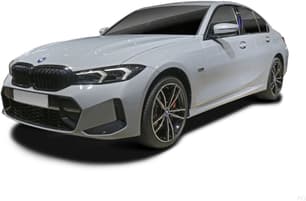
Sharper than its predecessor, the new 320i has LED everything with the rear lights being longer and curving around to the sides of the car.
The classic 'kidney' grille is darkened and more pronounced, with the black panelling extending to the rear to create an unapologetically sporty presence. A presence that’s accentuated by the twin exhausts.
The batcave interior with its black headliner, black seats… black everything, looks smart and stylish.
You do have a fair bit of harder touchpoints throughout but the customisable ambient lighting helps to soften the overall effect.
With its 2068mm width, 4709mm length and 1435mm height, the sedan makes its presence known without feeling cumbersome to manoeuvre. Urban dwellers need not fear their local car park!
Practicality is an important consolidation for the e-tron GT, it may have replaced the two-seater R8 as Audi’s definitive performance hero, but it’s a four-door sedan so it needs to be more family friendly. It’s especially relevant for Audi, as the brand has a history of brilliantly combining family needs with fast cars, namely its iconic wagons, the RS4 and RS6 Avants.
Audi also has a strong reputation for some of the best interior design in the industry, and the e-tron GT is arguably amongst its best work (at least in this reviewer’s opinion). It looks modern and stylish without leaning too far towards being different simply because it’s an electric car.
The new steering wheel fits the new design well, framing the digital driver’s display nicely. The display itself has a new RS-specific display for the higher-end models.
There’s a central infotainment touchscreen, but underneath this particular Audi skips the climate control touchscreen in favour of a digital readout and physical switchgear; a welcome relief for some, no doubt.
As for the seats, all three trim levels get the same style of sports seat trimmed in Nappa leather with a honeycomb stitch pattern. There are different finishes, both black and red leather, and some with contrasting stitching available through the optional design package. The RS performance package gets a unique ‘serpentine green’ stitching to stand out.
Small item storage in the front is adequate but not generous, which does make the e-tron GT feel more like a sports car at least, even if it doesn’t help practicality.
As for the rear, space is surprisingly good given the external dimensions and the nature of it being a low-roof sedan (rather than an SUV) with batteries underneath the floor. That’s largely because Audi has split the battery pack to allow for extra room in the rear for passengers’ feet, combating a common problem with electric sedans.
Headroom is adequate, and will be tight for anyone much taller than 180cm, but it will do the job of transporting the family in relative comfort. It is, by no means, the most spacious or family friendly model in the Audi range, but it does play its role as both a performance car and roomy sedan.
The boot is measured at 405 litres in the S but shrinks to 350L in the RS models, but both have the same 77L space under the bonnet, so space is (again) reasonable without being generous.
For such a sleek looking sedan, it’s generous up front with plenty of head and legroom.
You can adjust the seat to sit quite low and both front seats have extendable under-thigh supports, which should excite taller drivers.
My 189cm (6’2”) brother has the 328i and is very comfortable but taller front passengers will encroach on back seat passenger comfort.
The front seats are quite firm on the backside, they also lack adjustable lumbar support, so expect to stretch the kinks out on a longer trip.
The amenities and tech feel well thought out and easy enough to use. The 12.3-inch touchscreen multimedia system looks great and has the best-looking graphics I’ve sampled.
The BMW system is intuitive to use once you get used to it. If you’re not interested in using the touchscreen, you can also utilise the rotary-wheel for menu selections.
There’s also Bluetooth connectivity, wireless Apple CarPlay and Android Auto plus built-in satellite navigation.
The 12.3-inch digital instrument panel is customisable and the information displayed simply but you won’t really look at it because of the head-up display.
Front occupants enjoy a wireless charging pad for their smart phone, a USB-A and USB-C port plus a 12-volt socket. Rear passengers get a couple of USB-C ports, too.
The storage is good for this size sedan but overall passenger room takes priority, but the glove box and middle console will suffice for everyday use.
While it may not excite others, I love the big bottle holders in the doors. They’re large enough for my big 1.5L bottle and angled for easy access. These are found in the rear doors as well.
Back seat passengers enjoy climate control, directional air vents, two cupholders, netted map pockets and reading lights.
My six-year old was happy with the amenities and lower ground clearance because he felt comfortable and had his independence.
The boot offers a good capacity of 480L and the aperture isn’t too narrow, so you can comfortably access items if they roll to the back.
I had plenty of room for my little family’s needs but if you’re a larger family, you may need to get strategic with gear storage.
Being a base model, you do miss out on a powered tailgate, which is a shame but not too much of an issue given this is a sedan and the lid isn’t heavy.
There’s also no spare tyre or even a puncture repair kit but you have run-flats, so you should be able to limp to a service centre if need be.
The 2025 range begins at $209,900 for the S e-tron GT, steps up to $264,900 for the RS e-tron GT and hits $309,900 for the new RS e-tron GT Performance (all prices exclude on-road costs).
While there is more power and equipment, that’s still a significant leap in price, with the previous e-tron GT starting at $181,784 ($28,116 cheaper) and the RS e-tron GT priced from $250,484 ($14,416 cheaper).
This pushes the Audi close to its most direct rival, the Porsche Taycan. Despite what the brands try to say publicly, the reality is these two are very closely related mechanically. Porsche now has two models cheaper than the S e-tron GT (the $174,500 Taycan RWD and $184,500 Taycan 4), while the Taycan 4S is priced just above it at $215,700.
Porsche’s rival to the RS e-tron GT is the $260,300 Taycan GTS, while it has the $306,900 Taycan Turbo to challenge the new RS e-tron GT Performance - plus the Turbo S and Turbo GT above it for those craving more power.
While the Audi isn’t bad value, it isn’t surprising that people in the market for an electric performance car from Germany are leaning towards the Taycan instead of the e-tron GT given the pricing structure.
In terms of specification difference between the three variants, the S e-tron gets 20-inch alloy wheels, adaptive air suspension, all-wheel steering, HD Matrix LED headlights with Audi laser lights, and a panoramic fixed glass roof.
Moving up to the RS e-tron GT adds unique 21-inch wheel design, a panoramic glass sunroof with a new switchable transparency, performance brakes with a carbide coating, and an RS-specific instrument cluster design.
The RS e-tron GT Performance crowns the range with its own 21-inch alloy wheels, active suspension and a specific RS Performance exterior electric sound system as standard.
There are a range of option packages too for all three models, which bundle extras together. The Sensory package ($6000) and Design package ($3800) are available for the S, the RS can be had with the Gloss carbon exterior styling package ($6000) and RS design package ($4500), and the new RS Performance has the matte carbon camouflage exterior styling package ($10,000) and a unique version of the RS performance design package ($4500).
There are seven variants for the BMW 3 Series sedan and our model is the base model for the petrol variants.
There is a plug-in hybrid version, the 330e, if you’re after a more fuel-efficient option but it will up the price by about $20K.
As it stands the 320i M Sport is $78,900, before on-road costs. Our model has been finished in 'M Brooklyn Grey', which adds $1539 to the price.
That puts it at a similar price point as its rivals. You get a well-specified package with the M Sport but it doesn’t have the same sense of cushioned comfort as the Merc does, but more on that later.
Still, the sporty and streamlined interior is headlined by BMW’s dual 12.3-inch screens that sit propped on the dash like a futuristic cockpit.
The mix of synthetic leather and cloth seats are electric and have adjustable side bolsters for when you want to go hard in a turn.
The interior also boasts a sunroof and wireless Apple CarPlay and wired Android Auto. There are some other highlights like the 18-inch alloy wheels, leather steering wheel and the crystal-clear head-up display, to name a few.
The key number for the new model is 680kW - that’s what the new RS e-tron GT Performance produces from its dual electric motors. That makes it the most powerful production car Audi has ever offered, which is quite an achievement when you look back at some of the cars this brand has built over the years.
That power upgrade is an extra 205kW over the pre-facelifted RS e-tron GT, and comes with a whopping 1027Nm of torque.
The RS e-tron GT has been upgraded too, now making 630kW/865Nm, a 155kW improvement on the old model. Which is a good thing, because the new S e-tron GT has even more power than the original RS, underlining just how much Audi has focused on power for this mid-life enhancement. The new S packs a 500kW/717Nm punch, compared to the 475kW/830Nm the previous RS offered.
The 320i M Sport has the ‘baby’ engine in the 3 Series line-up but the 2.0-litre, four-cylinder turbo-petrol powertrain still delivers on power with a maximum output of 135kW/300Nm.
This is a rear-wheel drive and has an eight-speed auto-transmission which delivers very smooth gear changes.
Despite having the smaller engine, it can still go from 0-100km/h in just 7.4 seconds.
Another one of the significant unseen changes for this update is the battery. Audi has overall the battery for this latest e-tron GT, so it now has higher energy density (168.3Wh/kg), more size (105kWh v 97kWh), faster charging (10-80 per cent in 18 minutes) and reduced weight (down 9kg).
Despite all the extra power, driving ranges for the three models are still all beyond 500km. The S e-tron GT has a claimed range of 558km, the RS e-tron GT can manage up to 522km and RS e-tron GT Performance can run 528km on a single charge, according to Audi.
As for the charging itself, Audi claims it now takes just 18 minutes to get from 10 to 80 per cent using an ultra-fast DC charger.
In a world with rising fuel prices, the efficiency of this decently powered sedan should excite you.
The official combined fuel cycle is 6.5L/100km. Real world testing saw my figure at 7.4L/100km after a mix of open-road and urban driving this week.
I thought that was great for how hard I drove it and for the power, you won’t be wincing when you put your foot down. I would expect it to be higher in an urban setting.
The 320i has a 59L fuel tank and based on the official combined cycle figure, you should get just over 900km of driving range, which is great, especially if you do 'roadies' like me!
Befitting its role as Audi’s performance hero, the new range drives with a level of speed and precision you would expect from such a car.
Even the new S e-tron GT has a level of acceleration that not every sports car could keep up with (the official 0-100km/h claim is 3.4 seconds), which would be impressive on its own but is a standout when you consider this is a four-door sedan.
It also helps that the adaptive air suspension and all-wheel steering (which can help both low speed manoeuvring and high speed changes of direction) make for an incredibly responsive and agile handling vehicle.
And then you drive the RS e-tron GT Performance and the driving experience is a step up again with its 2.5s triple-digit sprint time. That’s largely because of the new active suspension system it uses, which features a hi-tech array of cameras, radars and sensors to ‘read’ the road ahead of it and adjust the ride accordingly.
The result is arguably one of the best riding, most comfortable electric performance cars on sale today. Typically the need to control so much weight, from the batteries, means the ride is often too firm. But with the active suspension, Audi has somehow managed to make the ride both compliant (on 21-inch wheels) but also very well controlled, which allows you to really drive with precision even at speed.
But it’s not just the suspension, as mentioned earlier, the RS models also get a new ‘Boost’ button on the steering wheel that offers an extra 70kW of power for 10 seconds. Along with the surge of extra performance there’s a large countdown timer on the digital dashboard when you press it to really give you a sense of urgency and speed.
Thankfully, with so much power the e-tron GT range has plenty of stopping power. The S comes equipped with steel brakes, which do a fine job. But for the faster RS models, you get a carbide coated rotor and you can option ceramic brakes for more resilient stopping power.
There's a lot that I like about how this performs but a highlight is how eagerly the car responds when you accelerate.
However, it’s not unbridled power. There’s no bucking at the front or shuddering through the steering wheel. It’s controlled but still very fun.
The lower centre of gravity and coupe-like height of this does mean it handles corners well and the bolstered seats hold you firmly into place, meaning you can be free to drive this a little harder than you might normally. Which I did and can confirm it handles itself well.
This has the M Sport suspension, which means it’s stiff, but you feel very connected to the road.
You do get a lot of talk-back from bumps in the road but unless you hit a big pothole, you never feel rattled by them.
But it is a harder ride than other luxury models, which doesn’t bother me as I like the handling, but if you want limo-like comfort, look elsewhere.
The cabin is very nice to spend a lot of time in and relatively quiet, even at higher speeds.
The 11.4m turning circle and sleek dimensions makes it very handy to park, even in tight car parks. The nose is long but the front and rear parking sensors take out any ‘will I make it’ moments and the super clear reversing camera is great.
Audi has equipped the e-tron GT trio with a respectable level of safety features, including adaptive cruise control with stop and go functionality, park assist plus, front and rear autonomous emergency braking, active lane assist, side assist with exit warning, collision avoidance assist and a 360-degree camera system for parking assistance.
Given its low sales volume, ANCAP has not crash tested the e-tron GT (or the structurally similar Taycan), so there is no score. But overall its level of equipment and Audi’s reputation and experience means we have no safety concerns over this particular model.
The safety list includes a suite of features and the following come as standard: adaptive cruise control, auto emergency braking (operational from 5.0-210km/h), blind-spot monitoring, speed sign recognition, forward collision warning, SOS emergency call button, daytime running lights and rear cross-traffic alert.
I like the intelligent seatbelt reminder and that the bonnet is considered 'active', meaning it will lift up and away from the engine if the sensors detect that a pedestrian has been hit.
However, I have to call out the lane departure and keeping aids. It’s a hit or miss system and I tested it extensively this week once I noticed it.
You can customise the sensitivity levels and even on the highest sensitivity, it works too sporadically for my liking. BMW should improve this system for future instalments.
The 3 Series has been awarded a maximum five-star ANCAP safety rating but it was done a while ago in 2019. It only has seven airbags and is missing the newer front centre airbag.
There are ISOFIX child seat mounts on the outboard seats and three top tether anchor points but the back seat is a bit too narrow to comfortably fit three child seats side by side.
You'll be able to fit a 0-4 rearward facing child seat but may struggle if you're a tall family.
Audi offers its standard five-year/unlimited kilometre warranty for the three e-tron GT variants, but the battery gets a specific eight year/160,000km warranty. The five years of coverage is fairly standard for the luxury car segment, but short of the increasingly common seven-year warranties for mainstream brands.
As for the servicing, that’s included in the cost of the car, with Audi covering the first six years of maintenance for no additional charge. It helps that service intervals, without a complicated and oily engine, are stretched to two years or 30,000km.
The 320i comes with a five-year/unlimited km warranty, which is standard for this class.
You can choose between a three- or five-year capped-priced servicing plan. The five-year plan costs just $2150, or $430 a year, which is competitive for this class.
Like other BMWs, servicing intervals are condition-based, with the car letting you know when it needs to be serviced.