What's the difference?
It can be easy to dismiss electric cars as an imperfect solution to the world’s problems. But that would be missing one big point - they’re really, really fast.
Carmakers twigged that not everyone was enamoured with the environmental credentials of electric vehicles (EVs), especially luxury brands, and thus pivoted to the new sales tacit of performance and prestige.
Which is why Audi’s current performance flagship vehicle is not a mid-engined V10-powered replacement for the R8, but rather the all-electric RS e-tron GT. And for the new model year they have not only updated the range, bringing (you guessed it) more power, but also added a new hero model - the RS e-tron GT Performance.
It leads a new three-pronged line-up for the four rings brand, with the RS e-tron GT Performance sitting above the RS e-tron GT and the new S e-tron GT; the latter effectively replacing the previous ‘entry-grade’ model known only as the e-tron GT.
These arrive as part of a mid-life update for the model, with some minor styling tweaks (inside and out) along with enhancements to the battery and changes to the specifications.
The new range has just arrived in Australia and Audi will be hoping it can turn around the sales performance, which saw the outgoing e-tron GT and RS e-tron GT find just 84 customers in 2024. That was a decline of 75 per cent on 2023 sales, and nearly 200 less than the closely related Porsche Taycan.
The Honda Accord is now in its 11th generation and there was a time when the Accord, and rivals like the Skoda Superb and Toyota Camry were the perfect family cars.
But if you head to a car park, it's obvious they're no longer the choice when it comes to family hauling.
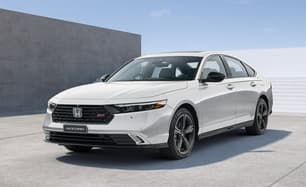
We’re family testing the new Accord, now offered in one highly-specified variant, to see if its new hybrid powertrain and design are worth a look in a world where the SUV is king.
While it may be a very different beast to the R8 supercar, it’s hard to argue that the e-tron GT offers performance that isn’t equal to anything Audi has previously produced. The immense acceleration and power, coupled with the brilliant and clever handling make this updated range, especially the RS pair, feel like something special.The fact that it will save you visiting a petrol bowser and might help cut harmful emissions is just a bonus.
Note: CarsGuide attended this event as a guest of the manufacturer, with travel, accommodation and meals provided.
Will the new Honda Accord e:HEV RS topple the SUV throne? Unlikely, but it proves sedans can still haul the family around in relative comfort and style.
The new Accord drives stupidly well and offers great ongoing ownership costs, even if it's price tag is a little steep. It's hybrid powertrain also offers fantastic efficiency and that's a big win.
While there are some big changes underneath, on the surface the design tweaks are quite subtle.
There are some tweaks to the front grille, headlights, lower bumper and air intakes, but overall the look isn’t dramatically different. The more noticeable styling change is between the S and RS models, with the latter looking more sporty and dynamic thanks to a unique lower bumper design and the larger alloy wheels, which have a sportier look.
The biggest design changes are arguably the introduction of the switchable transparency roof on the RS and the option to use matt carbon camouflage.
The former is another shared element between the RS e-tron GT and Taycan, and it uses a special glass that can switch between being clear or opaque depending on whether you put a current through it. Cleverly, Audi is offering the option to have individual sections alternate between the two states, so you can customise it to your preference.
As for the grandly named matte carbon camouflage, it wasn’t highlighted in Audi’s presentation, but it’s the same material the Lamborghini developed over a decade ago and calls ‘forged carbon’ instead.
Unlike traditional carbon-fibre, which is made from injecting resin into sheets of fabric-like carbon fibre weave, forged composite uses a malleable paste of carbon sheets and resin. This technique is quicker to make and easier to shape into complex pieces, but lacks the visual impact of conventional carbon-fibre.
The biggest design change internally is the new steering wheel, which is a not-quote-squared-off rim that feels nice in your hand without being too thick. The RS models feature two new large red buttons - ‘RS’ and ‘Boost’ - which allow you to select the drive modes and activate the short boost function, respectively.
The design for the new Accord is powerful with a sexy silhouette that features a rear spoiler, black accents and sporty 18-inch alloy wheels.
The old chunky grille is long gone and at certain angles you almost get a Nissan 200 SX vibe, which is gorgeously retro and a refreshing take for Honda - which has been playing it safe for the last few years.
The interior is simply styled but looks timeless. The dashboard has clean lines and a featured honeycomb mesh that hides the air-vents. It's a feature which might not land with everyone but it adds personality.
The black upholstery looks plush and there are enough soft-touchpoints to make the cabin feel like it deserves a premium tag.
Practicality is an important consolidation for the e-tron GT, it may have replaced the two-seater R8 as Audi’s definitive performance hero, but it’s a four-door sedan so it needs to be more family friendly. It’s especially relevant for Audi, as the brand has a history of brilliantly combining family needs with fast cars, namely its iconic wagons, the RS4 and RS6 Avants.
Audi also has a strong reputation for some of the best interior design in the industry, and the e-tron GT is arguably amongst its best work (at least in this reviewer’s opinion). It looks modern and stylish without leaning too far towards being different simply because it’s an electric car.
The new steering wheel fits the new design well, framing the digital driver’s display nicely. The display itself has a new RS-specific display for the higher-end models.
There’s a central infotainment touchscreen, but underneath this particular Audi skips the climate control touchscreen in favour of a digital readout and physical switchgear; a welcome relief for some, no doubt.
As for the seats, all three trim levels get the same style of sports seat trimmed in Nappa leather with a honeycomb stitch pattern. There are different finishes, both black and red leather, and some with contrasting stitching available through the optional design package. The RS performance package gets a unique ‘serpentine green’ stitching to stand out.
Small item storage in the front is adequate but not generous, which does make the e-tron GT feel more like a sports car at least, even if it doesn’t help practicality.
As for the rear, space is surprisingly good given the external dimensions and the nature of it being a low-roof sedan (rather than an SUV) with batteries underneath the floor. That’s largely because Audi has split the battery pack to allow for extra room in the rear for passengers’ feet, combating a common problem with electric sedans.
Headroom is adequate, and will be tight for anyone much taller than 180cm, but it will do the job of transporting the family in relative comfort. It is, by no means, the most spacious or family friendly model in the Audi range, but it does play its role as both a performance car and roomy sedan.
The boot is measured at 405 litres in the S but shrinks to 350L in the RS models, but both have the same 77L space under the bonnet, so space is (again) reasonable without being generous.
Access to the cabin is great thanks to wide door apertures but the Accord is a low car to get in and out of with its 134mm ground clearance. Expect a couple of grunts when parked on a hill!
Both rows offer ample legroom but the front enjoys the best of the headroom. A 183cm (6.0ft) friend was lumped with the middle seat and spent the trip dreadfully hunched over and uncomfortable. Save the middle seat for kidlets.
The electric front seats offer decent comfort for a longer trip but it's disappointing that only the driver’s side gets lumbar support.
The rear row enjoys well-padded seats and amenities, like retractable sunblinds, reading lights, two USB-C ports and directional air vents but it took a while for the back to cool down on hot days which my kid made known. Loudly.
Storage consists of a large glove box and middle console (which can accommodate a small handbag), a sunglasses holder, four cupholders, four drink bottle holders and two map pockets. There is also a dedicated phone tray but a few extra cubbies up front would be welcomed.
The boot offers plenty of space with its 570-litre capacity, which is great for the class, and you can also open up storage options with the ski-port door, if need be. The powered boot release is a handy feature.
The touchscreen multimedia system looks nice but is a pain in the butt to use until you set some time aside to get to know it. It’s just not intuitive but the screen is responsive and it's a bonus that you get the built-in sat nav and Google apps.
The new Accord gets wired and wireless Apple CarPlay and Android Auto but it took a few beats to get the wireless CarPlay to work.
The charging options are good throughout the car with four USB-C ports, two 12-volt sockets and a wireless charging pad to choose from.
The 2025 range begins at $209,900 for the S e-tron GT, steps up to $264,900 for the RS e-tron GT and hits $309,900 for the new RS e-tron GT Performance (all prices exclude on-road costs).
While there is more power and equipment, that’s still a significant leap in price, with the previous e-tron GT starting at $181,784 ($28,116 cheaper) and the RS e-tron GT priced from $250,484 ($14,416 cheaper).
This pushes the Audi close to its most direct rival, the Porsche Taycan. Despite what the brands try to say publicly, the reality is these two are very closely related mechanically. Porsche now has two models cheaper than the S e-tron GT (the $174,500 Taycan RWD and $184,500 Taycan 4), while the Taycan 4S is priced just above it at $215,700.
Porsche’s rival to the RS e-tron GT is the $260,300 Taycan GTS, while it has the $306,900 Taycan Turbo to challenge the new RS e-tron GT Performance - plus the Turbo S and Turbo GT above it for those craving more power.
While the Audi isn’t bad value, it isn’t surprising that people in the market for an electric performance car from Germany are leaning towards the Taycan instead of the e-tron GT given the pricing structure.
In terms of specification difference between the three variants, the S e-tron gets 20-inch alloy wheels, adaptive air suspension, all-wheel steering, HD Matrix LED headlights with Audi laser lights, and a panoramic fixed glass roof.
Moving up to the RS e-tron GT adds unique 21-inch wheel design, a panoramic glass sunroof with a new switchable transparency, performance brakes with a carbide coating, and an RS-specific instrument cluster design.
The RS e-tron GT Performance crowns the range with its own 21-inch alloy wheels, active suspension and a specific RS Performance exterior electric sound system as standard.
There are a range of option packages too for all three models, which bundle extras together. The Sensory package ($6000) and Design package ($3800) are available for the S, the RS can be had with the Gloss carbon exterior styling package ($6000) and RS design package ($4500), and the new RS Performance has the matte carbon camouflage exterior styling package ($10,000) and a unique version of the RS performance design package ($4500).
The model line-up has been streamlined for the new Accord and there’s only one variant available, the e:HEV RS model.
The new Accord is well-specified but misses out on some luxurious extras most of its rivals sport, like heated and cooled front seats, a heated steering wheel and heated rear outboard seats.
Which might all seem superfluous at first but maybe not when you consider the new Accord's $64,900, before on-road costs, price tag sits just shy of the more expensive Skoda Superb top model, which is $65,590, before on-roads.
The next two rivals are more affordable with the Mazda 6 Atenza priced at $52,590 MSRP and the new Toyota Camry SL at $53,990 MSRP.
The standard equipment list for the new Accord includes leather-appointed upholstery, electric front seats, lumbar support for the driver's side and a panoramic sunroof.
There's also keyless entry and start, adaptive LED headlights, a powered tailgate and a host of high-end technology throughout.
That includes a new 12.3-inch touchscreen multimedia system with satellite navigation and built-in Google apps, wired/wireless Apple CarPlay and Android Auto, the Honda app (with over-the-air updates), a 10.2-inch digital instrument cluster, dual-zone climate control, a wireless charging pad and a 12-speaker Bose sound system.
The key number for the new model is 680kW - that’s what the new RS e-tron GT Performance produces from its dual electric motors. That makes it the most powerful production car Audi has ever offered, which is quite an achievement when you look back at some of the cars this brand has built over the years.
That power upgrade is an extra 205kW over the pre-facelifted RS e-tron GT, and comes with a whopping 1027Nm of torque.
The RS e-tron GT has been upgraded too, now making 630kW/865Nm, a 155kW improvement on the old model. Which is a good thing, because the new S e-tron GT has even more power than the original RS, underlining just how much Audi has focused on power for this mid-life enhancement. The new S packs a 500kW/717Nm punch, compared to the 475kW/830Nm the previous RS offered.
Our test vehicle has an electric continuously variable transmission and features a new self-charging hybrid powertrain that couples two electric motors with a 2.0L, four-cylinder petrol engine that combine to produce 135kW of power and 335Nm of torque.
Only being available in one powertrain may limit its audience but the combo delivers decent performance for a sedan of this size.
Another one of the significant unseen changes for this update is the battery. Audi has overall the battery for this latest e-tron GT, so it now has higher energy density (168.3Wh/kg), more size (105kWh v 97kWh), faster charging (10-80 per cent in 18 minutes) and reduced weight (down 9kg).
Despite all the extra power, driving ranges for the three models are still all beyond 500km. The S e-tron GT has a claimed range of 558km, the RS e-tron GT can manage up to 522km and RS e-tron GT Performance can run 528km on a single charge, according to Audi.
As for the charging itself, Audi claims it now takes just 18 minutes to get from 10 to 80 per cent using an ultra-fast DC charger.
The new hybrid powertrain means lower outputs and the official combined fuel cycle figure is just 4.3L/100km! Which is only beaten by the Toyota Camry's 4.0L/100km.
The on-test figure pops out at 5.1L/100km after doing a some urban stuff but mostly open-road driving. Which is where hybrids tend to be the least efficient, so the fuel usage is excellent.
Based on the official combined (urban/extra-urban) fuel cycle and 48L fuel tank, you should see a theoretical driving range of up to 1116km, which is a little less than the Toyota Camry but still an amazing range for a family car.
That range figure drops to around 940km using our real-world average consumption number.
Befitting its role as Audi’s performance hero, the new range drives with a level of speed and precision you would expect from such a car.
Even the new S e-tron GT has a level of acceleration that not every sports car could keep up with (the official 0-100km/h claim is 3.4 seconds), which would be impressive on its own but is a standout when you consider this is a four-door sedan.
It also helps that the adaptive air suspension and all-wheel steering (which can help both low speed manoeuvring and high speed changes of direction) make for an incredibly responsive and agile handling vehicle.
And then you drive the RS e-tron GT Performance and the driving experience is a step up again with its 2.5s triple-digit sprint time. That’s largely because of the new active suspension system it uses, which features a hi-tech array of cameras, radars and sensors to ‘read’ the road ahead of it and adjust the ride accordingly.
The result is arguably one of the best riding, most comfortable electric performance cars on sale today. Typically the need to control so much weight, from the batteries, means the ride is often too firm. But with the active suspension, Audi has somehow managed to make the ride both compliant (on 21-inch wheels) but also very well controlled, which allows you to really drive with precision even at speed.
But it’s not just the suspension, as mentioned earlier, the RS models also get a new ‘Boost’ button on the steering wheel that offers an extra 70kW of power for 10 seconds. Along with the surge of extra performance there’s a large countdown timer on the digital dashboard when you press it to really give you a sense of urgency and speed.
Thankfully, with so much power the e-tron GT range has plenty of stopping power. The S comes equipped with steel brakes, which do a fine job. But for the faster RS models, you get a carbide coated rotor and you can option ceramic brakes for more resilient stopping power.
Power delivery for the new Accord is pretty punchy and, in most scenarios it’s responsiveness is great. But occasionally, when you’re getting up to speed, there can be a small lag before things kick in.
The Accord handles like a dream and feels firmly planted on the road in corners. Even in high winds, the car feels stable and sure of itself. Delightful.
The cabin is quiet and engine noise is at a minimum most of the time. Around town, the Accord sounds and behaves like an EV. Only once you hit the open road do you get some road noise but it never intrudes on chatting.
It might also be one of the easiest sedans to park and it's got a lot to do with the top-notch 360-degree view camera system and direct steering.
Audi has equipped the e-tron GT trio with a respectable level of safety features, including adaptive cruise control with stop and go functionality, park assist plus, front and rear autonomous emergency braking, active lane assist, side assist with exit warning, collision avoidance assist and a 360-degree camera system for parking assistance.
Given its low sales volume, ANCAP has not crash tested the e-tron GT (or the structurally similar Taycan), so there is no score. But overall its level of equipment and Audi’s reputation and experience means we have no safety concerns over this particular model.
The new Honda Accord hasn’t been assessed by ANCAP yet, but it has eight airbags, which includes a knee airbag for the front passenger, but you miss out on a front centre airbag.
Standard active (crash avoidance) safety tech includes blind-spot monitoring, driver attention alert, rear occupant alert, forward collision warning, tyre pressure monitoring, rear cross-traffic alert, lane departure alert, lane keeping aid, traffic sign recognition, intelligent seatbelt warning, a head-up display, adaptive cruise control and a 360-degree camera system as well as front and rear parking sensors.
There are two ISOFIX child seat mounts and three top tethers. The rear seat is wide enough to easily accommodate two big booster seats but you might get lucky with three smaller seats.
Audi offers its standard five-year/unlimited kilometre warranty for the three e-tron GT variants, but the battery gets a specific eight year/160,000km warranty. The five years of coverage is fairly standard for the luxury car segment, but short of the increasingly common seven-year warranties for mainstream brands.
As for the servicing, that’s included in the cost of the car, with Audi covering the first six years of maintenance for no additional charge. It helps that service intervals, without a complicated and oily engine, are stretched to two years or 30,000km.
The Accord comes with a five-year/unlimited km warranty, and an eight-year battery warranty, which are now normal terms for the class.
You get a five-year capped priced servicing program and it costs just $199 per service, which is very competitive.
Servicing intervals could get annoying if you put a lot of kays on your car as they're set at every 12-months or 10,000km, whichever occurs first.