What's the difference?
Straight off the bat, let's just acknowledge that there's nothing new about the Toyota Kluger large SUV for 2025 – but that might not be a bad thing.
In a world where there seems to be some new fangdangled piece of car tech out there that works on paper but not in reality - like keyfobs that don't unlock the car properly, or multimedia systems that are just too darn smart for their own good.
There is something quite charming about the familiar specs and on-road comfort of the mid-spec Toyota Kluger GXL seven-seater we're family testing this week. In true Toyota style, it has a healthy mix of the tradition thrown in with workable technology.
It's newer seven-seat SUV rivals might try to tell you that the old Kluger is starting to fall behind, but is it? Or will simplicity win out for tired parents who just want an SUV to do what it says it will?
Is 10 years long enough for a special birthday celebration? When you're a kid, hitting 'double figures' is a pretty big deal, and Audi's obviously in the mood to make some noise because it has lit the candles on a limited 10th anniversary version of its compact SUV rocket ship, the RS Q3.
Only 555 examples of the 'RS Q3 Sportback edition 10 years' will be produced for worldwide consumption, with Audi Australia capturing a batch of them and sending one our way for a brief blast as the fiery five-cylinder starts filtering into dealerships.
The Toyota Kluger GXL Hybrid has been the ultimate SUV this week, as it fits my gear and family in comfort, the on-road handling is excellent and the fuel usage makes owning this long term actually feasible.
This is a great example of a mid-spec seven-seater that is both functional and comfortable. There’s lots to satisfy here and even though it hasn’t been updated, it may be a case of ‘if it aint broke, don’t fix it’.
The Audi RS Q3 Sportback edition 10 years is dynamically brilliant, beautifully finished and surprisingly civilised on day-to-day duty. A polished compact performance package that even in this special 'get-it-while-you-can' guise offers compelling value relative to its direct competitors.
The Kluger epitomes what a large SUV was originally meant to look like. A big body and with enough ground clearance to earn the tag, but the shape is all long lines and gently curving panelling and that makes it look sleek rather than rugged.
Make no mistake, the Kluger is large at 4966mm long, 1930mm wide and 1755mm tall. It's only only 24mm shorter in its length than its big 4WD Toyota Prado cousin. It's size and road presence assures you that it's capable, but it's not trying to convince you it's a 4WD.
Despite not seeing any design updates, the Kluger still feels relevant and more than holds its own when it comes to kerbside handsomeness.
On the inside, the black synthetic leather trims, softly padded touchpoints and interesting dashboard make the cabin both pleasant to look at and spend time in.
The 12.3-inch multimedia display looks lovely with its clear graphics, but it’s still nice to see some traditional elements - like the gear selector, analogue instrument cluster (with a 7.0-inch digital display) and lots of buttons and dials to play with.
Interestingly, there isn’t a traditional transmission tunnel, which means you get a practical flat floor in the middle row and, thus, more legroom for middle seaters.
It's a forgiving cabin that lots of different drivers will find something to like in.
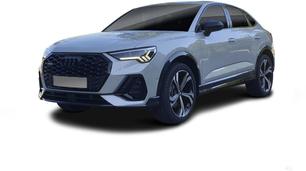
There's a lot going on with the RS Q3's exterior design; a mix of jagged lights, hard character lines, broad haunches and multiple vents surrounding the brand's signature, six-sided grille up front.
The big 21-inch rims fill the arches nicely and the rear features a deep diffuser with fat exhaust finishers poking out either side.
It's a purposeful, macho look and the Sportback edition 10 years is defined by a black package which adds gloss black to the side window trim, front spoiler blade, side blades, rear diffuser and exterior mirrors.
The limited edition is available in two colours, 'Chronos Grey metallic', which is unique to this model and 'Dew Silver matte' which will now be added to the broader RS Q3 colour palette.
Premium performance feels like the dominant theme inside with a typically Audi tech-focused approach including high-quality brushed metal elements, matt carbon inserts and quilted leather trim on the heavily bolstered front seats.
A meticulous attention to detail is obvious and the bottom line is it's all about the driver. A grippy, flat-bottom, leather-trimmed steering wheel looks as good as it feels, sleek screens enhance the racy vibe and the mix of physical and digital controls is sensible.
The Kluger is both practical and comfortable for passengers as each row gets a great amount of head- and legroom – yes, even third-rowers, but the low level of amenities in that row will render it a 'sometimes seat' for adults or older kids.
The 208mm ground clearance, wide door apertures and low-sitting seats makes it a very easy SUV to get in and out of, even for kids. The access to the third row is also good as the 60/40 split middle bench seat can be slid forward.
The electric front seats offer lots of adjustments, including lumbar support on the drivers side, but both seats get heating. They’re also well-padded and quite comfortable on a longer journey.
The outboard seats on the middle row offer the most comfort as they have longer under-thigh support, but the entire row benefits from heavy padding and the seat backs can recline.
The third row offers a curious 60/40 split and is wide enough for two adults to not be squished like sardines.
Although the Kluger is a seven-seater, families will be bummed that there are no child seat anchor points in the third row. But the middle row has two ISOFIX child seat mounts and three top-tether anchor points. It is more than wide enough to accommodate three seats side by side and you’ll have enough room for the front passenger when a rearward facing child seat is installed, too.
Individual storage is above average for the class, but the front row gets the best of it. There are two handy shelves built-into the dash, a glove box, a deep middle console (that swallows my arm) and cubbies in the centre console that include a phone cradle and two cupholders. There's also a sunglasses holder and little cubby beside the driver's knee.
In the middle row, you get two map pockets, two cupholders in a fold down armrest, and a drink holder in each door. While the third row gets a couple of cupholders.
Amenities are well-rounded for the most part, with the three-zone climate control and well-positioned directional air vents in the roof for the back two rows. Middle-rowers also get reading lights and two USB-C ports.
Technology is easy to use and looks great as the 12.3-inch display uses the same multimedia system as Lexus. The built-in satellite navigation is simple to set up and shows clear directions with lots of route customisations available.
There is wired Android Auto and wireless Apple CarPlay, but you do have to initially connect the CarPlay via a cable.
Rounding out the cabin is the great-size boot that offers 241L with all seats in use, but that can jump up to 552L when the third row is stored.
The level loading space makes it easy to slide larger items in and out of, and there’s a handy underfloor storage compartments for smaller items. You get a full-size spare tyre underneath the car and a powered tailgate in this model.
Snug but spacious enough, the RS Q3 Sportback's driver and front passenger are provided with plenty of breathing room without upsetting the intimate, performance car feel. Just be prepared for a bit of head-ducking physical origami when folding yourself into either of the heavily bolstered front seats.
Storage includes door bins with room for bottles, two generous cupholders in the centre console, a lidded tray in front of the gearshift (which doubles as the wireless device charging bay), a storage compartment and owners manual holder under the front seats, a modest glove box and an adjustable front centre armrest with storage compartment.
Given this car measures just over 4.5m end-to-end, a close to 2.7m wheelbase is significant and rear room is generous given the Q3's overall footprint. Plenty of head and legroom (for me at 183cm) with enough width for three adults on short journeys. A trio of up to teenage kids will be fine.
The back seat is able to slide for extra legroom (and slightly less boot space), while backrest angle is also adjustable.
Storage runs to small bins in the doors, a fold-down centre armrest (with two pop-up cupholders) and storage nets on the back of the front seats. Directional and temperature control in the rear for the ventilation system is a big plus.
Power and connectivity options run to a 12V outlet and two USB sockets in the front (Type A and C), another two Type C sockets in the back and a second 12-volt jack in the boot.
Speaking of which, cargo volume with all seats up is a handy 530 litres, enough to swallow CarsGuide's three-piece luggage set or large pram (the latter with room to spare) and 1400 litres with the 40/20/40 split-folding rear seat lowered.
The loading lip is low, a stainless steel sill protector helps minimise scuffs and scratches and the hands-free power tailgate is welcome.
If you're keen to hook up the boat or horse float the RS Q3 is able to tow a braked trailer up to 1900kg (750kg unbraked), but don't bother looking for a spare of any description, a repair/inflator kit is your only option. Boo...
You have to love a simple three-grade line up with variant names that aren't hard to say! The Kluger starts with the base GX, mid-spec GXL and then the flagship Grande model.
All Kluger models share the same all-wheel-drive hybrid powertrain, and our test model is the mid-spec GXL, which is priced from $70,440 before on-road costs.
Its price positions it in the middle of its seven-seat hybrid rivals; the Hyundai Santa Fe Elite ($65,000 MSRP) and the Kia Sorento GT-Line AWD ($73,330 MSRP), but it should be noted that the Sorento hybrid is only offered in one high-spec grade level and the Kluger can’t always match the Sorento’s plush features.
The GXL is still fairly well-specified and includes eight-way powered front seats with heating, adjustable lumbar support (driver's seat), black synthetic leather upholstery, a powered tailgate, rain-sensing wipers, dusk-sensing LED headlights, keyless entry/start and a full-sized spare tyre.
There is also 12 months of complimentary access to Toyota Connected Services, which allows you remote access, via the myToyota Connect app, to safety and security features, multimedia connect and driving insights.
The other technology is well showcased in the 12.3-inch multimedia display that has touchscreen functionality, in-built satellite navigation, wired Android Auto, wireless Apple CarPlay, Bluetooth and digital radio. You also get a single USB-A port, three USB-C ports, two 12-volt sockets and three-zone climate control.
The Audi RS Q3 Sportback edition 10 years is priced at $102,900, before on-road costs, which is a $3800 premium over the standard issue version.
For those extra dollars the car is upgraded with specific 21-inch black alloy rims, black badging and brake calipers as well as (three-stage heated) 'RS' Nappa leather-trimmed sports front seats with contrast 'Copper Honeycomb' stitching.
The fancy stitching extends to the Alcantara-trimmed steering wheel and gear lever, the RS floor mats also feature copper highlights and the door downlighting projects a unique rhombus design.
At that money the RS Q3 lines up against BMW's firecracker X3 M40i ($126,800), the ferocious Mercedes-AMG GLA45 S ($121,900) with the Jaguar E-Pace 300 Sport AWD ($84,500) the only other similarly pitched compact performance SUV within $20K of the Audi.
And as well as the performance and safety tech covered later in the review, the RS Q3's standard features list includes, three-zone climate control, adaptive cruise control, keyless entry and start, Nappa leather trim, ambient lighting (with 30 colour choices), an RS sport contour leather-trimmed steering wheel, 12.3-inch digital instrument cluster, 10.1-inch multimedia display (with text and voice control), (wired) Android Auto and Apple CarPlay, sat nav and wireless device charging.
There's also a Bang & Olufsen '3D Sound System' (15-speaker with 680-watt, 16-channel amp), digital radio, 21-inch alloys, electronically-controlled adaptive dampers, auto Matrix LED headlights (with RS-specific darkened trim) and a hands-free power tailgate. And it's worth noting metallic and pearl effect paint finishes are offered at no extra cost.
Pretty impressive. Especially when you consider even this special edition RS Q3 is $20,000 cheaper than its primary BMW and Merc-AMG rivals.
All Kluger grades are all-wheel-drives with a smooth continuously variable transmission. They share the same 2.5-litre four-cylinder hybrid powertrain that produces up to 184kW of power. Toyota does not quote a combined torque output.
At first look, these outputs may look underwhelming, but the on-road experience has shown that it’s more than enough to move the Klugers big body around without it feeling underpowered.
The Kluger has a braked towing capacity of up to 2000kg, which means you can hook up most of your weekend adventure toys!
The RS Q3 Sportback is powered by a 2.5-litre in-line five-cylinder intercooled turbo-petrol engine sending drive to all four wheels via a seven-speed dual-clutch automatic transmission and Audi's quattro permanent all-wheel drive system based on an electronically-controlled multi-plate clutch pack.
Featuring a cast iron block, alloy head, direct-injection as well as variable intake and exhaust cam adjustment, the (EA855) engine features a special firing order (1-2-4-5-3), the odd number of cylinders producing a signature engine sound and exhaust note reminiscent of the 1980s 'Ur' Quattro.
Peak power is 294kW from 5850-7000rpm and maximum torque is 480Nm delivered across a broad plateau from 1950-5850rpm.
The Kluger may be massive but it has an excellent combined fuel cycle usage of just 5.6L/100km because of its hybrid powertrain.
Combined with its large 65L fuel tank, you should see a theoretical driving range of up to 1160km, which is really good for a family SUV and rivals diesel models of the same size.
I’ve been super pleased with the fuel usage of our test model because despite doing quite a few long distance trips, which is where hybrids are usually the most inefficient, I’ve managed a real world usage of only 5.8L/100km! That is a great result.
The Kluger only accepts a minimum 95RON unleaded premium petrol.
Audi's official fuel economy number for the RS Q3 on the combined cycle is 8.9L/100km, the 2.5-litre turbo-petrol five-cylinder engine emitting 204g/km of CO2 in the process. Stop-start is standard.
We covered city, suburban and some freeway running on test, returning an (indicated) average of 9.6L/100km. And that's pretty good, given we pushed on enthusiastically on a reasonably regular basis.
The fuel tank requires 63 litres of 98 RON premium unleaded to fill it which translates to a theoretical range of just over 700km, shrinking to around 650km based on our real-world number.
The engine can sound like it’s under pressure, but that doesn’t translate to underwhelming power delivery. The GXL has enough grunt to make it a comfortable open-roader that’s confident on hills and overtaking.
The steering is light for such a big SUV, but with its 11.4m turning circle, it’s every parents dream when doing the school run or navigating small lanes or parks for after-school activities. It’s almost stupidly easy to drive and feels much smaller than what it is, even in the city.
Visibility is mostly good because of the large windows, but the B-pillar is larger than I’d like and I found myself checking my blind spots carefully.
The ride comfort is really good and suspension is forgiving on the worst of the bumps without feeling like it floats on the road. Road noise is low, even at higher speeds, but occasionally you get a weird wind whistle through the air vents.
Even those usually put off by a large SUV, should find this comfortable to get around in. Parking it is the only time you really notice its bulk. While the reversing camera is great quality, a 360-degree view system would have been much better.
It still seems counterintuitive when a high-riding SUV is tuned to perform and handle like a low-slung sports car but here we are. And Audi executes this mystifying transformation as expertly as any carmaker in the automotive world.
Audi says the RS Q3 Sportback will blast from 0-100km/h in 4.5 seconds. Anything under 5.0 seconds is properly fast, and there's nothing quite like the deep-throated bellow of a VW Group in-line five to raise the hairs on the back of your neck.
The RS Q3's sport exhaust system is a dual-branch set-up with exhaust flap control, and people of a certain age will instantly imagine themselves matching it with Ari Vatanen, Walter Röhrl and Michèle Mouton on a suburban special stage behind the wheel of a 1980s Group B Sport Quattro rally car (actually, the school drop off at an infinitely more sensible pace).
The car weighs in at a not insubstantial 1775kg, but 480Nm, available all the way from 1950rpm to 5850rpm, means a near instant surge of fierce acceleration is always lurking under your right foot.
And the VW Group is on the pace when it comes to dual-clutch auto transmissions, from Porsche's 'PDK' and VW's 'DSG' to Lambo's 'DCT' and Audi's 'S tronic'.
The RS Q3's seven-speed unit is quick and positive, the wheel-mounted paddles ramping up the engagement factor.
The variable ratio, electrically-assisted steering is capital G Great. Well weighted and precise with reassuring road feel and the Alcantara trimmed wheel is a nice way to access it all.
Suspension is by struts at the front and multi-links (four) at the rear with adaptive dampers on-board.
Despite running on 21-inch rims, shod with high-performance 255/35 Continental PremiumContact 6 rubber, ride comfort is surprisingly good.
Dial in 'Comfort' mode via the 'Drive Select' system and the impact of even substantial bumps is softened off appreciably.
An ideal set-up would be the first 'RS1' short-cut Drive Select button set for Comfort suspension, with throttle, steering and transmission set to maximum attack and the second 'RS2' mode tweaking the suspension to track-day level, too.
Push on through your favourite set of bends and you can feel the electronic wheel-selective torque control system keeping everything under control. This car puts its power down through sweeping sections with fuss-free authority.
The RS-specific menu in the digital instrument cluster provides extra instrumentation in the shape of a power/torque display, G meter and lap timer. Fun!
The brakes are professional grade with big ventilated rotors all around and aluminium fixed calipers at the front.
But beware, the flip side of the RS Q3's quick steering response is a sizeable 11.8m turning circle. Take your time when parking.
The Toyota Kluger has a maximum five-star ANCAP safety rating from testing done in 2021 and scored highly across its individual assessment scores. However, it only features seven airbags, which is a bit low for a car of this size, but the curtain airbags extend to the third row, which is good.
The Kluger has lots of safety equipment, including daytime running lights, hill-start assist, seatbelt warning (all seats), lane departure alert, lane-keeping aid, traffic sign recognition, rear cross-traffic alert, blind-spot monitoring, a reversing camera (with guidelines) and front and rear parking sensors.
The Kluger does miss out on family friendly safety items, like child-presence alert and side exit assist. The adaptive cruise control isn’t as well tuned as I’d like as it doesn't hold it's speed all that well, slows down too soon behind a vehicle, and sometimes can be sluggish to return to a normal speed once a vehicle has left its 'radar'.
The GXL has AEB with car, pedestrian, cyclist and junction turning assist and is operational from 10-80km/h (up to 180km/h for car), but it is usual to see that starting point sit closer to 5.0km/h.
Although the Audi Q3 received a maximum five-star ANCAP score in 2019, the RS Q3 was specifically excluded from the assessment, so it's officially untested.
But the car boasts an extensive active (crash-avoidance) safety suite including, auto emergency braking (AEB) (5.0km/h to 85km/h for pedestrians and cyclists and up to 250km/h for vehicles), adaptive cruise control (with stop-go function and active lane assist), lane change warning and lane departure warning (with lane keeping assist).
There's also 'Attention Assist' (warning tone and visual signal if the system determines the driver's attention may be lapsing), front and rear parking sensors, a reversing camera with 360-degree view, rear cross-traffic alert, tyre pressure monitoring, 'Hill hold assist' and hill descent control.
If, despite all that, a crash is unavoidable there are six airbags on-board (front and side for the driver and front passenger as well as full-length curtains). The RS Q3's showing its (10-year) age here because additional rear side and front centre bags are close to the norm now.
Nice to see a first aid kit and warning triangle included and there are three top tethers and two ISOFIX anchor points for securing baby capsules and child seats across the second row.
The Kluger is offered with Toyota’s five-year/unlimited-kilometre warranty, but that can be extended to seven years if you service on time and with a Toyota service centre, which makes it competitive against some rivals.
There’s a five-year capped-price servicing program available, with services costing just $285, which is cheap for the class. Servicing intervals are reasonable at every 12 months or 15,000km, whichever occurs first.
Audi Australia covers all the models it sells with a five-year/unlimited km warranty with 24-hour roadside assistance included for the duration. Pretty much cost-of-entry in this part of the market.
Paintwork defects are also covered for five years, and the body is warranted against corrosion (to the point of perforation) for no less than 12 years. Nice.
Service intervals are 12 months/15,000km and capped-price servicing is available, a five-year/75,000km plan for the RS Q3 costing $3580, an annual average of $770. Fairly steep.
An 'Audi Advantage' package is also available, adding an extra two years' worth of warranty, scheduled servicing and roadside assistance (to the end of any existing term) for $3800.