What's the difference?
This is the new Tesla Model Y L, of course, but before we even start I need to ask you a very important question.
How often, honestly, do you use all seven seats in your seven-seater? Or if you only have five seats, how often is there a human in every single one?
Rarely, if ever?
Yep, me too. So stick around, because this is, by far, the best family SUV seating layout. And one where there’ll finally be no fighting over who gets stuck with the dodgy seat.
And as a result, the six-seat Tesla Model Y L might just be among the best all-electric SUV offerings around.
The Audi SQ8 has had a mid-life refresh but this upper large SUV still offers luxury with its powerful V8 engine that fans know and love, as well as the features you would expect in a top model.
It competes against the Mercedes-AMG GLE and Porsche Cayenne but we’re family testing the SQ8 to see how it handles domestic life.
Keep reading to see what we’ve discovered.
If you like the five-seat Model Y, then you'll like the six-seat L version even more. I think this the best example of Tesla's electric SUV to date, and the cabin layout just makes a lot of sense, and would suit plenty of families who don't need to squeeze someone into a compromised middle seat.
Note: The author, Andrew Chesterton, is a co-owner of Smart As Media, a content agency and media distribution service with a number of automotive brands among its clients. When producing content for CarsGuide, he does so in accordance with the CarsGuide Editorial Guidelines and Code of Ethics, and the views and opinions expressed in this article are solely those of the author.
The Audi SQ8 isn’t your typical performance SUV. It’s more refined and less flashy. The tech can be more complicated than it needs to be and if you’re wanting that V8 soundscape, you won’t find it here.
However, the handling and on road experience are superb plus you can comfortably haul the family around and look good doing it.
Spoiler alert - it looks a lot like a five-seat Model Y, doesn’t it, albeit a slightly bigger one. And you’d have to be a bigger Tesla head than me to immediately spot the differences at a glance.
The wheelbase is longer, the rear doors are bigger as are the rear 3/4 panels and the roof line is higher, helping with headroom in the third row.
Still, safe to say if you like the look of the five-seat Model Y, you’ll like this one. And if you hate it, well, good luck.
The alloys are 19-inch and shaded by the aerodynamic caps and there are light bars front and rear which debuted on the updated five-seat Model Y when it arrived mid-last year.
The bigger changes are inside, of course. I promise we’ll get to the second and third rows in the Practicality section, but let’s talk about the look and feel first.
There’s a love/hate relationship with Tesla’s stripped-back aesthetics, and I’m probably somewhere in the middle. I like the airiness of the space in the cabin, and I think it feels nicely put together, and I really dig the contrasting fabric used on the doors and dash which add a little visual interest to the cabin.
But I hate using the central screen to select a gear and I hate not being able to see how fast I’m going without turning my head. A head-up display would work wonders in the Model Y L cabin.
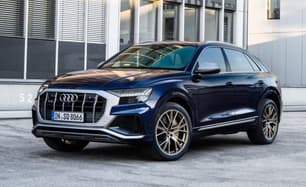
The SQ8 is a gorgeous coupe-style SUV that looks purposeful and poised with its balanced proportions and wide stance. It’s stands apart from its siblings thanks to the S-styled nose treatment and our test model's black accent package makes the honeycomb grille look even sportier.
The update sees new air intake vents at the front, matrix LED headlights and new chrome exhaust tailpipes.
The upgraded 23-inch alloys with red calipers behind them hint at what’s under the bonnet, as does the Sakhir (sack-heer) Gold paintwork which is aptly named after the one-off Grand Prix race circuit.
The interior looks luxuriously appointed with the black Valcona leather upholstery and the dash is headlined by three high-end technology screens. The SQ8 also gets sport seats featuring a quilted design and 'S' badging but there’s not much else separating it from its siblings.
Audi fans will love the the SQ8's more understated interior but newcomers might be surprised it's not as flashy as some of its rivals.
Captain’s chairs are simply a more luxurious version of second-row seating. With that there is no argument and the heated and cooled chairs that occupy the second row of the Model Y L are pretty good examples of them.
Space, both knee and headroom, is ample, and you can adjust each seat individually if you want to grant a bit more space to any third row occupants. Armrests deploy at the push of a button — as do the two hidden cupholders — and it really is easy to settle in and get comfy.
The third row is a bit more hit and miss. I’m 175cm and found I had enough legroom and headroom, but the big plastic mouldings that emerge from each side of the Model Y (which house a cupholder) are a miss. They end up pushing you into the seat next to you, and I can foresee a lot of arm rubbing with anything like two adults back there.
Also confusing is how to actually get out of it. You can fold the seat in front of you flat, but then you have to climb over it. I found it easier to just walk out between the seats.
There are another two USB-C ports in the rear row and you get air vents but no temperature controls.
The Model Y L stretches 4969mm in length, 1668mm in height and 2129mm in width, which is roughly 18cm longer and 4.5cm taller than the five-seat model. The extra space doesn’t sound like that much, but start dropping rows and you find a heap of storage space.
Both the second and third row stow electronically from the boot, but with them in place you’ll find 420 litres of storage in the double-layer boot. Drop the third row, and that number grows to 1076 litres. With the third row folded there is a massive 2423 litres of space. The frunk serves up another 116 litres.
There’s also room (and the ISOFIX attachment points) for four child seats.
The upper large SUV tag certainly makes sense when it comes to cabin space because there's a lot of it. Both rows enjoy ample head- and legroom and access is great thanks to wide door apertures and high ground clearance.
Comfort is high with well-padded seats and thanks to the Sensory Package all but the middle back seater get some luxury extras.
The centre rear position has compromised legroom courtesy of the transmission tunnel, so it's best for a kid. However, the front seats take the cake with their massage, heat and cooling functions and adjustable supports.
Amenities are great throughout the car and the extendable sun visors, rear electric sunshades, soft-close doors and four-zone climate control clinch the practicality deal.
Individual storage is a bit sparse up front with two cupholders, a drink bottle holder in each door and a shallow middle console that realistically only fits a phone.
The glove box is a great size. I can fit my handbag in it, but there are not a lot of areas to pop your smaller items in.
Individual storage is a bit better in the rear as you get two big map pockets, a drink bottle holder in each door, plus two cupholders in the fold-down armrest - so it feels like you have more places for your bits and pieces.
Technology looks amazing but overwhelming to use until you wrap your head around it all. The haptic feedback also gets tired fast. The built-in satellite navigation is super simple while the head-up display and digital instrument cluster feature pull through directions, which is handy.
Charging options are good with each row getting two USB-C ports and a 12-volt socket but the front also enjoys a wireless charging pad. The pad is slow to charge, though, and left my iPhone feeling super hot whenever it was used.
The boot is a good size at 605L and easy to access, too. The sloping roof means larger items have to sit flush with the seats but you shouldn’t have to worry for road trips.
The back seat has a 40/20/40 split which opens up storage options and this model has a powered tailgate.
The Model Y L sits smack bang between the $68,900 Long Range AWD and the $89,400 Performance, setting you back $74,900, before your on-road costs. It’s also the only three-row option in the Tesla family.
Aside from people movers, we’re not swimming with options in the three-row electric space, either. The Kia EV9 will get it done from $97,000, the Hyundai IONIQ 9 starts from around $120K and the Volvo EX90 is more expensive again (from $124,990).
Anyway, in Tesla land, the Model Y L rides on 19-inch alloy wheels, has a glass roof, automatic wipers and Tesla’s smartphone access key, as well as the little credit-card swipe.
Inside, there’s a 16.0-inch central screen that handles everything. And I mean everything. It's your gear selector, your speedometer, and everything else, too. There’s no Apple CarPlay or Android Auto, but you can access things like Spotify and podcasts through the in-built apps and the on-board navigation system is a good one, too.
All of that pairs with a 19-speaker sound system, and there are dual wireless charge pads. All three rows of seats are heated, while the first and second row get ventilation, too.
A second 8.0-inch touchscreen in the middle row then handles things like the seat heating or cooling, music and games to amuse the kids. And the Model Y L also debuts V2L, or Vehicle to Load, for Tesla in Australia, using a connector in the external charger.
There are three fuel-based variants for the Q8 and the model on test is the top-spec SQ8 TFSI quattro. Its mid-life refresh has seen a price hike of $10,015, bringing it's before on-road costs price to $178,815.
Our test vehicle has also been fitted with a few extras, like a 'Sensory Package' ($14,400) which includes a black headliner, upgraded 23-speaker Bang & Olufsen 3D surround sound system, massage function for the front seats, heat function for the rear outboard seats, electric sunshades for the rear row and an air-quality perfume function.
Also fitted are various black and matt carbon accents across/inside the body for a total of $5400, optioned 23-inch alloy wheels ($3000) and specialised 'Sakhir Gold Metallic' paintwork for $1600. Which brings the total MSRP price tag to $203,215.
Even with all of these extras, the SQ8 is still the most affordable performance SUV compared to its nearest rivals as the Porsche Cayenne GTS starts from $212,600 MSRP and the Mercedes-AMG GLE 63 outstrips them both at $272,300 MSRP.
As you'd expect the standard features list is robust for the SQ8 and includes premium features like a panoramic sunroof, electric front seats with heating/cooling and memory functions, full-leather upholstery, soft-close doors and a heated steering wheel.
There is a bunch of high-end technology throughout which includes a colour head-up display, 10.1-inch touchscreen multimedia system, 8.6-inch climate control panel, 12.3-inch digital instrument cluster, satellite navigation, wired/wireless Apple CarPlay and Android Auto, digital radio, four USB-C ports, three 12-volt sockets and a wireless charging pad.
Practical features include keyless entry and start, rain-sensing windscreen wipers, dusk-sensing LED headlights, a powered tailgate, adaptive air-suspension and four-zone climate control.
Overall, not a bad list of features for this part of the market and you won't be left wanting.
The Model Y L gets Tesla’s dual-motor AWD powertrain, with two electric motors producing a total 378kW and 590Nm. That’s enough, Tesla says, to knock off the sprint to 100km/h in five seconds flat.
Our test vehicle has a 4.0-litre, twin-turbo petrol V8 engine that produces 373kW and 770Nm. That means it sits in the middle of its rivals in terms of outputs with the Mercedes being top-dog with its 450kW/850Nm combo.
Still... the SQ8 is no dainty flower when it comes to power delivery and has an impressive 0-100km/h sprint time of just 4.1 seconds.
The SQ8 is a full-time all-wheel drive with an eight-speed auto transmission and the whole engine combo delivers a powerful but elegant on-road experience.
Tesla is always a little vague when it comes to the size of its batteries, but reports point to the Model Y L carrying a 84Wh (useable) NMC battery.
Whatever the specifics, the range is strong, with Tesla promising a 681km driving range on the WLTP combined (urban/extra-urban) cycle.
It’s also set up for 250kW DC fast charging, which should see you take on 288km in 15 minutes, according to Tesla.
The official combined (urban/extra-urban) fuel cycle figure is 11.9L/100km, which is lower than its rivals.
My real world usage sits at 12.3L/100km after a mix of open-road and urban driving.
This result is decent for a performance SUV but expect it to be thirsty in an urban environment as the on-board gauge hit the mid-20s in the city.
Based on the large 85L fuel tank theoretical driving range is 714km and around 690 using our real-world result. Respectable for a performance SUV but not as good as some family SUVs.
Honestly, it feels like the Tesla Model Y has grown up. I didn’t love earlier iterations of this car and I found the Performance to be fast but lacking any emotional fizz.
This one, though, feels solid and composed, and the power on tap (of which there is ample) is more about effortless progress than it is attempting to offer sports car excitement.
The steering is now nicely weighted and feels direct enough without being too sharp, and the cabin is well insulated, with often the slightly off-putting sort of rubbing noise the steering wheel makes when you turn it the only intrusive sound.
One drawback is a ride that definitely errs on the side of firm. This Model Y L gets electronic damping designed to iron out some of the more jagged stuff, but it still feels brittle in places, and you can definitely feel some sharpness in the cabin. Now, to be fair, it’s not too firm for me, but it might be for you.
Another is a bizarre turning circle which constantly reminds you you’re driving a big bus, especially when you try to complete a tight three-point turn.
But despite its stretched dimensions, I found the Model Y L easy to drive and park in the city, and once you're up to speed with Tesla's operating system (there's no Apple CarPlay or Android Auto), then the screen is pretty easy to use, too.
The SQ8 delivers on power because it’s effortless to get up to speed and the pick up is super responsive when the start/stop function is turned off (otherwise there can be some lag).
The engine doesn’t sound like a big and grumbly V8, though. There are some growls but it’s mainly when you turn the engine on and not to be obnoxious about it but if you're in a V8, you want to hear it as it’s part of the fun of having a big bruiser engine like this!
What doesn’t help the V8 soundscape is the fact the cabin sounds like a noise-cancelling headphone inside. There is a small hum from road noise but it’s pretty darn quiet. Almost EV quiet at times but that means the driving experience leans more towards refined and elegant rather than sporty and fun.
The SQ8's handling is great - super direct steering, stable in corners and well-rounded passenger comfort when it comes to suspension.
You still get road feedback, which I like as a driver, but it’s not too stiff thanks to the adaptive suspension.
The SQ8 is a large car but you wouldn’t know it when it comes to parking. The 360-degree view camera is clear and the dynamic guidelines help you to position this big unit even the smallest of car parks.
The Model Y L gets the same maximum five-star ACNAP safety rating as the rest of the Model Y range, with nine airbags (up from seven in the five-seat model), and things like AEB (Auto Emergency Braking), lane-keeping assist, 'Forward Collision Warning' and blind-spot monitoring all along for the ride.
Interestingly, the curtain airbags from the five-seat version haven't been replaced, with coverage still only extending to the second row. New airbags have instead been added for third-row occupants.
One more analogue quirk of the Tesla Model Y L is the thick B-pillar, which does a good job of almost completely obscuring driver-side blind-spot checks (for those of us who still like to do those manually).
The SQ8 has a maximum five-star ANCAP safety rating from testing done in 2019 and features eight airbags, including side chest airbags for both rows. It's common to only find the latter in the front – so that’s great for a family car.
The SQ8 scored well across its ANCAP individual protection segments, scoring 93 per cent for adult occupant, 88 per cent for child occupant, 71 per cent for vulnerable road user and 75 per cent for its safety assist.
The SQ8 has a long list of safety features including blind-spot monitoring, safe exit warning, driver attention monitor, fatigue reminder, matrix LED lights, SOS call, forward collision warning, rear collision warning, rear cross-traffic alert, lane keeping/departure aids, tyre pressure monitoring, adaptive cruise control (with stop & go and lane keeping), park assist and a 360-degree reversing camera plus front and rear parking sensors.
The rear row features two ISOFIX child seat mounts and three top tether anchors.
The SQ8 has AEB with car, pedestrian, and cyclist detection and is operational from 10 – 250km/h but it is usual to see this system operate from as low as 4.0km/h.
Tesla warranty is a these-days-underwhelming five years and unlimited kilometres, while the high-voltage battery is covered for eight years or (a wildly specific) 192,000km.
There’s also five years' of roadside assistance, including puncture repair (a good thing, given the lack of a spare wheel). I also couldn’t find a puncture repair kit and later research suggests Tesla sells them, rather than provides them as standard.
Tesla servicing is condition-based, so there’s no fixed schedule, with a summary on the car’s touchscreen providing a record of when vehicle maintenance was last carried out and prompts for when they should be performed next.
In the absence of a combustion powertrain the emphasis is on things like wheel rotation, balancing and alignment, brake fluid testing, air-con servicing, camera precision, radiator cleaning and high-voltage battery maintenance.
Expecty a ‘Vehicle Health Check’ to come in under $300 with ‘General Diagnosis’ at around $270 per hour.
The SQ8 comes with a five-year/unlimited km warranty, which is a normal term for the class.
It also comes with capped servicing for five years or up to 75,000km and averages $920 per service, which is very good for the segment.
Servicing intervals are reasonable at every 12-months or 15,000km, whichever occurs first.