What's the difference?
It’s been in Australia since 2019 and despite the arrival of a comprehensively upgraded version in late 2023, the Tesla Model 3’s once gargantuan popularity has been declining in recent years.
A seemingly never-ending influx of pure-electric alternatives, primarily from China, has eroded the mid-size sedan’s positioning as the go-to, best-value EV choice.
But to its credit Tesla has again evolved the Model 3 proposition with the introduction of this Long Range Rear-Wheel Drive grade in October last year, at the time positioning it as “the longest-range EV in Australia”.
Since then, Tesla has adjusted the model grade name to Premium Long Range Rear-Wheel Drive.
Some additional tweaks, made in response to customer feedback, also illustrates the EV pioneer’s determination to step up in the face of increasingly fierce competition.
So, does this latest Model 3 do enough to earn a spot on your electric vehicle shopping list? We spent a week behind the wheel to find out.
Surprisingly, for people who would rather be driven than drive themselves, there are quite a few options available in the large luxury sedan market.
While on the whole sedans have fallen from favour, this niche corner of the market continues to let the three-box design thrive.
The options here have changed a bit in the last few years, though, so how does the Lexus flagship, the LS fit into the picture? I drove one around for a week to find out.
Tesla has done enough with the introduction of this Premium Long Range RWD variant to keep the Model 3’s head well and truly above water in an increasingly competitive segment. After more than six years it still looks good, with a pleasant cabin environment, plenty of performance and leading energy efficiency. Safety is top-shelf and it stands up well in terms of practicality and driving dynamics.
That said, the ownership proposition is average, the determination to make so many functions screen-based is frustrating and the optional Full Self-Driving system is unconvincing. With the Model S and Model Y now discontinued globally it will be interesting to see how the Model 3 continues to evolve.
The LS500 is the least logical version of the most logical option in the ultimate luxury sedan segment in which logic doesn’t often apply at all.
Take from that what you will, but if it was me being driven around I would definitely be opting for the hybrid version of the LS instead for its smooth electrified driving characteristics and lower operating costs.
After four years in market, a heavily upgraded version of the Model 3 arrived in Australia in 2023, the biggest visual changes being a reshaped bonnet, aero massaged overall profile and angular slimline headlights.
The boot lid now incorporates a lip spoiler and the tail-lights were remodelled to create a truncated, two-layer effect. And in true Tesla fashion, the standard 18-inch alloy rims are fitted with matt black-finish aero elements filling the gaps between the satin black wheel spokes. Two new body colours - ‘Stealth Grey’ and ‘Ultra Red’ - were recently added to the available palette. For reference, our test car's finish is 'Quicksilver'.
It’s still clearly recognisable as a Model 3, but these relatively minor design changes have helped the mid-sizer keep up with the slew of sleek newcomers it now faces.
The interior was also given a substantial makeover, the expansive 15.4-inch central display screen backgrounded by an all-new wrap-around dash and revised console treatment, the former featuring a raised insert and the latter a two-device wireless charging station.
Introduction of this Premium Long Range RWD model also brought the small but significant addition of a physical indicator stalk on the left-hand side of the steering column, replacing buttons on the steering wheel. Big ergonomic tick for that.
Customisable ambient lighting lifts the tone, soft materials look and feel good and the doorcards, bins and armrests have been reprofiled into a more sophisticated arrangement.
Our test car’s dark grey and white synthetic leather trim combination lifts the mood as does light from the huge, two-panel glass roof. But beware, while white trim looks dazzling on the showroom floor it takes some extra work to maintain its schmick appearance in the day-to-day grind.
After seven years in market the Model 3 has aged well and still looks sleek and contemporary.
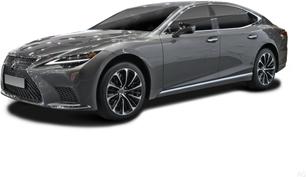
The distinctive but conservative style of Lexus is on full show across the LS’s massive frame. Like other cars in its class, it’s very much the image of the brand itself with styling points strong, but to me not as impressive as the LC500, which is a definitive expression of the brand.
The LS also has many styling points of the previous-generation Lexus design language which are in the process of being phased out.
The car was only updated last year, bringing with it a more recent interpretation of the brand’s big spindle grille, pointy headlight profile, and angular but traditional rear.
The LS - even in this Sports Luxury guise - does look quite menacing from certain angles. The width and stance of this car is accentuated by its curvaceous rear guards and big square front bumper, with the elegance of a classic three-box sedan maintained in a side profile.
The chrome wheel finish is a bit much for my taste, but there’s no doubt they’re real show pieces. They’d better be, too, because I hear they are incredibly expensive should you need to replace one.
The inside has highs and lows but it’s the place where you can most tell the LS has been on sale for a while.
I love the plush seats, big screen, integrated analogue clock and three-dimensional door card design, which sell the flagship luxury feel.
But this car’s age is on show with its clunky and much maligned 'Remote Touch' pad controller (which Lexus is at long last phasing out in its new cars), last-generation software suite, and its small, crowded instrument cluster.
There are a whopping nine interior trim combinations to choose from and ours has the most recently added black leather and ‘Nishijin Haku’ themed highlights which are meant to be inspired by the way "moonlight sits on an open sea".
The feel is a bit '90s, a rough textured fabric with a silver detailing and elements clad in a thin platinum foil, making you feel like you’re in a classic high-class Japanese taxi.
But I’ll admit it plays well with the ambient lighting effect in the doors, and is a unique selling point compared to the standard leather finish.
At just over 4.7m long, more than 1.8m wide and a bit over 1.4m tall (with a 2875mm wheelbase) the Tesla Model 3 is a low-slung medium-size sedan.
There’s plenty of space up front, a feeling enhanced by the standard panoramic glass roof and our test car’s white trim brightening up the cabin.
There are long, wide bins on the front doors with enough room for large bottles, a slim glove box (which opens only via an on-screen button, which is annoying) and a generous lidded storage box between the seats that doubles as a centre armrest.
The console houses two cupholders with another storage cubby ahead of them (both with sliding covers over the top) and the dual device wireless charging bay on the lower part of the dash under the media screen.
Switching to the rear, at 183cm I have a surprising amount of foot, leg and headroom when sitting behind the driver’s seat set to my position. The rear door aperture is surprisingly large which helps entry and egress.
Technically able to accommodate three passengers, the back seat is best for two full-size adults on anything other than a mid-length journey, although the flat rear floor helps ease pressure on the centre occupant.
There's a well-hidden fold-down centre armrest with cupholders, there are useful bins in the doors and hard shell map pockets on the front seatbacks.
The crisp 8.0-inch rear screen is a welcome entertainment option for back-seaters and there are adjustable air vents underneath it.
For power and connectivity there are two USB-C ports and a 12-volt socket in the front compartment, a USB-A in the glove box (mainly for dash cam and ‘Sentry Mode’ data storage) and two USB-C ports in the rear under the vents.
Boot space is a ample at 682 litres (the bootlid is adjustable for opening height) with an 88L ‘frunk’ in the nose. And if you need to tow a relatively light load like a box trailer or Jet Ski (or two) you can hook up a 1.0-tonne braked trailer (750kg unbraked).
While we understand it helps maximise battery space and reduce weight, we’re not on board with Tesla’s policy of providing a repair/inflator kit rather than a physical spare tyre. Even though this is likely to be a primarily urban cruiser, it’s not good enough.
Then, there’s the Tesla app, an electronic Swiss Army Knife that facilitates everything from remote vehicle access and cabin ‘preconditioning’ to planning your route (complete with charging stops) and monitoring Sentry Mode (checking the vehicle’s surroundings and receiving alerts of potential threats).
The list of functions goes on and on, but suffice it to say the app is hugely handy. For example, ‘Dog Mode’ keeps the air con on with the car locked for the benefit of your four-legged friend and lets passers by know the doggo is safe via a bold message on the central screen. An internal camera, accessible via the app, lets you check-in remotely, too. Nice.
Given its overall size and despite its conventional sedan configuration, the Tesla Model 3 offers efficient packaging and a heap of thoughtful features to enhance everyday practicality.
For passengers, as you’d expect, the LS is stellar. The massive outboard rear seats offer plenty of room, and are complete with reclining, message, and cooling functions.
Adjustable vents feature, with quad-zone climate, and the screens come with individual headphone jacks and HDMI-in so you can bring with you all sorts of entertainment options for those longer journeys.
Other suitable additions worth noting include the wine cooler (although it’s a bit small for anything other than minibar-sized beverages, hardly the 007 trope of rolling out a full-size bottle of Bollinger), flip-down mirror with a light in the roof, and the touch panel controls in the armrest. I also appreciate the built-in sunshades. Nice touch.
Less impressive is the general vibe of the middle seat. With a large raised centre split in the floor and such wide and lavish outboard seats, the middle seat feels a bit forgotten.
Up front, the practicality offering includes a high level of adjustability for the seats to suit a wide range of driving positions, electrical adjust even for the steering column, and a nice wide seat which you simply sink into.
Of course, soft finishes adorn even unseen parts of the cabin so you’ll never touch a nasty hard plastic, and there are large storage areas in both the doors and centre console box.
This big armrest console also hides the USB connectivity within, and there’s a set of big cup holders with a flip-away lid if you want the wood grain design uninterrupted when they are not in use.
I have to mention the useless touchpad controller here, but hand the brand props for offering a collection of climate shortcut buttons on the dash, an actual volume knob, and truth be told you don’t need the touchpad anyway because the screen is touch. Just be ready for the matching last-generation software, which isn’t the best to use or navigate.
The boot has a volume of 440 litres which sounds plentiful, but the actual use of it is a reminder of one of the reasons SUVs are so popular.
Yes, it’s big and reasonably deep, but putting the largest CarsGuide case in there proved a bit clumsy as you have to lift it over the tall rear bumper and it only just clears the top of the relatively small opening.
I love sedans, but this is one area where you can see the benefit of a hatch opening, particularly if you were frequently doing the airport run.
At $61,900, before on-road costs in NSW ($67,329, drive-away), the Tesla Model 3 Premium Long Range RWD sits in the same price ballpark as other pure-electric mid-size sedans like the BYD Seal Premium RWD ($58,798, BOC), Hyundai Ioniq 6 2WD ($67,300, BOC), MG IM5 Platinum RWD ($69,990, drive-away) and Polestar 2 Standard range Single motor ($62,400, BOC).
Broaden the consideration set to include medium EV SUVs and a dozen other options including the BYD Sealion 7, Kia EV5, Skoda Enyaq and Zeekr 7X enter the picture, many with a price-tag around $10K lower than the Model 3’s.
But price is one thing, value is another. Aside from the performance and safety tech we’ll get to shortly, let’s look at the Model 3 Premium Long Range RWD’s included features.
Standard spec highlights include LED exterior lighting, new design 18-inch alloy wheels, a 15.4-inch central display screen, synthetic leather seat trim, power-adjustable ventilated and heated front seats, tri-zone climate control, adaptive cruise control and nine-speaker audio.
There’s also ambient interior lighting, navigation (with real-time traffic updates), an 8.0-inch rear touchscreen for back seat climate and entertainment, a power boot lid, dual wireless phone chargers, surround parking sensors, keyless entry and start (plus a lot more through the Tesla app, which we’ll cover in the Practicality section) and 360-degree acoustic glass (including the standard glass roof). Still no Android Auto or Apple CarPlay, though.
Add in less obvious improvements like the extension of soft-touch materials throughout the cabin and this Model 3 stacks up well in terms of value relative to its cost-of-entry and direct competitors.
The Lexus LS is it, the flagship sedan in the Japanese premium outfit’s line-up. It’s available in two trim levels, either the borderline aggressive F-Sport or plush Sports Luxury.
It’s also available with two drivetrain choices, with no price difference between them. The F-Sport starts from $195,953, before on-roads, while the one we’re testing here, the Sport Luxury starts from $201,078.
This pricing is below par for big luxury sedans designed to be ridden in rather than driven, making it a relatively good-value proposition straight out of the gate.
The entry-level Mercedes-Benz S-Class (the S450) starts from $243,890, the single version of the BMW 7 Series (740i M Sport) starts from $268,900, leaving only the Audi A8 (50TDI) even close when it comes to pricing, which starts from $202,700. We don’t get its Korean rival, the Genesis G90 in Australia yet.
‘Value’ or not, the LS has its work cut out for it, as this particular corner of the executive transport marketplace is probably more about badge cred than it is logic, and the 500 Sports Luxury is at a further disadvantage, as it doesn’t offer the Lexus unique selling point, a silky smooth hybrid system.
Ask yourself, when it comes down to it, if money was no object would you rather have a Grand Seiko or a Rolex?
Again, logic doesn’t apply, but the Lexus does offer pretty much everything buyers in this class should be after.
Inclusions on every LS are 20-inch alloy wheels, adaptive LED headlights, 12.3-inch multimedia touchscreen with Apple CarPlay, Android Auto, and built-in navigation, a 23-speaker Mark Levinson branded audio system, climate control with interesting ‘infra-red body temperature sensors’, heated and cooled front seats with 28-way power adjust, a heated steering wheel, full four-door keyless entry with push-button start, ambient interior lighting, a panoramic view camera, electric motion-sensing boot, radar cruise, and connected services.
Just to remind you this Sport Luxury grade is the one to be driven in, not drive yourself, unlike the F-Sport alternative it scores dual 11.6-inch rear seat entertainment touch panels with HDMI input, full quad-zone climate, power reclining for the rear outboard seats with message functions, a drop-down armrest console with a climate control panel, electric sunshades for the rear three windows, a cooler box, seat ventilation, and two additional airbags for the rear seats. Proper plush. Wish it came with a driver, too.
Things you miss out on for picking this one? Not much, the F-Sport scores a more aggressive dash, an 'LFA-Style' cluster, bolstered front seats, sport steering wheel, variable gear ratio steering with rear steering, high performance brakes, and active stabilisers.
The Tesla Model 3 Premium Long Range RWD is powered by a single permanent magnet synchronous electric motor producing a handy 235kW and in excess of 400Nm.
It sends drive to the rear wheels only via a single-speed, direct-drive automatic transmission.
Kerb weight is 1747kg and Tesla claims 0-100km/h acceleration in a rapid 5.2 seconds.
The LS500 packs a 3.4-litre twin-turbocharged V6 petrol engine with impressive peak outputs of 310kW/600Nm.
This engine is designed to replace a V8 in terms of its power and feel, and in a lot of ways it does.
It might surprise you to learn the only other place you’ll see this engine used in Australia is the Toyota LandCruiser 300 Series.
The alternative present in the LS500h is a hybrid version of the same engine, sans the turbos.
With its electric assistance, power outputs are lower than this turbo version, but get close with a combined total of 264kW.
While I like the walloping nature of the turbocharged V6 we drove, I think the hybrid is a no-brainer choice for reasons explained in the driving segment.
Tesla claims a WLTP range of up to 750km for the Model 3 Premium Long Range RWD, the official EV term for which is… a lot.
As mentioned earlier, at the time of the car’s local launch in October last year Tesla claimed it as the longest-range EV in Australia and at the time of writing nothing had arrived to change that.
Unlike the standard Model 3, which is powered by a CATL-sourced LFP battery, the Long Range RWD is fitted with a lighter, more energy dense NMC pack from LG with a total capacity of 82kWh (78kWh usable).
In terms of energy consumption, Tesla claims 12.5kWh/100km on the combined (urban/extra-urban) cycle and on test we experimented with liberal use of the accelerator pedal, higher than average freeway running and keeping the car constantly chilled during extremely hot weather, which resulted in an average of 15.7kWh/100km.
Aside from that, more typical stop-start urban driving with occasional use of the ‘Chill’ (eco-focused) mode brings the number down to 13.1kWh/100km.
That’s an impressive performance, with even the upper test figure more than acceptable for a 1.75-tonne electric sedan.
Capable of accepting a 250kW fast charge, Tesla says the Model 3 Long Range RWD can take on 311km of range in 15 minutes, at that speed.
On a 150kW pylon we saw capacity go from 15-85 per cent (theoretically, 600km of range) in roughly 50min, although the charger fluctuated below peak output throughout.
Given the angry sounds emanating from under the bonnet of this LS every time I put my foot on the accelerator, I was surprised to find overall fuel consumption for the week was surprisingly good.
I used the LS to drive mostly around town, and yet it beat its own urban claim of 14.2L/100km, settling at 12.9L.100km, closer to the combined fuel figure of 10L/100km.
The hybrid is said to nearly halve this consumption, and I’m inclined to believe it based on previous experience with Toyota/Lexus hybrid systems.
The LS500 requires at least 95RON unleaded fuel and has an 82-litre fuel tank. That means you're looking at a range of around 635km, using our real-world figure.
So, surprise, surprise, the Tesla Model 3 Premium Long Range RWD is quiet. But it’s quiet, even in the context of other EVs in this part of the market.
That’s thanks in part to acoustic glass in the front, rear and side windows as well as the dual-pane glass roof and the Bridgestone Turanza T005 EV tyres (235/45x18) featuring ‘B-Silent’ technology. Corny, but it works.
A kerb weight under 1.8 tonnes is relatively lightweight for an EV of this size and the Model 3 RWD is quick with 0-100km/h acceleration in a fraction over five seconds. There’s always plenty of pulling power under your right foot.
Suspension is double wishbone front, multi-link rear and ride comfort is respectable rather than exceptional. Smaller bumps and irregularities find their way into the cabin but never to an alarming degree.
Steering sits in the middle-of-the-road between tactile and wooden, which is par for the EV course, although it's accurate and pleasingly progressive. Body roll, even in enthusiastic cornering, is modest.
The physical brakes are ventilated discs front and rear although they don’t come into play all that often because the Model 3’s regenerative braking system is so good. Single-pedal operation soon becomes the norm.
Our test car’s optional ‘Full Self-Driving (Supervised)’ will set you back $10,100 as a one-off payment, or $149 per month and Tesla says when using it, “Under your supervision, your car will be able to drive itself almost anywhere with minimal driver intervention”.
We engaged it for a 30km trip through suburbia, across the Sydney Harbour Bridge and into the city’s inner south.
A rainbow-coloured magic carpet in front of the car graphic on the nav map tells you the system is engaged and although things went smoothly at first we soon sliced a bit off the inner oncoming lane as we turned right at a T-intersection, which was alarming.
The system also has a consistent tendency to stick to the far right-hand side of the lane, stay five to 10km/h under the signposted speed limit and it continued to operate without my hands on the wheel, although I kept them there for 99.9 per cent of the drive (which is tiring when you’re not doing the steering).
Having been squeezed to the point where we couldn’t merge safely into a particular arterial road the nav took us on what’s known in the trade as a wild goose chase that had to be nipped in the bud. If I hadn’t known my way around it could have been a huge waste of time and (vehicle) energy. As much a nav issue as an FSD one, but overall, let’s just say, I’m not convinced.
Under the heading of miscellaneous observations, I’m not a fan of the on-screen gear position slider in place of a physical control. It’s needlessly fussy, although its ability to automatically switch between D to R (and back) during slow-speed manoeuvres is helpful.
The software behind the car’s multitude of functions is exceptionally good, as is the ability to swipe in the vicinity of the temp and audio volume screen sliders, rather than having to hit them bang on and the blind-spot camera view which pops up on the screen when indicating on either side is handy.
For a seemingly very sophisticated car, there’s something decidedly unsophisticated about the way the LS500 feels from behind the wheel.
Immediately, it feels nowhere near as cutting edge or even as special as something like the LC500, which to me becomes the truest expression of everything Lexus.
No, the LS500 in this turbo V6 guise feels a little bit too old-fashioned. It’s quiet and under acceleration feels like a V8 of just a few years ago, but the Aisin-sourced traditional torque converter automatic transmission is, dare I say, ordinary, lacking the finesse of its German rivals. It’s a problem which is easily solved. Pick the hybrid.
Elsewhere the experience is decidedly Lexus. If you’ve driven even an IS the experience is very familiar in the LS. The touchpoints all match, the steering is light and smooth with a healthy serve of electrical assistance, and, for the most part, the ride is as floaty and comfortable as you’d expect.
I say ‘for the most part’ because there are limits to what the LS’s adjustable-height air suspension will filter out on the enormous 20-inch wheels, complete with run-flat tyres.
Small bumps and potholes are dispatched with ease. Anything too large which passes a certain thud-factor will definitely be communicated to the cabin, though, making for a strange all-or-nothing ride quality.
It is impeccably silent inside, though. The engine is distant, even under load, and tyre noise is virtually non-existent thanks to specially designed alloy wheels with hollow chambers designed to minimise this effect. Now that’s more like what I expect from a Lexus.
It handles very well for such a big unit, making it at least decent to drive for the few buyers who will actually take the helm themselves.
This is no land yacht, it’s a surprisingly agile and adept machine when faced with a bit of blacktop. And it's here where the turbocharged V6 comes into its own compared to the hybrid, offering superior driver engagement.
The Model 3 has a maximum five-star ANCAP rating from assessment in 2025, with outstanding scores across the independent body’s four key pillars: Adult Occupant Protection - 90 per cent, Child Occupant Protection - 95 per cent, Vulnerable Road User Protection - 89 per cent and Safety Assist - 88 per cent. Wow.
Active (crash avoidance) safety ticks a heap of boxes including AEB (operational from one to 150km/h with forward collision warning covering cars, cyclists, pedestrians and motorcycles) as well as rear AEB, lane keeping assist (car-to-car and car-to-motorcycle), lane departure warning, blind-spot monitoring, a 360-degree camera view, driver fatigue detection and more. None of them are overly intrusive in operation.
The airbag count runs to seven - front head and front side as well as full-length curtains, and a front centre bag to minimise head clash injuries between driver and co-pilot in a side collision. There’s also multi-collision brake (to reduce the chances of subsequent impacts after an initial crash).
For baby capsules or child seats there are three top-tether points across the second row with ISOFIX anchors on the two outer positions.
A super-impressive safety package that matches or betters anything in the category.
Worth noting our test car features Tesla’s ‘Full Self-Driving (Supervised)’ functionality which we’re positioning as a convenience feature rather than an outright safety factor. So, its performance is covered in the Driving section.
This Sports Luxury version of the LS500 has everything and then some. The usual key highlights are included: high-speed radar based auto emergency braking with pedestrian and cyclist detection as well as intersection assist and fully adaptive cruise control, lane keep assist with lane departure warning, blind spot monitoring with rear cross traffic alert, rear auto braking, traffic sign assist, adaptive headlights, and a panoramic parking camera.
Specific to the Sports Luxury is two additional rear airbags for a total of 12. Despite this thorough suite of equipment, the LS has not been tested by ANCAP.
From January 1, 2026 all new Teslas sold in Australia have been covered by a five-year, unlimited kilometre warranty (including roadside assistance for the duration), up from four years/80,000km, previously.
A big step forward, no doubt, but that just gets Tesla to a base, mainstream market level with a dozen brands now at seven years, several at eight and three at 10 years (conditional).
The drive battery is covered for eight years/192,000km, which is in line with the category norm. And a Body Rust Limited Warranty covers rust perforation for 12 years, unlimited kilometres, which is reassuring.
Tesla servicing is condition-based, so there’s no fixed schedule, with a summary on the car’s touchscreen providing a record of when vehicle maintenance was last carried out and prompts for when they should be performed next.
In the absence of a combustion powertrain the emphasis is on things like wheel rotation, balancing and alignment, brake fluid testing, air-con servicing, camera precision, radiator cleaning and high-voltage battery maintenance.
Theoretically, if a workshop visit is flagged in the car’s system, it could include actions like a ‘Vehicle Health Check’ ($270), ‘General Diagnosis’ (270 per hour), brake fluid flush ($240.80) and replacement of both cabin air filters ($106.60).
Things like air-con desiccant bag replacement ($89.18), tyre rotation ($81.00), a wheels check - if tyre wear is abnormal ($81) and a wheel alignment ($225) are also set inspection and service items. All prices exclusive of GST.
In the States, the brand provides a range of estimated annual service pricing of between US$257 - US$499 ($367-$712), based on data collected by car buying specialist CarEdge. The suggested service range is around 20,000km and the first five annual estimates are at US$300 ($430) or less.
Tesla has 25 stores in Australia, not surprisingly covering mainly urban and larger regional centres, including four each in Melbourne and Sydney, three in Canberra, two each in Adelaide, Brisbane and Perth as well as one in Hobart.
Lexus offers a five-year and unlimited kilometre warranty, and LX buyers get three years of complimentary membership to the brand’s ‘Encore Platinum’ owner experience, which includes three years of capped price servicing, free loan cars at the time of service, invites to events, discounts on fuel at Ampol outlets, and four uses of ‘Lexus On Demand’ which lets owners swap into another Lexus model for up to eight days at a time, as well as eight free uses of valet parking at certain locations.
Servicing on the LS occurs once every 12 months or 15,000km and is fixed for the first three years at $595. Very cheap for the space it plays in.