What's the difference?
Typically appealing to those seeking quality engineering and tech without feeling the need to make a boastful badge statement, Skoda is a low-key, ultra-confident brand.
On sale here since 2018, the Skoda Karoq is a comparatively small fish in one of the most hotly contested segments in the Australian new-car market, namely medium SUVs, the leading trio consisting of the Toyota RAV4, Nissan X-Trail and Mitsubishi Outlander.
To increase its appeal against these and other high-profile contenders Skoda Australia has introduced a new entry-level Karoq designed to hit the Goldilocks zone between attractive standard specification and sharp pricing. CarsGuide was invited to its local launch.
If you’re in the market for an eight-seat family SUV, the Hyundai Palisade has probably already crossed your radar. But now there’s a twist. Hyundai has taken this well-established large SUV and given it a hybrid powertrain.
That puts it up against familiar rivals like the Toyota Kluger GXL Hybrid and Kia Sorento Sport+ Hybrid which are both strong players in the family-friendly space. The version we’re looking at for this review is the mid-spec Elite and we're family-testing it to see if the new hybrid powertrain makes for a winning combo.
This new entry-level Karoq gives the already accomplished mid-size SUV an even sharper value-for-money edge. On top of that it's space efficient, hugely practical and economical. Safety's up to speed, the ownership package is solid and it's a quiet, refined drive. Before joining the RAV4 queue, we'd suggest giving this Skoda some serious thought.
Note: CarsGuide attended this event as a guest of the manufacturer, with accommodation and meals provided.
The new hybrid powertrain for the Hyundai Palisade is a welcome addition for families looking for an efficient three-row SUV that doesn’t drive like a brick and looks good at the school pick up or client lunch. Overall, the Palisade remains a solid, all-round package that deserves praise and the eighth seat is an added bonus.
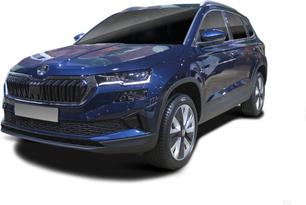
Skoda's distinctively broad, vertically slatted grille stands the brand apart, and even after six years in market the Karoq looks crisp and contemporary with chiselled character lines and jagged head and tail-lights blending successfully with more gently curved surfaces along the car's flanks and turret.
It might be a subconscious side-effect of knowing Skoda is part of the VW Group, but I can't help seeing hints of Tiguan here and there, particularly around the side windows and rear end.
But cool touches like aero-influenced inserts in the 18-inch alloy rims reinforce the Karoq's individual look.
Move to the inside and while the 8.0-inch central media touchscreen and 8.0-inch digital instrument display are on the pace the overall design shows the car's age.
Quality trim materials lift the tone, the cloth seats with contrast stitching look (and feel) great, but the understated dash design in particular is 'traditional', the vibe accentuated by liberal use of piano black highlight elements.
That said, the mix of on-screen functions and physical controls works well ergonomically and the leather-trimmed, partially-perforated, flat-bottom steering wheel is hard to fault.
The Hyundai Palisade leans heavily into a more American look. It’s unapologetically big and boxy, with a squared-off silhouette that makes no attempt to hide its size. Up front, there’s a bold grille flanked by oversized vertical LED light signatures, while the rear mirrors that same stacked lighting design. The bonnet is long, the proportions are broad and everything about it is geared towards presence.
The dark-tinted windows, clean body panels and metallic accents gives it a polished edge. It’s the kind of SUV that feels as much at home at a client lunch as it does in the school pick-up line.
Inside, the cabin is genuinely spacious and even without a sunroof, it doesn’t feel closed in. The dashboard has a softly curved, vertical layout that keeps things feeling open rather than bulky.
Thankfully, Hyundai hasn’t gone all in on touch controls and there are still plenty of physical buttons to fiddle with. You’ve got dual 12.3-inch displays and a 14-speaker Bose sound system doing the heavy-lifting with the 'visual' tech side of things.
Thickly padded touchpoints and premium materials round out a cabin that's simply a pleasant space to spend time in.
In terms of dimensions, at just under 4.4m long, a bit more than 1.8m wide and a fraction over 1.6m tall the Karoq is a relatively small medium SUV.
Yet, its 2638mm wheelbase means there's enough space between the axles for generous accommodation front and rear with enough room left over for a decent boot.
There's ample room for me, at 183cm, in the front with plenty of breathing space between driver and co-pilot. Not to mention heaps of storage including big door bins with room for large bottles, an open area in the centre console under an extending and height-adjustable centre armrest, various coin and oddments slots, a good size glove box, a broad lidded dash-top compartment and a drop down box near the driver's right knee.
Move to the rear, and sitting behind the driver's seat set to my position, I've got good head, leg and shoulder room. Best for two adults, although three would be possible for (cozy) short trips.
Three up to teenage kids will be fine back there, but if your kids are in a capsule, child seat or booster you'll be good with two but three will be a bridge too far.
Again there are door bins with enough room for oversize bottles, three cupholders in the fold-down centre armrest (one is 'venti'-sized) as well an oddments tray at the back of the front centre console and map pockets on the front seat backs. Adjustable ventilation is another plus.
With all seats up the Karoq offers a healthy 588 litres (VDA) of storage space, expanding to 1810L with the 60/40 split rear seat folded. A rear seat 'ski-port' style door also increases flexibility.
There are numerous bag and tie-down hooks as well as thoughtful storage spaces around the boot space. A full-size (speed limited) spare sits under the floor and while the tailgate misses out on power assistance, there's a typically useful dangling grab handle to help with closing.
For those keen on towing the FWD Karoq is rated up to a 1.5-tonne braked trailer (750kg unbraked).
Practicality is one of the Hyundai Palisade’s strongest points, and it starts up front. The first row is properly cavernous and, unless you’re the Hulk, you won’t be knocking elbows with your passenger. The seats themselves are wide, deep and well cushioned, making them an easy place to spend a few hours on the road.
The second row continues that theme of space. It’s wide enough to comfortably fit three adults. I tested that with three friends over a weekend trip and no one complained. That said, the bench-style seat does mean less defined support. My nine-year-old pointed out he tends to slide around a bit and that the cushioning is on the firmer side.
Unsurprisingly, the third row is usable but with some compromise. You can fit three small kids or two adults, though legroom is tight unless you slide the second row forward.
Access to both rear rows is easy thanks to the wide door openings and relatively low step-in height, which makes a difference when you’re loading kids in and out.
Amenities across all three rows are well thought out. Up front, you’ve got a good mix of storage options like a large glovebox and centre console, two cupholders, two drink bottle holders, and a handy open shelf that’s ideal for a handbag or Saturday night's takeaway. Charging is taken care of by three USB-C ports, a 12-volt socket and a wireless charging pad.
The second row gets four cupholders, a couple of bottle holders and map pockets, as well as a small drawer that's a good size for snacks or smaller devices. In the second row there’s also climate control, ceiling-mounted air vents and two USB-C ports.
Even the third row doesn’t feel like an afterthought. There are two USB-C ports, four cupholders, directional air vents, plus two ISOFIX points and two top-tether anchors for families juggling car seats.
Tech is easy to live with. The media system is intuitive, the touchscreen is responsive and you get wireless Apple CarPlay and Android Auto alongside built-in navigation. Hyundai’s Bluelink app also allows for remote functions like pre-conditioning the cabin or checking the car’s location, which comes in handy more often than you’d think.
Boot space is another win. With the third row folded, you’ve got up to 712L to work with, and the flat loading area makes it easy to slide in prams, sports gear or a full grocery run. There’s also a bit of underfloor storage for smaller items, along with a full-size spare and a powered tailgate in this grade.
To tempt people away from the Toyota RAV4 juggernaut you need a distinctive brand personality, which the Karoq has in spades, as well as a standard features list long enough to entice but not so lengthy that it sends the asking price over the top.
And this new Karoq entry-grade model is set at $39,990, drive-away, which is a shot across the bow of the base RAV4 GX 2WD sitting at $39,760, before on-road costs.
It's also in the same ballpark as the X-Trail ST five-seat 2WD ($37,250 before on-roads) and Outlander ES five-seat 2WD ($37,740 BOC).
So, the balancing act between price and equipment lands with standard feature highlights including dual-zone climate control, adaptive cruise control, 18-inch alloy rims, auto LED headlights, an 8.0-inch multimedia touchscreen, wireless Android Auto and Apple CarPlay, a reversing camera, built-in nav and eight-speaker audio.
That's pretty handy, although it's worth noting while the start is keyless, entry to the car isn't, and while the Karoq Style and SportLine boast an auto tailgate, this grade misses out.
Clearly, there's been careful fine-tuning of the value equation but the car maintains a premium look and feel that stacks up well in the segment.
The Hyundai Palisade range is fairly straightforward, offered in two trim levels. We’re looking at the recently added mid-spec Elite here, which sticks with an eight-seat layout and is priced from $76,500 before on-road costs. Step up to the flagship Calligraphy and you can choose between seven or eight seats, depending on how often you’re playing chauffeur.
Price-wise, the Palisade Elite hybrid does sit above its perceivd rivals. The Toyota Kluger GXL Hybrid starts from $71,930 MSRP, while the smaller Kia Sorento Sport+ Hybrid undercuts it more noticeably again at $67,180 MSRP. So yes, you are paying a premium here, but the Hyundai is quite a bit bigger than those two models.
That said, the features list does a decent job of justifying it. You get leather-appointed upholstery, power-adjustable front seats with heating, a heated steering wheel and power-folding outboard seats in the second row, all things that make day-to-day family life a bit easier.
Tech is another strong point. There’s a 14-speaker Bose sound system, dual 12.3-inch displays, built-in navigation, over-the-air updates and three-zone climate control. Charging is well covered too, with six 100W USB-C ports, an additional data port, two 12-volt sockets and a wireless charging pad.
There are a few newer touches worth mentioning. A fingerprint authenticator can store up to two users, which is handy if the car gets shared, and this generation also introduces two digital keys. You also get access to Hyundai’s Bluelink app, which allows for remote functions like pre-conditioning the cabin, locking or unlocking the car and checking its location.
On the practicality front, there’s a full-size spare alloy wheel, a 360-degree camera system and a powered tailgate. Families will also love the four ISOFIX child seat mounts and five top-tether anchor points.
The Karoq is powered by a 1.4-litre, all-alloy, direct-injected, turbo-petrol four-cylinder engine sending 110kW (at 6000rpm) and 250Nm (from 1500-3500rpm) to the front wheels via an eight-speed automatic transmission.
Under the bonnet, the Hyundai Palisade has made the full switch to hybrid, with the same powertrain offered across both trim levels. It pairs a 2.5-litre four-cylinder turbo-petrol engine with an electric motor, sending power to all four wheels.
Combined outputs sit at 245kW and 460Nm, which is a noticeable step up from the outgoing V6 petrol and 2.2-litre diesel it replaces.
On the road, the six-speed automatic does a smooth job of working through the gears, and the hybrid system keeps things impressively quiet at lower speeds. You’ll still notice the transition when the petrol engine cuts in, but it’s not especially intrusive.
It also retains a braked towing capacity of 2000kg, which should be enough for smaller weekend toys.
Skoda's official combined cycle fuel economy number for the Karoq is 6.5L/100km, the 1.4-litre turbo-petrol engine emitting 147g/km of CO2 in the process.
On the launch drive program for this new entry-level model, covering city, B-road and freeway running along the coast south of Sydney, NSW, we recorded an average of 7.6L/100km.
That's useful for a conventional combustion engine without the benefit of electric hybrid assistance. Worth noting, however, minimum fuel requirement is the pricier 95 RON premium unleaded.
You'll need 50 litres of it to fill the tank which equates to a theoretical driving range of 770km using the official figure or around 660km using our on-test result.
The new hybrid Hyundai Palisade has an official combined fuel cycle figure of just 6.8L/100km and a 72L fuel tank, giving this a theoretical driving range of just over 1000km, which is excellent for a big family mover. My real-world use, after doing a solid mix of open road and urban driving this week, is 7.7L/100km which is a decent result, especially given I’m not shy about utilising power!
Despite riding on sizeable 18-inch alloys (shod with 215/50 Goodyear Eagle F1 rubber), first impressions behind the Karoq's wheel are dominated by how composed and refined it is.
Even on coarse, irregular B-roads the car remains supple yet balanced and well buttoned down in the corners. The steering is nicely weighted and road feel is good.
Skoda says the Karoq will accelerate from 0-100km/h in 9.2 seconds, which isn't ferociously fast but the 1.4-litre turbo four delivers its peak pulling power from 1500-3500rpm, which means you're never short of mid-range urge.
The smooth eight-speed auto also helps keep things on the boil although power delivery isn't always linear. Squeeze the throttle and the engine can take half a beat before responding in something of a rush.
Shift from 'Normal' to 'Sport' mode and the transmission will respond more urgently, holding on to ratios longer and changing down more readily. And if you want full control, move the lever over into the 'Tiptronic' manual position for satisfyingly rapid changes on-demand.
The engine remains quiet, only making its presence felt at higher revs, the supportive front seats remain comfortable over lengthy stints and the brakes (vented discs front, solid rotors rear) deliver firm, progressive stopping power even under the pressure of an enthusiastic twisty backroad run.
Under the heading of miscellaneous observations, the multimedia system is easy to navigate and quick to respond, the extending, height-adjustable front centre armrest is brilliant and the adaptive cruise system responds to changes quickly yet calmly.
On the move, the Hyundai Palisade hybrid system feels like a worthwhile addition. Power delivery is smooth and there’s enough on tap to keep up with traffic without any stress. You’ll occasionally notice the transition between electric and petrol power, particularly when accelerating harder from a standstill, but it’s otherwise fairly well resolved.
Where the Palisade really shines is in comfort. It’s an easy cruiser, whether you’re on the highway or just doing the school run. The suspension strikes a nice balance as it’s well-cushioned without feeling overly soft, and there’s enough road feedback to stop it from feeling floaty. For something this size, body roll is also kept in check, so it doesn’t feel out of its depth on a winding road.
Around town, it’s just as easy to live with. The steering has a reassuring weight to it and feels responsive enough, while visibility from the driver’s seat is excellent. You sit high, with a clear view out the front and sides.
The only real quirk is that the regenerative braking can feel a little firm at lower speeds, particularly in stop-start traffic, and it takes a bit of adjustment to smooth things out. But it’s not a deal breaker.
Cabin noise is kept impressively low, even at highway speeds, making it easy to hold a conversation across all three rows, something my passengers appreciated on a recent weekend trip.
Despite its size, it’s not as intimidating to manoeuvre as it looks. The turning circle is a relatively tight 11.94 metres, and the 360-degree camera system does a lot of the heavy lifting when parking. You’re still aware of its footprint in tighter spaces, but it’s far from cumbersome.
The Skoda Karoq's previous five-out-of-five ANCAP star rating has timed out, given the assessment was from 2017, so it's now unrated.
But that doesn't mean it's underdone in terms of active crash-avoidance tech, this base version featuring AEB (operational from 4.0-250km/h) with pedestrian and cyclist detection, adaptive cruise control, 'Lane Assist', 'Side Assist' (with rear cross-traffic alert), Parking Distance Control (front and rear), a reversing camera, rear AEB as well as tyre-pressure and fatigue monitoring.
If a crash is unavoidable, there are seven airbags on-board - dual front, front side, full-length side curtain and a driver's knee bag.
Multi-collision brake minimises the chances of subsequent collisions following an initial impact and there are three top tethers and two ISOFIX anchors for baby capsules and/or child seats across the second row.
The Hyundai Palisade holds a five-star ANCAP safety rating from testing conducted in 2025, and comes equipped with eight airbags, including curtain airbags that extend across all three rows.
The safety suite is comprehensive, covering most of the expected bases. You get blind spot monitoring, lane keeping assist, lane departure warning, forward collision warning, a 360-degree camera system, front and rear parking sensors, rear cross-traffic alert and side exit assist.
There are a couple of omissions worth noting. It misses out on emergency call functionality, and there are no seatbelt reminders for the two middle seats in the second and third rows.
The adaptive cruise control isn’t well-calibrated as it slows down firmly on hills, up to 10km below the set speed limit, which is better than going over the limit but still makes the system feel a bit clunky in real-world use.
Autonomous emergency braking with pedestrian, cyclist and motorcyclist detection is operational from 5.0-85km/h, and up to 130km/h for vehicle detection.
For families, there’s solid flexibility with four ISOFIX child seat mounts and five top-tether anchor points, making it well set up for multiple child seats across the rear rows.
Skoda is ahead of the mainstream pack, offering a seven-year, unlimited kilometre warranty, which is two years up on the majority of the Karoq's competitors.
Roadside Assist is complimentary for the first year, renewed annually if you have your Karoq serviced at an authorised Skoda dealer.
The main service interval is 12 months/15,000km, which is in line with most of the competition, and Skoda offers a seven-year service pack for $2750, or $393 per workshop visit, which is competitive with much of the segment but some way off the Toyota RAV4 non-hybrid at $215 per service on a capped-price deal.
On top of that, through Skoda Choice you can opt for a Guaranteed Future Value offer ranging up to five years, with variable deposit and finance currently at a 6.99 per cent rate.
At the end of the term you can trade-in for a new Skoda, pay out the balloon amount and keep the car or simply hand it back.
Ownership for the Hyundai Palisade is fairly straightforward and competitive for the segment. It’s backed by Hyundai’s five-year, unlimited-kilometre warranty, which can be extended by a further two years if you service exclusively through the brand.
Servicing costs are also reasonable for a large SUV. You can pre-purchase a three-, four- or five-year plan, with the latter coming in at $2630, which stacks up well against similar rivals.
Intervals are set at every 12 months or 10,000km, and with more than 100 service centres across the country, access shouldn’t be an issue for most owners.