What's the difference?
Typically appealing to those seeking quality engineering and tech without feeling the need to make a boastful badge statement, Skoda is a low-key, ultra-confident brand.
On sale here since 2018, the Skoda Karoq is a comparatively small fish in one of the most hotly contested segments in the Australian new-car market, namely medium SUVs, the leading trio consisting of the Toyota RAV4, Nissan X-Trail and Mitsubishi Outlander.
To increase its appeal against these and other high-profile contenders Skoda Australia has introduced a new entry-level Karoq designed to hit the Goldilocks zone between attractive standard specification and sharp pricing. CarsGuide was invited to its local launch.
The Audi Q5 now has a sportier-looking sibling, with the German brand's all-time best-selling SUV welcoming a sleeker, more aggressive solution it calls its Sportback range.
And look, spoiler alert, it looks better than the regular Q5. It's as simple as that. So if that's all you're here to find out, feel free to close the laptop, put the phone away, and move on with your day.
But you'd be doing yourself a disservice, because there are more questions to be answered here. Like will you paying in on-board comfort for this new raked roofline? Do the Sportback's sporty intentions make for a more annoying daily drive? And how much does Audi want you to pay for one?
All these questions and more answered. So stay with me.
This new entry-level Karoq gives the already accomplished mid-size SUV an even sharper value-for-money edge. On top of that it's space efficient, hugely practical and economical. Safety's up to speed, the ownership package is solid and it's a quiet, refined drive. Before joining the RAV4 queue, we'd suggest giving this Skoda some serious thought.
Note: CarsGuide attended this event as a guest of the manufacturer, with accommodation and meals provided.
Let’s forget the money, for a second, because yes, you’re paying more for the Sportback variant. But if you can afford it, then why wouldn’t you. This is a sleeker, sportier and more stylish answer to the regular Q5, which was already a super-solid offering in the segment. And as far as I can tell, the practicality sacrifices you have to make are minimal at best.
So why not?
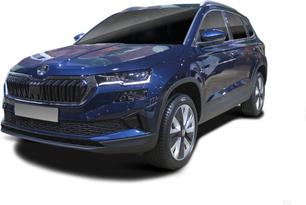
Skoda's distinctively broad, vertically slatted grille stands the brand apart, and even after six years in market the Karoq looks crisp and contemporary with chiselled character lines and jagged head and tail-lights blending successfully with more gently curved surfaces along the car's flanks and turret.
It might be a subconscious side-effect of knowing Skoda is part of the VW Group, but I can't help seeing hints of Tiguan here and there, particularly around the side windows and rear end.
But cool touches like aero-influenced inserts in the 18-inch alloy rims reinforce the Karoq's individual look.
Move to the inside and while the 8.0-inch central media touchscreen and 8.0-inch digital instrument display are on the pace the overall design shows the car's age.
Quality trim materials lift the tone, the cloth seats with contrast stitching look (and feel) great, but the understated dash design in particular is 'traditional', the vibe accentuated by liberal use of piano black highlight elements.
That said, the mix of on-screen functions and physical controls works well ergonomically and the leather-trimmed, partially-perforated, flat-bottom steering wheel is hard to fault.
Our adventure began with the SQ5, and, to my eye at least, it looks mean, and more like a jacked-up hot hatch than sportier version of a mid-size SUV.
Speaking of which, it looks bigger than a mid-size, too, as though the flattened roof has pushed the rear out for more length, at least visually.
By far its best angle, though, will be afforded to the people in front of you on the road, with each peek in the rear-view mirror revealing a wide, forward-leaning grille, all black honeycomb mesh, with a cat-clawed bonnet and headlights that sweep back into the bodywork, hinting at speed before it even sets off.
Side on, the massive 21-inch alloys hide red brake calipers, but it does also reveals a tale of two SUVs, with the front half looking taller and straighter, while the rear roofline is more raked as it flies towards a fairly small rear windscreen with a roof spoiler that juts out over it.
At the rear, the quad exhaust tips (which sound great), and a boot spoiler moulded into the bodywork complete the package.
But even in lesser lesser Q5 45 TFSI guise, this Sportback looks the business, I reckon. Though a little more premium than performance-focused, perhaps.
As the name suggests, the Sportback version gives you, well, a sportier back, and it all starts at the B-Pillar, with a more raked roofline that gives this version of the Q5 a sleeker, more slippery look.
But they aren’t the only changes. In Sportback models, the single-frame grille upfront is different, and the grille is also positioned lower, and seems to jut out from the bonnet more, for a lower, more aggressive look. The lights are also positioned a little higher, and those massive air vents on either side are different, too.
The cabin is the usual level of Audi niceness, with a big central screen, big digital screen in front of the steering wheel, and a sense of genuine solidity and quality wherever you look.
There are some questionable materials at work, though, like the door trims and the hard plastic that your knee rubs against when driving, but all in all, it's quite a lovely place to spend time.
In terms of dimensions, at just under 4.4m long, a bit more than 1.8m wide and a fraction over 1.6m tall the Karoq is a relatively small medium SUV.
Yet, its 2638mm wheelbase means there's enough space between the axles for generous accommodation front and rear with enough room left over for a decent boot.
There's ample room for me, at 183cm, in the front with plenty of breathing space between driver and co-pilot. Not to mention heaps of storage including big door bins with room for large bottles, an open area in the centre console under an extending and height-adjustable centre armrest, various coin and oddments slots, a good size glove box, a broad lidded dash-top compartment and a drop down box near the driver's right knee.
Move to the rear, and sitting behind the driver's seat set to my position, I've got good head, leg and shoulder room. Best for two adults, although three would be possible for (cozy) short trips.
Three up to teenage kids will be fine back there, but if your kids are in a capsule, child seat or booster you'll be good with two but three will be a bridge too far.
Again there are door bins with enough room for oversize bottles, three cupholders in the fold-down centre armrest (one is 'venti'-sized) as well an oddments tray at the back of the front centre console and map pockets on the front seat backs. Adjustable ventilation is another plus.
With all seats up the Karoq offers a healthy 588 litres (VDA) of storage space, expanding to 1810L with the 60/40 split rear seat folded. A rear seat 'ski-port' style door also increases flexibility.
There are numerous bag and tie-down hooks as well as thoughtful storage spaces around the boot space. A full-size (speed limited) spare sits under the floor and while the tailgate misses out on power assistance, there's a typically useful dangling grab handle to help with closing.
For those keen on towing the FWD Karoq is rated up to a 1.5-tonne braked trailer (750kg unbraked).
The Q5 Sportback range stretches 4689mm in length, 1893mm in width, and around 1660mm in height, depending on the variant. It rides on a 2824mm wheelbase.
And remember when I said there were few practicality penalties for the new sportier look? This is what I meant.
Up front, it's basically the same Q5, so if you know that car, you'll know this one, with its spacious and airy feeling front seats.
In the back, though, things are a little different, just not quite as different as I was expecting. The new sloping roofline has actually only reduced headroom by 16mm. I’m 175cm tall, and there was clear air between my head and the roof, and plenty of leg-room, too.
The central tunnel arrangement means you probably don’t want to squeeze three adults across the back, but two would really be no problem at all. That way, you can deploy the back seat divider to uncover two cupholders, use the two USB charge ports or adjust your climate controls, including temperature settings.
In the 45 TFSI and SQ5 models, the rear seats also slide or recline, meaning you can prioritise luggage space or passenger comfort, depending on what you're carrying.
Up front, there’s heaps of little cubby spots, including a key storage spot under the aircon controls, another in front of the gear shift, a phone slot next to the gear shift, two cupholders in the big centre console, and a surprisingly shallow centre console that’s home to a wireless phone charger and a USB port, joining the regular USB port under the drive mode selector.
And at the rear, Audi reckons there’s 500 litres of storage, only about 10 litres less than the regular Q5, which grows to 1470 litres with the second-row folded.
To tempt people away from the Toyota RAV4 juggernaut you need a distinctive brand personality, which the Karoq has in spades, as well as a standard features list long enough to entice but not so lengthy that it sends the asking price over the top.
And this new Karoq entry-grade model is set at $39,990, drive-away, which is a shot across the bow of the base RAV4 GX 2WD sitting at $39,760, before on-road costs.
It's also in the same ballpark as the X-Trail ST five-seat 2WD ($37,250 before on-roads) and Outlander ES five-seat 2WD ($37,740 BOC).
So, the balancing act between price and equipment lands with standard feature highlights including dual-zone climate control, adaptive cruise control, 18-inch alloy rims, auto LED headlights, an 8.0-inch multimedia touchscreen, wireless Android Auto and Apple CarPlay, a reversing camera, built-in nav and eight-speaker audio.
That's pretty handy, although it's worth noting while the start is keyless, entry to the car isn't, and while the Karoq Style and SportLine boast an auto tailgate, this grade misses out.
Clearly, there's been careful fine-tuning of the value equation but the car maintains a premium look and feel that stacks up well in the segment.
The three-model line-up (two regular Q5s and the SQ5) Sportback range kicks off with the Q5 40 Sportback TDI quattro, which will set you back $77,700 (which is plenty more than the $69,900 of the regular Q5).
The entry-level Q5 Sportback gets 20-inch alloys, a standard S Line sporty exterior styling treatment, LED headlights and tail lights, and an electric tailgate with gesture control. Inside, there’s leather trim, electric sport seats, three-zone climate, paddle-shifters for the steering wheel and ambient interior lighting.
You also get the virtual cockpit, the 10.1-inch central screen with all the Connect Plus services, like live traffic, weather and restaurant tips, as well Android Auto and wireless Apple CarPlay.
The range then steps up to the Q5 45 Sportback TFSI quattro, yours for $86,300. That's another marked jump from its regular Q5 equivalent.
That model delivers a new 20-inch alloy wheel design, a panoramic sunroof, and Matrix LED headlights, The S Line treatment extends to the interior, along with Nappa leather trim, heated front seats and a sliding or reclining rear bench. You get a better sound system, too, with 10 speakers, including a sub-woofer.
Finally, the SQ5 Sportback is yours for $110,900 (up from $106,500), and delivers 21-inch alloys, adaptive dampers and red brake callipers, while inside you get electric steering adjustments, a head-up display, colour ambient lighting and a banging Bang and Olufsen stereo with 19 speakers.
The Karoq is powered by a 1.4-litre, all-alloy, direct-injected, turbo-petrol four-cylinder engine sending 110kW (at 6000rpm) and 250Nm (from 1500-3500rpm) to the front wheels via an eight-speed automatic transmission.
There are three engines total here, kicking off with the 2.0-litre TDI in the Q5 Sportback 40. It produces 150kW and 400Nm - enough for a sprint to 100km/h in 7.6s. The 2.0-litre TFSI in the Q5 Sportback 45 petrol bumps those figures to 183kW and 370Nm, lowering your spring to 6.3s.
Both pair with a seven-speed S tiptronic automatic, and feature a 12-volt mild-hybrid system to smooth out acceleration and lower fuel use, as well Quattro ultra, which can disconnect the rear drive shaft so only the front wheels are driven.
The SQ5 gets a seriously lusty 3.0-litre TDI V6 which deliver 251kW and 700Nm, and a sprint of 5.1s It also gets a 48-volt mild-hybrid system, and an eight-speed tiptronic transmission.
Skoda's official combined cycle fuel economy number for the Karoq is 6.5L/100km, the 1.4-litre turbo-petrol engine emitting 147g/km of CO2 in the process.
On the launch drive program for this new entry-level model, covering city, B-road and freeway running along the coast south of Sydney, NSW, we recorded an average of 7.6L/100km.
That's useful for a conventional combustion engine without the benefit of electric hybrid assistance. Worth noting, however, minimum fuel requirement is the pricier 95 RON premium unleaded.
You'll need 50 litres of it to fill the tank which equates to a theoretical driving range of 770km using the official figure or around 660km using our on-test result.
All Q5 Sportback models are fitted with a 70-litre fuel tank, which should produce a driving range in excess of 1000kms - though prepare for pain at the pump. Sometimes premium fuel in Sydney can run to around $1,90 a litre, for example, so the good stuff will cost you around $130 bucks a tank in the petrol cars.
Audi says the Q5 Sportback 40 TDI will sip 5.4 litres per 100km on the combined cycle, while emitting 142g/km of c02. The 45 TFSI needs 8.0 litres per 100km on the combined cycle, and will emit 183g/km of c02. The SQ5 sits somewhere in the middle, with 7.1 litres per 100km and 186g/km of c02.
Despite riding on sizeable 18-inch alloys (shod with 215/50 Goodyear Eagle F1 rubber), first impressions behind the Karoq's wheel are dominated by how composed and refined it is.
Even on coarse, irregular B-roads the car remains supple yet balanced and well buttoned down in the corners. The steering is nicely weighted and road feel is good.
Skoda says the Karoq will accelerate from 0-100km/h in 9.2 seconds, which isn't ferociously fast but the 1.4-litre turbo four delivers its peak pulling power from 1500-3500rpm, which means you're never short of mid-range urge.
The smooth eight-speed auto also helps keep things on the boil although power delivery isn't always linear. Squeeze the throttle and the engine can take half a beat before responding in something of a rush.
Shift from 'Normal' to 'Sport' mode and the transmission will respond more urgently, holding on to ratios longer and changing down more readily. And if you want full control, move the lever over into the 'Tiptronic' manual position for satisfyingly rapid changes on-demand.
The engine remains quiet, only making its presence felt at higher revs, the supportive front seats remain comfortable over lengthy stints and the brakes (vented discs front, solid rotors rear) deliver firm, progressive stopping power even under the pressure of an enthusiastic twisty backroad run.
Under the heading of miscellaneous observations, the multimedia system is easy to navigate and quick to respond, the extending, height-adjustable front centre armrest is brilliant and the adaptive cruise system responds to changes quickly yet calmly.
How to best describe the drive experience in the Q5 Sportback? That's easy. And it's 'easy'.
Honestly, I know this is ostensibly the sportier version of the Q5, but the truth is that, in the 45 TFSI version we tested, it's a comfortable, light-feeling drive experience that only ever reveals its sporty nature when you really command it to.
Left in its Auto drive mode, the Q5 45 TFSI will positively waft around town, road noise kept to an absolute minimum, and feeling somehow smaller and lighter than its dimension would suggest.
You can dial-up the aggression by cycling through the drive modes, of course, but even in Dynamic guise it never feels too harsh, too aggressive. More that you've simply tightened the screws a little bit.
Plant your right foot and the 45 TFSI will collect speed in a way that Audi refers to as "hot hatch-like", punching towards the 100km/h sprint with verve and aggression. But having just stepped out of the SQ5, it still feels somehow sedate, and almost relaxing, rather than out-and-out aggressive.
And that's because the SQ5 variant is clearly, purposefully, the performance-focused variant here. I think this V6 engine is an absolute peach, and its the kind of powerplant that inspires you to stick with the vehicle's most dynamic settings, putting up with the just-too-firm suspension settings so you can access more fo the grunt more quickly.
And it feels constantly ready for action. Tap the accelerator and the car bristles, dropping down a gear, revving higher and preparing for your next command.
Through bends, it feels smaller and lighter than you might expect, with plenty of grip and steering that, while not overflowing with feedback, feels true and direct.
Short answer? It's the one I'd take. But you'll pay for it.
The Skoda Karoq's previous five-out-of-five ANCAP star rating has timed out, given the assessment was from 2017, so it's now unrated.
But that doesn't mean it's underdone in terms of active crash-avoidance tech, this base version featuring AEB (operational from 4.0-250km/h) with pedestrian and cyclist detection, adaptive cruise control, 'Lane Assist', 'Side Assist' (with rear cross-traffic alert), Parking Distance Control (front and rear), a reversing camera, rear AEB as well as tyre-pressure and fatigue monitoring.
If a crash is unavoidable, there are seven airbags on-board - dual front, front side, full-length side curtain and a driver's knee bag.
Multi-collision brake minimises the chances of subsequent collisions following an initial impact and there are three top tethers and two ISOFIX anchors for baby capsules and/or child seats across the second row.
The Audi Q5 Sportback carries a five-star ANCAP safety rating thanks to the regular Q5, but that’s really the minimum cost of entry these days. So what else do you get?
Advanced driver-assist systems on offer here include autonomous emergency braking (with pedestrian detection), active lane-keep assist with lane change warning, driver attention assist, blind-spot monitoring, rear cross-traffic alert, park assist, a great surround-view camera, parking sensors, exit warning and tyre pressure monitoring, and more radars than you can poke a stick at.
There's also twin ISOFIX anchor points, and top-tether points for child seats.
Skoda is ahead of the mainstream pack, offering a seven-year, unlimited kilometre warranty, which is two years up on the majority of the Karoq's competitors.
Roadside Assist is complimentary for the first year, renewed annually if you have your Karoq serviced at an authorised Skoda dealer.
The main service interval is 12 months/15,000km, which is in line with most of the competition, and Skoda offers a seven-year service pack for $2750, or $393 per workshop visit, which is competitive with much of the segment but some way off the Toyota RAV4 non-hybrid at $215 per service on a capped-price deal.
On top of that, through Skoda Choice you can opt for a Guaranteed Future Value offer ranging up to five years, with variable deposit and finance currently at a 6.99 per cent rate.
At the end of the term you can trade-in for a new Skoda, pay out the balloon amount and keep the car or simply hand it back.
All Audis are covered by a three-year, unlimited-kilometre warranty, which really isn’t great in a world of five-, seven- and even 10-year warranties.
The brand will let you prepay your services, required annually, for the first five years, with the regular Q5 Sportback billed at $3140 and the SQ5 billed at $3170.