What's the difference?
Typically appealing to those seeking quality engineering and tech without feeling the need to make a boastful badge statement, Skoda is a low-key, ultra-confident brand.
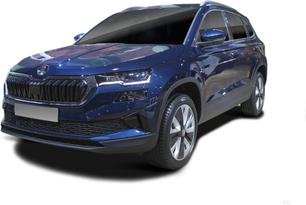
On sale here since 2018, the Skoda Karoq is a comparatively small fish in one of the most hotly contested segments in the Australian new-car market, namely medium SUVs, the leading trio consisting of the Toyota RAV4, Nissan X-Trail and Mitsubishi Outlander.
To increase its appeal against these and other high-profile contenders Skoda Australia has introduced a new entry-level Karoq designed to hit the Goldilocks zone between attractive standard specification and sharp pricing. CarsGuide was invited to its local launch.
In the eight years it’s been in our market, the Skoda Kodiaq large SUV has only seen modest updates, but the second-generation seven-seater marks a firm step forward.
You still get all of the clever practicality that Skoda is known for, but it now features a (slightly) sharper design, a raft of new features, improved technology and more room inside.
This week, my family of three has been living with the base 140TSI Select variant to find out whether this understated contender deserves more attention and if its rivals should start to worry.
This new entry-level Karoq gives the already accomplished mid-size SUV an even sharper value-for-money edge. On top of that it's space efficient, hugely practical and economical. Safety's up to speed, the ownership package is solid and it's a quiet, refined drive. Before joining the RAV4 queue, we'd suggest giving this Skoda some serious thought.
Note: CarsGuide attended this event as a guest of the manufacturer, with accommodation and meals provided.
The new Skoda Kodiaq Select 140TSI is a quiet achiever. It may not be as flashy as some of its rivals, and the engine won’t knock your socks off, but it delivers where it counts. This is a well-rounded seven-seater that’s comfortable, practical and cleverly equipped with more standard features than you’d typically expect from a base grade. If you’re after a family SUV that flies under the radar but ticks all the right boxes, the Kodiaq deserves a close look.
Skoda's distinctively broad, vertically slatted grille stands the brand apart, and even after six years in market the Karoq looks crisp and contemporary with chiselled character lines and jagged head and tail-lights blending successfully with more gently curved surfaces along the car's flanks and turret.
It might be a subconscious side-effect of knowing Skoda is part of the VW Group, but I can't help seeing hints of Tiguan here and there, particularly around the side windows and rear end.
But cool touches like aero-influenced inserts in the 18-inch alloy rims reinforce the Karoq's individual look.
Move to the inside and while the 8.0-inch central media touchscreen and 8.0-inch digital instrument display are on the pace the overall design shows the car's age.
Quality trim materials lift the tone, the cloth seats with contrast stitching look (and feel) great, but the understated dash design in particular is 'traditional', the vibe accentuated by liberal use of piano black highlight elements.
That said, the mix of on-screen functions and physical controls works well ergonomically and the leather-trimmed, partially-perforated, flat-bottom steering wheel is hard to fault.
From the outside, the new Kodiaq looks more athletic than bulky, with a long and low stance that gives it a sleeker profile than many of its taller, boxier rivals.
The new restyled grille, 19-inch alloy wheels, and distinctive C-shaped LED tail lights give it an understated but handsome roadside presence. This is an SUV that favours quiet confidence with a European flair.
Step inside, and the cabin continues that design language with a stylish, angular dashboard and a well-considered layout that’s both practical and premium in feel. The black leather upholstery, crisp technology displays are complemented by Skoda’s clever new multi-function rotary dials.
Even in the base Select grade, the interior punches above its price point.
In terms of dimensions, at just under 4.4m long, a bit more than 1.8m wide and a fraction over 1.6m tall the Karoq is a relatively small medium SUV.
Yet, its 2638mm wheelbase means there's enough space between the axles for generous accommodation front and rear with enough room left over for a decent boot.
There's ample room for me, at 183cm, in the front with plenty of breathing space between driver and co-pilot. Not to mention heaps of storage including big door bins with room for large bottles, an open area in the centre console under an extending and height-adjustable centre armrest, various coin and oddments slots, a good size glove box, a broad lidded dash-top compartment and a drop down box near the driver's right knee.
Move to the rear, and sitting behind the driver's seat set to my position, I've got good head, leg and shoulder room. Best for two adults, although three would be possible for (cozy) short trips.
Three up to teenage kids will be fine back there, but if your kids are in a capsule, child seat or booster you'll be good with two but three will be a bridge too far.
Again there are door bins with enough room for oversize bottles, three cupholders in the fold-down centre armrest (one is 'venti'-sized) as well an oddments tray at the back of the front centre console and map pockets on the front seat backs. Adjustable ventilation is another plus.
With all seats up the Karoq offers a healthy 588 litres (VDA) of storage space, expanding to 1810L with the 60/40 split rear seat folded. A rear seat 'ski-port' style door also increases flexibility.
There are numerous bag and tie-down hooks as well as thoughtful storage spaces around the boot space. A full-size (speed limited) spare sits under the floor and while the tailgate misses out on power assistance, there's a typically useful dangling grab handle to help with closing.
For those keen on towing the FWD Karoq is rated up to a 1.5-tonne braked trailer (750kg unbraked).
The Kodiaq does a solid job of blending family friendly space with clever design. Up front, there’s plenty of room to stretch out, and the wide door apertures combined with a 187mm ground clearance make getting in and out a breeze.
The front seats are genuinely comfortable, with thick padding, supportive side bolsters, extendable under-thigh supports and heating for both front occupants, which is a nice inclusion at this price point. The driver’s seat is also electrically adjustable with memory, which adds a layer of convenience.
Skoda has a reputation for smart storage and the new Kodiaq continues that trend. There’s a sunglasses holder, an umbrella nook inside the drivers door, removable rubbish bins in each front door pocket and a handy dual glove box set-up. The centre console offers a mix of deep storage, two cupholders and lots of charging options, including two USB-C ports and dual wireless charging pads, plus a third USB-C near the rearview mirror.
That said, the tech experience hasn’t been completely seamless. The 13.0-inch multimedia display looks sharp, but the touchscreen can be laggy at times. The three multi-function dials, while clever in theory, aren’t always intuitive in practice. Changing functions on the go can be fiddly, and I found the climate control system occasionally unresponsive — the ‘sync’ function worked inconsistently and for some reason, we couldn’t always unlock or adjust the rear climate control.
On the plus side, the system includes built-in sat nav, wireless Apple CarPlay and wireless Android Auto. CarPlay connected easily and stayed stable throughout the week.
In the second row, my eight-year-old had no trouble hopping in and out, and while the seats are on the firmer side, they’re still comfortable enough for long drives. Amenities are strong with two USB-C ports, a 12-volt socket, map pockets with device holders, and retractable sunblinds. There’s also a removable centre shelf between the seats that works as a clever storage solution, and the bench is wide enough to take advantage of all three top-tether anchor points.
And I have to call out one of my favourite Skoda features, the pop-out door edge protectors! This is the first time I’ve seen them in action and they’re brilliant. They automatically deploy as you open the door, helping prevent bumps and dings, which is a lifesaver for parents with energetic kids (like mine) who fling doors open with zero hesitation.
As with most three-row SUVs in this segment, the Kodiaq’s third row is best suited to kids. Adults can technically squeeze in but space is limited, with legroom and headroom both tight. It’s worth noting there are no directional air vents, USB charging ports or top-tether anchor points in the third row either, which might be a downside for some families.
Boot space, on the other hand, is a strong point. Even with all seven seats in use, there’s still a very usable 340L of cargo capacity which, is enough for a few school bags or a compact pram. There’s also an underfloor compartment for storing the cargo cover and space-saver spare tyre, which keeps things tidy. Fold the third row down and the capacity jumps to a generous 910L, giving you loads of room for family gear, groceries, or weekend luggage. The powered tailgate is another welcome convenience, especially when your hands are full.
To tempt people away from the Toyota RAV4 juggernaut you need a distinctive brand personality, which the Karoq has in spades, as well as a standard features list long enough to entice but not so lengthy that it sends the asking price over the top.
And this new Karoq entry-grade model is set at $39,990, drive-away, which is a shot across the bow of the base RAV4 GX 2WD sitting at $39,760, before on-road costs.
It's also in the same ballpark as the X-Trail ST five-seat 2WD ($37,250 before on-roads) and Outlander ES five-seat 2WD ($37,740 BOC).
So, the balancing act between price and equipment lands with standard feature highlights including dual-zone climate control, adaptive cruise control, 18-inch alloy rims, auto LED headlights, an 8.0-inch multimedia touchscreen, wireless Android Auto and Apple CarPlay, a reversing camera, built-in nav and eight-speaker audio.
That's pretty handy, although it's worth noting while the start is keyless, entry to the car isn't, and while the Karoq Style and SportLine boast an auto tailgate, this grade misses out.
Clearly, there's been careful fine-tuning of the value equation but the car maintains a premium look and feel that stacks up well in the segment.
Excluding the limited-edition ‘Launch’ variant, the new Kodiaq range consists of just two core grades and we’ve been family testing the entry-level 140TSI Select.
With a list price of $54,990 before on-road costs, the Select trim undercuts many of its key seven-seat rivals. The Hyundai Santa Fe kicks off at around $56,000, while the Kia Sorento Sport+ starts from $58,430, giving the Kodiaq a slight edge on paper when it comes to affordability.
Of course, it can’t compete with sharply priced Chinese contenders like the Chery Tiggo 8 Pro Max, which starts from just $40,990. But where the Skoda claws back ground is in its blend of space, smart storage solutions and the refined European design-flavour that the brand is known for. This makes it an appealing pick for families wanting practicality without compromising on quality.
Despite being the entry point into the Kodiaq range, the 140TSI Select comes impressively well-equipped and it doesn’t feel like a ‘base model’.
There’s black leather upholstery, a leather-accented steering wheel, heated front seats, a power-adjustable driver’s seat with memory functionality, and rear privacy glass. Three-zone climate control keeps everyone comfortable, and the powered tailgate adds convenience for a busy family life. Skoda even throws in carpet mats as standard, which is a small but appreciated touch.
On the technology front, the Select features a crisp 13.0-inch touchscreen multimedia display and a 10.0-inch digital instrument cluster. Satellite navigation is included, along with wireless Apple CarPlay and Android Auto, plus multiple device-charging options throughout the cabin. That includes two ventilated wireless charging pads up front, USB-C ports in each row, and a handy extra USB-C port near the rearview mirror, perfect for plugging in a dash cam without messy cables.
The cabin feels thoughtfully laid out, modern, and mostly user-friendly, particularly if you're hopping out of an older SUV. All up, it delivers a lot of bang for your buck, especially when compared with similarly priced, or even more expensive, competitors.
The Karoq is powered by a 1.4-litre, all-alloy, direct-injected, turbo-petrol four-cylinder engine sending 110kW (at 6000rpm) and 250Nm (from 1500-3500rpm) to the front wheels via an eight-speed automatic transmission.
The Select is all-wheel drive and powered by a 2.0-litre four-cylinder turbo-petrol engine, producing 140kW and 320Nm. On paper, that’s a solid output for a family SUV, but in practice the power delivery can feel a little underwhelming at times.
The seven-speed dual-clutch automatic transmission is quick to shift but isn’t always smooth. It tends to upshift early, especially when you’re accelerating, which can dull performance and make the engine feel less responsive than it should. It's not sluggish, but it doesn’t feel particularly eager either — especially when loaded up with passengers or gear.
Skoda's official combined cycle fuel economy number for the Karoq is 6.5L/100km, the 1.4-litre turbo-petrol engine emitting 147g/km of CO2 in the process.
On the launch drive program for this new entry-level model, covering city, B-road and freeway running along the coast south of Sydney, NSW, we recorded an average of 7.6L/100km.
That's useful for a conventional combustion engine without the benefit of electric hybrid assistance. Worth noting, however, minimum fuel requirement is the pricier 95 RON premium unleaded.
You'll need 50 litres of it to fill the tank which equates to a theoretical driving range of 770km using the official figure or around 660km using our on-test result.
The Kodiaq has an official combined fuel consumption figure of 9.2L/100km, and paired with a 58-litre fuel tank it has a theoretical driving range of about 630km. It's not as long-reaching as some seven-seat SUVs (especially diesel-powered rivals), but it's not terrible.
After my usual mix of urban errands and a couple of longer highway trips, my real-world fuel use averaged 8.7L/100km. Not too shabby.
Despite riding on sizeable 18-inch alloys (shod with 215/50 Goodyear Eagle F1 rubber), first impressions behind the Karoq's wheel are dominated by how composed and refined it is.
Even on coarse, irregular B-roads the car remains supple yet balanced and well buttoned down in the corners. The steering is nicely weighted and road feel is good.
Skoda says the Karoq will accelerate from 0-100km/h in 9.2 seconds, which isn't ferociously fast but the 1.4-litre turbo four delivers its peak pulling power from 1500-3500rpm, which means you're never short of mid-range urge.
The smooth eight-speed auto also helps keep things on the boil although power delivery isn't always linear. Squeeze the throttle and the engine can take half a beat before responding in something of a rush.
Shift from 'Normal' to 'Sport' mode and the transmission will respond more urgently, holding on to ratios longer and changing down more readily. And if you want full control, move the lever over into the 'Tiptronic' manual position for satisfyingly rapid changes on-demand.
The engine remains quiet, only making its presence felt at higher revs, the supportive front seats remain comfortable over lengthy stints and the brakes (vented discs front, solid rotors rear) deliver firm, progressive stopping power even under the pressure of an enthusiastic twisty backroad run.
Under the heading of miscellaneous observations, the multimedia system is easy to navigate and quick to respond, the extending, height-adjustable front centre armrest is brilliant and the adaptive cruise system responds to changes quickly yet calmly.
As I mentioned earlier, the powertrain is adequate but not impressive. The engine can over-rev at times, and it feels like there’s limited reserve when you really push it, though it’s far from gutless. It’s an odd one as you do have enough grunt to overtake safely on the open road, and it’s generally fine for a vehicle of this size, but it’s not particularly eager or lively.
The suspension strikes a good balance. It’s soft enough to smooth out bigger bumps and rough patches without feeling too floaty. At the same time, you still get decent feedback through the steering, and the Kodiaq corners reasonably well with minimal body roll.
Speaking of steering, it’s on the softer side and not as sharp as I’d prefer, but it’s responsive enough to make city driving and tight car park manoeuvres easy. Visibility is good all-around from the driver’s seat, which is good.
Noise levels are typical for a large SUV. Road and wind noise are noticeable, especially at higher speeds, but the cabin remains quiet enough to have a conversation in the middle row without raising your voice. If you’re sitting in the third row, though, you might have to ask people to repeat themselves from time to time. Still, it’s a comfortable space to spend time in.
The Select grade comes with a reversing camera, but the image quality isn’t great. The camera view seems skewed to the left, which caught me off guard occasionally. I found myself relying more on the mirrors and good old-fashioned looking around when parking.
The Skoda Karoq's previous five-out-of-five ANCAP star rating has timed out, given the assessment was from 2017, so it's now unrated.
But that doesn't mean it's underdone in terms of active crash-avoidance tech, this base version featuring AEB (operational from 4.0-250km/h) with pedestrian and cyclist detection, adaptive cruise control, 'Lane Assist', 'Side Assist' (with rear cross-traffic alert), Parking Distance Control (front and rear), a reversing camera, rear AEB as well as tyre-pressure and fatigue monitoring.
If a crash is unavoidable, there are seven airbags on-board - dual front, front side, full-length side curtain and a driver's knee bag.
Multi-collision brake minimises the chances of subsequent collisions following an initial impact and there are three top tethers and two ISOFIX anchors for baby capsules and/or child seats across the second row.
The Skoda Kodiaq is covered by a five-star ANCAP safety rating from testing done in 2024 and features nine airbags, which includes side chest airbags for the front and middle rows, but the curtain airbags don’t cover the third row, which is disappointing for a family SUV.
The Select grade showcases a healthy safety features list including emergency lane keeping aid, rear cross-traffic alert and side exit assist. Most of the safety items aren’t intrusive for daily driving but the lane-keeping aid can feel sporadic with when it activates and it adjusts the wheel firmly, which takes a bit to get used to.
Other standard safety equipment includes blind-spot monitoring, q reversing camera, front/rear parking sensors, adaptive cruise control with stop and go, driver attention warning and alert, intelligent seatbelt reminders, two ISOFIX child seat mounts and three-top tether anchor points.
The Kodiaq is equipped with autonomous emergency braking with forward collision warning (pedestrian, backover, cyclist, motorcycle and car) and is operational from 4.0 – 85km/h (up to 250km/h for car detection).
Skoda is ahead of the mainstream pack, offering a seven-year, unlimited kilometre warranty, which is two years up on the majority of the Karoq's competitors.
Roadside Assist is complimentary for the first year, renewed annually if you have your Karoq serviced at an authorised Skoda dealer.
The main service interval is 12 months/15,000km, which is in line with most of the competition, and Skoda offers a seven-year service pack for $2750, or $393 per workshop visit, which is competitive with much of the segment but some way off the Toyota RAV4 non-hybrid at $215 per service on a capped-price deal.
On top of that, through Skoda Choice you can opt for a Guaranteed Future Value offer ranging up to five years, with variable deposit and finance currently at a 6.99 per cent rate.
At the end of the term you can trade-in for a new Skoda, pay out the balloon amount and keep the car or simply hand it back.
The Kodiaq is backed by a seven-year/unlimited-kilometre warranty that is better than the five-year cover you’ll find on some of its rivals.
Servicing is required every 12 months or 15,000km, whichever comes first, and Skoda offers pre-paid service packs for up to seven years. These average out to around $393 per service, which is competitive for this segment and helps take the guesswork out of maintenance budgeting.
The Kodiaq runs on 95 RON premium unleaded, which is worth factoring into ongoing costs.