What's the difference?
This time around my family of three has been reviewing the updated Renault Arkana Esprit Alpine mild-hybrid, and you might be wondering… why?
In a market that is positively bursting at the seams with established and new competition, including full-hybrid rivals like the Honda HR-V RS and Hyundai Kona Premium, the Arkana has its work cut out for it.
It’s also a slightly unusual proposition, pairing the raised ride height of an SUV with the swooping roofline of a coupe, while sticking with a mild-hybrid powertrain as more and more rivals make the jump to full-hybrid.
So, does this small French SUV coupe still have enough going for it to stand out from the crowd?
Let’s make one thing clear from the very beginning - this new Mercedes-AMG GLC63 S E Performance is technically superior to the model it replaces. Whether it’s actually better or not, is the real question at the heart of the matter.
Why? Because, like the C63 sedan stablemate, AMG has opted to replace the previous model’s 4.0-litre twin-turbo V8 engine with a new 2.0-litre four-cylinder hybrid powertrain. It was a move brought about in part because of increasingly stricter emissions standards in Europe, but also ties-in with the German firm’s success in modern Formula One racing.
While the new hybrid system offers more power, more torque and better fuel economy, as the lukewarm response to the C63 has demonstrated, the hard reality for AMG is that its buyers associate it with V8 and even V12 engines. That emotional pull is hard to replace with logic, even if the new model offers technical superiority.
But how does the new powertrain suit the GLC63 - is it just technically better or is it holistically improved?
The Renault Arkana Esprit Alpine mild-hybrid combines some serious design flair with a reasonable amount of practicality for a smaller family, but it’s hard to ignore the lack of improvement in efficiency following the addition of the mild-hybrid system. That said, it still succeeds on some fronts. It just does it quietly.
Like I said right from the start, this new, hybrid version of the AMG GLC63 is technically superior to the model it replaces in every meaningful way. It is faster, more powerful and more fuel efficient and therefore a better performance SUV than the model it replaces.
Is it a better model than the one it replaces? Ultimately that will come down to how much stock you put into the soundtrack and your feelings on an AMG not powered by a V8 engine.
Because if you can see past that, then the AMG GLC63 is an absolutely fantastic performance SUV. Not only does the new powertrain make it faster in a straight line, but the chassis is very well-balanced, making for an engaging driving experience.
For those who can look past the smaller engine they will be rewarded with an incredibly fast and rewarding-to-drive member of the AMG family.
Note: CarsGuide attended this event as a guest of the manufacturer, with travel, accommodation and meals provided.
I’d describe the Arkana as muscular and sporty, with its strong body lines, twin exhausts and 19-inch alloys. The Satin Grey matt paintwork only enhances this grunty exterior styling.
From the outside, the biggest differences between this and its mid-spec sibling come down to the darker accents across the body and grille, along with the Alpine badging. And while that pronounced rear-end won’t be to everyone’s taste, it certainly gives the Arkana a defined personality on the road.
The Esprit Alpine shines inside the cabin, with synthetic leather and synthetic suede liberally used throughout, while contrasting blue stitching on the seats and blue seatbelts highlight Renault’s Formula 1 ‘Alpine’ racing roots.
There’s some real flair inside that this segment can sometimes lack, and I love how many physical controls there are, from the traditional gear shifter and rotary sunroof dial to the satisfyingly clicky buttons. It’s very ASMR-coded.
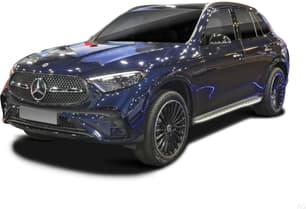
The GLC63 is unmistakably an AMG from the moment you first lay eyes on it. That’s thanks to the AMG-specific elements, starting with the grille with vertical strikes and the AMG crest on the bonnet; which is now a signature item for the performance sub-brand.
The GLC63 is also fitted with the Night Package II design kit; this adds a darkened grille and black chrome badging to further enhance its visual appeal.
The AMG-specific alloy wheels and more aggressive stance do mean the GLC63 stands out from the rest of the GLC range, helping it look fast even when it’s standing still.
The front is roomy enough that you don’t feel penned in, and the seats hug you nicely into place. The armrest sits a little too high for me, but I like that it slides forwards. The heated function is welcome, and the seats remain supportive on a longer trip.
Storage is best up front, with a couple of cupholders, plus decent space and drink bottle holders in each door bin. The glove box is quite deep, although I reckon you’ll pop a rib if you’re on the shorter side trying to access it from the driver’s seat!
In front of the gear-selector is where all of the charging options are and its easy to have them all in one place, with two USB-A ports, a 12-volt socket and a wireless charging pad, although it’s easy for your phone to slide off while you’re driving. For a flagship grade, it's a little disappointing we're not seeing any faster USB-C ports.
At 9.3 inches, the multimedia display isn’t the largest, but it looks more considered than the usual ‘tablet-stuck-on-the-dash’ styling we’re seeing lately. Overall, the touchscreen is responsive and the system is simple to use. The wireless Apple CarPlay also starts up quickly and maintains a reliable connection.
One small gripe is that the volume controls are tucked away on an easy-to-miss stalk that sits behind the steering wheel. I wish they were on the steering wheel itself... because you forget they’re there.
The back seat is a little awkward to access as an adult, with a relatively small door aperture that makes it easy to knock your head on the way in. There’s also not a stack of legroom behind my driving position, and I’m only 168cm. It should suit two kids reasonably well, although my nine-year old notes the armrest sits too high and the seats are quite firm.
Amenities are decent, with two USB-A ports, map pockets and multiple drink holders.
There are two ISOFIX child-seat mounts and three top-tether anchor points, but two seats will fill this space best. You’ll also need to be careful of knocking your head when buckling any tots in.
The boot is the standout, with up to 485L of capacity when all seats are in use and that can jump up to 1268L when the rear row is folded flat.
Its capacity is more than some mid-sized SUVs, and it's handy that you can adjust the floor to two positions. It’s been more than enough for all of my family’s errands this week.
This grade also gets a powered tailgate and a temporary spare tyre.
Inside the GLC63 is clearly a derivative of the rest of the range, with its C-Class-inspired design and layout, but there’s enough AMG-specific elements to ensure it looks and feels special. This starts with the AMG steering wheel, which comes not only with a thick rim wrapped in Alcantara, but also some AMG special dials to adjust the various performance settings for the powertrain, suspension and transmission.
Then there are the AMG-specific seats, which look good and offer good support for the driver and front seat passenger. The rear seats offer decent space for what is a mid-size SUV, with room enough for two adults or teenagers or three smaller kids.
Those in the back aren’t particularly well looked after though, with only rear air-con vents and small door pockets but no USB charging ports or other small item storage.
The boot is 590 litres, down from 620L in the rest of the range, thanks to the addition of the rear-mounted electric motor. There’s also no room for the temporary spare the rest of the GLC range gets and instead you have to make do with a puncture repair kit.
There are just two variants available for the Renault Arkana, and we’re testing the Esprit Alpine (pronounced AL-peen for any non-Formula 1 fans), which now sports a mild-hybrid powertrain and comes with a relatively modest $990 price increase. That takes this flagship grade to $45,990, before on-road costs.
Our test vehicle is finished in Satin Grey, a matt finish that adds another $1150 to the price tag, but it’s arguably money well spent as it does some serious heavy lifting in the style department.
It’s also priced about on par with its closest hybrid rivals, with the Hyundai Kona Premium starting at $45,950 and the Honda HR-V RS from $44,400, both before on-road costs. Their full-hybrid powertrains are important to consider, though, if you're after outright efficiency.
The Esprit Alpine has the following features:
The power and torque figures aren’t the only numbers that have risen sharply, with the GLC63 clearly impacted by a double whammy of inflation and the usual new-car price rise.
The GLC63 now starts at more than $191,814 for the SUV and $198,415 for the Coupe, which represents a nearly $30k increase over the old V8-powered model, which was priced at $164,600 just two years ago. Even for luxury car buyers that’s a big jump, especially when you’re trying to convince people of the merits of the four-cylinder powertrain.
That also means it's more expensive than all of its key competitors, including the BMW X3 M Competition, Maserati’s Grecale and the outgoing, petrol-powered Porsche Macan GTS.
To help explain some of this price increase Mercedes-Benz Australia has opted for a high level of standard specification for local cars. Standard equipment includes 21-inch alloys, AMG composite braking, a panoramic sliding sunroof, a unique AMG steering wheel, power-adjustable sports seats in Nappa leather, a head-up display, dual-zone climate control, wireless smartphone charging and a Burmester 3D Sound system.
Also included is the AMG Track Pace suite, for those who want to unleash their GLC on the racetrack.
There’s also a limited run, AMG Edition 1 Package available too, for an additional $12,900. On the outside you get Manufaktur graphite grey magno paint, foiling with colour gradation and large AMG logo on the sides, an AMG Aerodynamics Package, unique alloy wheels with Edition 1 and AMG branding, yellow brake calipers and an AMG fuel filler cap in silver chrome with AMG lettering.
Inside there’s AMG Performance seats, AMG Nappa leather in black with yellow contrasting stitching, AMG illuminated door sills, carbon-fibre AMG trim highlights, yellow seat belts and a unique AMG Performance steering wheel wrapped in carbon-fibre and microfibre.
The Esprit Alpine is now a mild-hybrid, combining a 1.3-litre four-cylinder turbo-petrol engine with a 12-volt hybrid system to produce up to 116kW of power and 270Nm of torque. But that’s only 1.0kW and 8.0Nm more than the previous iteration, and it doesn’t improve overall fuel efficiency, so the benefits of the new system are limited on paper.
The idea behind the mild-hybrid system is to improve power delivery off the mark, but a firmer commitment to a proper hybrid powertrain would have done more to improve the Arkana’s efficiency and competitiveness in this increasingly electrified segment.
It’s front-wheel drive and uses a seven-speed dual-clutch automatic transmission, which can seem a little unsure of itself at lower speeds but settles into its rhythm and feels more confident on the open road.
This is what lies at the heart of the AMG GLC63’s success or failure. As I mentioned at the beginning, the previous generation’s 4.0-litre twin-turbo V8 has been replaced by an F1-inspired plug-in hybrid powertrain.
But don’t think that means AMG is suddenly focused on efficiency over performance. When AMG says the powertrain is inspired by the brand’s success in Formula 1 racing, what it means is the battery and electric motor provides a significant performance boost to support the internal combustion engine, not just save fuel.
To that end the combination of the turbocharged 2.0-litre four-cylinder petrol engine and the rear-mounted electric motor produces an impressive 500kW and 1020Nm. That’s a massive jump over the 375kW/700Nm made by the outgoing V8.
Despite now being a mild-hybrid, its combined fuel consumption remains unchanged at 5.9L/100km. With its 50-litre fuel tank, that gives it a theoretical driving range of up to 847km, which is still a pretty great result for a family SUV.
My real-world result came in at 6.7L/100km after a mix of highway and urban driving, which is a respectable result and not too far off the official figure.
Mercedes makes no secret that the battery is designed for performance, not saving fuel. It only has a 14km EV range but can recharge quickly on the move to provide a power boost when needed.
But despite all that, the GLC63 is actually significantly more fuel efficient than the old V8, using a claimed 7.3L/100km, which is a massive 4.9L/100km improvement over the old model. Although, on our day-long test drive we didn’t manage to come close to that claimed figure and instead saw returns around 11L/100km, albeit after a lot of spirited open-road driving.
The Arkana can access a decent amount of power once you’re up to speed, but it can feel underwhelming off the mark. It’s also surprisingly easy to lose a little traction when you need to accelerate quickly from a stop.
That said, once you’re up to speed on the open road, it’s more than capable of keeping up with traffic or overtaking when needed.
The suspension is on the firmer side, so you do feel some of the smaller bumps through the cabin, but otherwise I like the handling.
There’s not much body roll through corners and the steering feels responsive, making the Arkana reasonably enjoyable to drive.
The cabin is relatively quiet, although some road noise creeps in on the highway. There are three drive modes that are easy to cycle through, and Sport mode offers slightly sharper gear shifts at lower speeds, which helps give the powertrain a little more urgency.
Visibility is good from my driving position, with a fairly commanding view of the road through the front and sides.
The Arkana isn’t too difficult to park given it’s not a particularly large car, but the 360-degree camera system is underwhelming compared with some of its rivals. My husband reckoned he’d seen better graphics in 8-bit Tetris…
Anyone who still believes in the adage ‘there’s no replacement for displacement’ hasn’t driven a modern turbocharged and hybridised engine. The GLC63 is a demonstration of the metaphorical and literal power of modern technology, combining an extremely efficient and potent internal combustion engine with an electric motor to make enormous real-world performance.
To be blunt, the GLC63 feels like a rocketship out of corners, launching with a ferocity and relentlessness the old V8 simply can’t match. It shouldn’t come as a surprise, a mid-size SUV with 1020Nm was always going to have plenty of performance, but even so it’s a shock to the system every time you give the GLC63 full throttle. Officially AMG claims it takes just 3.5 seconds to run 0-100km/h and has an electronically limited top speed of 275km/h - mighty impressive figures for a five-seat mid-size SUV.
To help get all that torque to the road, AMG deploys torque distribution technology that allows for it to be split an even 50/50 front/rear all the way to 100 per cent to the rear tyres.
Other technologies deployed to enhance its handling include AMG Ride Control suspension with adaptive damping and rear-axle steering. There’s also eight AMG Dynamic Select driving modes and four AMG Dynamics settings (Basic, Advanced, Pro and Master), so it’s a complex vehicle that is designed for the enthusiast.
While it’s easy to drive around town, once you get out on the open road you can really get a sense of the GLC63’s performance potential. Beyond just its powertrain the suspension offers good body control and the rear-axle steering helps it feel agile and responsive.
It’s not perfect though. At times the complexity of the system does lead to some hesitation when you put your foot down. It certainly lacks the linear power delivery of the old V8 and makes for a slightly trickier driving experience at times.
As for the sound, which is one of the biggest elements missing from the V8, Mercedes has added AMG Real Performance Sound, which features a pressure sensor in the exhaust that picks up on the engine note and plays it through the speaker system. It certainly helps make for a louder, more noticeable engine noise, but it still sounds more like an A45 than the previous GLC63 and for many would-be buyers, that’s a major turn-off.
The Arkana’s previous maximum five-star ANCAP safety rating expired in 2025, and it hasn’t been tested since, so it’s currently unrated.
It has six airbags but does miss out on a front-centre airbag, emergency phone call capability, and front cross-traffic alert which we're starting to see become more common in this segment.
Safety equipment includes:
The GLC63 comes standard with a comprehensive suite of safety features including 'Distronic' (Mercedes’ name for adaptive cruise control), 'Active Lane Keeping Assist', 'Blind Spot Assist', 'Traffic Light Assist' and 'Adaptive Highbeam Assist'. It also includes Mercedes’ 'Pre-Safe' accident anticipation system - which pre-tensions the seat belts and will even play a white noise to protect your ears if it senses a crash is imminent.
A parking system that includes a 360-degree camera and active parking assist is also included.
The GLC range was awarded a five-star ANCAP rating in 2022, which pre-dates the latest testing protocols, so doesn’t provide a like-to-like comparison for vehicles tested after that date.
The Arkana is offered with Renault’s five-year, unlimited-kilometre warranty, which is now considered a below-average term for the class, although you do get five years of complimentary roadside assistance.
Servicing intervals are well spaced at every 12 months or 30,000km, which is great if you do heavy kays each year.
Renault also has an assured pricing structure for its scheduled services, with the Arkana averaging around $477 per service across its first five workshop visits, although the fourth is notably more expensive at $859.
Renault currently has 52 locations listed across Australia, although that figure includes some service and parts-only locations, so the network isn’t quite as extensive as some of the mainstream brands.
The GLC63 is covered by Mercedes Australia’s usual five-year/unlimited kilometres warranty.
As for maintenance, Mercedes offers service plans, spanning three to five years. Three years will cost you $5025, $6455 for four years and five years is priced from $7180. Servicing intervals are 12 months or 20,000km, whichever comes first.