What's the difference?
Coincidence is a funny thing. The same week I had the Mini Cooper S 60 Years, the last VW Beetle rolled down the line in Mexico. VW blamed its mammoth €25bn investment in electric, but the reality is that nobody was buying that nostalgia trip anymore.
The story of Mini is quite different. BMW's aggressive expansion of the range beyond the three-door hatch has breathed all sorts of life into a brand that could have disappeared up its own Union Jack. Instead of sticking to the formula, the brand tried all sorts of things but has since settled on the hatch (three- and five-door), the Cabrio, the wacky Clubman semi-wagon and the Countryman SUV. BMW is now making lots of cars on the same platform, a nice two way street.
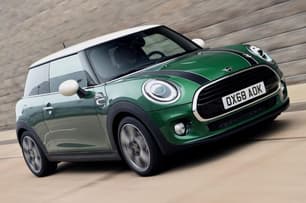
The Mini Cooper S is 60 years old and unlike the Beetle, it's powering on past its birthday and the company - no stranger to a special edition - has slapped together a classic combo of colours, stripes and badges.
If, like just about everybody, you’re a bit concerned that an electric car might not be able to travel as far as you need to go, then the new MG ZS EV Long Range could be the small, fully-electric SUV for you.
We’ve tested the ZS EV Long Range here and can tell you how far you’ll get on a full charge and how much extra you’ll have to pay in price over the standard range version, along with what it’s like to drive, its features, practicality, ownership costs and of course its safety systems.
Be sure to watch the video above, where I’ll take you for a ride and show you my Big Foot tattoo. Yes, seriously.
The Mini 60 Years is another classic special edition Mini and its definitely one for the fans. I'm not at all fussed by it and would quite happily save my money for a standard Cooper S. The Mini is still one of the most playful, interesting cars from a mainstream car maker and while it doesn't please everyone with its size and weight, it's tremendous fun to drive.
It's the kind of car I could own and I always feel comfortable in - it's the perfect size for urban environments but is just as much at home belting down a freeway on a long trip or scooting down a B-road just because.
The MG ZS EV Long Range is a practical small SUV that's easy to drive and the 440km it can travel on a full charge makes it the better choice over the standard range ZS EV. The extra 120km offered by the Long Range version reduces anxiety and is truly useful in covering more ground between charging.
The asking price may seem expensive but electric vehicle batteries are extremely costly to produce and will remain so for years to come.
Remember, too, that the MG4 electric car has an even great range for the same money - the only catch is, it's a hatch and not an SUV.
Always readily identifiable, Mini updates always add detail without touching the main game. I quite like the indicators, which are big LED rings surrounding the headlights, but then again I'm a sucker for lighting. I think the Mini looks terrific in three-door form and the Union Jack rear lights have grown on me. They're a bit silly but in a good way, which kind of sums up the car. The British Racing Green looks pretty good, too. Amusingly, the puddle lamp even has a 60 Years flavour.
You can spot the Cooper S by the centre exhaust and the 60 Years has its own set of 17-inch alloys.
The cabin is pretty much the same apart from the particularly warm hue of the leather. It's a classic colour for British cars but works nicely. In the Cooper S, the panoramic sunroof is split in two, but the front section opens. It does make the car feel a bit bigger, which is handy given it's pretty tight in there. The piping is a nice touch, too, although the Piano Black on the dash was so last decade rather than so last century but at least there isn't a slab of tacky wood. The fact the interior is otherwise unchanged means there are other cheap touches that somehow fail to ruin the ambience.
Mini calls its version of iDrive 'Visual Boost' for some reason, and it's displayed via a 6.5-inch screen set in a big round dial ringed by changeable LED lights.
The ZS EV Long Range has a traditional SUV shape but with a very futuristic looking face thanks to its grille-less nose. That’s because with no radiator needed to cool a combustion engine there’s no need for an open vent or grille for air flow.
MG has used a textured plastic to subtly imitate an old-school grille to lessen the visual impact of a sheet of plastic between the headlights.
I think the effect works although the obvious charging flap could have been cleverly and seamlessly integrated into the nose, in the same way Genesis has done with the GV80 Electric. But the attempt has failed.
The ZS EV Long Range’s cabin looks premium with the sporty seats and red stitching, the landscape screen and digital driver display.
But, while the interior looks great, it feels a little low quality in places such as the vinyl upholstered seats.
There are some ergonomic issues with the high centre armrest and the raised seating position, too.
Yep, it's a small car so expect things to be reasonably cosy. I fit in there fine but I am neither particularly tall nor broad. Taller folks will fit just fine in the front (but not too tall, don't be greedy) while larger people might find themselves uncomfortably close to their passengers.
The rear seat is bearable for children and patient adults on short trips. At least they'll be well hydrated because as well as the pair of cupholders up front there are a further three in the back for a total of five. The Mini joins the NC Mazda MX-5 as a car with a greater cup capacity than passenger capacity. Front seat passengers can keep the water topped up as there are also small bottle holders in the doors.
There are two USB ports in the front seat and a wireless charging pad that doesn't fit bigger phones under the armrest. If your iPhone is the smaller size, the combination of wireless CarPlay and charging pad is excellent.
The boot is surprisingly big for such a small car, beating many of its cheaper rivals with 211 litres with the seats in place and 731L with them folded down.
The ZS EV Long Range is a practical small SUV and it fit my little family of four, although my kids are both under 10 years old and not at the lanky teenager point yet.
Space on board is good, offering ample legroom for even me (at 188cm) in the second row and adequate headroom back there, too.
I like the large door pockets, the wireless phone charger, and there are two USB ports for the back seats and another two up front.
The second row also has directional air vents and dark-tinted windows. I liked the panoramic sunroof's retractable shade, too.
SUVS like the MG ZS offer easier access than sedans and hatches thanks to the elevated ride height which means people of my height don’t need to crawl in and out on their knees.
Boot capacity is decent at 359 litres, but not enormous.
There are four ways you can have your 60th Anniversary Mini. If you're happy with 1.5-litres of power, there is the three or five-door Cooper for $33,900 and $35,150 respectively. If you want a bit more grunt, you can step up to the Cooper S three-door (the car I had) for $43,900 and the five-door for $45,150. Eagle-eyed readers who know their Mini pricing will see a price rise of $4000, and Mini Australia says you get $8500 of value. All of those prices are before on-road costs.
The standard Cooper S package brings dual-zone climate control, keyless entry and start, driving mode selection, leather interior, reversing camera, sat nav, auto LED headlights and wipers, wireless Apple CarPlay, run-flat tyres and you can add all the 60 Years stuff on top of that.
Without putting too fine a point on it, the Mini isn't cheap to begin with, so whacking four grand on top of the already stiff pricing obviously doesn't improve matters. You do get more stuff, obviously, as suggested by the claimed $8500 figure.
That means British Racing Green IV metallic paint with Pepper White mirrors and roof or Midnight Black Lapis Luxury Blue with black mirrors and roof. Inside you get a choice of Dark Cacao with the green paint or Carbon Black with the blue paint. If you choose the latter you miss out on the special piping and details.
Cooper S buyers pick up wireless phone charging, Comfort Access pack, heated front seats and LED headlights while the Cooper S adds a panoramic sunroof, Harmon Kardon-branded system and head-up display.
The MG ZS EV Long Range lists for $55,990 which is about $11,000 more than the standard range ZS in the Essence grade.
The features on this Long Range are almost identical to the Essence, too.
Coming standard are LED headlights and running lights, then there are those 17-inch alloy wheels (which have aerodynamic covers on them), proximity unlocking, roof rails, the rear spoiler and a panoramic sunroof with a retractable cover.
Inside, the seats are a combination of polyurethane and PVC, plus there’s a 10.1-inch media display with sat nav, Apple CarPlay and Android Auto.
You can see the battery status from the screen as well along with the energy efficiency.
Climate, phone and media are all accessed through the screen, but fortunately there are physical buttons for volume, temperature and fan speed.
There’s single-zone climate control and tinted rear windows.
A 360-degree camera view is also standard, but the quality of the picture is pretty murky.
How does that cost compare to rivals? Well, you could buy an MG4 electric vehicle for about the same price with 530km of range, but it’s not an SUV.
You can even get a Tesla Model 3 for about $61K, but again, that’s not an SUV. The Tesla Model Y is an SUV and lists for $69,300 and has 455km of range.
The closest competitor would be the BYD Atto 3 Extended Range which can travel 420km and lists for $51,011.
There are more affordable EVs coming from brands like BYD and GWM, too, and they’re all competing for your money.
Compared to the MG ZS EV Essence the Long Range has exactly the same features, apart from the tinted rear windows, but you’re paying $11,000 more. What you’re paying for is a bigger battery which will allow you to drive 120km further.
The MG4 Long Range offers more distance and represents better value, but it’s not an SUV and therefore not as practical as the ZS EV.
The Cooper S has the usual 2.0-litre turbocharged four (the Cooper has a 1.5-litre turbo three-cylinder), serving up 141kW and 280Nm. Power finds its way to the front wheels via a seven-speed twin-clutch transmission and will push the 1265kg Cooper S to 100km/h in 6.8 seconds.
The MG ZS EV has one electric motor driving the front wheels and it makes 115kW of power and 280Nm or torque.
That’s the same power as the petrol MG ZS, but more torque, so it accelerates faster. We’re talking 0-100km/h in 8.5 seconds.
Sure, that’s not Tesla quick, but being an electric car the acceleration is instantaneous with none of the lag petrol cars have due to turbos or changing gears.
How much can the ZS EV tow? Not much. The braked towing capacity of the ZS EV Long Range is 500kg. But think of it like this: a box trailer can weigh about 250kg and a fully grown Sumatran tiger can also weigh up to 250kg.
So an ZS EV Long range can tow a box trailer carrying a fully grown tiger. That sounds impressive.
For more on what the ZS EV Long Range is like to drive, keep reading.
Mini reckons you'll get 5.6L/100km on the combined cycle. Maybe you could if you don't drive it like I did (I got an indicated figure of 9.4L/100km).
The Mini has stop-start to help cut fuel use around town and launch control to ruin those efforts.
The ZS EV Long Range has a larger battery than the standard range ZS EV and this gives it the ability to travel further on a full charge.
The regular version is fitted with a 51.1kWh battery and the Long Range has a 72.6kWh battery which is pretty big - and that gives this an official range of 440km.
The standard range ZS EV has a range of 320km. So the Long Range will get you 120km further which could make all the difference in whether you make it to your destination or not.
So, is 440km a lot compared to other electric cars? Well, it’s more range than the Nissan Leaf (385km) or Mini Electric (233km), but not as much as the Kia Niro (460km) and 50km less than the entry-grade Tesla Model 3 (491km).
Put it this way, the 320km offered by the standard ZS EV falls short of what I think is enough. But anything with more than 400km is truly useful and I find anything less than this can bring on range anxiety pretty quickly.
The ZS EV Long Range is fully electric and that means you’ll have to plug it in to charge it.
You can charge up using a household power point, but it’ll take more than 24 hours to get to 100 per cent. So, a much better idea is to use a fast public charger.
A 50kW charger will take the battery from empty to 80 percent in 63 minutes using a CCS Type 2 port/plug.
As for energy efficiency, MG says that after a combination of open and urban roads the ZS EV Long Range will use 17.7kWh/100km.
I drove our ZS EV Long Range every day and used it for school drop offs, city commutes and some motorway running. And while most of the 156km I travelled was urban-based the trip computer was reporting an average of 20.0kWh/100km.
Driving a Mini is a unique experience. Almost no other car on sale today has the combination of that far-away, near-vertical windscreen and an A-pillar that is almost slim by today's standards. The side of the car is almost fifty percent glass, so vision is terrific.
It had been a little while since I drove a Mini Cooper S so I was looking forward to the Mini bounce that I've always loved and my wife despised. Somewhere along the way, that bounce has faded somewhat, to the point where my wife says she doesn't mind it anymore. That must be a good thing, because while the ride is more refined, it's still a blast to drive, even if you're just getting around in traffic.
The Mini just loves point and squirt driving. The quick, well-weighted steering helps you swing the nose in and out of gaps and the handy slab of torque from the 2.0-litre ensures you stay out of trouble while doing it. The Mini also loves haring down a country road, the more secure-feeling ride belying its short wheelbase. The weight of the car probably helps keep things on the straight and narrow. It's pretty clever to make the car feel grown-up while also maintaining its sense of playfulness.
The driving mode switch doesn't make a huge amount of difference, with Sport mode adding a few apologetic pops from the exhaust.
Complaints are few, but there are too many buttons on the steering wheel and to my mind are all in the wrong place. By necessity, the controller for the media screen is practically on the floor and is crowded in by the cupholders and huge handbrake lever. But that doesn't mean Mini should take away the handbrake.
I have my reasons.
At first, the driver’s seat felt overly high and the lack of reach adjustment in the steering wheel made finding a good driving position harder.
But, the ZS EV Long Range is comfortable and easy to drive, while its size and ‘electric zippiness’ makes this little SUV perfect for narrow city streets and tight car spaces.
Some EVs have break-neck acceleration and minimalist cabin controls which can feel weird, but the ZS EV Long Range’s cabin looks just like a regular combustion engine car’s and the motor has the same power as a petrol ZS’s engine.
That said, the instant acceleration of their ZS EV Long Range is fun and great for moving quickly out of car space, merging and overtaking when needed.
As with all EVs, passengers who are prone to motion sickness might find the acceleration and heavy deceleration a bit much. My family didn’t complain but the photographer who filmed the video above found it a bit much while looking down at his screen.
Like the rest of the range, the 60 Years has six airbags, ABS, stability and traction controls, forward collision warning, AEB (auto emergency braking), a reversing camera, speed sign recognition, and tyre pressure monitoring (it also has run-flat tyres and no spare, so that's an important consideration).
There are two top tether and ISOFIX points for the kiddies.
The Mini scored four out of a possible five ANCAP stars in April 2015. This was before AEB became standard earlier in 2019.
The ZS EV Long Range has yet to be given an ANCAP rating, but it is equipped with AEB, rear cross-traffic alert, lane keeping assistance and blind-spot warning. There are front and rear parking sensors and six airbags.
For child seats there are two ISOFIX points and three top tether anchor mounts across the second row.
As with parent company BMW, Mini only offers a three-year/unlimited kilometre warranty with roadside assist for the duration. You can buy an extension to five or hold your breath during negotiations with a dealer.
Servicing is condition-based - the car will tell you when it needs one. You can buy a servicing package that covers the basics for five years for about $1400 or step up to the near-$4000 option which throws in consumables like brake pads and wiper blades.
The ZS EV Long Range is covered by MG’s seven-year/unlimited kilometre warranty. The battery is covered by a seven-year unlimited kilometre warranty, too.
Servicing is recommended by MG at 40,000km/24 month intervals.
According to MG the first service costs $295, then the next is $810, then $295 for the third, $810 for the next and so on. That’s about $233 a year over six years which is excellent value.