What's the difference?
Coincidence is a funny thing. The same week I had the Mini Cooper S 60 Years, the last VW Beetle rolled down the line in Mexico. VW blamed its mammoth €25bn investment in electric, but the reality is that nobody was buying that nostalgia trip anymore.
The story of Mini is quite different. BMW's aggressive expansion of the range beyond the three-door hatch has breathed all sorts of life into a brand that could have disappeared up its own Union Jack. Instead of sticking to the formula, the brand tried all sorts of things but has since settled on the hatch (three- and five-door), the Cabrio, the wacky Clubman semi-wagon and the Countryman SUV. BMW is now making lots of cars on the same platform, a nice two way street.
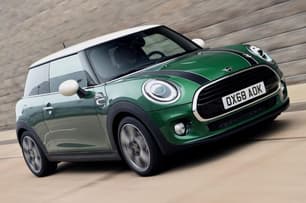
The Mini Cooper S is 60 years old and unlike the Beetle, it's powering on past its birthday and the company - no stranger to a special edition - has slapped together a classic combo of colours, stripes and badges.
For a vehicle that Subaru has touted as a Sport Electric Vehicle, promising the all-terrain adventuring the brand is known for, the Trailseeker AWD looks like it should be stepping up to the plate with plenty of confidence.
It has all the ingredients on paper: electric power, decent driving range, all-wheel drive and the sort of go-anywhere credentials Subaru buyers have come to expect.
But is an electric wagon-SUV-crossover really the product Aussies have been screaming out for? Will you happily point this towards Alpine country and strap your skis to the roof, or has Subaru swung a little too hard here?
Because the electric vehicle market is getting crowded, with what seems like a new brand arriving every other week. The Trailseeker has some serious competition from the likes of the Skoda Enyaq, Tesla Model Y and Zeekr 7X and they're all vying for attention.
I've spent the week finding out what makes the Trailseeker AWD stand out.
The Mini 60 Years is another classic special edition Mini and its definitely one for the fans. I'm not at all fussed by it and would quite happily save my money for a standard Cooper S. The Mini is still one of the most playful, interesting cars from a mainstream car maker and while it doesn't please everyone with its size and weight, it's tremendous fun to drive.
It's the kind of car I could own and I always feel comfortable in - it's the perfect size for urban environments but is just as much at home belting down a freeway on a long trip or scooting down a B-road just because.
The Subaru Trailseeker AWD really hits it out of the park when it comes to its comfort, practicality and all-round solid family features. It's one of the nicest EVs I've sampled of late when it comes to handling and power delivery.
There's no doubt that it's a capable car being a dual-motor AWD and sporting a great ground clearance ... but it's still an EV.
And the general rule of thumb is that it's best to avoid off-roading in most EVs (potential battery damage yadda yadda), you also can’t plug it into a gumtree to charge.
Is it a comfortable family wagon-SUV crossover? Absolutely. Will you actually be driving ALL of those trails it's promising to seek out? We'll see.
Always readily identifiable, Mini updates always add detail without touching the main game. I quite like the indicators, which are big LED rings surrounding the headlights, but then again I'm a sucker for lighting. I think the Mini looks terrific in three-door form and the Union Jack rear lights have grown on me. They're a bit silly but in a good way, which kind of sums up the car. The British Racing Green looks pretty good, too. Amusingly, the puddle lamp even has a 60 Years flavour.
You can spot the Cooper S by the centre exhaust and the 60 Years has its own set of 17-inch alloys.
The cabin is pretty much the same apart from the particularly warm hue of the leather. It's a classic colour for British cars but works nicely. In the Cooper S, the panoramic sunroof is split in two, but the front section opens. It does make the car feel a bit bigger, which is handy given it's pretty tight in there. The piping is a nice touch, too, although the Piano Black on the dash was so last decade rather than so last century but at least there isn't a slab of tacky wood. The fact the interior is otherwise unchanged means there are other cheap touches that somehow fail to ruin the ambience.
Mini calls its version of iDrive 'Visual Boost' for some reason, and it's displayed via a 6.5-inch screen set in a big round dial ringed by changeable LED lights.
This is not a pillowy or small wagon-SUV (can we make WUV a thing?!) crossover. At 4845mm long, 1860mm wide and with 211mm of ground clearance, the Trailseeker isn’t compromising on size just to slot neatly into the EV category. This is very much an EV-styled Outback, which should delight fans looking for that familiar Subaru ruggedness and impressive on-road presence.
The biggest tell-tale sign that this is, in fact, an EV is the front end, which gets smooth panelling and a more streamlined silhouette. However, you still get plastic moulding around easy-to-hit areas.
Full LED lighting, 18-inch alloys with aerodynamic caps and familiar paintwork colours round out the handsome offering.
Head inside and the cabin is plush and well styled, with a stepped dashboard and display design creating some interesting focal points. It absolutely scores goals with its tactile functionality, too. Buttons, steering wheel stalks and door-mounted side mirror controls keep the Trailseeker feeling very car-like, which is a welcome relief in an increasingly screen-heavy EV world.
The synthetic leather upholstery on the seats, dash and doors feels nice underhand and even the slightly odd hexagonal steering wheel soon becomes charming.
The cabin feels fresh but comfortingly familiar.
Yep, it's a small car so expect things to be reasonably cosy. I fit in there fine but I am neither particularly tall nor broad. Taller folks will fit just fine in the front (but not too tall, don't be greedy) while larger people might find themselves uncomfortably close to their passengers.
The rear seat is bearable for children and patient adults on short trips. At least they'll be well hydrated because as well as the pair of cupholders up front there are a further three in the back for a total of five. The Mini joins the NC Mazda MX-5 as a car with a greater cup capacity than passenger capacity. Front seat passengers can keep the water topped up as there are also small bottle holders in the doors.
There are two USB ports in the front seat and a wireless charging pad that doesn't fit bigger phones under the armrest. If your iPhone is the smaller size, the combination of wireless CarPlay and charging pad is excellent.
The boot is surprisingly big for such a small car, beating many of its cheaper rivals with 211 litres with the seats in place and 731L with them folded down.
Subaru has nailed the available space in the Trailseeker. The entire cabin is roomy where it counts and passengers will be all the happier because of it.
In the front, the heat function, side bolsters, and deep padding make the front seats feel super comfortable. You'll get very little fatigue on a big road trip which is great for a WUV (it's happening) that's being positioned for family adventuring.
The rear row has legroom for days and there is a limo-like sense of space that taller adults will praise. When I say limo-like, I mean it. You'll easily be able to fit rearward-facing child seats behind a taller adult and make use of the three top-tether anchor points in general.
All of my passengers this week, including my parents, commented on how easy it is to get in and out of the car, and that’s largely thanks to the 211mm ground clearance and wide door apertures.
Despite missing out on a glovebox, which makes the giant User's Manual essentially homeless, there are still quite a few storage options throughout the car.
Up front, there is a shallow but wide middle console with a dual-opening lid (very Lexus coded), a centre console that has dual wireless charging pads, two cupholders and a little shelf underneath for smaller items. Each door (front and back) has bin storage and a drink bottle holder.
In the rear, there is a fold-down armrest with two cupholders and a couple of map pockets. My nine-year old is particularly chuffed with the heated outboard seat function and the dual USB-C ports. A handy addition here would have been sunblinds, like the Skoda Enyaq sports.
The boot rounds out the storage with its 609L of capacity, which is more than enough for luggage and kid paraphernalia. It’s handy having a retractable cargo cover and handsfree powered tailgate, but you only get a tyre repair kit, which isn’t super practical for a car that might want to hit a gravel road or two.
You also miss out on vehicle to load (V2L) functionality, which the Trailseeker AWD Tourer gets, and that too would help weekend adventurers.
Let's talk tech.
The 14-inch media display shares the same operating system as Toyota and Lexus, which offers a straightforward layout and responsive touchscreen. Note that this car is the mechanical twin of the recently released Toyota bZ4X Touring.
Climate controls are positioned in the screen but they're easy to operate.
There is wireless Apple CarPlay and Android Auto and CarPlay connected quickly and maintained a steady connection all week for me. You get a standard six-speaker sound system but it proved to be more than enough to successfully belt out some tunes to.
All in all, the Trailseeker AWD has a straightforward and practical cabin for family use.
There are four ways you can have your 60th Anniversary Mini. If you're happy with 1.5-litres of power, there is the three or five-door Cooper for $33,900 and $35,150 respectively. If you want a bit more grunt, you can step up to the Cooper S three-door (the car I had) for $43,900 and the five-door for $45,150. Eagle-eyed readers who know their Mini pricing will see a price rise of $4000, and Mini Australia says you get $8500 of value. All of those prices are before on-road costs.
The standard Cooper S package brings dual-zone climate control, keyless entry and start, driving mode selection, leather interior, reversing camera, sat nav, auto LED headlights and wipers, wireless Apple CarPlay, run-flat tyres and you can add all the 60 Years stuff on top of that.
Without putting too fine a point on it, the Mini isn't cheap to begin with, so whacking four grand on top of the already stiff pricing obviously doesn't improve matters. You do get more stuff, obviously, as suggested by the claimed $8500 figure.
That means British Racing Green IV metallic paint with Pepper White mirrors and roof or Midnight Black Lapis Luxury Blue with black mirrors and roof. Inside you get a choice of Dark Cacao with the green paint or Carbon Black with the blue paint. If you choose the latter you miss out on the special piping and details.
Cooper S buyers pick up wireless phone charging, Comfort Access pack, heated front seats and LED headlights while the Cooper S adds a panoramic sunroof, Harmon Kardon-branded system and head-up display.
Subaru is offering two trim levels of the Trailseeker: the mid-spec AWD, which is what we’re reviewing, and the slightly higher-specced AWD Touring. Before on-road costs, they’re priced at $63,990 and $69,990 respectively, making our test vehicle competitive against its nearest rivals.
The Skoda Enyaq Sportline 85 starts at $66,990 MSRP, while the Tesla Model Y Premium Long Range comes in at $68,990 and the Zeekr 7X RWD starts at $57,900. That makes the Trailseeker AWD the more affordable option than two of its key rivals, while also offering something you’ll need to level up for, both grade- and price wise, with its dual-motor all-wheel-drive system.
Standard features include:
The Cooper S has the usual 2.0-litre turbocharged four (the Cooper has a 1.5-litre turbo three-cylinder), serving up 141kW and 280Nm. Power finds its way to the front wheels via a seven-speed twin-clutch transmission and will push the 1265kg Cooper S to 100km/h in 6.8 seconds.
The Subaru Trailseeker is powered by a dual-motor all-wheel-drive set-up with a hefty 280kW of combined power.
Subaru doesn’t quote a combined torque figure, but it can sprint 0-100km/h in just 4.5 seconds, making this feel very performance coded compared to some of its single-motor rivals.
Mini reckons you'll get 5.6L/100km on the combined cycle. Maybe you could if you don't drive it like I did (I got an indicated figure of 9.4L/100km).
The Mini has stop-start to help cut fuel use around town and launch control to ruin those efforts.
The Trailseeker AWD has a large 74.7kWh lithium-ion battery and a WLTP driving range of up to 533km. I got pretty close to the claimed energy consumption of 15.4kWh/100km, with my 15.7kWh average this week. Given I’ve done some serious highway trips, that’s an impressive result.
It sports a Type 2/CCS charging port which accepts up to 22kW on an AC charger and up to 150kW on a fast DC charger. I would have liked to see a higher DC charging capacity, but on a compatible fast charger, you can go from 10 to 80 per cent in around 30 minutes, which is reasonable.
Driving a Mini is a unique experience. Almost no other car on sale today has the combination of that far-away, near-vertical windscreen and an A-pillar that is almost slim by today's standards. The side of the car is almost fifty percent glass, so vision is terrific.
It had been a little while since I drove a Mini Cooper S so I was looking forward to the Mini bounce that I've always loved and my wife despised. Somewhere along the way, that bounce has faded somewhat, to the point where my wife says she doesn't mind it anymore. That must be a good thing, because while the ride is more refined, it's still a blast to drive, even if you're just getting around in traffic.
The Mini just loves point and squirt driving. The quick, well-weighted steering helps you swing the nose in and out of gaps and the handy slab of torque from the 2.0-litre ensures you stay out of trouble while doing it. The Mini also loves haring down a country road, the more secure-feeling ride belying its short wheelbase. The weight of the car probably helps keep things on the straight and narrow. It's pretty clever to make the car feel grown-up while also maintaining its sense of playfulness.
The driving mode switch doesn't make a huge amount of difference, with Sport mode adding a few apologetic pops from the exhaust.
Complaints are few, but there are too many buttons on the steering wheel and to my mind are all in the wrong place. By necessity, the controller for the media screen is practically on the floor and is crowded in by the cupholders and huge handbrake lever. But that doesn't mean Mini should take away the handbrake.
I have my reasons.
No one will claim that the Trailseeker is underwhelming when it comes to power. It’s quick, with no bucking through the body when you have to plant it, and it’s a perfect companion on the open road.
The suspension and steering are nicely balanced to deliver a dynamic and engaging driving experience, and I’m really enjoying how stable it feels through corners.
It’s easy to choose between the four levels of regenerative braking thanks to the steering wheel-mounted paddles. But you don’t get one-pedal driving, which seems like an important omission for an EV.
The cabin is quiet around town and on the open road, and it’s easy to chat across the cabin without raising your voice.
Visibility is quite good out the front and sides from my driving position, and I like that the A-pillar has a glass insert to break up its width. And it doesn’t matter if you have a car full of gear or people, because you have a digital rear-view mirror.
Even with the regen on its strongest level, you can still ‘creep’ at lower speeds and, coupled with a really clear 360-degree camera, the Trailseeker is downright easy to park.
Like the rest of the range, the 60 Years has six airbags, ABS, stability and traction controls, forward collision warning, AEB (auto emergency braking), a reversing camera, speed sign recognition, and tyre pressure monitoring (it also has run-flat tyres and no spare, so that's an important consideration).
There are two top tether and ISOFIX points for the kiddies.
The Mini scored four out of a possible five ANCAP stars in April 2015. This was before AEB became standard earlier in 2019.
The Subaru Trailseeker has a maximum five-star ANCAP safety rating from testing conducted in 2025 and features eight airbags. It didn’t manage an individual assessment score in the nineties, but still performed well, scoring 89 per cent for adult occupant protection, 86 per cent for child occupant protection, 80 per cent for vulnerable road user protection and 82 per cent for its safety assist systems.
The biggest callout here is that the new Trailseeker misses out on emergency call capability, but it is good that none of its safety equipment intrudes too much on everyday driving.
Standard equipment includes:
As with parent company BMW, Mini only offers a three-year/unlimited kilometre warranty with roadside assist for the duration. You can buy an extension to five or hold your breath during negotiations with a dealer.
Servicing is condition-based - the car will tell you when it needs one. You can buy a servicing package that covers the basics for five years for about $1400 or step up to the near-$4000 option which throws in consumables like brake pads and wiper blades.
The Trailseeker is offered with Subaru’s five-year/unlimited km warranty. While some of its rivals have the same term, it’s now a below-average offering for the class in general.
Servicing, however, is downright cheap, with a three-year pre-purchased plan costing just $584.29 and the five-year plan set at $984.18. Servicing intervals are also well-spaced at every 12 months or 15,000km, whichever occurs first.
It’s also fairly easy to get your Trailseeker serviced, with around 120 Subaru service centres across Australia.