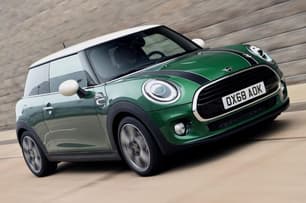
What's the difference?
Coincidence is a funny thing. The same week I had the Mini Cooper S 60 Years, the last VW Beetle rolled down the line in Mexico. VW blamed its mammoth €25bn investment in electric, but the reality is that nobody was buying that nostalgia trip anymore.
The story of Mini is quite different. BMW's aggressive expansion of the range beyond the three-door hatch has breathed all sorts of life into a brand that could have disappeared up its own Union Jack. Instead of sticking to the formula, the brand tried all sorts of things but has since settled on the hatch (three- and five-door), the Cabrio, the wacky Clubman semi-wagon and the Countryman SUV. BMW is now making lots of cars on the same platform, a nice two way street.
The Mini Cooper S is 60 years old and unlike the Beetle, it's powering on past its birthday and the company - no stranger to a special edition - has slapped together a classic combo of colours, stripes and badges.
Sole traders, SMEs, transport companies and corporate fleets are potential customers LDV is aiming at with its new eDeliver7 electric van range, which competes in Australia’s mid-sized (2.5-3.5-tonne GVM) commercial van segment.
The Chinese manufacturer claims the eDeliver7’s combination of quiet operation, reduced maintenance costs, no battery impact on cargo space and, critically, more competitive pricing is ideal for businesses looking to build ‘sustainable’ fleets.
As the number of battery electric van offerings continues to grow, we recently spent a week in one of the new eDeliver7 variants to see if it can offer a viable alternative to diesel powertrains that traditionally dominate this competitive market segment.
The Mini 60 Years is another classic special edition Mini and its definitely one for the fans. I'm not at all fussed by it and would quite happily save my money for a standard Cooper S. The Mini is still one of the most playful, interesting cars from a mainstream car maker and while it doesn't please everyone with its size and weight, it's tremendous fun to drive.
It's the kind of car I could own and I always feel comfortable in - it's the perfect size for urban environments but is just as much at home belting down a freeway on a long trip or scooting down a B-road just because.
There’s room for improvement, but that room is getting smaller. For urban daily fleet or solo operation, using the convenience of back-to-base overnight charging, it offers a compelling alternative to diesel in terms of real-world driving range, performance, payload, warranty/servicing costs... and zero tailpipe emissions.
Always readily identifiable, Mini updates always add detail without touching the main game. I quite like the indicators, which are big LED rings surrounding the headlights, but then again I'm a sucker for lighting. I think the Mini looks terrific in three-door form and the Union Jack rear lights have grown on me. They're a bit silly but in a good way, which kind of sums up the car. The British Racing Green looks pretty good, too. Amusingly, the puddle lamp even has a 60 Years flavour.
You can spot the Cooper S by the centre exhaust and the 60 Years has its own set of 17-inch alloys.
The cabin is pretty much the same apart from the particularly warm hue of the leather. It's a classic colour for British cars but works nicely. In the Cooper S, the panoramic sunroof is split in two, but the front section opens. It does make the car feel a bit bigger, which is handy given it's pretty tight in there. The piping is a nice touch, too, although the Piano Black on the dash was so last decade rather than so last century but at least there isn't a slab of tacky wood. The fact the interior is otherwise unchanged means there are other cheap touches that somehow fail to ruin the ambience.
Mini calls its version of iDrive 'Visual Boost' for some reason, and it's displayed via a 6.5-inch screen set in a big round dial ringed by changeable LED lights.
The SWB Low Roof rides on a 3000mm wheelbase, which is 366mm shorter than the LWB models. As a result, its compact 4998mm overall length makes it well suited to work duties that require quick steering response and easy manoeuvrability in tight spaces. Plus its 1990mm height allows easy multi-storey car park access.
The front wheel-drive chassis has MacPherson strut front suspension, a leaf-spring solid-beam rear axle and four-wheel disc brakes, with the 77kWh lithium-ion battery mounted beneath the floor to optimise cargo bay volume.
It has a clean and streamlined appearance, with a functional grille that is “required to cool any later ICE (internal combustion engine) variants” according to LDV. So, in this application, it serves no purpose other than a styling feature.
Dark grey composite mouldings are used on the lower body sections to absorb the unsightly bumps and scrapes often inflected on these areas in hard-working vans.
The cabin’s interior has an upmarket look that creates a nice working environment, with a harmonious mix of colours, seat fabrics and soft-touch materials that display good fit and finish.
However, there’s no bulkhead to separate the cabin from the cargo bay, resulting in not only higher noise levels but also no protection for occupants from shifting cargo.
The cabin floor is covered in non-slip rubber finished in a smart ‘checker-plate’ pattern that's easy to wipe clean. The dash layout is uncluttered and the controls are easy to reach and intuitive to use. The transmission shifter is a stalk on the steering column.
Although the passenger bench seat has no adjustments, the centre position is surprisingly spacious, even for people my height (186cm) as it provides about 60mm of knee clearance from the dash. However, the centre passenger must also sit with their feet in a split-level position, due to a higher centre-floor section.
Yep, it's a small car so expect things to be reasonably cosy. I fit in there fine but I am neither particularly tall nor broad. Taller folks will fit just fine in the front (but not too tall, don't be greedy) while larger people might find themselves uncomfortably close to their passengers.
The rear seat is bearable for children and patient adults on short trips. At least they'll be well hydrated because as well as the pair of cupholders up front there are a further three in the back for a total of five. The Mini joins the NC Mazda MX-5 as a car with a greater cup capacity than passenger capacity. Front seat passengers can keep the water topped up as there are also small bottle holders in the doors.
There are two USB ports in the front seat and a wireless charging pad that doesn't fit bigger phones under the armrest. If your iPhone is the smaller size, the combination of wireless CarPlay and charging pad is excellent.
The boot is surprisingly big for such a small car, beating many of its cheaper rivals with 211 litres with the seats in place and 731L with them folded down.
With a typically hefty 2300kg EV kerb weight, its 3650kg GVM allows for a sizeable 1350kg payload rating which is more than competitive with ICE rivals.
It’s also rated to tow up to 1500kg of braked trailer but with its 4250kg GCM (or how much it can legally carry and tow at the same time), that would require a substantial 900kg reduction in vehicle payload to 450kg to avoid exceeding the GCM. So, keep these numbers in mind if you plan to tow heavy.
The cargo bay is lined to mid-height and accessed through a kerbside sliding door with 990mm opening width, or through symmetrical rear barn-doors with 180-degree opening that’s handy for forklifts or when accessing loading docks.
The load floor, with its non-slip rubber surface, is 2547mm long and 1800mm wide with 1390mm between the rear wheel-housings.
That means it can carry up to two standard 1165mm-square Aussie pallets, two 1000mm x 1200mm Euro pallets or up to three 800mm x 1200mm Euro pallets.
And with its 1328mm internal height, it offers a competitive 5.9 cubic metres of load volume.
It’s also equipped with six load anchorage points plus bright LED lighting and a large handle at the front of the side-door opening to assist access.
Cabin storage includes a bottle-holder and bin in each front door, plus smaller bins above and below. There are also bottle/cupholders on each side of the dash and the driver has small bins on each side of the steering column.
There’s also a single glove box and a slender storage shelf above it for small items. And the centre seat’s backrest folds forward and flat to reveal a small work desk, with two more cupholders and an elastic strap to hold documents or laptops in place.
There are four ways you can have your 60th Anniversary Mini. If you're happy with 1.5-litres of power, there is the three or five-door Cooper for $33,900 and $35,150 respectively. If you want a bit more grunt, you can step up to the Cooper S three-door (the car I had) for $43,900 and the five-door for $45,150. Eagle-eyed readers who know their Mini pricing will see a price rise of $4000, and Mini Australia says you get $8500 of value. All of those prices are before on-road costs.
The standard Cooper S package brings dual-zone climate control, keyless entry and start, driving mode selection, leather interior, reversing camera, sat nav, auto LED headlights and wipers, wireless Apple CarPlay, run-flat tyres and you can add all the 60 Years stuff on top of that.
Without putting too fine a point on it, the Mini isn't cheap to begin with, so whacking four grand on top of the already stiff pricing obviously doesn't improve matters. You do get more stuff, obviously, as suggested by the claimed $8500 figure.
That means British Racing Green IV metallic paint with Pepper White mirrors and roof or Midnight Black Lapis Luxury Blue with black mirrors and roof. Inside you get a choice of Dark Cacao with the green paint or Carbon Black with the blue paint. If you choose the latter you miss out on the special piping and details.
Cooper S buyers pick up wireless phone charging, Comfort Access pack, heated front seats and LED headlights while the Cooper S adds a panoramic sunroof, Harmon Kardon-branded system and head-up display.
The new single-motor eDeliver7 range consists of four models, comprising SWB Low Roof and LWB Low Roof with a 77kWh battery, plus LWB Low Roof and LWB High Roof with an 88kWh battery.
Our SWB Low Roof test vehicle is the entry-level model, with a list price of $59,990 plus on-road costs. That’s considerably higher than diesel rivals like the Ford Transit Custom 320S ($55,990), Hyundai Staria-Load ($46,740) and Toyota’s dominant HiAce ($50,886).
Our example, finished in 'Blanc White', comes standard with 16-inch steel wheels and 215/65R16 tyres plus a full-size spare. There’s also a Type 2 11kW AC charging cable, dusk-sensing LED headlights with DRLs, front/rear fog lamps, heated door mirrors, reversing camera and more.
The keyless-entry cabin offers seating for three, comprising a driver’s bucket seat and two-passenger bench seat with heating for the two outer seating positions (tough luck if you’re in the middle during winter).
The driver’s seat has multiple manual adjustments including lumbar support and base-cushion rake, plus a fold-down inboard armrest.
There’s also a 4.2-inch LCD instrument cluster, electronic parking brake and a heated multi-function synthetic leather steering wheel with height (but no reach) adjustment.
A big 12.3-inch touchscreen controls the four-speaker multimedia system, which includes digital radio and Apple/Android connectivity. There are also two USB ports and a 12-volt socket, an extensive safety menu and more.
The Cooper S has the usual 2.0-litre turbocharged four (the Cooper has a 1.5-litre turbo three-cylinder), serving up 141kW and 280Nm. Power finds its way to the front wheels via a seven-speed twin-clutch transmission and will push the 1265kg Cooper S to 100km/h in 6.8 seconds.
Our test vehicle has a permanent magnet synchronous electric motor which produces up to 150kW of power and 330Nm of instant torque, delivering drive to the front wheels via a single-speed transmission.
The driver can select three levels of regenerative braking intensity. We used the strongest setting to ensure optimum battery top-ups when driving. This setting also requires minimal use of the brake pedal, due to powerful retardation each time the accelerator is released.
There’s also a choice of three drive modes. ‘Eco’ ensures minimal battery drain but performance is restrained and speed is capped at 90km/h. ‘Normal’ offers a good compromise in engine response and energy use, with speed increased to 120km/h. ‘Power’ is also capped at 120km/h but offers the most energetic performance and consumes the most energy.
Mini reckons you'll get 5.6L/100km on the combined cycle. Maybe you could if you don't drive it like I did (I got an indicated figure of 9.4L/100km).
The Mini has stop-start to help cut fuel use around town and launch control to ruin those efforts.
LDV claims our test vehicle’s 77kWh battery can deliver a (WLTP) driving range of up to 318km. The battery was fully charged when we collected the vehicle and we drove 211km. This comprised mostly city and suburban driving, about 50km of which was hauling a one-tonne-plus payload.
At the completion of our test, the dash display was claiming average energy consumption of 26kWh/100km. So, based on that figure, LDV’s claimed range of more than 300km from a single charge (unladen) is credible.
The 77kWh battery takes about eight hours to charge from five to 100 per cent using an 11kW AC home charger, or around 43 minutes for 20-80 per cent using a 78kW DC charger.
Driving a Mini is a unique experience. Almost no other car on sale today has the combination of that far-away, near-vertical windscreen and an A-pillar that is almost slim by today's standards. The side of the car is almost fifty percent glass, so vision is terrific.
It had been a little while since I drove a Mini Cooper S so I was looking forward to the Mini bounce that I've always loved and my wife despised. Somewhere along the way, that bounce has faded somewhat, to the point where my wife says she doesn't mind it anymore. That must be a good thing, because while the ride is more refined, it's still a blast to drive, even if you're just getting around in traffic.
The Mini just loves point and squirt driving. The quick, well-weighted steering helps you swing the nose in and out of gaps and the handy slab of torque from the 2.0-litre ensures you stay out of trouble while doing it. The Mini also loves haring down a country road, the more secure-feeling ride belying its short wheelbase. The weight of the car probably helps keep things on the straight and narrow. It's pretty clever to make the car feel grown-up while also maintaining its sense of playfulness.
The driving mode switch doesn't make a huge amount of difference, with Sport mode adding a few apologetic pops from the exhaust.
Complaints are few, but there are too many buttons on the steering wheel and to my mind are all in the wrong place. By necessity, the controller for the media screen is practically on the floor and is crowded in by the cupholders and huge handbrake lever. But that doesn't mean Mini should take away the handbrake.
I have my reasons.
There’s no handle on the driver’s windscreen pillar to assist climbing aboard, or a driver’s left footrest, both of which would be welcome additions. The driver’s seat is comfortable and the flat-bottom steering wheel with height adjustment provides ample space.
It has clear eyelines to the large door mirrors but vision through the central rear view mirror is obscured by the thick central join of the symmetrical rear barn-doors, which is wide enough to block vision of a vehicle travelling behind. Asymmetric doors would alleviate this.
Being a solid-walled van, there’s a huge blind-spot over the driver’s left shoulder, but fortunately the left door-mirror is assisted by blind-spot monitoring. And there’s rear cross-traffic alert when reversing out of driveways or loading docks. These active aids should be mandatory on all solid-walled vans.
We’re often critical of steering and ride quality in Chinese LCVs but the eDeliver7 has refreshing chassis refinement, from its responsive and nicely-weighted steering to its relatively supple unladen ride quality.
The single 150kW/330Nm electric motor provides an effortless surge of acceleration in all drive modes, with the Power setting producing enough instant torque to make the front tyres chirp on occasions.
Its near-silent operation also ensures deceptive acceleration, which is why the absence of a digital speedo is a glaring omission and needs to be included.
The EV silence, though, is largely negated at speeds above 80km/h due to tyre roar emanating from the rear wheel-housings, which can be intrusive enough to require raised voices. Noise-absorbing materials in the cargo bay (like the HiAce’s full-length roof-liner) would be useful.
To test its load-hauling ability, we forklifted 975kg into the cargo bay. Combined with our two-man crew, this 1155kg payload was less than 200kg shy of the van’s 1350kg limit.
The rear leaf-springs barely flinched under this loading as they compressed only 25mm, which engaged large cone-shaped jounce rubbers above the springs that provide a smooth-riding second stage of support.
Impressively, changes in ride quality and acceleration were minimal, as it proved more than competent in hauling this big payload on a congested city and suburban test route which typified the urban environments these vehicles are designed for.
Like the rest of the range, the 60 Years has six airbags, ABS, stability and traction controls, forward collision warning, AEB (auto emergency braking), a reversing camera, speed sign recognition, and tyre pressure monitoring (it also has run-flat tyres and no spare, so that's an important consideration).
There are two top tether and ISOFIX points for the kiddies.
The Mini scored four out of a possible five ANCAP stars in April 2015. This was before AEB became standard earlier in 2019.
No ANCAP rating at this stage but it does boast a solid suite of passive and active features including six airbags, AEB, front collision warning, blind-spot monitoring, rear cross-traffic alert, lane-keeping, speed sign recognition, front/rear parking sensors, reversing camera, adaptive cruise, tyre pressure monitoring, adjustable overspeed alarm and more.
As with parent company BMW, Mini only offers a three-year/unlimited kilometre warranty with roadside assist for the duration. You can buy an extension to five or hold your breath during negotiations with a dealer.
Servicing is condition-based - the car will tell you when it needs one. You can buy a servicing package that covers the basics for five years for about $1400 or step up to the near-$4000 option which throws in consumables like brake pads and wiper blades.
LDV's warranty for the eDeliver 7 is five years/160,000km whichever occurs first, plus five years/unlimited km roadside assist.
The lithium-ion battery has a separate eight year/250,000km warranty.
Scheduled servicing is every two years/30,000km, with a capped-price of $1393 applying to the first three services up to six years/90,000km. That’s an average cost of only $464 every two years.