What's the difference?
The Australian market hasn’t truly revolved around a sedan since I was a kid. These days it’s all about SUVs, and anything low-slung is easy to overlook when it comes to family hauling. Add to that the current fixation on hybrid and electric powertrains, and a mid-size petrol sedan feels almost out of step.
And yet, here’s the MG7.
It’s a mid-size fastback with a turbo-petrol engine and just one trim level. Its sharp styling is matched by an even sharper price, and it doesn’t seem particularly concerned about not fitting the current mould.
It lines up against the Toyota Camry SL, Skoda Octavia Sportline and Hyundai Sonata N Line and raises an interesting question. Is this the sedan comeback nobody saw coming? And could it remind modern families why sedans were once king?
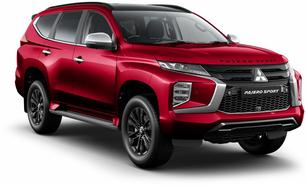
The Mitsubishi Pajero Sport GSR is the top-spec wagon in an updated line-up.
The next-gen performance-enhanced Pajero Sport is expected here in 2025 but, in the meantime, Mitsubishi looks determined to squeeze the last bit of sales juice out of the current line-up as the entire range has now undergone a notable refresh including the introduction of 18-inch alloys, design tweaks to the front and rear, as well as new styling inside and new exterior paint choices.
Is this upgraded Pajero Sport a noteworthy rival for the likes of the Ford Everest and Isuzu MU-X and, more importantly, does it represent a solid buy?
Read on.
In a world obsessed with SUVs and electric powertrains, a mid-size petrol sedan almost feels rebellious. But the MG7 kind of is. A sleek fastback with a turbocharged engine, a sporty edge and a price that makes you look twice - it’s a compelling combination. There are some drawbacks for families in efficiency and back-seat practicality but it's not a bad offering for those wanting something a bit more fun than an SUV.
The Pajero Sport is reasonable on-road, more than satisfactory as a daily driver and it’s still a very effective 4WD.
This is a proven touring vehicle and while this update treatment doesn’t add a whole lot to the Pajero Sport package – and nothing in terms of power, torque or performance in general – it’s easily enough to tempt those who aren’t patient enough to wait for the next-generation version to arrive here.
The MG7 is genuinely good looking. The fastback roofline gives it a sleek silhouette, and there’s a confidence to the way it carries itself.
The blacked-out badging, quad exhaust outlets, 19-inch Michelin tyres and red brake calipers all lean into that sporty brief. It looks fast standing still. The frameless doors are a nice touch, and the retractable rear spoiler adds a bit of theatre and fun.
Inside, the cabin follows through on that upmarket intent. Deep burgundy leather and synthetic suede are used generously throughout, giving it a sumptuous feel. Although, my husband joked that he wouldn't be able to drive it during State of Origin... sorry, Queenslanders!
There’s less reliance on piano black trim, which I appreciate as it scuffs easily, and most surfaces look well-finished. The integrated headrests up front give the illusion of proper sports seats but I do wonder if the interior would pop half as well if it was finished in the optional black.
The dashboard is dominated by a wide digital display incorporating a 10.25-inch instrument cluster and a 12.3-inch media screen. The panoramic sunroof helps keep things light and airy, and while there aren’t many physical buttons or dials, which is usually a gripe of mine, the overall execution feels cohesive and premium for the price point.
Most of the Pajero Sport’s latest round of upgrades is focused on styling refreshes, inside and out.
The upgraded interior in the GSR includes quilted two-tone burgundy and black synthetic leather upholstery.
This adds a welcome touch of understated class to an interior which is otherwise looking and feeling old.
The Pajero Sport now also has a three-spoke leather steering wheel and revised digital instrument display graphics, which may be difficult to discern for those unfamiliar with the previous renderings.
Outside, the GSR retains the distinctive Pajero Sport shape, albeit now with updated upper and lower grilles, front and rear bumper enhancements and black headlamp extensions (those are range-wide inclusions), as well as black door mirrors, door handles and tailgate handle.
Up front is where the MG7 feels most generous. The electrically adjustable front seats are comfortable and supportive for daily driving, although extendable under-thigh support would help reduce fatigue on longer trips. You do get heating for both the seats and the steering wheel but having to dive into the media menu to activate them is annoying.
In the second row, legroom is respectable for a mid-size sedan. Headroom, however, is tighter thanks to the fastback roofline and panoramic sunroof. Tall teenagers won't feel like they can sprawl out but younger kids will be fine. The second row features two ISOFIX child seat mounts and three top-tether anchor points but two child seats will fit best. Bending down to buckle in a child will remind your back why SUVs became all the rage, but it's certainly doable.
The seats in the second row are thickly padded and comfortable, and the fold-down armrest sits at a good height to lean on. Amenities aren’t especially extensive given there’s only one grade available, but you do get a couple of cupholders, map pockets, directional air vents and two USB-C ports.
Storage in the front row is about what you’d expect for a car of this size. There’s a decent glove box, a shallow middle console, large door bins and some handy little nooks near your knee. A sunglasses holder and a dedicated phone cradle with wireless charging round things out nicely. The wireless charger can lag a little in topping up your battery, and it's quick to overheat your phone - added ventilation would be a big help here. However, there’s also a 12-volt socket and two USB-C ports if you prefer a cable.
The media system itself is responsive and largely intuitive, although the touchpad-style controls on the dash feel slightly back-to-front in use. On the plus side, it’s very easy to flick into Sport mode and open up the exhaust using the cluster controls, which adds a bit of fun to the daily drive.
The boot offers 375 litres of capacity, which is on the smaller side for the segment. Comparatively, the Sonata N Line offers 480L, the Skoda Sportline 600L and the Camry 524L. That said, it’s been perfectly usable for grocery runs and the odd road trip this week. You do need to load bulkier items further back toward the seats to work around the sloping fastback design. A powered tailgate adds convenience, and there’s a temporary spare tyre underneath, which I always prefer to a repair kit.
The Pajero Sport cabin is practical, but now, as a result of the upgrade, it has more of a premium look and feel. Sure, it’s still on the wrong side of aged and it’s cramped, but at least it has a layer of gloss to it.
From front to back, it’s a well set-up space. The driver and front passenger seats (both power-adjustable) are very supportive, with a nice wrap-around feel to them. The other seats are also fine.
The reach- and height-adjustable steering wheel has paddle shifters for energetic shifting if you get the urge.
The dash and touchscreen media unit are nicely integrated, but that 8.0-inch screen is too small – and thankfully the likely introduction of a 9.0-inch screen in the 2025 Pajero Sport will sort out that issue.
The cabin’s familiar feel includes the fact that all buttons and dials are easy to locate and operate, even when you're bouncing around off-road.
The second row is comfortable and roomy enough, though the entire cabin tends towards the squeezy end of the spacious spectrum. Having said that, I slotted in behind my driving position and I had plenty of head, knee and foot room.
There are three top tether points, two ISOFIX anchors and a fold-down armrest with cupholders in the second row. There are USB charge points and a power socket in the back of the centre console bin.
Third-row seating is a bit of a straight-up-and-down affair with a flat seat base, but passengers back there – god bless ’em – have access to cupholders and air vents.
In terms of packability, the Pajero Sport’s cabin, as mentioned, is quite narrow compared to most of its rivals and there are plenty of other SUVs and 4WD wagons around that offer more room inside for people, gear and dogs.
With the third-row seats in use, boot space is listed as 131L. There are power sockets and tie-down points in that rear cargo area.
With the third row stowed away, there’s a claimed 502L of cargo space, which is pretty handy. With the second and third rows stowed, there’s a claimed 1488L.
For now, the MG7 is offered in a single grade, the Essence, priced from $44,990 before on-road costs.
That positions it just above the Skoda Octavia Sportline, which starts from $44,490 MSRP, although the Skoda doesn’t match the MG7 feature for feature. In terms of features and styling, it’s closer to the Hyundai Sonata N Line, which opens at $56,500 MSRP. And then there’s the segment darling, the Toyota Camry SL, from $53,990 MSRP, happily flexing its hybrid efficiency credentials.
On price alone, the MG7 looks competitive. On specification, it starts to look like a bit of a statement. You get leather and synthetic suede upholstery, heated and electrically adjustable front seats, memory function for the driver’s seat, a heated steering wheel, a panoramic sunroof and 19-inch Michelin tyres.
Technology feels well thought out and a large centre display houses a 12.3-inch media system, paired with a 10.25-inch digital instrument cluster that appears larger than it is thanks to the integrated touch controls. There’s wired and wireless Apple CarPlay and Android Auto, built-in satellite navigation, 256-colour ambient lighting and a 14-speaker Bose sound system.
Practicality hasn’t been overlooked either. A powered tailgate, temporary space saver spare wheel, dual-zone climate control, acoustic door glass, rain-sensing wipers and a 360-degree camera system round out the package.
As mentioned, the test vehicle is a GSR spec Pajero Sport, a seven-seat 4WD wagon with a price-tag of $64,840, before on-road costs.
But this test example has a bunch of accessories onboard – including a towbar kit ($1546), snorkel ($1103), electric brake controller ($710), roof rack/cross bars ($604), carpet mats ($249) and a towball ($42), pushing its price-tag up to the $69,094 mark, excluding on-road costs.
Standard features include an 8.0-inch touchscreen multimedia system (with Apple CarPlay and Android Auto), digital radio, as well as three-zone climate-control, front and rear parking sensors and a power-operated tailgate.
The Pajero Sport packs a whole lot more, of course, and it compares evenly with most other similarly priced seven-seat 4WDs on the market.
Exterior paint choices include 'White Diamond', 'Terra Rossa', 'Graphite Grey' and 'Black Mica', but you can also choose from White Diamond with black roof, Terra Rossa with black roof, and the new Graphite Grey with black roof.
The MG7 has a 2.0L, four-cylinder turbo-petrol engine producing up to 170kW of power and 380Nm of torque. That’s pretty gusty compared to its nearest rivals, although the Sonata N Line still beats it with its 213kW/422Nm outputs. The Hyundai is more of a dedicated sports model. Still, with these outputs the MG7 manages a 0 -100km/h sprint in a swift 6.5-seconds!
Power is delivered to the front wheels and the nine-speed auto transmission punches through its gears relatively smoothly. You can also flip it into Sport mode, where gear changes become more pronounced.
Overall, the whole setup creates an engaging on-road experience without lulling you into any false pretences. The MG7 is not a racer, even though it looks like one, but it holds its own.
The Pajero Sport has a 2.4-litre, four-cylinder, turbo-diesel engine producing 133kW at 3500rpm and 430Nm at 2500rpm – and that’s matched to a eight-speed automatic transmission.
This is a solid but lacklustre combination – it’s agricultural, truck-like and it takes a heavy right foot to punch it off the mark. But overall, I don’t mind the driving experience.
This is a respectable and well-proven combination, more than a bit sluggish and far from dynamic, but it does the job.
The GSR has Mitsubishi’s 'Super Select II' 4WD (a full-time 4WD system), selectable off-road modes and a rear diff lock.
The Super Select dial is positioned at the rear of the shifter and enables the driver to switch from '2H' (two-wheel drive), '4H' (4WD high-range), '4HLc' (4WD High Range with locked centre diff) and '4LLc' (4WD Low Range with locked centre diff).
The driver is able to safely switch between 2WD (2H) and 4WD (4H, 4HLc) at speeds of up to 100km/h.
The GSR has a button-operated off-road mode system – with 'Gravel', 'Mud/Snow', 'Sand' or 'Rock' settings, each of which tweaks engine output, transmission settings and traction control to best suit the terrain. It also features hill descent control.
The 2025 Pajero Sport will have the new Triton’s twin-turbo four-cylinder diesel engine (producing 150kW and 470Nm) and it’ll be paired with an eight-speed auto.
The MG7 has a claimed combined fuel consumption figure of 8.0L/100km. With its 65-litre fuel tank, that equates to a theoretical driving range of up to 812km.
That places it broadly in line with the Hyundai Sonata N Line, which claims 8.1L/100km, although the Hyundai delivers stronger engine outputs. The Skoda Octavia Sportline is notably more frugal at 6.1L/100km, while the Toyota Camry SL continues to dominate the efficiency conversation with its 4.0L/100km hybrid figure.
In real-world driving, expect that 8.0L/100km claim to creep up. Even after a week consisting mostly of longer highway stretches, my trip computer was sitting at 8.6L/100km. That’s not wildly unexpected for a turbo-petrol engine, and it’s hardly alarming, but efficiency is a major consideration for families. Against hybrid rivals, it doesn’t win that particular argument.
Combined CO2 (ADR 81/02) emissions sit at 183g/km, which is comparative to the Hyundai Sonata N Line but not as low as its other rivals.
The Pajero Sport has an official fuel consumption figure of 8.0L/100km on a combined (urban/extra-urban) cycle.
I recorded 9.8L/100km on this test. I did a lot of high- and low-range 4WDing and the Pajero Sport was never working hard.
The Pajero Sport has a 68L fuel tank, so, going by my on-test fuel-consumption figure, you could reasonably expect a driving range of about 694km from a full tank.
Power delivery in the MG7 is smooth and responsive, and it doesn’t take long to feel confident with the turbo-petrol engine. For a bit of extra fun, flick it into Sport mode and open the exhaust; gear changes become more pronounced, and the engine note gets noticeably throatier. It’s not a performance sedan, but it’s definitely engaging on the road.
Handling is another highlight. The steering is responsive and firms up depending on your selected drive mode, and the low-slung stance helps the car feel surprisingly nimble in corners. That said, it’s not always surefooted when accelerating out of tight bends, which reminds you that the MG7 is sporty but not track-focused.
Visibility is adequate but not perfect. The thicker pillars, lower roofline, and relatively small windows do make the cabin feel a touch enclosed, and there’s some road noise, which is enough to remind you it’s not a luxury saloon, but it never becomes intrusive.
The MG7 feels agile in tighter spaces, and the 360-degree camera system is high-quality. Parking is straightforward, which frazzled parents will appreciate.
There have been no power, torque or driver-assist tech changes to this upgraded Pajero Sport – you’ll have to wait for the next-gen version for those – so no surprises lay in wait when driving.
But that’s okay, because the Pajero Sport in its current guise is a solid daily driver – not spectacular, but far from atrocious.
The Pajero Sport is 4840mm long (with a 2800mm wheelbase), 1815mm wide, 1835mm high and has a kerb weight of 2130kg.
Compared to other similarly-sized 4WD wagons, the Pajero Sport is narrower and has a higher centre of gravity, so it’s nimble – the turning circle is a respectable 11.2m – but it also feels a bit floaty on roads and tracks, but not despicably so.
The Pajero Sport is reasonable on sealed surfaces, although it is sluggish, noisy and there’s quite a lot of body-roll through sharp turns, especially compared to some of its more refined rivals, such as the Ford Everest.
But it is a very capable off-roader, mostly because the driver has access to a raft of technical advantages engineered into the Pajero Sport aimed at making 4WDing a safer challenge.
One of the major points of difference it has with its rivals is Super Select II 4WD. You can switch, via a dial to the rear of the auto shifter, from 2H into 4H (four-wheel drive, high-range), if you're not already driving with 4H engaged, and that gives you the best traction possible in low-grip conditions, which you may face on rough back-roads and dirt tracks peppered with loose rocks and potholes.
There's no risk of transmission wind-up because the centre diff is open when 4H is engaged in the Pajero Sport, so Super Select II 4WD adds an extra element of safety and sure-footedness to your driving experience.
Then turn the dial to 4HLc (four-wheel drive, high-range, locked centre diff) and you're ready to take on more difficult terrain but at lower speeds, because the centre diff is no longer open.
If you want to tackle even harder stuff than high-range territory, turn the dial to 4LLc (four-wheel drive, low-range, locked centre diff) and the Pajero Sport has an opportunity to excel in low-speed, low-range four-wheel driving.
Turn the dial to 4HLc and you're ready to take on more difficult terrain but at lower speeds.
So, along with decent high- and low-range gearing and a centre diff-lock – activated when 4HLc (4WD high-range, locked centre diff) or 4LLc (4WD low-range, locked centre diff) is selected – the Pajero Sport has a rear diff lock, which is engaged/disengaged via a button in front of the shifter and this further help you to easily maintain safe forward momentum.
Hill descent control sustains a controlled low speed of 3.0-4.0km/h all the way down steeper, longer hills.
The GSR also has selectable off-road modes, including Gravel, Sand, Mud/Snow (when in high-range 4WD) and Rock (when in low-range 4WD).
Each of these modes adjusts engine output, transmission settings and braking, the aim being the acquisition of superior traction to suit specific conditions and terrains.
The Pajero Sport is riding on Toyo Open Country A32 all-terrains (265/60R18 110H), which are decent tyres, but it would perform even better with more aggressive rubber.
Wheel travel is adequate, ground clearance (218mm) is reasonable, although you still have to mind your driving line through rough terrain and be mindful of this 4WD’s approach (30 degrees), departure (24.2) and ramp-over (23.1) angles. Wading depth is listed as 700mm.
While it’s never been regarded as a tow rig in the same vein as something like the Toyota LandCruiser or the Nissan Patrol, the Pajero Sport offers sensible claimed towing capacities of 750kg (unbraked) and 3100kg (braked).
Payload is listed as 645kg (so about standard for this size 4WD wagon), gross vehicle mass (GVM) is 2775kg and gross combined mass (GCM) is 5565kg.
The MG7 has a maximum five-star ANCAP safety rating from testing done in 2025 and scored well across its individual criteria with 88 per cent for its adult protection, 85 per cent for child protection, 80 per cent for vulnerable road user and 81 per cent for its safety assist.
Passive safety items include seven airbags including a front centre airbag and curtain airbags covering both rows. Families will like that there are two ISOFIX child seat mounts and three top-tether anchor points but realistically, two child seats will fit best. There are also powered locks for the rear windows and intelligent seatbelt reminders for all five seats. Parking is easy with the rear parking sensors and 360-degree view camera system.
Active safety includes forward and rear collision warning, lane keeping aids, lane departure warning and prevention, blind-spot detection, side exit assist and a relatively unobtrusive driver monitoring system.
Other highlights include emergency lane keeping, which will activate when there’s no response from the driver and the rear cross-traffic alert also gets assisted braking. The adaptive cruise control is fairly well-calibrated and it’s a bonus having the emergency call functionality, although it seems to connect to an MG service line, rather than directly with emergency services. And you have to select which country you’re in before it activates, which might not be a delay you want when you really need it!
There’s autonomous emergency braking with car, pedestrian and motorcyclist detection and it's operational from 4.0 – 85km/h and up to 150km/h for car detection but it is more typical to see that top figure closer to 180km/h.
The Pajero Sport range did have the maximum five-star ANCAP safety rating, but that expired in January 2023.
As standard it has dual front airbags, driver knee, front-side and curtain airbags, as well as two ISOFIX points and three top tether points for child seats/baby capsules in the second row.
Driver-assist tech includes AEB, blind spot warning, rear cross-traffic alert, lane-departure warning/intervention, hill descent control, trailer stability assist and more.
MG backs the MG7 with a seven-year, unlimited-kilometre warranty. If you service exclusively through MG service centres, that coverage can be extended to 10 years or up to 250,000km, which makes it one of the more generous warranty offerings currently available.
At the time of this review, servicing intervals and service prices haven't been set for the MG7. It's fairly easy to secure servicing for an MG, as they have around 90 service centres nationwide at the moment.
The Pajero Sport has a 10-year/200,000km manufacturer’s warranty as long as you get it serviced as per the schedule at an authorised Mitsubishi dealer.
Mitsubishi’s 10-year capped price servicing applies – with prices ranging from $399 to $999 – and servicing is scheduled for every 12 months or 15,000km whichever occurs first. Check with your dealership for up-to-date servicing costs.
All Pajero Sports come with 12-months roadside assistance, but that can be extended to four years if the vehicle is serviced at an authorised Mitsubishi dealer in line with the official service schedule.