What's the difference?
Has it really been 20 years since the humble Mazda6 station wagon hit our roads? You betcha, but I was more shocked that I remembered when it did!
I have a sudden flashback of questionable fashion choices, glittery butterfly hair clips and how Skipper was making a play at being the coolest 'Barbie' (she wasn't).
I've always had a soft spot for wagons, they are the forgotten heroes for family hauling. It's hard not to glide over them when the market is dominated by SUVs but if you happen to remember they still exist (albeit, barely) you might remember why they were popular back in the day.
Being a 20th Anniversary Edition means there are some nods to the past in this model but unlike the low-slung jeans of my youth, they're stylishly done. With some luxuriously-appointed rivals to contend with, like the Skoda Octavia and Volkswagen Passat, does it offer enough to be considered by a modern family?
My little family of three has been in it all week to find out for you!
Audi’s flagship is the A8, a long, luxurious sedan where being driven is often as important as doing the driving.
To put this ultra-premium machine in context, it competes with other German heavyweights like BMW’s 7 Series and, of course, the Mercedes-Benz S-Class as well as Porsche’s Panamera. Not to mention the Lexus LS or Maserati’s Quattroporte.
What’s life like at the top of the Audi pyramid? Stay with us to find out.
So, what did my family think about the Mazda6 20th Anniversary wagon? Firstly, I like that it drives well and how many luxe features are up front. The trims and body paint look divine but there's a disconnect with family practicality in the back seat. Besides the multimedia system, which 100 per cent needs to be improved, I don't mind the retro-feeling elements in the cockpit but my husband's first comment was that it looked old.
It may be better suited to a smaller and older family that isn't carting around a stack of gear but you get a lot of features for your cash in this model. So, this gets a 7.0/10 from me.
My son didn't spend heaps of time in this one but he liked the colour of it and the seats. He gives it a 7.0/10.
The Audi A8 swims in a luxury car shark tank where those paying the big dollars expect top-shelf everything. It delivers a serene driving experience whether you’re in the front or the back, in a superbly engineered and executed luxury sedan package. Not perfect, but very, very impressive.
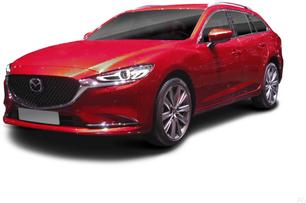
At first glance there's not a lot that separates this from its siblings, it's not until you get up close that you notice more shiny chrome accents on the grille, those special anniversary badges on the side and its limited colour options – I hope you like red or white, as those are your only choices!
The wagon manages to look sporty with its 19-inch alloy wheels, full LED exterior lights and the classic protruding nose that Mazda seems known for now.
It's far more obvious in the interior though with the beautiful tan Nappa leather seats, synthetic suede trims and special embossing on the front headrests.
Surprisingly, the dashboard is still headlined by the older 8.0-inch touchscreen multimedia system. There's also the traditional gear-shifter and buttons/dials to deal with. All of which manage to nod to its long history while starting to feel like relics for such a special edition.
Overall, its pleasant and handsome but don't expect to be wowed, Mazda hasn't broken new ground with this one.
The A8 is close to 5.2 metres long, yet instantly recognisable as an Audi thanks mainly to its evenly weighted proportions, gently curved roofline and overall high-waisted design. Worth noting its drag coefficient (Cd) is an impressively slippery 0.25.
The characteristic look is accentuated by the brand’s signature, six-sided grille, in this instance highlighted by a matrix of high-relief chrome accents. And typically angular LED Matrix headlights sit either side.
Check out our video review for the carefully orchestrated animation they run through when the car is unlocked.
The car looks equally svelte and contemporary from the rear, with just the right amount of chrome lifting the tone and multi-spoke 20-inch rims filling the wheel arches nicely.
As you’d expect, the top-shelf look and feel continues inside with the seats trimmed in aniline leather, perforated on the front and outer rear positions, with genuine hide also covering the centre console, door rails and armrests, steering wheel and upper dashboard.
Fine grain ash wood inserts sit alongside brushed metal elements and a meticulous attention to detail is obvious… everywhere.
For example, the interior door handle design has been thoroughly thought through, requiring a simple underhand tap to open the door, rather than the more conventional, and ergonomically convoluted, ‘over the top’ movement.
Three sleek screens dial up the tech - a 10.1-inch multimedia interface at the top of the centre stack, an 8.6-inch display below it for heating and ventilation, and a 12.3-inch version of Audi’s ‘Virtual Cockpit’ in the instrument binnacle.
And the spacious rear is the epitome of cool, calm Teutonic form and function. You feel relaxed the moment you get in, and isn’t that the primary aim of a car like this?
The interior is comfortable and well-proportioned but front passengers will enjoy the most room. You'll still feel like you'll be jostling for premium armrest position, though!
Up front, the individual storage is adequate and the open utility tray is large but my phone slid around in it, making it hard to use the wireless charging pad.
There are enough charging options throughout the car to satisfy four people, with two USB-A ports in each row. Curiously, you can only utilise the backseat USBs when the armrest is down, which makes this feel more suited to a smaller family.
The 8.0-inch touchscreen is small and the graphics aren't super clear. You can use it as a touchscreen or opt for the rotary dial but I found switching between the two awkward. Especially, since the touchscreen is disabled while using the (wireless) Apple CarPlay or (wired) Android Auto.
The back seat is quite lean when it comes to amenities and storage. Although, the heated outboard seats are a nice touch, but again, you can only access the controls when the armrest is down.
You can fit up to three (skinny) child seats but with the low roofline, you might not want to be bending over to buckle them in. The door apertures are not too wide either but my six-year-old had no trouble climbing in and out.
For this class, the boot is an okay size at 506L. There is a temporary spare wheel under the level loading space and it's great how the cargo-blind lifts up and away from the space because it's attached to the boot lid.
Unfortunately, this doesn't come with a powered tailgate and I did miss having that feature this week.
Space is luxury, be it a large house, a first class seat or a spacious car, and at nearly 5.2 metres long with a close to 3.0m wheelbase the Audi A8 measures up.
Even before you get in, the doors have an amazing sense of solidity and quality. It’s like opening and closing a bank vault… if that huge circular door had a power-assisted soft-close function.
There’s copious amounts of space for the driver and front passenger with lots of storage including a lidded box between the front seats, complete with a two-piece longitudinally split top design, so you can sneak your half’s open without displacing your neighbour’s elbow.
The door bins are decent but there isn’t a specific cut-out for bottles, so it’s more a case of laying them down than standing them up. There’s also a handy covered cubby at the end of the door armrests.
The glove box is a good size and there are two cupholders under a pop-up cover in the centre console.
Of course, the back is where space really counts, and there’s as much room as you’d find in, well… a limo.
Sitting behind the driver’s seat, set for my 183cm position, I enjoyed copious amounts of head, shoulder and legroom.
There are electric sunblinds for the rear and rear side windows, controlled by buttons in the door as well as the rear seat remote, a 5.7 inch OLED display housed in the beautifully trimmed fold-down centre armrest (which also has a soft close function!). The remote also allows adjustment of the lighting and climate control. Classy.
There’s a shallow storage box and twin cupholders in the armrest, medium size door bins and hard shell pockets on the front seat backs. The rear armrests also feature a small lidded cubby.
In terms of connectivity and power options there’s wireless Android Auto and Apple CarPlay, a USB-A and USB-C in the front, and an identical pair in the rear, as well as a 12-volt socket in the front and two in the back.
Boot volume is a useful 505 litres (VDA) and the lid is electric, with gesture control. It’s able to easily swallow our three-piece luggage set or the bulky CarsGuide pram. And while the rear seats don’t fold there’s a ski port door to accommodate long items. Just make sure you use the tie-down anchors in the boot to ensure they’re properly secured. There’s a handy netted section behind the left wheel well and a cargo net is included.
Maximum towing capacity, for a braked trailer, is 2.3 tonnes (750kg unbraked) and in more good news, the spare is a space-saver rather than the increasingly prevalent inflator/repair kit.
As the name suggests, this is a special edition and it bumps the Atenza from its usual 'top spot' in the model line-up. Yet, for a top-model it is spectacularly well-priced at $54,935, before on-road costs.
That places it below the Volkswagen Passat 162TSI Elegance ($57,190) and above the Skoda Octavia RS 180TSI ($53,090) wagons.
You get all of the features of the Atenza, like the luxurious heated and ventilated front seats, heated rear outboard seats, heated steering wheel and a sunroof.
Then, you'll also be enjoying the 20th Anniversary badging on the exterior, tan Nappa leather seats with that same badging embossed on the headrests and a delightful synthetic suede trim on the dashboard.
Other features include some nice tech, like wireless Apple CarPlay and wired Android Auto, dual-zone climate control and a premium Bose sound system with 11 speakers, but more on tech below.
With an entry price of $202,700, before on-road costs, the A8 is in the thick of it amongst its full-size primo sedan competitors from Europe and Japan. Specifically, BMW’s 740i MHEV ($272,900), the Lexus LS500h ($195,920), Maserati Quattroporte GT ($210,990), Mercedes-Benz S450 ($244,700) and Porsche’s Panamera ($207,800).
By definition, a luxury car should be loaded to the gunwales with features that make life on the road that little bit easier. And aside from the performance and safety tech we’ll cover shortly, the highlights from a very lengthy standard equipment list are - 20-inch alloy rims, metallic paint, adaptive cruise control, digital matrix LED headlights, digital OLED tail-lights, full keyless entry and start, power-assisted door closing, power boot lid (with gesture control), a panoramic sunroof, heated, ventilated and massaging electrically adjustable front seats, heated front armrests and extended leather trim (centre console, door rails and armrests, steering wheel and upper dashboard).
Also included are ambient interior lighting (with 30 colours and six colour profiles), four-zone climate control, electric sunblinds for the rear and rear side windows, ‘Audi Connect’ navigation and multimedia (with voice and handwriting recognition), wireless Android Auto and Apple CarPlay, 17-speaker 730-watt Bang & Olufsen audio (with digital radio) and a colour head-up display.
There’s a lot more, and the A8 can hold its head high in terms of pricing and features relative to its $200K price tag and the competition.
This shares the same engine with the Atenza and that's a 2.5-litre, four-cylinder turbo-petrol one. It has a max power output of 173kW and 420Nm of torque. Plenty of oomph to get you (and your gear) to where you need to go.
The 20th Anniversary edition is a front-wheel-drive and has a six-speed auto transmission. It's not the smoothest combination at lower speeds but let it stretch its legs and you'll be happy with the results.
The Audi A8 50TDI is powered by a 3.0-litre turbo-diesel V6 engine sending 210kW (from 3500-4000rpm) and 600Nm (from 1750-3250rpm) to all four wheels via an eight-speed automatic transmission (with ‘Tiptronic’ sequential manual shift function) and Audi’s quattro constant all-wheel drive system using a self-locking centre differential.
It also features a 48-volt electrical set-up for mild hybrid functionality built around a belt connected starter/generator, AC to DC converter and a 48-volt lithium-ion battery.
With energy recovery of up to 12kW from regenerative braking, it enables the A8 to regularly coast with the engine switched off and helps the extended stop-start system to operate smoothly.
Let's talk about efficiency. It has a combined cycle fuel figure of 7.6L/100km but I only managed to achieve 10.9L. I reckon that's pretty thirsty considering how much open-road driving I did this week but it's not outrageous for a turbo. Expect a higher figure in an urban setting.
Based on the combined figure, you should be able to get a driving range of around 816km, which is perfectly respectable for those wanting to do a road trip.
Audi’s official fuel economy number for the combined (ADR 81/02 - urban, extra-urban) cycle is 6.6L/100km, the 3.0-litre turbo-diesel V6 emitting 175g/km of CO2 in the process.
Over a week of city, suburban, and some freeway running we averaged 11.1L/100km, which is acceptable for a 2.1-tonne luxury sedan.
Also worth noting the standard stop-start system works beautifully thanks to the 48-volt starter/generator.
You’ll need 82 litres of diesel to fill the tank and using the official number, that translates to a range of just over 1240km, which drops to around 740km using our real-world figure.
This is a car that knows what it is and stays in its lane. It's not trying to be the best but it certainly comes close with how it handles itself.
The lower centre of gravity and responsive steering make it hug corners and the car feels firmly situated on the road.
There's enough power that this is a comfy open-roader and you're confident overtaking or getting up to speed but you do feel like you're starting to dig when you hit steeper slopes.
The suspension is a little firm but your backseat passengers will feel that more than you will. Still, it absorbs enough of the bumps that you feel cushioned, even on rough country roads!
The cabin space is fairly quiet but you will get wind noise at higher speeds. Otherwise, all passengers should be able to chat without raising their voices.
I didn't find this to be a bother to park but the 360-degree view camera is terrible. It's very blurry and on the 8.0-inch screen, the image looks small, too.
That said, I love the 11m turning circle and the front and rear parking sensors. Overall, you won't have much trouble parking this one.
Despite extensive use of aluminium in the ‘ASF’ platform and body panels, the A8 tips the scales at a sturdy 2095kg, yet Audi says the A8 will accelerate from 0-100km/h in just 5.9 seconds. And with 600Nm of peak torque available across a flat plateau from 1750-3250rpm this big four-door gets up and goes hard when asked to.
At more sedate speeds you’re occasionally reminded there’s a diesel engine under the bonnet, with that characteristic engine and exhaust noise only making their presence felt under pressure.
In fact, under normal circumstances, noise, be it the engine, tyres or wind is minimal, thanks to a combination of the car’s aero-efficient shape, thick acoustic glass and other sound-deadening measures throughout the car.
The eight-speed auto transmission is suitably smooth, with the central shifter or wheel-mounted paddles able to make snappy sequential ‘manual’ shifts.
There are four drive modes in the ‘Drive Select’ system - ‘Comfort’, ‘Auto’, ‘Dynamic’ and ‘Individual’ - enabling tweaks to the steering, transmission, throttle and suspension. Comfort felt most appropriate most of the time, although dialling up the throttle and transmission to more aggressive modes in Individual adds an enjoyable edge.
The suspension is five-link front and rear with an adaptive air system smoothing even high-frequency bumps and ruts amazingly well.
Push into a corner and the A8 feels nicely balanced, its wide track, sophisticated suspension, plus the quattro AWD system seamlessly distributing drive between the front and rear axles, keeping the big body under control. In fact, you feel the ‘big car shrinking around you’ syndrome from the get-go.
The steering is precise without being overly sharp and road feel is good. Again, with that 2.1-tonne kerb weight in mind, braking is appropriately powerful with big ventilated discs front (350mm) and rear (330mm).
It pays to remember the turning circle is 12.5m, and it’s worth picking your spot for a U- or three-point turn.
Although there’s a lot going on for the driver in terms of screens, buttons and switches it all makes sense ergonomically. The head-up display is helpful and there’s a common sense mix of digital and physical controls, the latter including an audio volume knob. Yes.
Safety is important on any car, but more so on a family one. I'm happy this has the usual specs, like daytime running lights, lane keeping aid, lane departure alert, blind-spot monitoring, rear cross-traffic alert, 360-degree view camera, front and rear parking sensors and intelligent seatbelt reminders.
I like the fact the adaptive cruise control now has a stop and go function and that traffic sign recognition and a head-up display are included.
The autonomous emergency braking (and forward collision warning) with car, pedestrian and cyclist detection, is operational from 10–80km/h (a little slower than the average 5.0km/h).
It has a maximum five-star ANCAP safety rating but it was done a while ago in 2018. It only has six airbags which is a bit low for a family vehicle now but that does include curtain airbags covering both rows.
There are ISOFIX child seat mounts on the outboard rear seats and three top-tether anchor points across the back. You may get lucky with three skinny child seats but two will fit best.
A 0-4 rearward facing child seat can be installed but will encroach on front passenger comfort, especially if they're tall.
Even though the A8 hasn't been assessed by ANCAP, as you might expect, it goes to town when it comes to active safety tech, the car’s standard crash-avoidance features including auto emergency braking (AEB) (pedestrians/cyclists - 5.0-85km/h, vehicles - to 250km/h), ‘Active Lane Assist’, blind-spot monitoring, a reversing camera and 360-degree view (including kerb view function), front and rear parking sensors, ‘Collision Avoidance Assist’ (steering assistance in critical situations), ‘Turn Assist’ (monitors incoming traffic when turning right), and rear cross-traffic alert.
There’s also ‘Intersection Crossing Assist’, ‘Attention Assist’, tyre-pressure monitoring and an ‘Exit Warning System’ (detects cars and cyclists when opening doors).
If all that isn’t enough to avoid a crash the airbag count runs to nine, including front and side bags for the driver and front passenger, side airbags covering the outer rear passengers, full length curtains and a front centre airbag to minimise head clash injuries in a side impact. A first aid kit, warning triangle and high visibility vests are also on-board.
There are three top tethers for baby capsules/child seats across the back seat with ISOFIX anchors on the outer positions.
The ongoing costs match the purchase price for their affordability. This has a five-year/unlimited km warranty, which is pretty normal for this class.
However, on the five-year servicing plan, services average $501 per service - which is very competitive for this class! Servicing intervals are also reasonable at every 12 months or 15,000km, whichever occurs first.
You're not even getting hit with the fuel pricing you can see on other mid-range models because this accepts a minimum of 91 RON petrol and is even E10 suitable.
The A8 is covered by Audi Australia’s five-year/unlimited km warranty, which is now par for the luxury market course, and 24-hour roadside assistance is included for the duration.
Paint defects are also covered for five years, with rust (to the point of perforation) covered for 12. Nice.
Service is required every 12 months or 15,000km with a five-year capped-price plan for the A8 coming in at $3830, or $766 per year. That’s a fair wedge but not outrageous for the category.