What's the difference?
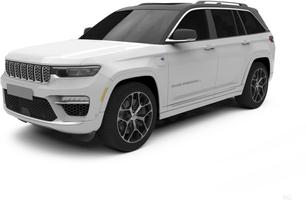
Jeep Australia's first plug-in hybrid, the Grand Cherokee 4xe, has arrived at a time when the company’s sales figures need a decent shot in the arm.
Though it’s seemingly spearheading a large and extra-large SUV hybrid push into the Aussie market, with the likes of a Toyota LandCruiser 300 Series hybrid on its way, the marque’s debut PHEV is only available here in the range-topping Summit Reserve spec, and only as a five-seater.
So, does the 4xe have enough of a jump on any large SUV hybrid rivals – including a rumoured but postponed Ford Everest hybrid – and is it enough to give the brand a much-needed boost?
Read on.
This is the new Tesla Model Y L, of course, but before we even start I need to ask you a very important question.
How often, honestly, do you use all seven seats in your seven-seater? Or if you only have five seats, how often is there a human in every single one?
Rarely, if ever?
Yep, me too. So stick around, because this is, by far, the best family SUV seating layout. And one where there’ll finally be no fighting over who gets stuck with the dodgy seat.
And as a result, the six-seat Tesla Model Y L might just be among the best all-electric SUV offerings around.
A wise man* once said "Being first can sometimes feel like being wrong" and perhaps that's how it is with the 4xe, but at least Jeep Australia is giving the large SUV hybrid realm a good ol' try.
* Former CarsGuide Big Kohuna, Glen Knowles.
The company's first plug-in hybrid, the Grand Cherokee 4xe, is not perfect by anyone's standards, however, it is a definite move in the right direction.
It's a quiet and refined drive, it retains the brand's renowned 4WD capability, and even its hefty price-tag likely won't dissuade Jeep loyalists from giving it a go.
If you like the five-seat Model Y, then you'll like the six-seat L version even more. I think this the best example of Tesla's electric SUV to date, and the cabin layout just makes a lot of sense, and would suit plenty of families who don't need to squeeze someone into a compromised middle seat.
Note: The author, Andrew Chesterton, is a co-owner of Smart As Media, a content agency and media distribution service with a number of automotive brands among its clients. When producing content for CarsGuide, he does so in accordance with the CarsGuide Editorial Guidelines and Code of Ethics, and the views and opinions expressed in this article are solely those of the author.
Spoiler alert - it looks a lot like a five-seat Model Y, doesn’t it, albeit a slightly bigger one. And you’d have to be a bigger Tesla head than me to immediately spot the differences at a glance.
The wheelbase is longer, the rear doors are bigger as are the rear 3/4 panels and the roof line is higher, helping with headroom in the third row.
Still, safe to say if you like the look of the five-seat Model Y, you’ll like this one. And if you hate it, well, good luck.
The alloys are 19-inch and shaded by the aerodynamic caps and there are light bars front and rear which debuted on the updated five-seat Model Y when it arrived mid-last year.
The bigger changes are inside, of course. I promise we’ll get to the second and third rows in the Practicality section, but let’s talk about the look and feel first.
There’s a love/hate relationship with Tesla’s stripped-back aesthetics, and I’m probably somewhere in the middle. I like the airiness of the space in the cabin, and I think it feels nicely put together, and I really dig the contrasting fabric used on the doors and dash which add a little visual interest to the cabin.
But I hate using the central screen to select a gear and I hate not being able to see how fast I’m going without turning my head. A head-up display would work wonders in the Model Y L cabin.
The Jeep Grand Cherokee Summit Reserve 4xe PHEV retains the regular model’s level of functionality but adds a reasonably classy touch to everything.
All seats offer adequate comfort, support and room.
There are plenty of storage spaces, cupholders etc, and charging points - two USB-A and two USB-C plus a 12V socket in the front and two USB-A and two USB-C plus a 230V point in the back.
Controls are generally easy enough to locate and operate although some buttons are positioned in awkward places – including drive-mode buttons under the steering wheel – and it sometimes takes a few finger-stabs at the multimedia touchscreen to get to where you want to go in the operating system.
In terms of packability, the rear cargo area has a listed 1067 litres of space, and, with the second row folded and out of the way, that space opens up to 2004 litres.
Captain’s chairs are simply a more luxurious version of second-row seating. With that there is no argument and the heated and cooled chairs that occupy the second row of the Model Y L are pretty good examples of them.
Space, both knee and headroom, is ample, and you can adjust each seat individually if you want to grant a bit more space to any third row occupants. Armrests deploy at the push of a button — as do the two hidden cupholders — and it really is easy to settle in and get comfy.
The third row is a bit more hit and miss. I’m 175cm and found I had enough legroom and headroom, but the big plastic mouldings that emerge from each side of the Model Y (which house a cupholder) are a miss. They end up pushing you into the seat next to you, and I can foresee a lot of arm rubbing with anything like two adults back there.
Also confusing is how to actually get out of it. You can fold the seat in front of you flat, but then you have to climb over it. I found it easier to just walk out between the seats.
There are another two USB-C ports in the rear row and you get air vents but no temperature controls.
The Model Y L stretches 4969mm in length, 1668mm in height and 2129mm in width, which is roughly 18cm longer and 4.5cm taller than the five-seat model. The extra space doesn’t sound like that much, but start dropping rows and you find a heap of storage space.
Both the second and third row stow electronically from the boot, but with them in place you’ll find 420 litres of storage in the double-layer boot. Drop the third row, and that number grows to 1076 litres. With the third row folded there is a massive 2423 litres of space. The frunk serves up another 116 litres.
There’s also room (and the ISOFIX attachment points) for four child seats.
The five-seat Jeep Grand Cherokee Summit Reserve 4xe PHEV has a MSRP of $129,950 (excluding on-road costs).
Standard features include a 10.1-inch multimedia system (with Apple CarPlay and Android Auto), a 10.25-inch digital instrument cluster, 19-speaker audio system, quilted Palermo leather-trimmed seats, air suspension and 21-inch alloy wheels.
It also has a heated steering wheel, 12-way power-adjustable seats and four-way power lumbar adjustment with memory for driver and front passenger, driver and front passenger seat massage function and heated and ventilated seats (driver, front passenger and rear outboard passengers).
A Mode 2 charging cable is also included.
An 'Advanced Technology Group' pack is available as a $5500 option and that includes a head-up display, a 10.25-inch screen for the front passenger, wireless phone charger, and night vision camera.
Exterior paint options include 'Bright White', 'Diamond Black', 'Silver Zynith', 'Velvet Red', 'Baltic Grey', 'Rocky Mountain', 'Midnight Sky' and 'Hydro Blue'.
The Model Y L sits smack bang between the $68,900 Long Range AWD and the $89,400 Performance, setting you back $74,900, before your on-road costs. It’s also the only three-row option in the Tesla family.
Aside from people movers, we’re not swimming with options in the three-row electric space, either. The Kia EV9 will get it done from $97,000, the Hyundai IONIQ 9 starts from around $120K and the Volvo EX90 is more expensive again (from $124,990).
Anyway, in Tesla land, the Model Y L rides on 19-inch alloy wheels, has a glass roof, automatic wipers and Tesla’s smartphone access key, as well as the little credit-card swipe.
Inside, there’s a 16.0-inch central screen that handles everything. And I mean everything. It's your gear selector, your speedometer, and everything else, too. There’s no Apple CarPlay or Android Auto, but you can access things like Spotify and podcasts through the in-built apps and the on-board navigation system is a good one, too.
All of that pairs with a 19-speaker sound system, and there are dual wireless charge pads. All three rows of seats are heated, while the first and second row get ventilation, too.
A second 8.0-inch touchscreen in the middle row then handles things like the seat heating or cooling, music and games to amuse the kids. And the Model Y L also debuts V2L, or Vehicle to Load, for Tesla in Australia, using a connector in the external charger.
The Jeep Grand Cherokee Summit Reserve 4xe PHEV has a 2.0-litre four-cylinder turbo-charged petrol engine, two electric motors (one on each axle) and a 17.3kWh battery.
Combined engine and electric outputs for power and torque are 280kW and 637Nm, respectively. The 4xe has it over any of its stablemates equipped with the 3.6-litre Pentastar V6 petrol engine because that yields 210kW and 344Nm.
The 4xe has an eight-speed automatic torque-converter transmission and regenerative braking.
Drive modes include 'Hybrid' (with combined engine and electric motor providing “maximum instant torque and impressive acceleration”, according to Jeep), 'Electric' (“zero emissions”) and 'eSave' (aims to save battery power).
There are a few options available when it comes time to charge the 4xe.
The 4xe vehicle has a Mode 2 charging cable so you can charge it at home in less than 10 hours, according to Jeep.
With a full charge, the 4xe has a claimed driving range, on electric charge alone, of 52km.
Jeep reckons a Mode 3 (wall box) single-phase electric vehicle charger will fully charge the 4xe in less than three hours.
If out and about and looking for a charge, a 4xe driver can use the onboard 'UConnect' system to locate an appropriate public charging station.
The Model Y L gets Tesla’s dual-motor AWD powertrain, with two electric motors producing a total 378kW and 590Nm. That’s enough, Tesla says, to knock off the sprint to 100km/h in five seconds flat.
As mentioned, the 4xe has a listed electric-only driving range of 52km.
On our official test day, we drove just under 50km on a full electric charge and then the rest of the trip was courtesy of the good ol’ petrol engine.
Jeep's official figure for the combined cycle is just 3.2L/100km, but that's predicated on keeping the hybrid battery charged at all times. On fuel-only we recorded 11.6L/100km.
The 4xe has a 72-litre fuel tank (you need 95RON premium to fill it), so going by that on-test fuel-consumption figure, you could reasonably expect to get a driving range of about 620km out of a full tank.
Add an approximate electric range of about 50km on a full charge to that figure and you have a total estimated driving range of 670km.
Tesla is always a little vague when it comes to the size of its batteries, but reports point to the Model Y L carrying a 84Wh (useable) NMC battery.
Whatever the specifics, the range is strong, with Tesla promising a 681km driving range on the WLTP combined (urban/extra-urban) cycle.
It’s also set up for 250kW DC fast charging, which should see you take on 288km in 15 minutes, according to Tesla.
We’re all time-poor, right? So, why should I take up your time and rattle on about the 4xe for a thousand words when I can get the essence of it across to you, the reader, in a few sentences? Call me, Mr Thoughtful.
This is generally a big, quiet and refined, easy-steering large SUV, but it feels bulky at times and tends to be quite fussy on irregular surfaces, exhibiting a jittery ride on even brief sections of light corrugations on dirt tracks.
The 4xe’s PHEV set-up is smooth and highly responsive on-road and you can switch between the aforementioned drive modes to suit the circumstance.
Driving range on electric only is listed as 52km. I only recorded a total distance of just under 50km, and it’s a very quiet and smooth drive while relying on electric power.
It regenerates power rather quickly down big hills and via braking, but we’d exhausted all electric charge by the time we’d reached our 4WD test track.
As expected, this Grand Cherokee tackled every off-road challenge without any strife.
The air suspension, set to full off-road height, is a bonus.
Our 4WD test track consists of difficult set-pieces, including one small steep rocky hill that I’ve seen heavily modified vehicles struggle to conquer and, to the Jeep’s credit, it climbed the incline, no sweat.
The 4xe’s efforts were only ever hampered by its 'all-season' Continental CrossContact tyres (275/45R21) which are much better suited to blacktop driving and the fact the 4xe costs upwards of $129,950 and I didn’t want to risk any damage to it.
The 4xe has a listed wading depth of 610mm but our test track was dry so I never had the chance to do any water crossings.
The Grand Cherokee has a solid enough rep as a towing vehicle but, take note, the 4xe is rated to tow 2722kg.
Honestly, it feels like the Tesla Model Y has grown up. I didn’t love earlier iterations of this car and I found the Performance to be fast but lacking any emotional fizz.
This one, though, feels solid and composed, and the power on tap (of which there is ample) is more about effortless progress than it is attempting to offer sports car excitement.
The steering is now nicely weighted and feels direct enough without being too sharp, and the cabin is well insulated, with often the slightly off-putting sort of rubbing noise the steering wheel makes when you turn it the only intrusive sound.
One drawback is a ride that definitely errs on the side of firm. This Model Y L gets electronic damping designed to iron out some of the more jagged stuff, but it still feels brittle in places, and you can definitely feel some sharpness in the cabin. Now, to be fair, it’s not too firm for me, but it might be for you.
Another is a bizarre turning circle which constantly reminds you you’re driving a big bus, especially when you try to complete a tight three-point turn.
But despite its stretched dimensions, I found the Model Y L easy to drive and park in the city, and once you're up to speed with Tesla's operating system (there's no Apple CarPlay or Android Auto), then the screen is pretty easy to use, too.
The Jeep Grand Cherokee Summit Reserve 4xe PHEV has the maximum five-star ANCAP safety rating from assessment this year.
Safety gear includes AEB with pedestrian detection, blind-spot monitoring with rear cross-traffic alert, adaptive cruise control, lane-keep assist, driver monitoring, traffic sign recognition, intersection collision assist, and a surround-view parking camera.
The Summit Reserve spec brings with it 'ParkSense' parallel and perpendicular park assist and (low-level autonomous) 'Active Driving Assist'.
It has eight airbags including front, side, and knee (for driver and front passenger), sides (for second-row passengers) and full curtain airbags.
The Model Y L gets the same maximum five-star ACNAP safety rating as the rest of the Model Y range, with nine airbags (up from seven in the five-seat model), and things like AEB (Auto Emergency Braking), lane-keeping assist, 'Forward Collision Warning' and blind-spot monitoring all along for the ride.
Interestingly, the curtain airbags from the five-seat version haven't been replaced, with coverage still only extending to the second row. New airbags have instead been added for third-row occupants.
One more analogue quirk of the Tesla Model Y L is the thick B-pillar, which does a good job of almost completely obscuring driver-side blind-spot checks (for those of us who still like to do those manually).
The Jeep Grand Cherokee Summit Reserve 4xe PHEV has a five-year/100,000km warranty and a lifetime roadside assist service.
Servicing is set at 12-month/12,000km intervals and capped price servicing keeps what you pay for each appointment at $399 for the first five.
Tesla warranty is a these-days-underwhelming five years and unlimited kilometres, while the high-voltage battery is covered for eight years or (a wildly specific) 192,000km.
There’s also five years' of roadside assistance, including puncture repair (a good thing, given the lack of a spare wheel). I also couldn’t find a puncture repair kit and later research suggests Tesla sells them, rather than provides them as standard.
Tesla servicing is condition-based, so there’s no fixed schedule, with a summary on the car’s touchscreen providing a record of when vehicle maintenance was last carried out and prompts for when they should be performed next.
In the absence of a combustion powertrain the emphasis is on things like wheel rotation, balancing and alignment, brake fluid testing, air-con servicing, camera precision, radiator cleaning and high-voltage battery maintenance.
Expecty a ‘Vehicle Health Check’ to come in under $300 with ‘General Diagnosis’ at around $270 per hour.