What's the difference?
The Jeep Compass is something of a unicorn among the long list of small SUVs sold in Australia. It is now the only model in either the light or small-SUV category that is available with a diesel engine.
That diesel is found under the bonnet of just one variant – the rugged Trailhawk which is also the flagship of the range.
Aside from Suzuki’s adorable Jimny light SUV, the Compass Trailhawk is the only small SUV with some off-road ability.
After going on sale in Australia in late 2017, the second-generation Compass was overhauled as part of a mid-life update in 2021. Aside from subtle styling tweaks, the biggest change was a new multimedia system.
Has Jeep done enough to lift the Compass from an also-ran to a model that buyers should consider, or was the update too little, too late?
This might be the biggest gamble in Porsche's history. It's the latest version of its best-selling car, the Porsche Macan, only this one has a very big difference.
You see, this time, it’s all-electric. There is not an internal-combustion engine (ICE) in sight. And that makes climbing into an entry-level Macan significantly more expensive than ever before.
So, will this bold shift help or hinder the Macan in Australia? And is this the country’s best all-electric SUV?
There’s only one way find out.
The Jeep Compass Trailhawk is a curious beast. On the one hand, it looks pretty cool, and it has a well-executed new interior, featuring one of the best multimedia set-ups in the business. It’s spacious and has a long list of standard comfort and safety gear.
Sadly, that’s where the positives end.
It is way too expensive for what you get, especially when you consider the quality of some of its rivals from mainstream and premium brands.
The driver assist features are badly in need of recalibration and the overall drive experience is a letdown.
If you really want a diesel-powered small SUV, perhaps look at one of the much better diesel models at the smaller end of the medium-SUV segment.
There is no doubting the substance of the Porsche Macan Electric. Its ride, steering and poise make it a joy to drive on twisting roads, and it ticks the practicality boxes, too.
The only lingering question is whether enough people are ready to make the all-electric switch. Only then will we know if Porsche's Macan gamble has paid off.
Note: CarsGuide attended this event as a guest of the manufacturer, with travel, accommodation and meals provided.
When the second-gen Compass was revealed, it was seen by many as a mini Grand Cherokee. Which isn’t a bad thing. It looks tough enough, but also has a softer edge than something like the Jimny.
As part of the 2021 update, Jeep refreshed the styling with slimmer LED headlights and a new daytime running light signature, a revamped bumper and seven-slot grille, as well as a broader bonnet.
The Trailhawk features variant-specific red and black decals on the bonnet, and a unique grille treatment, as well as the visible skid plates and red tow hooks.
It certainly gives the impression of having some off-road cred, and while some will love the Trailhawk name emblazoned across the bonnet, it’s a bit much for me. The 'Galaxy Blue' premium paint looks too sparkly in direct sunlight and has an almost purple hue.
An example of wishful thinking is the green ‘Diesel’ badge with a leaf next to it on the rear of the vehicle. Save the eco badges for your electrified vehicles, Jeep.
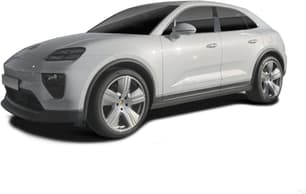
The Macan Electric looks sharp, all aerodynamic and swept-back like a range-maximising electric SUV should.
There’s functional method behind all this swoopy styling, too. The headlights look as though they’ve been chiselled into the body work, and at the grille, you’ll find active venting to help with cooling when needed.
There is also a sizeable front splitter that looks very much like the Macan is sticking its jaw out. All of which is to assist with aero and range.
It’s also a dual charging port layout with access left and right, though the latter is AC charging only, while the one on the left does both.
Step inside the Macan and you’ll find a familiar and very welcoming space. I especially like the twin-screen set-up that looks great in the way it's kind of embedded into the dash. Each is big, clear and easy to use.
I also really like the control panel that gives you quick-button access to the climate control, and the haptic feedback is next level, with the whole screen clicking in or out whenever you hit a button.
That said, in Turbo-guise you’re dropping almost $200,000, and some of the materials feel too hard and plasticky at that price point.
The Compass sits in the small-SUV category but its larger dimensions mean it’s almost big enough to compete with models in the medium-SUV segment.
It’s longer, taller, wider and has a longer wheelbase than other larger small SUVs like the Kia Seltos and Honda HR-V, but isn’t as big as a mid-size Mazda CX-5.
It feels larger inside than other models it shares a platform with – namely the Jeep Renegade and Fiat 500X, that are no longer sold in Australia.
The biggest change ushered in by the update is the interior. Jeep has completely overhauled the cabin to the point that it’s unrecognisable compared to the pre-facelifted model.
The new dash design is much more appealing and the layout is well executed. There’s a mixture of soft-touch materials and plastic panels with red stitching running across the fascia. It’s so much more up-to-date than the old Compass and there’s a robust yet semi-premium look to the cabin.
A new steering wheel is in keeping with Jeep’s new generation of models that includes the Grand Cherokee due in Australia this year. It’s chunky, feels nice to touch and features clear audio, phone and cruise controls.
Jeep has persisted with its quirk of housing the volume and song/station skip buttons on the rear side of the steering wheel spokes. Once you remember which side volume lives (the right), it’s easy to change the levels. But surely it would be better to house them on the front of the wheel, with labels?
Storage wise, the glove box is narrow, as is the central bin, but it’s deep. The doors will hold 600ml bottles and the console houses two decent-sized cupholders with durable rubber lining which is easy to clean and can take a beating. The cupholders are separated by an upright phone holder.
Speaking of durable, that’s clearly the theme Jeep is going for with the Compass Trailhawk interior. It comes standard with rubber mats throughout, including the boot, which is great for protecting the carpet if you fancy a bit of camping.
What isn’t durable, however, is the cheap and tacky indicator stalk that feels like it will snap off every time you touch it.
After spending some time in European cars prior to the Jeep, it’s nice to experience strong air flow from the air conditioning system, especially at the height of a Melbourne summer. It’s also great to see physical buttons for the air con controls.
You can, however, also control the climate via the latest 'Uconnect 5' multimedia system housed in the 10.1-inch touchscreen.
This system is undoubtedly one of the Compass’ strong points. The modern graphics look very cool and the main icons make sense.
Once you dive into the menu there are extensive options but it’s not overwhelming. It’s intuitive and clever. The sat-nav visuals are clear and appealing too.
It’s an excellent set-up and better than systems from a whole host of Jeep’s mainstream rivals.
Apple CarPlay set-up was easy but there is an odd lag when selecting a command on the touchscreen that isn’t there when you use the Jeep system.
Another highlight is the exceptional Alpine nine-speaker audio system that’s part of the Trailhawk Premium package. It’s a belter!
The new digital instrument cluster has clear dials but changing the screen layout is fiddly. The Compass also lacks a head-up display.
The front seats with red embossed Trailhawk across the front look good, but the cushion feels like it’s elevating you in the seat. It’s not a problem with the power adjustment, it’s just the way the cushioning is designed. Thigh support is limited but upper body bolstering is good.
Visibility is impacted by the narrow rear windscreen and the tiny rear windows behind the C-pillar, that are pointless.
Rear occupants have access to lower air vents, a USB-A and USB-C port, 230-volt AC plug and a 12-volt DC plug. There are two map pockets, rubber floor mats and 600ml bottles will just fit in the door.
Space wise, there’s plenty of leg and toe room in the rear, and just enough headroom for this six-footer to avoid scraping the headliner.
Getting in and out of the front and rear seats is easy thanks to the Compass’ ride height.
The rear seats are flat and firm and the 60/40 split-fold seats have a fold-down central armrest with two cupholders.
When you open the power tailgate, the boot doesn’t look particularly big, but at 438 litres (1251L with rear seats folded), it’s five litres more than the Kia Seltos GT-Line and eight more than the Haval Jolion.
A full-size spare wheel lives under the boot floor and the cargo area features metal tie-down hooks and a small storage tray.
The cargo blind is useful but there’s nowhere to stow it when it’s not in use. And you have to lower the rear seats when you want to put it back in place.
There is a little open-sesame magic at play with the Macan, and that starts at the frunk, where, if you lovingly caress the bonnet, it will automatically pop open for you, revealing an 84-litre storage space.
Rubbing the charging port will see it slide open, too, but just in case you’re not the kind of person who likes to fondle their car in public, you can use the key.
The Macan’s boot is a little more traditional, opening to reveal 540 litres (but just 480 litres in the 4S or Turbo) of storage with the rear seats in place, with a wide, flat and very useable area for your goodies.
The back seat of the Macan feels spacious enough, without being outstanding. There’s more than enough space for my 175cm frame, with enough knee and head room, but the way the middle console juts out will definitely eat into leg room for any middle-row passenger.
Elsewhere you get air-con controls with vents, along with bottle storage in each of the doors. There is also a pull-down divider that’s home to two extra cupholders.
Jeep’s pricing for the updated Compass range is at the higher end of the segment compared with its rivals. It starts at $37,950, before on-road costs, for the Launch Edition and tops out at $51,650 for the range-topping Trailhawk.
Our Compass Trailhawk test vehicle was fitted with options including premium paint ($895) and a 'Trailhawk Premium' package ($4195) that added heated and ventilated front seats, heated steering wheel, a panoramic sunroof and a nine-speaker Alpine audio system. That bumped the price up to $56,740 before ORC, meaning it’s about $60,000 on the road.
Top-spec versions of competitor small SUVs are much cheaper than that. The Kia Seltos GT-Line is $42,200, the Mazda CX-30 X20 Astina is $47,390 and even the European Peugeot 2008 GT Sport is $43,990.
Considering you can buy an Audi Q3 40 TFSI quattro for $61,600 or a Volvo XC40 T5 R-Design for $56,990, Jeep is creeping into premium territory with the Compass Trailhawk.
Luckily, Jeep has packed the Compass Trailhawk with loads of standard goodies.
The Indian-built SUV includes keyless entry and start, wireless charging, leather bucket seats, dual-zone air conditioning, eight-way power adjustable driver’s seat, power folding exterior mirrors, auto-dimming rear-view mirror, a 10.25-inch digital instrument cluster, a 10.1-inch multimedia screen housing a 360-degree surround-view camera, satellite navigation and wireless Apple CarPlay/Android Auto.
As the rugged Compass variant, the Trailhawk comes with off-road bits as standard, like underbody skid plates, a 180-amp alternator, two front (red) tow hooks, reversible carpet and vinyl cargo mat, low-range gearing as part of the four-wheel drive system, hill hold control and a terrain-type mode selector.
Despite all the standard gear and unique off-road features, it still doesn’t represent great value compared with its rivals.
The Macan arrives with four trim levels, the entry-level Macan, the Macan 4, Macan 4S and then the flagship Macan Turbo. The latter is just a name Porsche now applies to its go-fast models — obviously there isn’t an actual turbo in action.
The new electric range opens with the Macan, which lists at $128,400, before on-road costs. A reminder here that the old entry-level Macan with an ICE powertrain would have set you back less than six figures, so this one represents quite the jump.
Now, it should be pointed out that you can still buy the previous-generation ICE Macan, at least until supply runs dry. The brand isn’t getting any more, but suggests there are enough in the country to satisfy demand until around Q2 next year.
Next is the 4, which is $134,400 and adds a second e-motor. Then comes the 4S, yours for $149,300, before the range tops out with the Turbo, which climbs to $184,400. All prices before on-road costs.
Those are big numbers, but at least Australian-delivered cars are some of the best-specified on the planet.
That starts with the Macan, which gets a 12.6-inch digital instrument cluster, and a second 10.9-inch central touchscreen with Apple CarPlay and Android Auto.
It rides on 20-inch alloys, has synthetic-leather seats that are heated up front and Australian cars get things like the clever 'Porsche Active Suspension Management' (PASM) system as standard.
Next up is the Macan 4, which adds a second electric motor, but otherwise largely mirrors the base car’s spec. Next on the list is the 4S, which rides on a different 20-inch alloy, picks up LED matrix headlights, sports a better Bose stereo, a panoramic roof and four-zone climate control.
Finally, the Turbo is the big dog of the electric Macan range, packing serious power, but also arriving with its own 20-inch alloy wheel design (with 21-inch wheels a no-cost option) — an augmented reality head-up display, and things like the 'Porsche Electric Sport Sound', the 'Sport Chrono Package' and a performance-focused 'Sport+' drive mode.
As mentioned, the Compass Trailhawk is now the only remaining small SUV in Australia offered with a diesel engine. Well, from a mainstream brand at least. The BMW X1 is the only premium small SUV offering with a diesel donk.
The Jeep uses a 2.0-litre four-cylinder turbo-diesel delivering 125kW at 3750rpm and 350Nm at 1750rpm. It is paired with a nine-speed automatic transmission and comes with four-wheel drive as standard.
The entry-level Macan is equipped with a single rear-mounted electric motor, and it will make a total 250kW (265kW with launch control activated) and 563Nm, which is enough to push the cheapest Macan to 100km/h in 5.7 seconds.
The 4 then adds a second electric motor for AWD, upping the grunt to 285kW (300kW with the launch function) and 650Nm, and drops the sprint to a brisk 5.2 seconds.
The 4S is probably the performance sweet spot, with its dual-motor set-up generating 330kW (380kW in launch) and 820Nm, and a blistering sprint of just 4.1 seconds.
But the Macan Turbo is a true monster. We’re talking 430kW (470kW with launch control), 1130Nm and a sprint to 100km/h that’s as fast as a Carrera Cup race car – just 3.3 seconds.
It’s twin-motor, all-wheel drive and offers the kind of brutal acceleration that gives you a little facelift every time you step on the accelerator.
Jeep’s official combined cycle fuel use figure for the Trailhawk is 6.9 litres per 100 kilometres. After a week of mixed but mostly urban driving, we recorded a much higher figure of 11.2L/100km.
The Compass has a 60-litre tank. Combined CO2 emissions are rated at 181g/km.
Every Macan is fitted with a big 100kWh lithium-ion battery, which helps deliver a solid driving range no matter which one you choose.
The entry-level Macan will cover the most distance, at a claimed 654km, while the 4, 4S and Turbo will travel 624km, 619km and 616km, respectively.
The Macan rides on an 800V architecture, and is set up for 270kW DC high-speed charging, which will take 21min to go from 10 to 80 per cent. It will also accept 11kW AC charging, which should take 10 hours to go from empty to full.
Worth noting, though, that most home wall boxes are around 7.0kW, which means a full charge would take more like 13 hours plus.
Jeep claims the Trailhawk has some off-road ability, but we didn’t get a chance to test that. Most driving was around town, freeways and city fringe.
The first thing I noticed when I got behind the wheel was the awkward position of the accelerator pedal. It could be the wheel arch intruding into the footwell, but the right side of my right foot constantly brushed the carpeted panel. It’s annoying and a clear design flaw.
Another flaw is the idle-stop system. When you park, the idle stop kicks in and cuts the engine off. But if you want to properly turn the engine off and get out of the car, you have to do something to wake up the engine, then turn off the ignition. Another annoyance.
The diesel engine is responsive enough, but it lags on take-off and it’s not as torquey as expected. Accelerating hard doesn’t reward the driver with instant response, and momentum is blunted by steep ascents.
It does come alive around 3000rpm which seems to be a sweet spot.
The nine-speed auto can sometimes hold gears and the brakes are on the spongey side.
The Trailhawk feels like a heavy vehicle on the road. Much heavier than its 1621kg tare weight would suggest. As a result, it lumbers along and makes for sloppy handling.
It moves around the road too much and there is quite a lot of body roll in corners. It’s slow to respond coming out of corners, too.
The steering feels lazy and it’s weighted on the heavy side. It doesn’t make for an engaging steer.
Ride comfort around town is well sorted. For the most part, it absorbs speed bumps and crumby urban streets, without offering a truly comfortable ride.
Overall ride quality diminishes at higher speeds. It’s busy and jittery and never feels settled.
Needless to say, this is not the small SUV to buy for navigating city traffic or to take for a fun drive on your favourite twisty country road.
A brief section of unsealed road highlighted the excellent traction of the Trailhawk.
The 225/60 R17 Falken Wild Peak tyres produce a bit of tyre noise on coarse chip roads but otherwise the cabin is fairly well insulated from outside noise.
Porsche seemed at pains to prove that, though the all-electric Macan has lost its ICE heart, it's still worthy of the badge, and still very much a Porsche.
First stop, then, was the Norwell race circuit in Queensland, to put the Macan through its paces with 0-100km/h sprints, drifting (well drift attempts... ) on a watered-down skid pan and finally some high-speed running on the circuit.
And two things immediately became very clear. The first, and most obvious, was that, like the first men on the moon, we were likely among only a handful of people that might ever take their all-electric Porsche mid-size SUV to a race track. And second, this is one seriously sorted electric car.
Happily, for the many (read: every) owners who won't be pulling out of a pit garage at their next local track day, the Macan is actually more enjoyable on the road than it is on the track.
On the latter, there's a freedom to push too hard – what with the lack of trees, guard rails or oncoming traffic – and cracks do appear, mostly from the screaming tyres struggling with the two-tonne-plus weight.
But on public roads, where a thick fog of consequence prevents you pushing too hard, the Macan is a gem.
Porsche tends to have a knack for these things, I know, but the Macan is a seriously smooth and satisfying drive.
The ride is bang-on (comfortable enough on rougher surfaces, firm and grippy enough on twisting roads) and the steering is direct and confidence-inspiring.
Body-roll has been largely banished, too, with the Macan staying flat, stable and satisfying, even on the tighter stuff.
In much the same way the ICE Macan defined what it meant to be a driver's SUV, I think this one does the same in the EV space. And the fact that it does it with five seats and a decent boot is a sizeable bonus.
But there's no denying it lacks in the emotion department. That sense of excitement, the sound track, the hard-to-define fizz – as competent its this, and as weaponised as the EV powertrain is – it does feel a little clinical, like a tool doing its job and doing it well.
One important caveat. We've driven the 4 and Turbo to date. The entry-level Macan and the mid-tier 4S are still incoming. And I suspect I wouldn't be dropping my deposit on the Turbo.
Yes, the power is ridiculous, but I don't reckon you need it. For me, the 4 is more than enough, but I suspect the real performance sweet spot will be with the 4S.
The Jeep Compass was tested by ANCAP in 2017 and the updated model retains its five-star rating.
It features a solid list of standard safety gear including auto emergency braking with pedestrian and cyclist detection, forward collision warning, lane departure warning, lane keep assist, rear cross-traffic alert, a driver fatigue monitor, adaptive cruise control and traffic sign recognition, blind spot monitor, tyre pressure monitor, parallel and perpendicular park assist, 360-degree surround-view monitor, and front and rear parking sensors.
It has six airbags but does not include a front centre airbag that helps minimise injuries during a side collision.
The proximity sensor for the surround-view monitor is overly sensitive when parking or in traffic. It beeps a lot when it doesn’t need to.
Thankfully you can alter the strength of many of the Jeep’s driver assist functions because there are so many audible alerts that it can be overwhelming.
The forward collision warning can also be overly sensitive and go off when there’s clearly no danger. On the flip side, the adaptive cruise control is too slow to respond, prompting me to brake before getting dangerously close to the car in front on the freeway. I had to double check that the car was fitted with adaptive cruise and not just regular cruise control.
Jeep’s 'Active Lane Management System' caused some headaches. It ping pongs you between lane markings rather than centring the vehicle in the lane. It’s jolty and pulls at the wheel far too much.
Again, you can change the strength, but even on the lowest setting it intervenes far too much and makes for a truly frustrating drive experience.
It’s an opt-out system and by the end of my time with the Compass I switched it off every time I got behind the wheel. It’s one of the worst lane-keeping systems I have come across in some time.
On the positive side, the 360-degree reversing camera display is top notch.
The Porsche Macan Electric is yet to be assessed by ANCAP, or by Europe’s NCAP, but it doesn’t appear to be missing any key equipment from its safety list.
That includes curtain airbags that extend all the way to the boot, AEB with pedestrian detection, lane keeping assist, a surround view camera and 'Intersection Assist'.
The Compass comes with a five-year or 100,000km warranty and five years of free roadside assistance. Every time you service your vehicle at a Jeep dealer, another year will be added to the roadside assist program.
The servicing schedule is every year or 20,000km for a diesel Jeep, whichever comes first.
Jeep offers a capped-price servicing scheme for the first five years. The Compass Trailhawk costs $399 for each of these services.
The Porsche ownership experience is frankly underwhelming by modern standards, with the brand offering just a three-year/unlimited kilometre warranty, plus an eight-year/160,000km battery warranty.
The positive, though, is that servicing should only be required every two years or 30,000km. You also buy a prepaid service plan for three, four or five years, priced at $1495, $2795, $2995.