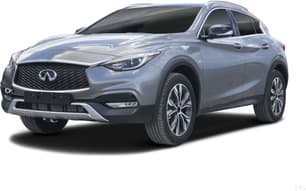
What's the difference?
Tim Robson road tests and reviews the 2016 Infiniti QX30 at its Australian launch with specs, fuel consumption and verdict.
There’s no doubt that the compact crossover segment is a vitally important place for any carmaker to be. Nissan’s luxury arm, Infiniti, is no different, and thanks to a decision from its Japanese masters, the diminutive premium brand will go from having no players on the field to having two marquee players in a matter of just a few months.
The architecturally identical front-wheel-drive Q30 launched only a month ago in three variants, and now it’s the turn of the all-wheel-drive QX30 to take to the pitch.
But is there enough of a difference between the two to actually consider them different cars? Is it adding a layer of complexity for the prospective Infiniti customer? As it turns out, the differences run more than skin deep.
For 15 years the Mitsubishi ASX has been one of the most popular SUVs in Australia. Well into its life cycle, it maintained strong sales thanks to keen pricing and a reputation for reliability.
The second-generation ASX is finally here, but it’s a very different proposition to the original.
For starters, the new model is a twin of French brand Renault’s Captur small SUV. That model is not currently sold here, so Mitsubishi has clear air, for now.
Secondly, it’s no longer cheap. Pricing puts this new model into the high-$30,000 section of the segment, but it also gains modern tech and specs.
Whether buyers care that the ASX has gone upmarket remains to be seen. But we attended the Australian launch to see if French flair has improved the ASX formula.
Even though it’s almost identical to the Q30, the QX30 manages to feel sufficiently different in suspension tune and cabin ambiance to be considered different.
It’s a disappointing oversight, though, by Infiniti to deny the base GT such basic safety fundamentals as a rear view camera (which Infiniti assures us is being worked on).
There is no question the new ASX is a much better car to drive than the model it replaces. This one is actually fun behind the wheel. The tech represents a massive upgrade, so too does the interior design and practicality. The fact is, it’s a much more expensive car than the old ASX. It is a European built and designed small SUV with loads more tech and features so when you consider that, the pricing makes more sense.
Regardless of the previous model, this new ASX impresses. It’s not perfect - the LS is missing too many items, no hybrid, slightly firm ride - but it’s now a genuine rival for higher quality rivals in the small SUV segment. If the ASX is in your price bracket, it might be time to add it to the consideration list.
The QX30 is one of the first projects to result from a technology partnership formed between the parent company of Mercedes-Benz and the Nissan-Renault Alliance.
In a sign of how worldly the car industry is becoming, the QX30 is built in Nissan’s Sunderland plant in the UK, using the German Mercedes-Benz A-Class platform and powertrains, all under Sino-French ownership via the Nissan-Renault Alliance.
On the outside, the design that first aired on the Q30 is pretty unique. It’s not a subtle car, with deep crease lines along its sides that, according to Infiniti, is an industry first in terms of manufacturing complexity.
When it comes to differences between the two vehicles, it’s minimal at best. There is a 35mm increase in height (30mm from taller springs and 5mm from roof rails), an extra 10mm in width, and extra trims affixed to the front and rear bumpers. Aside from the all-wheel-drive underpinnings, that is pretty much it for the exterior.
The same black plastic overfenders that are fitted to the Q30 are present on the QX30, with 18-inch rims on both the base model GT and the other variant, the Premium.
The dimensions of the QX30 are also an exact match for those on the Mercedes-Benz GLA, with the long front overhang acting as the main visual connection between the two cars.
The look of the new ASX is not a huge surprise given it’s based on the second-generation Renault Captur that launched in 2021. Actually the ASX we get is the mid-life facelift for the ASX/Captur twins in Europe, so the design has been refreshed.
At 4238mm long, 1797mm wide, 1585mm tall and with a 2639mm wheelbase, the new ASX is 127mm shorter, 13mm narrower, and 55mm lower than the original, but the wheelbase is only 31mm shorter.
It has a round almost bubble like quality to the exterior design, and not in a bad way. The redesigned front end has Mitsubishi flavour thanks to the ‘Dynamic Shield’ front-end signature, while the sleek headlights and black and chrome grille give off an almost menacing look.
C-shaped tail-lights at the rear flank a massive ‘Mitsubishi’ badge and the lower cladding ensure there’s no doubt this is an SUV.
It’s a handsome car and should get some attention on the road.
Inside, it’s not the last word on interior design, but it’s well laid out and functional. It’s definitely another massive leap over the old model.
At the launch there were no LS grades to drive, but the Aspire comes with cool grey cloth trim and roofliner that adds a nice contrast to the darker plastics and finishes. It’s more vibrant than the top-spec Exceed which has an all-black interior with leather-appointed seats.
The top two grades feature a floating console where the gear shifter is housed (a standard shifter in LS, and notch-like ‘eShifter’ in Aspire and Exceed), while the big multimedia screen dominates the dash.
The QX30 is obviously very similar to the Q30 in many respects, but the interior is slightly different, with larger, less cosseting seats up front and slightly higher seats in the rear.
The cabin is also lighter in overall appearance, thanks to a paler colour palette.
There are plenty of neat inclusions, including a pair of USB ports, plenty of door storage, a space for six bottles and a sizable glove box.
A pair of cupholders resides up front, along with a pair in the fold-down armrest in the rear.
There is no particularly logical location for the storage of smartphones, though, and the lack of Apple CarPlay or Android Auto is down to Infiniti opting for its own phone connectivity suite.
A decent 430 litres of luggage space behind the rear seats is contrasted by a cramped rear area for all but the smallest of passengers, while sharply shaped rear door apertures making getting in and out a bit of an ask.
There are two ISOFIX baby seat points and a 12-volt socket in the rear, as well.
This is an area the ASX excels in.
Up front there are loads of storage options. Multiple nooks for mobile phones, keys and other items, and the Aspire and Exceed get a wireless charging pad and extra storage under the shifter.
The central bin isn’t massive but doesn’t need to be with all the other cubbies, and there is ample room for large and tall bottles in the door bins.
A pair of USB-C ports and a 12V port up front handle electronics.
Thankfully there are physical controls for climate control at the base of the multimedia screen. The other functions housed in the screen like vehicle information and connectivity options are logically laid out and the system is not overly complicated.
Opting for the Aspire or Exceed means you get the brilliant Google Built-in, which is exactly what it sounds like. It’s essentially the Google operating system but for your multimedia screen so you have in-built Google Maps, Play and Assistant. Log in to your Google account and all your favourite places show up on Maps, and you can also log into Spotify and the like. It's a great set-up.
The seats are supportive and well bolstered. Much nicer than the old ASX’s overly cushioned seats.
The second row has more space than you’d expect looking at the car. It’s not cavernous by any stretch, but clever touches like scalloped out front seatbacks and roofliner ensure decent leg, toe and headroom, even with the sunroof in the Exceed. However, three adults in the rear isn’t super comfortable - we tried. Kids should be fine.
Amenities include more USB-C ports, rear air vents (very rare in this category), storage for small bottles in the door, phone holders in the door arm rests, dual map pockets, but no central armrest, which is no great loss.
That rear pew is comfy and more supportive than the old ASX. And it has a neat party trick. You can slide the entire row (via the base) forwards by up to 16cm, making for more cargo space in the boot. It also folds 60/40 split and when the boot floor is in its highest setting the seats fold flat, aiding loading.
Yet another clever feature is the split level boot. It features under-floor storage that adds a handy 183 litres to the cargo capacity.
With all seats in place Mitsubishi says the cargo space is 484 litres, which is 23 per cent more than the old model. If you slide the rear seat forward as far as it goes that increases that figure to 616L. And if the second row is folded flat the capacity is 1596L.
Interestingly, despite having space for one under the bottom boot floor, a spare wheel (even a temporary one) is not a standard feature. Instead the ASX comes with a tyre repair kit and offers a temporary spare wheel as part of its accessories offering for $750. If you’ve got the space for a spare wheel, why not make it standard? Especially when Mitsubishi is a popular brand in regional and rural areas.
The QX30 will be offered in two variants; the base model GT at $48,900 plus on-road costs, while the Premium will cost $56,900.
Both come equipped with the same engine; a 2.0-litre four-cylinder turbocharged petrol engine that’s sourced from Mercedes-Benz and also used on the Q30 and Merc GLA.
Eighteen-inch rims are standard on both cars, while an electronic handbrake, 10-speaker Bose audio, 7.0-inch multimedia screen and a full set of LED lamps all round are fitted across both variants as well.
Unfortunately, the QX30 GT misses out on a reversing camera all together, a fate it shares with the Q30 GT.
Infiniti Cars Australia told us that this was an oversight at the time the cars were being specced for Australia, particularly in light of the other technologies that the car would receive, like automatic emergency braking.
The company says it’s working hard to bring a reversing camera to the GT.
The top-spec Premium gets leather trim, a powered driver’s seat, and additional safety equipment like a 360-degree camera and radar cruise with brake assist.
The only optional extra on each car is metallic paint.
So, let’s get straight to the big news. This new ASX has gone up in price in a big way. The previous entry point was a touch under $27,000 before on-road costs for the GS auto.
The new model now starts at $37,740 BOC, which is about the same price as the flagship grade of the previous-generation ASX.
There are three grades - LS, Aspire and Exceed. Like for like the LS is $7K dearer than the old LS. The Aspire is $42,690 and the Exceed tops out at $46,490.
Yes, this is a significant change in price and positioning for the ASX. But the only relationship this car has to the previous model is its name. If Mitsubishi gave it a different name, the pricing announcement may not have attracted so much attention.
This pricing shifts the Spanish-built ASX into a new sub-section of the mainstream small SUV segment, away from other cheapies like the Suzuki Vitara, MG ZS and GWM Haval Jolion. It’s now closer to the likes of the Honda HR-V, Nissan Qashqai and Subaru Crosstrek.
The previous model was dated in every area, but it really lagged when it comes to in-car and safety tech. This new model addresses that.
In terms of standard gear, the list is decent without being jaw dropping.
The LS comes with a 10.4-inch multimedia screen with wireless Apple CarPlay and Android Auto, DAB digital radio, Bluetooth, six-speaker audio, digital driver display, two USB-C ports, proximity key, keyless entry and start, single-zone climate control, power and heated door mirrors, cloth seats and 17-inch alloy wheels.
Aspire and up gain the Google built-in platform that includes integrated Google Maps, Play and Assistant, as well as in-house sat-nav, three drive modes (Comfort, Sport, Perso), auto-dimming rear-view mirror, wireless device charger, privacy glass, 18-inch alloy wheels and power-folding mirrors.
The flagship Exceed adds a panoramic sunroof, two-tone paint, leather-appointed seats, heated front seats and power adjust for the driver’s seat.
There are no options aside from accessories.
Just the one engine is used across both cars; the 155kW/350Nm single-turbo 2.0-litre four-cylinder petrol engine from the Q30 and A-Class.
It’s backed by a seven-speed transmission and wired into an all-wheel-drive system that is biased towards a front-drive configuration.
Sourced from Mercedes-Benz, up to 50 per cent of drive can be sent to the rear wheels, according to Infiniti.
For now, all grades of the new ASX use the same 1.3-litre four-cylinder turbocharged petrol engine offering up 113kW of power and 270Nm of torque. That’s up on the old 2.0-litre naturally aspirated unit’s 110kW/197Nm.
This is paired with a seven-speed dual-clutch transmission driving the front wheels only, so there’s no all-wheel-drive version.
Mitsubishi is looking into the mild hybrid and full hybrid versions that are offered in Europe but not confirmation on those as yet.
Infiniti claims a combined fuel economy figure of 8.9L/100km for the 1576kg QX30 across both the variants; this is 0.5L thirstier than the Q30 version.
Our brief test yielded a dash figure of 11.2L/100km over 150km.
The new ASX consumes 6.4 litres of fuel per 100 kilometres on the combined cycle and emits 142 grams per kilometre of CO2.
That’s a decent figure for sure, but not quite as frugal as the 1.3-litre Nissan Qashqai, which manages 5.8-6.1L/100km.
The ASX drinks 91 RON fuel and has a 48-litre tank which makes for a theoretical driving range of about 750km.
Again, it would be easy to think that the QX30 would feel almost identical to its lower-riding sibling – but that would be incorrect. We criticised the Q30 for being a bit too buttoned down and unresponsive, but the QX30 feels more lively and involving, thanks to its unique spring and damper set-up.
Even though it’s 30mm higher than the Q, the QX doesn’t feel it at all, with a benign, pleasant ride with good body roll control and competent steering.
Our front-seat passenger complained of feeling a little ‘hemmed in’, which is a valid point. The sides of the car are very high, and the roofline is quite low, exacerbated by the steeply raked windscreen.
The 2.0-litre four-potter is smooth and punchy, and the gearbox well suited to it, but it’s lacking in aural character. Luckily the QX30 does a terrific job of suppressing noise before it gets into the cabin, then…
Look, it’s fair to say the original ASX was not a driver’s car. Reliable? Yes. Spacious? Absolutely. Great value? You bet. But fun to drive? Not so much.
So it’s good news then that the new-gen ASX is much more engaging to drive. I quite enjoyed the current-gen Renault Captur the last time I drove it, and the underpinnings of the ASX are the facelifted version of that Captur.
The 1.3-litre turbo-petrol unit might not be ultra quick off the mark, but it is sprightly and really comes alive when you’re at speed. It also has a decent engine note.
I've recently driven another Renault model with basically the same powertrain but it suffered from dreadful lag - a combination of a turbocharger and a dual-clutch transmission.
I had expected the same of the ASX, but there’s little lag to speak of. And the transmission is much smoother in this application. It doesn’t hold gears or do anything DCTs are known for, which is a lovely surprise.
Steering is sharp enough and the feel can be adjusted in the settings. Aspire and Exceed grades come with Comfort, Sport and Perso mode, which is for personalisation.
Ride quality is fine on smooth roads but big pot holes and other bumps are felt in the cabin. It is a European car, so no surprise that it’s been tuned for a more European experience. It’s not so firm it’ll dampen the drive experience, but it could be a touch more supple.
On that, the ASX has not undergone a local ride and handling tuning program like the one its larger Outlander stablemate has benefited from.
That doesn’t mean you can’t have fun in the ASX - you can. It handles high-speed bends on country roads surprisingly well, with more grip than you’d expect. There’s a little body roll but nothing dramatic.
More time behind the wheel is needed, but the tight chassis means the ASX likes a corner.
The cabin has better insulation than the outgoing model but it’s still not the most hushed small SUV money can buy. But it’s another element that’s far from a dealbreaker.
The QX30 gets seven airbags, auto emergency braking, forward collision warning and a pop-up bonnet as standard across the line.
The base GT does, however, miss out on a reversing camera.
The Premium model also offers a 360-degree camera, blind spot warning, radar cruise control and brake assist, traffic sign detection, reverse motion detection and lane departure warning.
The new ASX is yet to be assessed for crash safety by ANCAP, but Mitsubishi is anticipating a four-star rating to match its European score.
It comes with six airbags, but no front centre bag for side collisions. It also gets a reversing camera and front parking sensors.
All the expected advanced driver assistance systems (ADAS) are present like auto emergency braking, lane departure warning and prevention, emergency lane assist, traffic sign recognition and a less invasive driver attention alert than is found in some of Mitsubishi’s other models.
The base LS misses out on features like blind-spot warning, rear cross-traffic alert, and adaptive cruise control (it has old-school cruise control) as well as front parking sensors. At least some of these could have been standard.
One neat feature is the personalised driver profile that allows you to determine what ADAS features you want active each time you get behind the wheel.
The launch cars we drove were missing an ADAS feature that will be included on all customer cars, so we will reserve judgement on the effectiveness of the safety suite. However, it doesn’t appear that they are too overzealous.
The Q30 is offered with a four-year, 100,000km warranty, and servicing is suggested every 12 months or 25,000km.
Infiniti offers a fixed three-year service schedule, with the GT and the Premium both costing an average of $541 over the three services provided.
Mitsubishi's standard warranty is five years or 100,000km, but if you service your car exclusively at a Mitsubishi dealer, it extends to an impressive 10 years or 200,000km.
You’ll also get 10 years of roadside assistance and capped-price servicing. The servicing schedule is every 12 months or 15,000km.
Service pricing starts from $349, but bigger services every four years or 60,000km will cost circa-$1000. The average price of a service across the 10 years is $568, or the total overall is $5686.
Mitsubishi has an extensive network of 185 dealers across Australia and many in regional areas. So service coverage is among the best in the country.