What's the difference?
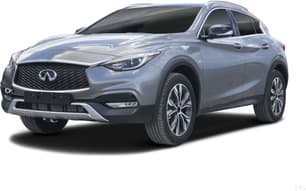
Tim Robson road tests and reviews the 2016 Infiniti QX30 at its Australian launch with specs, fuel consumption and verdict.
There’s no doubt that the compact crossover segment is a vitally important place for any carmaker to be. Nissan’s luxury arm, Infiniti, is no different, and thanks to a decision from its Japanese masters, the diminutive premium brand will go from having no players on the field to having two marquee players in a matter of just a few months.
The architecturally identical front-wheel-drive Q30 launched only a month ago in three variants, and now it’s the turn of the all-wheel-drive QX30 to take to the pitch.
But is there enough of a difference between the two to actually consider them different cars? Is it adding a layer of complexity for the prospective Infiniti customer? As it turns out, the differences run more than skin deep.
When the BMW iX first showed up a few years ago, it was a promising look at what BMW seemed capable of when it comes to electric cars.
While mildly flawed, the iX was fast, comfortable and felt properly premium. Now it’s had a decent update, with the iX xDrive45 M Sport here to replace the former entry-level xDrive 40.
BMW claims among other mechanical and tech updates a power increase of 25 per cent, a 30 per cent greater energy content for the battery, a 38 per cent increase in driving range and a 17 per cent faster charging rate.
But in the time since the iX launched, there have been big strides in the premium electric SUV space, including new arrivals from European opposition like the Polestar 3; even a new American in the form of the Cadillac Lyriq.
Even though it’s almost identical to the Q30, the QX30 manages to feel sufficiently different in suspension tune and cabin ambiance to be considered different.
It’s a disappointing oversight, though, by Infiniti to deny the base GT such basic safety fundamentals as a rear view camera (which Infiniti assures us is being worked on).
If anyone was worried that it would be too late to get a decent bit of value out of an entry-level iX, there's reassuring news.
With more power, range and features added to the model and the cost remaining close to its former sticker price, the iX has held up well despite now existing in a more competitive environment.
The QX30 is one of the first projects to result from a technology partnership formed between the parent company of Mercedes-Benz and the Nissan-Renault Alliance.
In a sign of how worldly the car industry is becoming, the QX30 is built in Nissan’s Sunderland plant in the UK, using the German Mercedes-Benz A-Class platform and powertrains, all under Sino-French ownership via the Nissan-Renault Alliance.
On the outside, the design that first aired on the Q30 is pretty unique. It’s not a subtle car, with deep crease lines along its sides that, according to Infiniti, is an industry first in terms of manufacturing complexity.
When it comes to differences between the two vehicles, it’s minimal at best. There is a 35mm increase in height (30mm from taller springs and 5mm from roof rails), an extra 10mm in width, and extra trims affixed to the front and rear bumpers. Aside from the all-wheel-drive underpinnings, that is pretty much it for the exterior.
The same black plastic overfenders that are fitted to the Q30 are present on the QX30, with 18-inch rims on both the base model GT and the other variant, the Premium.
The dimensions of the QX30 are also an exact match for those on the Mercedes-Benz GLA, with the long front overhang acting as the main visual connection between the two cars.
The iX was a bit divisive upon its original launch, because it was one of the early adopters of BMW’s current ‘big grille’ era.
The good news for the iX is that many have adjusted their expectations on that front and it now feels pretty well at home in the brand’s line-up.
The addition of the 'Iconic Glow' grille surround might be a step too far for some, but overall the iX has aged well and its exterior design hasn’t changed much because of that.
The adaptive LED headlights have new DRL elements, and the M Sport pack is now standard, but if you were only casually familiar with the iX you’d have to be looking closely to spot the update.
The new colour palette for the iX also includes the pictured 'Arctic Race Blue metallic', though I’m personally a fan of the iX in all black, giving it a more monolithic look.
Inside, it’s a similar story - what was once perhaps ahead of its time is now the expectation in an electric SUV. Minimalism in terms of physical controls, but plenty of space.
Helping the feeling of spaciousness is the now-standard panoramic sunroof, though a lack of physical shade is one of the iX’s few interior let-downs. Instead, it can electrochromatically ‘shade’, which still lets in plenty of light.
At night, ambient lighting joins the glow of the iX’s rather large 14.9-inch multimedia touchscreen and 12.3-inch driver display.
The QX30 is obviously very similar to the Q30 in many respects, but the interior is slightly different, with larger, less cosseting seats up front and slightly higher seats in the rear.
The cabin is also lighter in overall appearance, thanks to a paler colour palette.
There are plenty of neat inclusions, including a pair of USB ports, plenty of door storage, a space for six bottles and a sizable glove box.
A pair of cupholders resides up front, along with a pair in the fold-down armrest in the rear.
There is no particularly logical location for the storage of smartphones, though, and the lack of Apple CarPlay or Android Auto is down to Infiniti opting for its own phone connectivity suite.
A decent 430 litres of luggage space behind the rear seats is contrasted by a cramped rear area for all but the smallest of passengers, while sharply shaped rear door apertures making getting in and out a bit of an ask.
There are two ISOFIX baby seat points and a 12-volt socket in the rear, as well.
The space on offer in both rows of the iX is a huge plus, and it might even be enough to make you look past some of the small downsides to the electric Bimmer’s interior.
The iX’s clever two-level central console has the phone charger pad and drinks holders down out of the way and means you can put distractions (phone) and your tall bottles out of the way. There's a slot above for your phone to sit upright with a gap under for charging, too.
The storage bin under the armrest also has plenty of space as well as a little shelf for smaller items you don't want to go hunting for, but the iX’s control panel and dial are still reflective and, at certain times of the day, this means distracting light getting in your eyes.
Speaking of distracting, I have found BMW’s multimedia software to be less intuitive and more complicated with each major update, and ‘OS 8.5’ is no different. At this point, using the brand’s touchscreen feels like operating an iPad on the move, with dozens of menu tiles to sort through.
But back to the physical space that is the iX’s interior - the big EV makes a lot of sense as a family car, especially if your kids are old enough to appreciate (and keep clean) the fit and finish.
Not only does the drive have a nicely adjustable and comfortable sports seat thanks to the M Sport pack, there's also heating and a massage function.
The front passenger gets the same, and the second row is borderline palatial. There's heaps of kneeroom, headroom, and even space under the front seats at their lowest setting to slot your feet.
The four-zone climate controls mean arguments are avoided, there is of course a central armrest, though even with it folded up and a person in the centre there's enough room in the back to be comfortable.
Behind that, the iX’s 500 litres of boot space could probably be expanded but at the expense of rear legroom, so it's acceptable. There is space under the floor for cables, but no space saver spare, just a repair kit.
There's a switch that allows you to fold the seats down from the tailgate, but you can also manually fold the middle seat for a 40/20/40 split rather than the more expected 60/40.
The QX30 will be offered in two variants; the base model GT at $48,900 plus on-road costs, while the Premium will cost $56,900.
Both come equipped with the same engine; a 2.0-litre four-cylinder turbocharged petrol engine that’s sourced from Mercedes-Benz and also used on the Q30 and Merc GLA.
Eighteen-inch rims are standard on both cars, while an electronic handbrake, 10-speaker Bose audio, 7.0-inch multimedia screen and a full set of LED lamps all round are fitted across both variants as well.
Unfortunately, the QX30 GT misses out on a reversing camera all together, a fate it shares with the Q30 GT.
Infiniti Cars Australia told us that this was an oversight at the time the cars were being specced for Australia, particularly in light of the other technologies that the car would receive, like automatic emergency braking.
The company says it’s working hard to bring a reversing camera to the GT.
The top-spec Premium gets leather trim, a powered driver’s seat, and additional safety equipment like a 360-degree camera and radar cruise with brake assist.
The only optional extra on each car is metallic paint.
The sole entry-grade iX is the xDrive45 M Sport, which brings with it more than the original base xDrive40, but also a price a few thousand dollars higher.
It starts from $142,900 but can quickly become much more expensive when you start ticking options boxes. But in this market segment, it's not that unusual, especially considering recent arrivals like the Polestar 3.
Given it’s only a little more expensive than before, the extra kit and higher grade that now forms the iX entry-point is impressive.
The 'M Sport' pack is now standard as the name suggests, plus there’s M trim inside like the steering wheel, the M seats and silver design highlights.
The LED lights are now adaptive and the glowing grille surround has also been added.
There’s also now a panoramic glass roof as standard, rather than an option, plus the steering wheel is heated and there’s now a tyre pressure monitor.
Aside from that, there’s plenty that carries over, like the wireless phone charging, wireless Android Auto and Apple CarPlay, 18-speaker surround sound by Harman Kardon, four-zone climate control and heated front seats.
There’s also an 'Executive Pack' which adds some comfort features like soft-close doors, privacy glass and front seat ventilation with rear seat heating. That one’s $6500.
Then there’s active steering, which brings the rear wheels into play for more manoeuvrability and stability for $3000.
Adaptive air suspension is $4000, while the most expensive option is a 30-speaker Bowers & Wilkins ‘Diamond’ surround sound system for $9500.
Just the one engine is used across both cars; the 155kW/350Nm single-turbo 2.0-litre four-cylinder petrol engine from the Q30 and A-Class.
It’s backed by a seven-speed transmission and wired into an all-wheel-drive system that is biased towards a front-drive configuration.
Sourced from Mercedes-Benz, up to 50 per cent of drive can be sent to the rear wheels, according to Infiniti.
The iX has, as the xDrive part of its name would suggest, a dual-motor electric set-up with all-wheel drive.
Power and torque now total 300kW and 700Nm for the system in the xDrive45 M Sport, up from the 240kW and 630Nm on offer in the outgoing xDrive40.
BMW says the iX is now good to hit 100km/h from a standstill in 5.1 seconds, with its claimed top speed a nice, rounded 200km/h.
Infiniti claims a combined fuel economy figure of 8.9L/100km for the 1576kg QX30 across both the variants; this is 0.5L thirstier than the Q30 version.
Our brief test yielded a dash figure of 11.2L/100km over 150km.
The iX’s 94.8kWh battery allows a range up to 522km, but relatively low efficiency because of the size and weight.
Its 20kWh/100km is on the higher side of power use for cars around this size and this is part of the reason its huge battery capacity results in a fairly average driving range.
Maximum power input for DC fast charging is, however, up from 150kW to 175kW with the update, which is good news for those long drives.
Again, it would be easy to think that the QX30 would feel almost identical to its lower-riding sibling – but that would be incorrect. We criticised the Q30 for being a bit too buttoned down and unresponsive, but the QX30 feels more lively and involving, thanks to its unique spring and damper set-up.
Even though it’s 30mm higher than the Q, the QX doesn’t feel it at all, with a benign, pleasant ride with good body roll control and competent steering.
Our front-seat passenger complained of feeling a little ‘hemmed in’, which is a valid point. The sides of the car are very high, and the roofline is quite low, exacerbated by the steeply raked windscreen.
The 2.0-litre four-potter is smooth and punchy, and the gearbox well suited to it, but it’s lacking in aural character. Luckily the QX30 does a terrific job of suppressing noise before it gets into the cabin, then…
The BMW iX was a relatively early entry into the catalogue of electric cars I’ve driven and because of that it had a couple of (in hindsight) unfair criticisms levelled at it.
For a start, it felt heavier than expected and its ride quality didn’t feel up to BMW’s standards - both things that plenty of electric SUVs have struggled with since.
But its drivetrain, design, and interior all impressed, aside from perhaps some of the aforementioned interior reflections.
Now years on, and the iX has aged well.
Some of the mechanicals and suspension also copped a tweak along with the entry iX now being a more powerful ‘45’. The result is a big electric SUV that holds up better than I remember.
‘Smooth’ is the key word that comes to mind in regards to a lot of the iX’s characteristics. While it’s still not perfect and feels heavy, the iX rides well in comparison to many SUVs on the market, including some of its close rivals.
Perhaps key to this is the fact its standard 21-inch wheels leave plenty of tyre to help the suspension soak up sharp edges on bumps, while we’re sure BMW’s handling engineers have learned more about getting the best out of a big, heavy electric vehicle in the last couple of years.
Road noise is well-muted as a result, and the shape of the iX doesn’t seem to lend itself to excessive wind noise. Even when you’re getting rather quick.
Despite being a 2525kg beast, its 5.1-second sprint to 100km/h is in the muscle car realm - the last of Holden’s V8 Commodores would do about that, for reference.
Its acceleration is also nicely progressive, rather than giving you an almighty but unnecessary jolt of torque right as you put your foot down. But once there’s traction and you’re rolling, the xDrive45 is impressive.
Meanwhile, its cornering and braking still reveal the heft behind the iX, it’s not something you can chuck around like a go-kart, but that’s also not really its area.
Anyone familiar with BMW’s steering characteristics will find the slightly higher force required for its weight (and thickness of the steering wheel rim) standard, though it’s still unnecessarily on the heavier side.
The QX30 gets seven airbags, auto emergency braking, forward collision warning and a pop-up bonnet as standard across the line.
The base GT does, however, miss out on a reversing camera.
The Premium model also offers a 360-degree camera, blind spot warning, radar cruise control and brake assist, traffic sign detection, reverse motion detection and lane departure warning.
The BMW iX holds a five-star ANCAP rating, which it earned under slightly more lenient testing back in 2021.
Seven airbags, auto emergency braking with cyclist and pedestrian detection up to 80km/h, lane-assist, rear-cross traffic alert and intersection assist, plus a surround view parking camera all help immensely.
The Q30 is offered with a four-year, 100,000km warranty, and servicing is suggested every 12 months or 25,000km.
Infiniti offers a fixed three-year service schedule, with the GT and the Premium both costing an average of $541 over the three services provided.
BMW offers a five-year/unlimited kilometre warranty with an eight-year/160,000km warranty on the battery.
BMW servicing takes place as needed rather than on a schedule, meaning you’ll be alerted via the car or app when a service is required in the near future.
For the iX a six-year all-inclusive service pack costs $3475, regardless of how many km you drive.
BMW has 54 servicing dealers listed in Australia, with each capital city covered and many more locations in the eastern states.