What's the difference?
Tim Robson road tests and reviews the 2016 Infiniti QX30 at its Australian launch with specs, fuel consumption and verdict.
There’s no doubt that the compact crossover segment is a vitally important place for any carmaker to be. Nissan’s luxury arm, Infiniti, is no different, and thanks to a decision from its Japanese masters, the diminutive premium brand will go from having no players on the field to having two marquee players in a matter of just a few months.
The architecturally identical front-wheel-drive Q30 launched only a month ago in three variants, and now it’s the turn of the all-wheel-drive QX30 to take to the pitch.
But is there enough of a difference between the two to actually consider them different cars? Is it adding a layer of complexity for the prospective Infiniti customer? As it turns out, the differences run more than skin deep.
The Volvo XC60 has long been an understated achiever of the premium mid-size SUV crowd.
It doesn’t shout for attention like some of its rivals, but it’s built a reputation for quiet confidence and family-friendly practicality. For 2026, the XC60 Ultra B5 Dark keeps the same engine but has received a facelift in other areas. Is it enough to keep family buyers who want a mix of practicality and luxury happy?
Even though it’s almost identical to the Q30, the QX30 manages to feel sufficiently different in suspension tune and cabin ambiance to be considered different.
It’s a disappointing oversight, though, by Infiniti to deny the base GT such basic safety fundamentals as a rear view camera (which Infiniti assures us is being worked on).
The facelifted Volvo XC60 Ultra B5 Dark is the car at school pick-up that doesn’t need to brag. It just gets on with things and it looks good doing it. It offers a strong mix of family-focused features, comfortable and composed road manners and thoughtful practicality throughout the cabin.
The updated media system is crisp and responsive, though it could use a few tweaks to be truly intuitive. Overall, the XC60 mild-hybrid remains a solid choice for families who value understated luxury, comfort and safety over flash. It doesn’t reinvent the wheel, but it does what it does well.
The QX30 is one of the first projects to result from a technology partnership formed between the parent company of Mercedes-Benz and the Nissan-Renault Alliance.
In a sign of how worldly the car industry is becoming, the QX30 is built in Nissan’s Sunderland plant in the UK, using the German Mercedes-Benz A-Class platform and powertrains, all under Sino-French ownership via the Nissan-Renault Alliance.
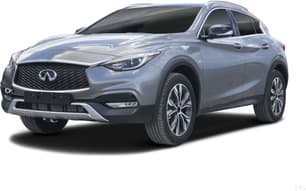
On the outside, the design that first aired on the Q30 is pretty unique. It’s not a subtle car, with deep crease lines along its sides that, according to Infiniti, is an industry first in terms of manufacturing complexity.
When it comes to differences between the two vehicles, it’s minimal at best. There is a 35mm increase in height (30mm from taller springs and 5mm from roof rails), an extra 10mm in width, and extra trims affixed to the front and rear bumpers. Aside from the all-wheel-drive underpinnings, that is pretty much it for the exterior.
The same black plastic overfenders that are fitted to the Q30 are present on the QX30, with 18-inch rims on both the base model GT and the other variant, the Premium.
The dimensions of the QX30 are also an exact match for those on the Mercedes-Benz GLA, with the long front overhang acting as the main visual connection between the two cars.
The XC60 has a graceful, poised curbside presence. Its wide stance and smooth body panels give it a confident silhouette, while the redesigned grille with dark accents, integrated intake vents (both faux and real), and those sharp 'Hammer of Thor' headlights tie it all together. It’s not trying to be sexy, but it is undeniably handsome. It's the kind of SUV that turns heads quietly rather than shouting for attention.
Inside, the vibe is pure Scandi chic. There’s a refreshing lack of plasticky surfaces, with everything feeling solid and premium to the touch. The supple Nappa leather seats and expansive panoramic sunroof instantly make the cabin feel airy and refined.
Taking centre stage on the dash is a new 11.2-inch portrait-style media display. The layout is a little too reminiscent of an oversized iPad for my taste, but the crisp graphics and quick touch response are big pluses. Adding a touch of craftsmanship, the crystal Orrefors gear shifter and genuine driftwood inlays across the dash and centre console bring warmth and texture you don’t find in most rivals.
Is this facelift breaking new ground? Not really. But then, it doesn’t need to. Volvo has long been firmly planted in the premium end of the field and this update simply shows it's still cultivating all the right qualities.
The QX30 is obviously very similar to the Q30 in many respects, but the interior is slightly different, with larger, less cosseting seats up front and slightly higher seats in the rear.
The cabin is also lighter in overall appearance, thanks to a paler colour palette.
There are plenty of neat inclusions, including a pair of USB ports, plenty of door storage, a space for six bottles and a sizable glove box.
A pair of cupholders resides up front, along with a pair in the fold-down armrest in the rear.
There is no particularly logical location for the storage of smartphones, though, and the lack of Apple CarPlay or Android Auto is down to Infiniti opting for its own phone connectivity suite.
A decent 430 litres of luggage space behind the rear seats is contrasted by a cramped rear area for all but the smallest of passengers, while sharply shaped rear door apertures making getting in and out a bit of an ask.
There are two ISOFIX baby seat points and a 12-volt socket in the rear, as well.
The XC60 is spacious without being sprawling. The front row is the sweet spot for comfort, with generous leg and headroom plus ergonomic seats that offer excellent under-thigh and side-bolster support. They also bring the luxury of heating, ventilation and even massage functions.
The rear row uses firmer padding, and while the backrest looks fairly flat, it’s deceptively supportive. Adults should be comfortable back there on longer journeys. Access is only slightly compromised by the wheel arch eating into the rear aperture, but otherwise it’s an easy SUV to get in and out of. My eight-year old pointed out that the rear doors are on the heavy side, though, and often need a good slam to latch properly.
Storage is well thought out throughout the cabin. Up front you get a decent glove box, cupholders, drink bottle holders, door bins, a dedicated phone tray that doubles as the wireless charging pad and a shallow centre console with two USB-C ports. One niggle. The cupholders don’t grip cups as snugly as they should.
The rear row has a 60/40 split with a 'ski-port' door and a fold-down armrest. And in the back, there are door bins with bottle holders, a fold-down armrest with cupholders and net map pockets. Rear passengers are also spoiled with dual-zone climate control, four directional air vents and two more USB-C ports.
One of the XC60’s best family-friendly features is the integrated booster seats, which have two height settings and fold neatly back into the base when not in use. They’re a lifesaver if you have kids who feel like they've 'aged out' of car seats but aren’t quite tall enough to go without. Of course, there are also ISOFIX mounts and three top-tether points if you still need to install child seats.
Out back, the boot offers a flat loading space, a powered tailgate with kick function and a healthy 613L of storage with all seats up (up to 1543L when the rear row is folded). You also get a 12-volt socket, a proper temporary spare tyre, and if you’ve got the optional air suspension (as per our test model) you can raise or lower the boot height for easier loading.
Tech usability is a bit of a mixed bag. The new 11.2-inch media display is sharp and responsive, and it comes pre-loaded with Google apps like Maps, Spotify and Assistant. But the Apple CarPlay and Android Auto isn't wireless, which feels like a miss at this price point.
The Bluetooth is patchy, with calls and music sometimes not syncing properly. A wired connection works better, especially for my iPhone 15 Pro Max, but I'm not a fan of leaving my phone on charge all the time. If you’re already familiar with Volvo or Polestar’s system, you’ll feel at home, but first-timers may need a little time to adjust.
The QX30 will be offered in two variants; the base model GT at $48,900 plus on-road costs, while the Premium will cost $56,900.
Both come equipped with the same engine; a 2.0-litre four-cylinder turbocharged petrol engine that’s sourced from Mercedes-Benz and also used on the Q30 and Merc GLA.
Eighteen-inch rims are standard on both cars, while an electronic handbrake, 10-speaker Bose audio, 7.0-inch multimedia screen and a full set of LED lamps all round are fitted across both variants as well.
Unfortunately, the QX30 GT misses out on a reversing camera all together, a fate it shares with the Q30 GT.
Infiniti Cars Australia told us that this was an oversight at the time the cars were being specced for Australia, particularly in light of the other technologies that the car would receive, like automatic emergency braking.
The company says it’s working hard to bring a reversing camera to the GT.
The top-spec Premium gets leather trim, a powered driver’s seat, and additional safety equipment like a 360-degree camera and radar cruise with brake assist.
The only optional extra on each car is metallic paint.
There are two mild-hybrid variants in the XC60 line-up, and the one we’re driving here is the flagship Ultra B5 Dark. Priced at $81,990, before on-roads, it costs about $7000 more than the entry-level Plus B5 Bright, but that premium buys you a longer list of included features that makes the Ultra Dark feel like the sweet spot of the range. Especially considering Volvo also offers two plug-in hybrid XC60s, but those command up to $20K more!
In terms of market rivals, the XC60 sits right in the middle. The Audi Q5 TFSI starts at $81,000, while the Lexus NX 350h Sports Luxury AWD asks $87,900, both before on-road costs.
Standard equipment is generous. The Ultra Dark gets a panoramic sunroof and Nappa leather upholstery, with the electric front seats offering heating and ventilation functions plus a heated steering wheel for winter comfort. There's a 360-degree view camera system with surrounding parking sensors and a park-assist feature.
Tech upgrades include a new 11.2-inch media display with in-built navigation, Google apps, and wired Apple CarPlay/Android Auto, backed up by four USB-C ports, a 12-volt socket and a wireless charging pad. There's also a Volvo phone app, which allows users to pre-condition the climate prior to entry, have a digital key and program the spare key for any kids who might want to borrow the car!
Families will appreciate the thoughtful touches like a powered tailgate with kick function, built-in child booster seats in the rear row, a temporary spare tyre (a welcome feature), four-zone climate control and lots of storage throughout the cabin. Keyless entry sensors on every door add another layer of convenience.
Our test car was also fitted with just over $5000 worth of options, including the Bowers & Wilkins premium sound system, active air suspension, tinted rear windows, and even front seat massage functions. When you consider that many rivals charge extra for equipment that comes standard here, the XC60 Ultra B5 Dark makes a strong case for itself on value.
Just the one engine is used across both cars; the 155kW/350Nm single-turbo 2.0-litre four-cylinder petrol engine from the Q30 and A-Class.
It’s backed by a seven-speed transmission and wired into an all-wheel-drive system that is biased towards a front-drive configuration.
Sourced from Mercedes-Benz, up to 50 per cent of drive can be sent to the rear wheels, according to Infiniti.
The Ultra B5 Dark tested here is all-wheel drive and has a 2.0-litre, four-cylinder, turbo-petrol mild-hybrid engine. It produces up to 183kW of power and 350Nm of torque.
The 'mild hybrid' tag comes from a 48-volt system paired with an integrated starter-generator. It’s not a full hybrid, so you won’t be gliding around silently on electric power alone, but it helps smooth out stop-start driving, boost efficiency and add a little extra shove when you put your foot down.
The result is an engine that feels lively in the city and confident out on the open road, with enough in reserve to make overtaking stress-free.
Infiniti claims a combined fuel economy figure of 8.9L/100km for the 1576kg QX30 across both the variants; this is 0.5L thirstier than the Q30 version.
Our brief test yielded a dash figure of 11.2L/100km over 150km.
Volvo claims combined cycle (urban/extra-urban) fuel use of 7.6L/100km for the XC60 Ultra B5 Dark, which isn’t bad for a turbo-petrol but reminds you that this is only a mild hybrid. With a 71-litre fuel tank, you’re looking at a theoretical driving range of up to 934km which is great for a family SUV likely to see its fair share of school runs and road trips.
In my real-world testing, which included plenty of urban driving with one longer trip in the mix, I averaged 8.6L/100km. That’s a little higher than the claim, but still a respectable result overall.
Again, it would be easy to think that the QX30 would feel almost identical to its lower-riding sibling – but that would be incorrect. We criticised the Q30 for being a bit too buttoned down and unresponsive, but the QX30 feels more lively and involving, thanks to its unique spring and damper set-up.
Even though it’s 30mm higher than the Q, the QX doesn’t feel it at all, with a benign, pleasant ride with good body roll control and competent steering.
Our front-seat passenger complained of feeling a little ‘hemmed in’, which is a valid point. The sides of the car are very high, and the roofline is quite low, exacerbated by the steeply raked windscreen.
The 2.0-litre four-potter is smooth and punchy, and the gearbox well suited to it, but it’s lacking in aural character. Luckily the QX30 does a terrific job of suppressing noise before it gets into the cabin, then…
There’s plenty of power on tap, with enough left in reserve when you really need to push it. Around town, the XC60 keeps up with traffic effortlessly, and out on the highway it never feels strained. The transmission is fairly punctual with its shifts, though you do need to drive it a little more assertively to avoid any lag when accelerating from a stop.
Visibility is excellent thanks to the big, wide windows and higher driving position. It’s also refreshing to have a wide rear window behind the C-pillar as it's something not all rivals manage.
On the road, the XC60 feels composed and comfortable. The cabin stays quiet even at highway speeds and the suspension soaks up the worst bumps without ever feeling floaty or disconnected. Handling is equally predictable, with steering and dynamics that feel natural and reassuring. Take a sharp corner at speed and you will notice a slight loss of composure but it rights itself quickly.
Day to day it’s also very car park friendly. Parking sensors and the 360-degree camera view make manoeuvring simple, though the video feed looks a little blurry at the edges. A more seamless stitch between camera angles would improve the presentation, but functionally it gets the job done.
The QX30 gets seven airbags, auto emergency braking, forward collision warning and a pop-up bonnet as standard across the line.
The base GT does, however, miss out on a reversing camera.
The Premium model also offers a 360-degree camera, blind spot warning, radar cruise control and brake assist, traffic sign detection, reverse motion detection and lane departure warning.
While the 2026 Volvo XC60 hasn’t undergone ANCAP testing yet, it continues Volvo’s long-standing reputation for safety with a comprehensive suite of features. Standard equipment includes autonomous emergency braking, blind-spot monitoring, lane keeping aid, lane departure warning, rear cross-traffic alert, front and rear collision warning, traffic sign recognition, driver attention warning and seven airbags - basically covering all of the essentials.
For families, there are integrated booster seats in the rear row, ISOFIX child seat mounts, and three top-tether anchor points. A stand-out feature is the programmable spare key, which is colour-coded in bright orange and allows you to set speed and speaker-volume limits. Which is ideal for nervous parents who share the car with teens or other young drivers.
Other practical safety touches include a protective first-aid kit and warning triangle, adaptive cruise control with stop/go function, parking assist, surrounding parking sensors and a 360-degree camera system.
The Q30 is offered with a four-year, 100,000km warranty, and servicing is suggested every 12 months or 25,000km.
Infiniti offers a fixed three-year service schedule, with the GT and the Premium both costing an average of $541 over the three services provided.
The XC60 is covered by a standard five-year/unlimited-km warranty, which is okay for its class, especially at the premium end. You can pre-purchase either a three- or five-year 'Volvo Genuine Service Plan'. The five-year plan will set you back $3870, which is steeper than many rivals, though Volvo sweetens the deal with five years' complimentary roadside assistance. Services are spaced at every 12 months or 15,000 km, whichever comes first.
One thing for regional owners to keep in mind, while Volvo has a decent retail footprint, there are only 34 Volvo service centres in Australia. Depending on where you live, that can mean a long drive. In my case, the nearest Volvo service centre is almost two hours away. That adds travel time and inconvenience for regular maintenance or unscheduled work.