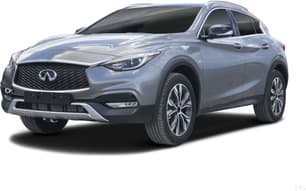
What's the difference?
Tim Robson road tests and reviews the 2016 Infiniti QX30 at its Australian launch with specs, fuel consumption and verdict.
There’s no doubt that the compact crossover segment is a vitally important place for any carmaker to be. Nissan’s luxury arm, Infiniti, is no different, and thanks to a decision from its Japanese masters, the diminutive premium brand will go from having no players on the field to having two marquee players in a matter of just a few months.
The architecturally identical front-wheel-drive Q30 launched only a month ago in three variants, and now it’s the turn of the all-wheel-drive QX30 to take to the pitch.
But is there enough of a difference between the two to actually consider them different cars? Is it adding a layer of complexity for the prospective Infiniti customer? As it turns out, the differences run more than skin deep.
If you want luxury it will cost you. But that’s okay if the product or service you’re buying delivers on the promise or hype.
Posh has a price and even though times are tougher now, economically, and people’s belts are a little tighter, Genesis, Hyundai’s prestige spin-off, has released its GV80 line-up, which is headlined by the GV80 Black SUV and GV80 Black coupe.
These new range-toppers are based on the GV80 Signature 3.5-litre V6 turbo-petrol all-wheel drive and as such are now aimed at setting the gold standard for plush vehicles.
So, does the GV80 Black deliver? Read on.
Even though it’s almost identical to the Q30, the QX30 manages to feel sufficiently different in suspension tune and cabin ambiance to be considered different.
It’s a disappointing oversight, though, by Infiniti to deny the base GT such basic safety fundamentals as a rear view camera (which Infiniti assures us is being worked on).
I rarely drive luxury vehicles so it doesn’t take much to impress me. However, it’s clear to anyone with half a brain (even me) that the GV80 is a premium ride and in Black guise it’s even better, albeit by increments only and those perceived improvements largely hinge on styling tweaks to the Signature platform on which it’s based.
Does it tick all of the boxes that someone considering this type of vehicle would want ticked? Sure it does and then some. But there’s plenty of stiff competition in the form of other premium AWDs on the market nowadays and even some 4WD wagons that offer similar levels of prestige.
The QX30 is one of the first projects to result from a technology partnership formed between the parent company of Mercedes-Benz and the Nissan-Renault Alliance.
In a sign of how worldly the car industry is becoming, the QX30 is built in Nissan’s Sunderland plant in the UK, using the German Mercedes-Benz A-Class platform and powertrains, all under Sino-French ownership via the Nissan-Renault Alliance.
On the outside, the design that first aired on the Q30 is pretty unique. It’s not a subtle car, with deep crease lines along its sides that, according to Infiniti, is an industry first in terms of manufacturing complexity.
When it comes to differences between the two vehicles, it’s minimal at best. There is a 35mm increase in height (30mm from taller springs and 5mm from roof rails), an extra 10mm in width, and extra trims affixed to the front and rear bumpers. Aside from the all-wheel-drive underpinnings, that is pretty much it for the exterior.
The same black plastic overfenders that are fitted to the Q30 are present on the QX30, with 18-inch rims on both the base model GT and the other variant, the Premium.
The dimensions of the QX30 are also an exact match for those on the Mercedes-Benz GLA, with the long front overhang acting as the main visual connection between the two cars.
I most frequently test and review vehicles that are tall, bulky and have plenty of ground clearance – usually 4WDs – so the GV80 is, in my experience, a mild revelation.
Firstly, it’s low and sleek and practically oozes – yes, oozes – prestige. Word of warning here. If you don’t like black as a colour on your car you’re in the wrong place because the GV80 Black and GV80 Coupe Black are only offered with – you guessed it – a black exterior and interior.
Secondly, this G80’s interior is a plush mix of quilted Nappa leather upholstery with black suede inserts, black ash wood trim, an abundance of soft-touch surfaces and very impressive all-around fit and finish. The interior of the cabin makes a strong style statement but it’s not over the top.
Genesis Motors Australia also says it has used a range of eco-friendly materials, including leather upholstery and door trims dyed using recycled carbon-black extracted from waste tyres. So, there’s that.
The cabin more than matches its rivals, such as Audi Q7, BMW X5 and Mercedes-Benz GLE, in terms of pure styling and as for practicality? Well, keep reading…
The QX30 is obviously very similar to the Q30 in many respects, but the interior is slightly different, with larger, less cosseting seats up front and slightly higher seats in the rear.
The cabin is also lighter in overall appearance, thanks to a paler colour palette.
There are plenty of neat inclusions, including a pair of USB ports, plenty of door storage, a space for six bottles and a sizable glove box.
A pair of cupholders resides up front, along with a pair in the fold-down armrest in the rear.
There is no particularly logical location for the storage of smartphones, though, and the lack of Apple CarPlay or Android Auto is down to Infiniti opting for its own phone connectivity suite.
A decent 430 litres of luggage space behind the rear seats is contrasted by a cramped rear area for all but the smallest of passengers, while sharply shaped rear door apertures making getting in and out a bit of an ask.
There are two ISOFIX baby seat points and a 12-volt socket in the rear, as well.
The GV80 Black is the same size as the standard GV80 – 4940mm long (with a 2955mm wheelbase), 1975mm wide and 1715mm high – so nothing has changed there.
And because the Black treatment is all about the looks, inside and out, the interior remains the same as standard for roominess and practicality. So, let’s dive into it.
First up, the 27.0-inch multimedia touchscreen dominates upfront, which is handy because it’s from here you operate most of the GV80’s controls. Thankfully, though, there are some physical dials and buttons, as well.
That screen is big, the colours are clear and crisp and the on-screen controls are easy to use, even for a true luddite like me.
Same goes for the driver display and the 12-inch head-up display. Clear to read and versatile enough in configuration choices to set them up as you want.
Then, everything flows on from that well-appointed dash.
The steering wheel is heated and power adjustable. By the way, I still don’t see why a heated steering wheel is a thing in Australia. Nowhere on this continent is cold enough to warrant it.
All seats are soft but supportive and very comfortable as you’d expect in a prestige vehicle with an interior that’s replete with “rich textures and bespoke materials”, according to Genesis.
There’s adequate seating room all-around, but the third row is squeezy and best suited to children or other height-challenged people that you despise.
The front seats are 18-way power-adjustable, heated and ventilated. They even have a massage function – if that’s your particular cup of tea.
The second row has heated and ventilated outboard seats (with power-base tilt and backrest recline), and there’s a climate-control panel each for the second and third rows.
Charge points abound with USB and 12V options available in the front and second row.
There are plenty of storage options throughout the cabin including a glove box, sunglasses case, cupholders etc. But the door pockets are narrow and awkward to get anything in and out of. A minor annoyance, but an annoyance, nonetheless.
In terms of cargo area capacity, with all three rows up and in use there is a claimed 327 litres of space available, 727L with the power-folding third row stowed away, and 2147L with the second and third rows folded down and out of the way.
Worth noting for anyone who drives beyond city limits is the fact this vehicle does not have a spare wheel, it only has a tyre mobility kit attached by Velcro to the rear cargo area floor.
The GV80 also has a power-operated tailgate.
The QX30 will be offered in two variants; the base model GT at $48,900 plus on-road costs, while the Premium will cost $56,900.
Both come equipped with the same engine; a 2.0-litre four-cylinder turbocharged petrol engine that’s sourced from Mercedes-Benz and also used on the Q30 and Merc GLA.
Eighteen-inch rims are standard on both cars, while an electronic handbrake, 10-speaker Bose audio, 7.0-inch multimedia screen and a full set of LED lamps all round are fitted across both variants as well.
Unfortunately, the QX30 GT misses out on a reversing camera all together, a fate it shares with the Q30 GT.
Infiniti Cars Australia told us that this was an oversight at the time the cars were being specced for Australia, particularly in light of the other technologies that the car would receive, like automatic emergency braking.
The company says it’s working hard to bring a reversing camera to the GT.
The top-spec Premium gets leather trim, a powered driver’s seat, and additional safety equipment like a 360-degree camera and radar cruise with brake assist.
The only optional extra on each car is metallic paint.
The top-spec GV80 Black variants are based on the GV80 Signature 3.5T-GDi AWD and are only offered with that powertrain.
Our test vehicle, the seven-seat GV80 3.5T Black all-wheel drive SUV, has a Manufacturer’s List Price (MLP) of $136,250, while the five-seat GV80 Coupe 3.5T Black AWD has a MLP of $141,750. Both prices exclude on-road costs but include Luxury Car Tax where applicable.
Standard features onboard this test vehicle include:
Other features that set this Black variant apart from its stablemates include interior highlights such as a dark-tinted Genesis steering wheel logo, quilted Nappa leather upholstery (with black suede accents), welcome and goodbye animations, black ash real wood trim, black garnishes, bezels and switchgear and black aluminium speaker grilles.
Exterior highlights include black 22-inch wheels and brake calipers, black G-Matrix grille, dark-tinted Genesis front emblem and tailgate lettering and black body cladding.
All 2026 GV80s also get what Genesis calls a “Digital Key 2.0”, which enables users to lock and unlock front and rear doors and start the engine using a smart-phone or -watch. It can be stored on one device and shared with up to 15 devices.
Black is the exterior paint colour. Matt paint is optional and costs $2000.
Just the one engine is used across both cars; the 155kW/350Nm single-turbo 2.0-litre four-cylinder petrol engine from the Q30 and A-Class.
It’s backed by a seven-speed transmission and wired into an all-wheel-drive system that is biased towards a front-drive configuration.
Sourced from Mercedes-Benz, up to 50 per cent of drive can be sent to the rear wheels, according to Infiniti.
This Genesis GV80 Black has a 3.5-litre twin-turbocharged V6 petrol engine producing 279kW and 530Nm, matched to an eight-speed automatic transmission.
This SUV has an all-wheel drive system and an electronic limited-slip rear differential.
The GV80’s engine has plenty of punch and the auto is impressively cluey as well.
Infiniti claims a combined fuel economy figure of 8.9L/100km for the 1576kg QX30 across both the variants; this is 0.5L thirstier than the Q30 version.
Our brief test yielded a dash figure of 11.2L/100km over 150km.
Official combined cycle (urban/extra-urban) fuel consumption is listed as 11.7L/100km.
On test we were seeing a dash-indicated 9.6-9.8L/100km but recorded an overall average of 12.4L/100km after a mix of city, highway and suburban driving.
The GV80 has a 80-litre fuel tank so, going by our on-test fuel figures, you can reasonably expect a driving range of about 645km from a full-tank.
Worth noting this car requires 95 RON premium fuel.
Again, it would be easy to think that the QX30 would feel almost identical to its lower-riding sibling – but that would be incorrect. We criticised the Q30 for being a bit too buttoned down and unresponsive, but the QX30 feels more lively and involving, thanks to its unique spring and damper set-up.
Even though it’s 30mm higher than the Q, the QX doesn’t feel it at all, with a benign, pleasant ride with good body roll control and competent steering.
Our front-seat passenger complained of feeling a little ‘hemmed in’, which is a valid point. The sides of the car are very high, and the roofline is quite low, exacerbated by the steeply raked windscreen.
The 2.0-litre four-potter is smooth and punchy, and the gearbox well suited to it, but it’s lacking in aural character. Luckily the QX30 does a terrific job of suppressing noise before it gets into the cabin, then…
An excerpt from my initial drive notes on the GV80 Black read "smooth, slick (too slick?), impressive open-road cruising, plush, couch on wheels”. All sound points but there’s even more to this car.
For a big wagon, the circa-2345kg GV80 gets off the mark nicely with a crisp throttle response and it punches along at a fair clip once on the move. There’s little to no noise from the outside world, other than the low-key rumble of the V6 and it’s easy to hit the speed limit without realising.
The power-adjustable steering wheel can be dialled in for a preferred position and while this weighty AWD still exhibits minor body roll through tighter corners that characteristic can be restrained somewhat via the Sport drive mode for better suited suspension behaviour and controlled with sufficiently precise steering.
Ride and handling are well sorted out with the GV80’s all-wheel drive system and an electronic limited-slip rear differential giving the driver welcome levels of confidence in a variety of driving conditions.
Turning circle is listed as 11.98m and this car doesn’t feel unwieldy on busy suburban streets.
A few niggles. Digital rear-view mirrors are not among my favourite features in cars as they offer a headache-inducing fish-eye view of the world not to my liking and such is the case in this GV80.
Speaking of views, because the GV80 is low and sleek, it doesn’t afford the driver the levels of visibility I’m used to getting in the taller, more upright vehicles I most frequently review.
All-around, however, the GV80 is a smooth daily driver, with plenty to like about it and just a few foibles.
The QX30 gets seven airbags, auto emergency braking, forward collision warning and a pop-up bonnet as standard across the line.
The base GT does, however, miss out on a reversing camera.
The Premium model also offers a 360-degree camera, blind spot warning, radar cruise control and brake assist, traffic sign detection, reverse motion detection and lane departure warning.
The Genesis GV80 3.5T Black does not have an ANCAP safety rating because it has not been tested.
As standard it has 10 airbags (including side curtain airbags) and driver-assist tech includes forward collision-avoidance assist, lane keep assist, highway driving assist, smart cruise control, a surround-view monitor and more.
The second row has ISOFIX child-seat anchors in the two outboard seats, and three top-tether points.
The Q30 is offered with a four-year, 100,000km warranty, and servicing is suggested every 12 months or 25,000km.
Infiniti offers a fixed three-year service schedule, with the GT and the Premium both costing an average of $541 over the three services provided.
Every new 2026 GV80 is covered by a five-year/unlimited km warranty and five years' roadside assistance. If the car's serviced at an authorised Genesis dealer this coverage increases to 10 years.
Servicing, scheduled for every 12 months or 15,000km, is free for the first five years or 75,000 km, whichever occurs soonest. Genesis offers a concierge and courtesy vehicle service for five years with the complimentary service.
There are 11 Genesis dealers in Australia - Five in Sydney (including a CBD 'studio'), two in Melbourne and one each in Brisbane, The Gold Coast, Adelaide and Perth.