What's the difference?
Hyundai has recently launched an updated Staria Load range, with the most significant addition for buyers of mid-size (2.5 tonne-3.5 tonne GVM) commercial vans being the first-time availability of a hybrid drivetrain.
On paper this new HEV (Hybrid Electric Vehicle) option brings numerous advantages over its diesel sibling, so we recently spent a week at the wheel to see if they are sufficient to win over traditional diesel van buyers.
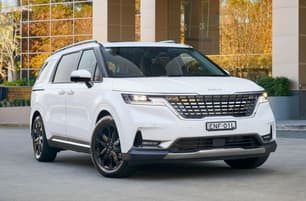
This is actually the Carnival that Kia always wanted.
See, the last Carnival, the one this replaces, was Covid compromised, missing out on key technologies, as well as skipping an in-depth ride and handling localisation program, due to part supply issues and a freeze on international travel.
This one, though, addresses all of that, which is why you get a new cabin experience, new tech, and a complete overhaul of the steering and handling.
It is, however, significantly more expensive, right across the range.
So, is the Carnival still worth it? Let’s find out.
The Staria Load HEV offers numerous advantages over its diesel equivalent including superior fuel economy, lower exhaust emissions, higher power output and a bigger payload. However, it also has a higher purchase price and no tow rating, so careful analysis of your specific work requirements will determine if Hyundai’s new hybrid van is fit for purpose.
Ok, here's the rub. Everything you just read could well be pointless. You like the Carnival. In fact, it sometimes makes up close to 90 per cent of the sales in its segment, and outsells all of its competitors combined.
So whether I like it or not, I suspect you'll be buying one anyway.
But I can say this - the new Carnival improves the formula right across the board. Well, everything except for price.
The updated Staria Load range brings mild styling revisions of the headlights and front bumper along with a more conventional and (in our eyes at least) stylish grille design.
The roomy and practical cabin has also been refreshed with a new four-spoke leather-trimmed steering wheel and a more spacious and versatile centre console (see Practicality).
The refreshed Staria Load is available only in a two-seater configuration, as the five-seater ‘crew’ variant with a bench seat in the cargo bay has been discontinued.
Surely the greatest trick the Carnival pulls off, and it does so convincingly, is that it manages to make something so quintessentially uncool, the people-mover, and make it look good. Somehow sporty, even.
I like the Carnival's big, bold and blacked-out front end of the GT-Line, and with its two-tone 19-inch alloys, wide stance and low ride height, it looks almost like some mad attempt at a JDM tune car, rather than a sensible people mover.
Elsewhere, the boxy profile, the sharp body creases and the third-row compartment that kind of juts over the rear tyres like a house that's been extended all somehow work, and give the Carnival far more street cred than you might expect.
Inside, we spent time only in the flagship GT-Line and its GT-Line Lite sibling, and both present as calming, comfortable spaces, and Kia's minimalist approach to combining the climate and audio controls into a single strip (it's functionality can be changed by pushing a button) helps keep the cabin fuss free.
The tech in the top-spec models feels modern and on-point, too, and the materials are all nice under the touch. Be warned though, the cabin plastics get progressively worse the further back you sit, and the third row is cocooned by hard and scratchy plastics.
With its peak kerb weight of 2091kg and 3130kg GVM, our test vehicle has a one-tonne-plus payload rating of 1039kg which is slightly higher than its diesel sibling (997kg). And it can legally carry up to 100kg of that payload on the roof.
However, unlike the diesel version which is rated to tow up to 2500kg of braked trailer, our HEV variant is not rated for towing. Obviously, this could be a deal breaker for tradies and other users who rely on being able to haul trailers to get the job done.
The cargo bay is 2500mm long and 1640mm wide with (according to our tape measure) 1250mm between the rear wheel housings, which means it can carry up to two 1165mm-square Aussie pallets or up to three Euro pallets, secured by a choice of eight load anchorage points.
It can also accommodate load heights up to 1436mm and offers a total (VDA) load volume of 4935 litres. That’s a snip under 5.0 cubic metres which is significantly less than the 6.2 cubic metres offered by the segment-leading Toyota HiAce LWB. Walls and doors are lined to mid-height and there’s a rubber load floor covering.
The cargo bay is accessed through sliding doors on each side with 870mm openings (just wide enough for a Euro pallet) or through the rear via the standard swing-up tailgate. However, for working roles that need rear forklift access, optional twin-swing doors with 180-degree opening are available. Our example is also equipped with a sturdy mesh-type cargo barrier from Hyundai’s genuine accessories range.
The cabin is a comfortable and practical workspace with its work-focused vinyl floor (ours also has genuine accessory all-weather floor mats), dark fabric-trimmed seats and wipe-clean hard surfaces.
There’s also plenty of storage courtesy of a glovebox, two overhead shelves, wide-opening doors with three tiers of storage including large-bottle holders, long shelves on either side of the dash plus a cup-holder next to the driver’s instrument display.
The centre fascia adds a wireless phone-charging pad, two USB-C ports, 12V socket and more small bins while the new centre console between the seats provides a cavernous open bin and two cup/small-bottle holders.
The Carnival measures 5115mm in length, 1995mm in width and 1775mm in height, and it rides on a sizeable 3092mm wheelbase.
And those mini-van dimensions have a predictably positive impact on luggage space, with room growing from 627 litres with all seating rows in place, to a massive 2827 litres with the third row stowed.
The key practicality perk here, though, is space, and lots of it. At 175cm, there was ample room for me in the middle row, and you can configure the cabin to your liking, too. You can slide the row on rails, for example, to prioritise leg room where you need it, and the middle seat folds down to reveal cupholders in a kind of hard plastic travel tray.
But even in the third row I could easily get comfortable, though head room begins to get a little tighter. There are cupholders and USB connection points, too, and I can honestly say you could send full-size humans back there and not feel overly guilty about it.
The Carnival will tow 2000kgs braked, too.
Our test vehicle is the entry-level Staria Load HEV which comes standard with Creamy White paint, 1.6 T-GDi petrol-electric drivetrain and six-speed automatic transmission driving the front wheels for a list price of $53,490 plus on-road costs.
This pricing is higher than its Staria Load diesel sibling ($49,990) but lower than its better equipped Premium HEV stablemate ($61,240). It’s also cheaper than Ford’s Transit Custom Trend SWB Auto ($58,990) and almost lineball with the Toyota HiAce LWB Auto ($53,880) which dominates mid-size commercial van sales in Australia.
Although it’s the base model, our example comes well equipped for work duties with useful standard features that include:
New standard features include:
Over the air software updates that don’t require dealership visits.
Bad news first. The price is higher this time around, right across the five-trim line-up, with the prices up between around $2600 and $5300, depending on which trim level you’re shopping for.
Prices start at $50,150 for the entry-level S petrol, and climb to $72,910 for the top-spec GT-Line diesel. There’s also a GT-Line Hybrid, which tops the group at $76,210, but it’s not here yet, so we’ll cross that electrified bridge when we get to it and stick with the ICE range for now.
The range opens with the S ($50,150 petrol, $52,380 diesel), which scores 17-inch alloys, LED headlights and DRLs, heated mirrors, cloth seats, an electronic parking brake, and a smart key with push-button start, which is new for this update.
On the tech front, there is a new integrated 4.0-inch driver display, and a new 12.3-inch central screen with Apple CarPlay and Android Auto, linking with an eight-speaker sound system, now with a surround-sound function.
Stepping up to the Sport ($56,050 petrol, $58,280 diesel) adds 18-inch alloys, rear LED combination lamps, a leather steering wheel and shifter, and dual-zone climate up front with single-zone temperature control in the second row. New for this update is a wireless charging pad and artificial leather seats.
Next is the Sport+ ($62,380 petrol, $64,610 diesel), which gets a whole host of new safety equipment, which we will come back to in a moment, along with a powered tailgate, automatic sliding doors and auto windows, and heated seats in the first and second rows. It also ups the tech, with twin 12.3-inch screens taking care of multimedia and driving info duties.
Then comes the GT-Line Lite ($66,350 petrol, $68,580 diesel), which is fitted with bigger 19-inch alloy wheels, scores LED interior lighting, gets a dual-pane auto sunroof and some chrome embellishments on the exterior. The trade-off, though is that the powered windows are now for the driver only, as is the powered front seat.
Finally, there’s the flagship GT-Line ($70,680 petrol, $72,910 diesel), which nabs dual-projection headlights, a heated steering wheel, a 12-speaker BOSE sound system, ventilated seats up front, a big head-up display and a digital rear-view mirror, along with a slightly better interior treatment and the return of the auto window and powered seat to the passenger side of the car.
The Staria Load HEV is powered by Hyundai’s 1.6 T-GDi (Turbocharged-Gasoline Direct Injection) hybrid drivetrain, which comprises a 1.6-litre four-cylinder turbo-petrol engine producing 132kW at 5500rpm and 265Nm across a wide peak torque band between 1500-4500rpm. It also has combined CO2 emissions of 147g/km which is lower than the diesel’s 183g/km output.
This engine is paired with a single electric motor that produces up to 54kW of power and 304Nm of torque. Their official combined power output is rated at 180kW (50kW more than the diesel’s 130kW) but there’s no official combined torque figure, given the petrol engine and electric motor do not produce their peak torque values at the same time. Even so, based on our test drive, its torque is ample for mid-size van duties.
The six-speed automatic transmission replaces the conventional hydraulic torque converter with a hybrid electric motor/engine-disconnect clutch assembly. However, it still shifts and behaves much like a conventional auto, including the choice of sequential manual shifting.
It also offers three drive modes comprising ‘Eco’, ‘Sport’ and ‘Smart’ with the latter offering the best balance of performance and fuel efficiency which we mostly used during our test.
The hybrid system is also equipped with what Hyundai calls ‘e-Motion Drive’ which incorporates a series of automated control strategies for the electric motor that actively enhance chassis dynamics to optimise ride quality, handling and stability.
New front subframe bushings bring additional rough-road comfort while rear hydro bushings allow for more natural body movement over bumps. NVH (Noise/Vibration/Harshness) has also been addressed with greater noise insulation within the dash structure and body mountings.
There are two ICE options on the table here. The first is what I reckon is the lesser of the two, a 3.5-litre petrol V6, producing a rev-happy 216kW and 355Nm.
The better option, I think, is the 2.2-litre, four-cylinder diesel, which makes 148kW and 440Nm, and just suits the nature of the car a little better.
Both pair with an eight-speed automatic, and send their power to the front tyres.
Hyundai claims HEV combined consumption of only 6.5L/100km and the dash display was close to that at 6.8 when we stopped to refuel at the completion of our test. We covered a total distance of 339km comprising our usual mix of suburban, city and highway driving, of which more than 100km was carrying a heavy payload.
Our own figure, calculated from fuel bowser and tripmeter readings, came in slightly higher at 7.1L/100km. Even so, that’s outstanding economy for a mid-size commercial van in real-world use, given the much higher figures we recorded with a Toyota HiAce LWB (10.7L/100km) and Staria Load diesel (10.9L/100km) during our most recent tests of those models using similar test procedures.
So, based on our numbers, you could expect an extensive real-world driving range of around 900km from its 65-litre petrol tank, which is 10 litres less than its diesel sibling.
The petrol engine will sip a claimed 9.6 litres per hundred kilometres on the combined cycle, and produce 220g per kilometre of C02. The diesel lowers both those numbers, to 6.5 litres and 170 grams.
Both models are fitted with a 72-litre fuel tank, which means you’ll be sailing well north of $100 to fill one up.
Driving a hybrid van is no different to driving a non-hybrid van. Apart from accelerating, braking and switching between drive modes, the driver has no input in how the vehicle performs as it continuously monitors and distributes outputs from the petrol engine, electric motor and hybrid battery to ensure sufficient charge, good response and optimum fuel efficiency at all times.
So, the driver only needs to concentrate on driving while the hybrid components talk among themselves. You can feel and hear the smooth transitions between petrol and electric power which are also visually tracked by information on the digital screens.
Although the HEV has more power than its diesel sibling, we didn’t sense a dramatic performance increase given its kerb weight is also higher.
Even so, it’s an energetic performer with good acceleration from standing starts combined with surefooted handling and braking. The unladen ride quality is firm, as you’d expect given its one-tonne payload, but with enough suppleness to maintain acceptable ride comfort.
To test its GVM rating we forklifted 650kg into the cargo bay which with driver equalled a total payload of around 750kg. The rigid-beam axle/leaf-spring rear suspension only compressed about 20mm under this weight which ensured it had plenty of wheel travel remaining to avoid any bottoming-out on our test route.
It hauled this payload with ease which included our 13 per cent gradient, 2.0km set climb at 60km/h. Engine braking on the way down, in a manually selected second gear, was not as robust but within expectations given its relatively small 1.6-litre displacement restraining a heavy payload. Overall, this hybrid drivetrain is well calibrated for commercial van use.
However, for potential buyers doing regular highway travel, we recommend fitment of Hyundai’s genuine accessory solid bulkhead between the cabin and cargo bay, to insulate occupants from considerable tyre noise emanating from the rear wheel housings at these speeds.
Forgive the horrific paraphrasing, but it seems rumours of the death of diesel have been greatly exaggerated, at least when it comes to the Kia Carnival.
Get this – diesel sales make up some 90 per cent of the Carnival's total haul, with petrol providing a pittance towards the sales total, presumably being picked up by fleet buyers.
And to be honest, that means nine out of 10 people are making the right choice here. Yes, the petrol makes more power, but it's the torque on offer from the diesel that makes pushing the Carnival around feel far more effortless.
The petrol engine can definitely get you moving, but it feels a bit too rev-happy and thrashy when you really put your foot down, and its significantly thirstier to boot.
The diesel isn't perfect – the thrum of the engine is a constant companion whenever you put your foot down, and there's actually too much torque on offer at times, like if you're accelerating up hill from a standstill on a damp road, and so the front tyres can scrabble and scramble for grip.
But it otherwise so perfectly suits the nature of the Carnival that it is definitely the best and most satisfying choice.
Another big change for this update is the fact that Kia's complete ride and handling program has been rolled out here. Kia says local work done on the outgoing car, the one this replaces, was curtailed by Covid and bushfires, and so ended up being done by correspondence.
This one, though, has had the whole enchilada thrown at it, and it shows. They've succeeded in making a bigger car feel smaller around you. It's not a sports car by any measure, but nor does it ever feel too big and unwieldily.
Part of that is down to the steering, which is direct and confidence inspiring, but mostly I suspect it's because of the ride, which is firmer than you might expect in a family hauler, but also offers a connection to that road below that makes you feel in control.
Whether a firm-ish ride is a perk or negative is up to you, but it definitely works for me.
The Staria Load HEV earned the top Platinum rating in ANCAP’s Commercial Van Safety Comparison which assesses active collision-avoidance technology. Standard passive and active safety features include:
Adaptive cruise control and more.
Part of the change package for this updated Carnival is in its safety kit, some of which simply wasn’t available when Kia launched its predecessor.
Which is why every model now gets a centre side airbag, 'Forward Collision Assist AEB', 'Rear Occupant Alert', 'Trailer Stability Assist' and front parking sensors, joining the rear ones that were already there.
Sport+ Models and up now add a 'Blind Spot View Monitor' and rain-sensing wipers, as well as rear AEB through the 'Parking Collision Avoidance' function.
I have to say, though, when your entry-level car is $50k-plus, there’s no real excuse for limiting the best safety kit to the upper-spec models.
Also standard are lane keep assist, with 'Lane Follow Assist', multi-collision braking, a speed-limit warning (which you will turn off) and a reversing camera.
The Carnival range carries a five-star ANCAP safety rating, which it earned in 2021.
The Staria Load HEV comes standard with a five-year/160,000km warranty and a separate eight- year/160,000km warranty covering the hybrid battery. There’s also 12 months of complimentary roadside assistance which is renewable annually with scheduled Hyundai dealer servicing.
Scheduled servicing is every 12 months/15,000km whichever occurs first. Hyundai offers a five-year pre-paid servicing plan covering the first five scheduled services but pricing is calculated from a participating dealer's scheduled servicing prices at the time the plan is purchased, rather than a national standard set by Hyundai (hence the lower score in this segment).
Like all Kias, the Carnival arrives with a seven-year, unlimited-kilometre warranty, with capped-price servicing throughout.
Kia’s servicing costs are higher than some of its competitors, though, so you might want to compare them, as well as compare what’s included, and the diesel model will usually cost slightly more to maintain than the petrol version.
Service intervals are every 12 months or 15,000kms, and while the brand is still finalising the petrol servicing costs, the diesel prices are $386, $682, $480, $869, $434, $845 and $461, covering the first seven years of ownership.