What's the difference?
I’m just going to cut to the chase here. This Honda Civic hybrid is a good car. A great one, even.
But for some reason, nobody is really buying it. And it’s not just because it’s not an SUV – it has been outsold in its segment this year by the the BMW 1 Series, the Mercedes A-Class, the MG4 EV, and the VW Golf. Premium and non-premium alike, they’ve all got the little Honda licked.
So, what’s going on? A CarsGuide investigation is required. Stick around and we’ll try to figure this out together.
You wouldn’t know it to look at it, but this is a brand-new — as in really and truly all-new — Fiat 500.
That has got to be a big deal for fans of Fiat’s pint-sized city car, with a genuinely all-new 500 about rare as spotting Halley’s Comet soaring over Turin. The last time was way back in 2007, by the way, and that car will remain on sale alongside this new one for the foreseeable.
But that’s not the only surprise. This 500 is also entirely electric, properly modern inside, and it has actual technology in its cabin and on its safety list.
Fiat reckons this is a big reset for the 500. And that there will never be another all-new petrol model again.
So, how does this new 500e stack up against the recent flood of small EVs, predominantly from China?
Let’s go find out.
Talk about your new-car unsung heroes – I can't believe Honda's not selling more of these. So, if you can get over the price, and you worry it might be too small for you, I encourage you to check the Civic out. The back seat and boot are both bigger than you might expect, and the drive experience leaves most SUVs in the rear view mirror.
A fun, funky EV which will no doubt appeal to lovers of Italian style, but also one which struggles a little on the range and price front.
Still, there’s no doubt that electrification has improved the Fiat 500 formula.
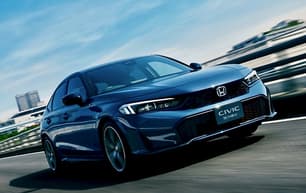
Beauty. Eye. Beholder. All that. But I reckon this Civic looks fantastic. Low-slung and sporty. The perfect antidote to all those bland, beige SUVs currently doing the rounds.
New as part of the most recent refresh is the front-end treatment, a new front bumper, more body-coloured flourishes and new designs for the 18-inch alloys.
I think it looks sleek, premium and purposeful, and not at all boring.
Inside, though, it’s a little less adventurous, though I do adore some of the little design touches, like the perforated metal effect that spans the dash.
The central screen is pretty small by modern standards, and you don't want to push too hard on some of the touch points, like the gloss-black highlights on the doors, which feel flimsy, flexible and pretty cheap.
Now, the screen. Does UX design count in the overall design section? Let's say that it does. I haven’t really experienced less intuitive and user friendly cabin tech lately.
For example, I couldn't figure out (though I must admit I didn't resort to owner's manual) how to get Apple CarPlay to load automatically, if you can.
Instead I had to select my phone, cycle through several screens of approval, and then select my phone again, every single time I got in the car. I had a similar issue using Google maps, which simply wouldn't connect at all for me.
Good tech is easy and intuitive. This wasn't.
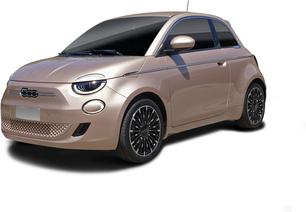
It looks, well, it looks like a Fiat 500.
It’s actually bigger in every dimension than an ICE cinquecento, but it doesn’t really look like it, which is a good thing.
The 17-inch wheels look great, and big against the very small Fiat, and I like the hidden doorhandles, which make the already smooth-looking 500’s flanks look a little smoother still. But I can take or leave the little DRLs up front that are meant to act as little illuminated eyebrows for the headlights, which come over a bit too cutesy.
But I think the highest compliment I can pay it is that it looks like a regular Fiat 500 — one of the most successful reincarnations of a timeless design ever — and not some modern, eco-friendly version that would have killed the look.
In the cabin, however, it’s definitely a more modern affair, with the big screen, the horizontal push-button gear selector, and the nifty push-button door openers.
Still, it’s all pretty familiar Fiat 500, only a little nicer, even if some of the plastics are far too hard and scratchy for a vehicle this expensive.
There are five colours available: Ice white, Onyx black, Rose gold, Ocean green and Celestial blue.
The Honda Civic measures 4569mm in length, 1802mm in width and 1415mm in height, and as you've no doubt already noticed, it's not an SUV, rather a liftback-style sedan.
But if you feel like you need an SUV to move a family, I beg to differ. While the middle seat in the second row is too tight for adults (owing largely to the intrusive raised tunnel that runs through the middle of the cabin), the two window seats can absolutely fit adult humans. I'm 175cm, and had absolutely no issue sitting behind my own driving position.
But the biggest surprise is the boot, which opens to reveal a flat and wide storage space that can swallow 409 litres (VDA) of luggage. In real terms, that's more than enough for our pram and the assorted knick-knacks that go with it on a baby day out.
Unfortunately, though, there’s no spare. Instead you’ll find yourself wrestling with a hateful repair kit should you get a puncture, and you don't want to wait for roadside assist.
There's also twin USB ports in the back, as well as air vents, along with twin cupholders in the pulldown divider.
The 500e is 29mm taller, 61mm longer and 56mm wider than the current ICE Fiat 500 (now 1529mm, 3631mm and 1683mm respectively), and it rides on a longer wheelbase, too .
That means more front-seat room and head room, but there’s still not oodles of space in the four-seat cabin, and especially in the back, where things are pretty tight.
I’m 175cm tall, and my head touches the ceiling in the back, and if I had another full-size human in the back with me, I’d want it to be someone I know well, because we’d be well and truly aquatinted by the time we got to our destination.
The front seats are more accomodating, but there is a strange tightness to the pedal area for the driver. It’s so tight, in fact, that when you rest your left foot, you have to be careful not to accidentally clip the brake pedal when driving.
The boot is a small 185 litres, too. But you’re not buying this for practicality perks, are you?
Ah, so we may have hit the first Honda hurdle. Ours is the entry-level e:HEV L, and it’s a cool $49,900, drive-away. The top-spec LX is $55,900, on the road.
To put that into perspective, Toyota's two Corolla sedan hybrid grades are about $36K and $39K, drive-away, at the moment. The admittedly non-hybrid Golf starts at $39,990, on the road.
The German premium brands are still more expensive, but I think that might be at least part of the Honda’s problem. It now occupies a space between mainstream and premium, which might also be something of a no-man’s land.
Still, the entry-level L is decently equipped, with 18-inch alloy wheels wrapped in quality Michelin Pilot Sport rubber, all-LED lighting all around and key-less entry.
Inside, there’s synthetic leather and fabric seats, dual-zone climate, a 9.0-inch central touchscreen with Apple CarPlay and Android Auto, but also with Google built-in that provides mapping and updates and a 12-speaker Bose stereo.
Both Civic variants also arrive with a three-year subscription to 'Honda Connect', which gives you remote access to your car to lock or unlock it, pre-heat or cool the cabin, or set a geofence alert if your teenagers are borrowing it, that sort of stuff.
But… there are no full-leather seats, there's no sunroof, no wireless charging and you have to open the boot yourself.
The lack of all that doesn’t feel overly premium.
The 500e is not cheap by modern small EV standards — we’re looking at you, China — but it does arrive in one well-equipped trim level, called La Prima, with paint the only available option.
It's also, quite shockingly for anyone who has driven an ICE Fiat 500 lately, stacked with some truly high-tech kit.
There’s heated seats for the first time ever, for example, and there’s 10.25-inch central screen with Apple CarPlay and Android Auto, and wireless charging.
There’s a digital driver display, too, plus there’s faux-leather on the seats and dash, a panoramic glass sunroof and fancy push-button front doors (though with a mechanical back-up lever hidden in the door pockets should something go pear shaped).
Outside, you’ll find 17-inch alloys, as well as LED lightning all around, including the DRLs, and there’s keyless entry and push-button start, too.
But, and it’s a significant but, the 500e lists at $52,500 before on-roads , which — when you consider its size, battery and range — really edges it into the premium EV space.
A similar-sized EV from China can be had for under $40k, which means you are going to have to really love the 500e to drop that extra $15k or so.
The Civic range is an all-hybrid affair, which in this case is what Honda calls its 'two-motor hybrid', which pairs a 2.0-litre petrol engine with two electric motors, one being an electric generator, and the other being the actual propulsion motor which sends power to the wheels. Expect a total 135kW and 315Nm, which is sent to the front wheels via a CVT auto.
A single front-mounted electric motor delivers the power here, with 87kW and 220Nm on offer. Enough, Fiat says, to knock off 100km/h in 9.0 seconds. But it does feel quicker than that in real life, thanks to the way electric vehicles deliver their power.
There’s the usual EV single-speed gearbox, too, with power sent to the front wheels.
Honda says you can expect 4.2L/100km on the combined (urban/extra-urban) cycle, but we found the fuel use was a still impressive 5.5L or so, admittedly mostly in the city.
The 40-litre tank drinks 91 RON 'standard' fuel, meaning its cheapish to fill up, and — using Honda’s numbers at least — should deliver a 950km driving range.
Yesterday, 91 RON was about $1.80 per litre meaning you can theoretically get from Melbourne to Sydney for around $75.
The Fiat 500e’s 42kWh battery provides a smallish 311km driving range on paper, but when we got in it was more like 290km at 96per cent charged. A city car, then, rather than a long-distance hauler.
When it does come time to charge, you’re set up for 85kW DC fast charging which should take you from zero to 80 percent in 35 minutes.
First things first – I really, really like the way this Honda drives. There's a finesse, a confidence, in the drive experience that's sometimes missing from the new brands when they first arrive in Australia.
In short, it feels like it was engineered by people who really know what they're doing. That's the easiest way to describe it.
If you're used to driving older-fashioned hybrid systems you might be used to a bit of shuddering harshness when the engine kicks in, but that's simply not the case here.
Instead, the transition is seamless, with the Honda Civic making the choice for you and largely leaving you out of the process entirely.
Where the powertrain does let itself be more known is under heavier acceleration, with engine thrum seriously invading the cabin, without much in the way of flat-footed performance to accompany it.
But the magic of the Civic drive experience is in its balance. It's not a performance car, but there's real driver engagement to be found in the way it rides and handles. Equally, though, it's never uncomfortable, striking the balance between road-holding confidence and comfort really well.
Happy in the city, happy on a twisting road - this is not one of those smaller cars that leaves the drive experience as a secondary factor. It feels like it really has the driver at heart.
This is the probably the best-driving example of the Fiat 500 I’ve ever climbed into. Sure, it’s not quite as engaging as self-shifting a perky little manual, but it’s smoother, easier and more comfortable, and a whole lot better than ICE vehicles fitted with Fiat's odd dual-logic automatic gearbox.
The EV transition genuinely suits the little Fiat, admittedly sapping a little character, but also thoroughly modernising the drive experience, with smooth, constant acceleration, sharp-enough steering and a ride that’s mostly settled, only really becoming crashy over the bigger road imperfections.
The small dimensions here also help the EV reincarnation. Yes, it’s heavier than you might expect, weighing in at 1290kg (tare), with the batteries adding several hundred kilograms to the equation, but the 500e still doesn’t feel overly heavy, with the little Fiat remaining pretty light on its feet.
There are three drive modes on board, including the catchy Sherpa mode (because it will help get you where you’re going), which, when you’re running low on battery, kills the climate control and anything else it needs to preserve range and get you home.
But you can’t shake the feeling that the 500e is a little expensive for such a specialist tool. It’s unashamedly a city car, but one that will cost you more than $50k, and which doesn’t feel quite premium enough in the cabin to justify that asking price.
The big safety news surrounding the Civic is that its eight airbags are joined by 'Honda Sensing', which packages up every safety system you can possibly imagine — forward collision warning, lane keeping, adaptive cruise, AEB – and delivers them as standard across the range.
But the bigger news is that, refreshingly, none of it is overly intrusive. Even the speed limit warning, which – as in most cars – always gets the speed wrong, just flashes gently on the driver display, rather than binging and bonging through the cabin.
The Civic Hybrid scored a full five-star ANCAP safety rating, with the score based on crash testing in Europe through Euro NCAP.
There’s a heap of active safety stuff on board (again, unusual for a 500), with active cruise control, traffic sign recognition, front, rear and side parking sensors, blind-spot monitoring, AEB with pedestrian and cyclist detection, and more.
Still, the 500e only secured a four-star ANCAP safety rating, scoring just below the five-star cut off in Adult Occupant Protection, Child Occupant Protection and Safety Assist, with a lack of a centre airbag not helping.
The Honda is covered by a five-year/unlimited-kilometre warranty, and servicing is every 12 months or 10,000km.
There is a capped-price servicing program, called 'Low Price Servicing', which means your first five services are $199, but don't cover things like brake pads and tyres.
The fly in Fiat’s ointment is its ownership proposition, with a three-year, 150,000km warranty now way below par in Australia these days, even if the battery is covered for the standard eight years.
Servicing is every 12 months or 15,000kms, and will cost $250 a pop for the first eight years, which is commendably cheap.