What's the difference?
Andrew Chesterton road tests and reviews the updated Holden Spark LT with specs, fuel consumption and verdict.
The micro-car segment in Australia has driven off a cliff. We are shunning our smallest cars in a way we never have before, and nobody seems to be entirely sure why.
The strength of the second-hand market is one suspected culprit, while another is the tempting price point of vehicles that are one size bigger, with city-car shoppers able to upsize for relative peanuts.
Whatever the reason, the segment is stuck in neutral and halfway along Struggle Street. It needs a spark. And Holden's hoping theirs is just the ticket.
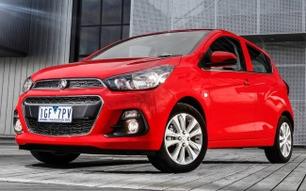
Now you might recognise it as a Barina, but Holden dropped that part of the moniker when this new model launched in March. It is now simply known as the Holden Spark, tested here in top-spec LT guise and wearing a sticker price of $18,990. It sits above only the entry-level, bargain-basement LS ($13,990 manual, $15,690 automatic) in the two-model Spark range.
Designed and built in Korea, the Spark seems to have little to do with our unique marketplace, but Holden promises us this new model couldn't be more dinky-di if it ran on vegemite. Australia had crucial input into its design in Korea, while Holden's Aussie engineers put the new model though its paces on the company's proving ground, tweaking the suspension and steering for Australia's road surfaces.
So the question now is, is the Spark bright enough to lure buyers back to the micro-car segment?
Cupra is not trying to fit in.
In a car market that is getting more and more crowded the Volkswagen Group-owned Spanish performance brand is looking to stand out. Which is why its refreshed Leon hatchback range has added the most unlikely of new models - a small wagon.
The conventional hatchback is struggling to survive against the onslaught of SUVs, and almost every brand has abandoned the wagon in all its sizes, but not Cupra. It has added the Leon Sportstourer to its facelifted Leon hatchback range, giving buyers looking for something different a new alternative.
This new compact wagon is powered by a plug-in hybrid powertrain and joins the Leon hatch in a three-pronged line-up initially, with the Leon S mild-hybrid and VZx hot hatch. A red hot VZx version of the Sportstourer and plug-in hybrid hatch are locked in to join the local Cupra range in 2026, but for now we’ll focus on this trio.
The marvels of local engineering strike again: the Spark LT definitely feels a cut above some of its budget competition from behind the wheel. It is well-equipped, too, and packed with connectivity and technology features. In short, it could be just the spark Australia's city-car segment needs.
There's a lot to like about the updated Leon line-up, but probably not by lots of people. It won't be a best-seller, Cupra doesn't need or even want it to be. What it will do is offer something different, and in the case of the Sportstourer something very rare.
The S and VZx will face stiffer competition in the hatchback markets, primarily from Volkswagen, Audi and even Skoda, and it's hard to pick an area where they really stand out from the competition, apart from the unique styling. Not that they aren't pleasant cars to drive, it's just a crowded market.
Which is why the Sportstourer, especially with its plug-in hybrid powertrain, has a chance to be something that really sets Cupra apart from its rivals. Dynamic, efficient and different, it won’t fit in - and that’s exactly what the brand is hoping for.
Note: CarsGuide attended this event as a guest of the manufacturer, with meals provided.
There's only so much that can be done with a car in this bracket (there's hardly an abundance of surface metal to play with), but Holden's Korean design team have done an admirable job of inserting some excitement into what is traditionally a fairly bland category.
More youth appeal arrives courtesy of a huge array of personalisation options.
A powerful front end, with two fog lights sitting below the headlights, is dominated by a vaguely Kia-esque grille. And when viewed side on, the Spark looks to be sitting low, courtesy of standard 15-inch alloys that fill the wheel arches and tarmac-kissing side skirting that runs front to back. Two fairly heavy body creases also break up the metal monotony, running along the front and rear doors.
It's an energetic-looking package, and even more youth appeal arrives courtesy of a huge array of personalisation options, with Holden promising 33 different changes a buyer can make, including the wheel inserts, wing mirror caps and roof rails.
Inside, the focus is more on connectivity than luxury, so you can expect fake leather, hard plastics and fairly ordinary seat cushioning, but it's all nicely put together, and the basic feel is broken up by some well-placed style elements, like the coloured insert that runs the length of the dash.
Design is a key tenet of Cupra’s ethos, because while it may share Volkswagen mechanical DNA, the Spanish brand wants to really stand apart when you look at or sit inside the Leon.
While it may be the same size as a VW Golf, it certainly doesn’t look or feel like one. Yes, there’s the typical Volkswagen build quality to the fit and finishes, but overall it has a unique Spanish style to it.
On the exterior, Cupra has given the Leon a major visual overhaul with the front end featuring a new-look grille, bumper and headlights. At the rear the tail-lights have been redesigned and now incorporate the logo into a single horizontal light bar that runs the width of the rear.
Inside there’s some new materials, but the most notable change is the introduction of a 12.9-inch multimedia screen. Ambient lightning available on all three models helps to highlight the cabin design.
Nope. This is a pocket-sized car, namely because it has the same cargo capacity as your pocket.
Holden has stretched the space between the wheels to maximise passenger space, and as a result there's actually plenty of room in either row. But to add space somewhere, you need to take it from somewhere else, and that somewhere else is the boot, where you'll find a mere 185-litres of luggage space. The situation is improved by dropping the 60:40 split rear seats, but you'll be forever choosing between passengers and luggage.
Front seat passengers share a pair of cupholders, but rear seat passengers get none. They don't get room for bottles in their door pockets. Or door pockets at all, for that matter. The backseat does, however, get two ISOFIX attachment points, one in each window seat.
While we’re talking about two different bodystyles here - hatch and wagon - the front seats are the same. So you are treated to Cupra’s stylish but thoughtful layout, which looks nice but also has good practicality.
The seats themselves are comfortable, even after extended periods behind the wheel, while there’s cupholders, sizeable door pockets, a lidded centre console box and a wireless smartphone charging pad.
The previously mentioned 12.9-inch multimedia screen dominates the centre console, sitting proudly at the top of the fascia. Unfortunately, Cupra (like Volkswagen) has fallen to the modern trend of ‘touch controls’ rather than physical buttons.
Not to sound like an old man yelling at clouds, but these touch-sensitive sliders are simply not as user-friendly, especially in a moving vehicle, as a traditional physical button or dial. While the multimedia system is easy to use, especially with Android Auto or Apple CarPlay fully integrated, adding dials for the stereo (on/off and volume) and the climate control would have been great.
Otherwise, the 12-speaker Sennheiser sound system with subwoofer and 390W amplifier sounds great, offering a premium in-car entertainment experience to match the Cupra’s price and positioning.
As for space in the back, which is obviously where the hatch and Sportstourer vary. There isn’t a lot to split them in terms of passenger space. These are both small cars, so neither offer the kind of room you’d get from an equivalent-sized SUV. The real difference is the cargo capacity, the hatch pair offer 344L (or 888L with the rear seats down) whereas the Sportstourer has a more generous 470L/1045L.
While the cheap and cheerful entry-level Spark, the $13,990 LS, plays smack-bang in the middle of the micro-car segment, the top-spec LT has bigger, and considerably more expensive, shoes to fill. At $18,990, the LT sails perilously close to its bigger and equally well-equipped competition.
For that money, the Spark needs to arrive wanting for little, and in most respects it does exactly that. For a start, a CVT automatic is standard, and is joined by some stand-out features in this segment, like cruise control, keyless entry with proximity unlocking, push-button start and a fake leather trim that Holden calls Sportec.
While navigation isn't standard, the Spark LT's seven-inch touchscreen is both Android Auto and Apple Car Play equipped, so phone maps fill the blank with ease.
Knowing that hatchbacks and wagons aren’t big sellers and Cupra’s desire to stay boutique rather than mainstream, the line-up is relatively simple.
The Leon S kicks off the range at $46,990 (all prices listed exclude on-road costs) and comes with 18-inch black and silver alloy wheels, LED headlights, keyless entry and ignition, heated sports bucket seats, tri-zone climate control and a six-speaker sound system with Apple CarPlay and Android Auto.
The Leon VXz starts at $64,990 and includes 19-inch black and copper alloy wheels, multi-link rear suspension, adaptive dampers, front locking differential, upgraded brakes, quad exhaust and Cupra drive modes. There’s also leather-appointed seats and a 12-speaker Sennheiser sound system.
The VZe Sportstourer completes the line-up priced at $69,990 featuring unique 19-inch black and copper alloys, LED headlights and tail-lights, a power tailgate with handsfree opening and black roof rails. Inside it gets leather-appointed sports seats, heated front seats and steering wheel, tri-zone climate control, native navigation, Apple CarPlay and Android Auto plus the 12-speaker Sennheiser stereo.
There's just the one engine available across the Spark range, and that's a 1.4-litre petrol unit that'll generate 73kW and 128Nm.
The three Leon models all feature a different powertrain, as each is targeting a distinctly different buyer.
The Leon S is powered by a 110kW/250Nm 1.5-litre turbocharged petrol engine with mild-hybrid assistance.
The Leon VZx gets a more potent 2.0-litre four-cylinder turbo-petrol engine that makes 221kW/400Nm, to put it right at the heart of the hot hatch market.
The Leon VZe Sportstourer manages to combine efficiency with performance, with a 1.5-litre turbo-petrol engine paired to an electric motor to make an efficient 200kW and 400Nm.
The one thing all three have in common is a seven-speed dual-clutch transmission and front-wheel drive.
Spring for the LT, and that's paired with a CVT automatic transmission, with Holden promising that combination will sip a claimed/combined 5.5L/100km (though we recorded a less impressive 8.0 litres on our test).
Naturally, the three different powertrains provide three very different fuel economy numbers.
The mild-hybrid system in the Leon S allows it to use just 5.4L/100km, which provides a theoretical range of up to 833km thanks to its 45-litre fuel tank.
The VZx is the thirstiest member of the range, not surprisingly, using 7.6L/100km. With its 50-litres tank it has a theoretical driving range of approximately 650km.
Finally, the Sportstourer VZe manages a claimed 0.4L/100km on paper, thanks to its 20kWh battery providing up to 121km of electric-only driving range. Obviously achieving that claimed figure in the real world is incredibly difficult (as it is with any PHEV) but we still managed to use just 2.4L/100km on our mostly extra-urban test drive, which is still a good return.
Holden's Aussie engineering team say they were able to get their hands all over the new Spark pre-launch, launching lap after lap of the company's proving ground as they tweaked the steering and suspension tune to better suit local conditions. And the results are very good.
The 1.4-litre engine doesn't generate a huge amount of power (though it is good for its class), but it's delivered in a way that makes the Spark feel like it's punching well above its weight, rarely feeling underpowered in everyday situations.
There is a certain skittishness to the way it drives at times.
The Aussie magic sprinkled over the suspension and steering transforms the way the Spark LT drives, both in the city and further afield. The ride nudges the firm side of the spectrum (but not enough to bother you over inner-city ruts and bumps) which translates to a low, flat feeling through corners.
All in all, the little Spark more than holds its own on more challenging roads. The steering, too, helps the Spark outshine the regular city commuters, with a naturally engaging set-up that always feels connected to the road below.
There is a certain skittishness to the way it drives at times, though, with the gearbox wanting to continue lurching forward for a split-second after you take your foot off the accelerator, which takes some getting used to.
Obviously there are three very different variants in the Leon range, with three different powertrains and two different body styles, and yet there is a familiar feeling between all three when you’re behind the wheel.
This is arguably the ‘most Volkswagen-y’ element of the Cupras, with the solid, stable Volkswagen underpinnings coming through. This is, of course, not a criticism, but rather highlights the positive connections between Cupra and its parent company, which has allowed it to make an immediate impression on the Australian market.
However, it also means the Leons feel so familiar that they don’t leave you with a unique impression and driving character.
For example, the VZx is almost too good, too quick and too clinical. It lacks the excitement and engagement rival hot hatches offer, notably the Hyundai i30 N and Honda Civic Type R, but instead compensates by just being really capable.
Obviously, that may not be seen as a negative by everyone and for those who want that sort of engaging, dare I say ‘fun and edgy’, driving experience the Leon VZx may not be precisely what they are looking for. Still, the engine is potent and even the lack of all-wheel drive doesn’t dampen its performance abilities too significantly compared to the likes of a VW Golf R or Audi S3.
The Leon S offers a different proposition, a warmed up hatch, rather than something hot. On that front it delivers, providing a well-mannered drive but without the punch of the VZx.
The Sportstourer is arguably the pick of the range, with its combination of sharp driving dynamics and very efficient powertrain. At no point do you feel like Cupra compromised its sporty intent to make the Sportstourer save fuel. Instead, the PHEV powertrain offers plenty of performance when you need it but is otherwise quiet and efficient the rest of the time, helping it to sip fuel at a much lower rate than its Leon hatchback alternatives.
Standard safety fare comes courtesy of six airbags, along with hill-hold assist, ABS and ESC, but it does miss out on more advanced technologies like autonomous brakes.
Springing for the LT will add rear parking sensors, a rear-view camera and cruise control as standard fare, though the lot can be added to the entry-level LS as part of Holden's Driver Assistance Pack.
The Spark range scored the maximum five-star ANCAP safety rating when tested early this year.
The Cupra trio come loaded with plenty of safety features including 10 airbags for excellent passive protection plus autonomous emergency braking, front and rear cross-traffic alert, blind spot warning and driver fatigue monitoring.
For convenience and safety there’s also adaptive cruise control, front and rear parking sensors and even self-parking.
As the Leon has had no major structural changes, the original 2021 five-star ANCAP rating still applies. However, it should be noted that ANCAP updated its testing protocols in 2023, so that five-star rating is different to a five-star rating applied since then.
The Spark range is covered by a three-year, 100,000km warranty and requires servicing every 15,000kms. The Spark range falls under Holden's lifetime capped price servicing scheme, with trips to the dealership capped at $1,145 total for the first five services.
All three Leons are covered by Cupra Australia’s standard warranty, which covers the first five-years/unlimited kilometres. Which is good, especially for a new and more premium brand, even if it’s obviously short of the best-in-market.
Servicing is required every 12 months/15,000km, whichever comes first, and Cupra is offering a servicing pack special until the end of 2025, of $1990 for five years. That works out to an average of $398 per year.
Cupra is expanding its dealer network in Australia too. The Leon drive event we attended began at the newly-opened Cupra Macarther in Sydney’s growing west. There’s also a new dealership at Melbourne’s Essendon Fields.
Of course, one of the key advantages that Cupra has over many other new brands to Australia is its Volkswagen/Audi connections, which allows its models to be serviced at those dealerships as well. That provides a much larger footprint for customers to find somewhere convenient to service their car, which cannot be underestimated.