What's the difference?
Andrew Chesterton road tests and reviews the updated Holden Spark LT with specs, fuel consumption and verdict.
The micro-car segment in Australia has driven off a cliff. We are shunning our smallest cars in a way we never have before, and nobody seems to be entirely sure why.
The strength of the second-hand market is one suspected culprit, while another is the tempting price point of vehicles that are one size bigger, with city-car shoppers able to upsize for relative peanuts.
Whatever the reason, the segment is stuck in neutral and halfway along Struggle Street. It needs a spark. And Holden's hoping theirs is just the ticket.
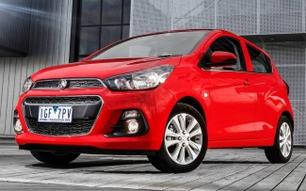
Now you might recognise it as a Barina, but Holden dropped that part of the moniker when this new model launched in March. It is now simply known as the Holden Spark, tested here in top-spec LT guise and wearing a sticker price of $18,990. It sits above only the entry-level, bargain-basement LS ($13,990 manual, $15,690 automatic) in the two-model Spark range.
Designed and built in Korea, the Spark seems to have little to do with our unique marketplace, but Holden promises us this new model couldn't be more dinky-di if it ran on vegemite. Australia had crucial input into its design in Korea, while Holden's Aussie engineers put the new model though its paces on the company's proving ground, tweaking the suspension and steering for Australia's road surfaces.
So the question now is, is the Spark bright enough to lure buyers back to the micro-car segment?
I miss my old phone. Sure, my new phone has a bigger screen and it’s smarter and faster, but my previous phone was smaller and easier to use, and now when I go to do a screen shot I accidentally hit the volume button every time.
What I really want in a phone is a new version of the old one – and I have a feeling people may feel the same way about the 2018 Volvo V40.
Some time next year the completely new generation V40 is expected to arrive and there will be some things I’ll miss about the old one. So, this really is your last chance to buy a new ‘old’ Volvo V40.
In a last-hurrah review, I road tested the V40 in the Inscription grade with the T4 petrol engine. What’s so 'missable' about it? Read on to find out.
The marvels of local engineering strike again: the Spark LT definitely feels a cut above some of its budget competition from behind the wheel. It is well-equipped, too, and packed with connectivity and technology features. In short, it could be just the spark Australia's city-car segment needs.
I’m going to miss this V40 like I do my old phone, and for many people this hatch really could really be close to perfect: excellent safety equipment, enjoyable to drive, cool prestige styling and some lo-fi buttons and dials that are far easier to use than swiping a screen. This is your last chance to own an old, new V40.
There's only so much that can be done with a car in this bracket (there's hardly an abundance of surface metal to play with), but Holden's Korean design team have done an admirable job of inserting some excitement into what is traditionally a fairly bland category.
More youth appeal arrives courtesy of a huge array of personalisation options.
A powerful front end, with two fog lights sitting below the headlights, is dominated by a vaguely Kia-esque grille. And when viewed side on, the Spark looks to be sitting low, courtesy of standard 15-inch alloys that fill the wheel arches and tarmac-kissing side skirting that runs front to back. Two fairly heavy body creases also break up the metal monotony, running along the front and rear doors.
It's an energetic-looking package, and even more youth appeal arrives courtesy of a huge array of personalisation options, with Holden promising 33 different changes a buyer can make, including the wheel inserts, wing mirror caps and roof rails.
Inside, the focus is more on connectivity than luxury, so you can expect fake leather, hard plastics and fairly ordinary seat cushioning, but it's all nicely put together, and the basic feel is broken up by some well-placed style elements, like the coloured insert that runs the length of the dash.
The V40 has been around forever (well, since 2012) but somehow it still looks great – it’s the Nicole Kidman/Rob Lowe of cars.
The thing is Volvo’s new-generation vehicles now have a different look, which will be worn by the next V40, and that seriously dates the current car.
Sure, in 2016 this V40 was updated and given 'Thor’s Hammer' LED running lights like the new-gen cars, but it’s clear the V40 has the old look.
The question is: are you the type of person who would be annoyed if this time next year somebody in the latest ‘new-look’ V40 pulled up beside you at the lights. If yes, then stop reading now… we’ll just wait a moment for you to leave.
Okay, it’s just us now. We don’t need those shallow people anyway, right? They don’t know what they’re missing out on – like an interior with lots of buttons. I’m serious the centre console actually has a numerical key pad for making phone calls. There are also lots of dials for the climate control and seat warmers and for the auto parking system.
All of these buttons will be replaced by a sexy, large touchscreen in the new V40, which will make the screen in the current one look like the slot in Ned Kelly’s helmet. Wait, don’t leave. See, I’ve road tested the new X60 and I missed just flinging a dial to make the cabin’s temperature cooler, instead I had to go into the screen’s menu, find the climate functions, and then slide my finger down a little digital ladder until I found 21 degrees. It’s a frustrating design and potentially distracting in that it takes your eyes off the road longer than twisting a dial does.
I’ll stop the rant. So, yes, the interior of the new V40 will look so sleek and minimalist, decluttered of its buttons and sporting a large vertical screen, but there are functional advantages to keeping it simple.
That said the current V40’s cabin is still special and elegant. The Inscription grade brings milled aluminium trim to the centre console and that leather steering wheel. Volvo owners would be aware of that solid, well-built feeling with a high-quality fit and finish.
What are the V40’s dimensions? Compared to the Audi A3 Sportback the V40 is 59mm longer at 4369mm end-to-end, 72mm wider at 1857mm across, and 5mm shorter in height at 1420mm.
Nope. This is a pocket-sized car, namely because it has the same cargo capacity as your pocket.
Holden has stretched the space between the wheels to maximise passenger space, and as a result there's actually plenty of room in either row. But to add space somewhere, you need to take it from somewhere else, and that somewhere else is the boot, where you'll find a mere 185-litres of luggage space. The situation is improved by dropping the 60:40 split rear seats, but you'll be forever choosing between passengers and luggage.
Front seat passengers share a pair of cupholders, but rear seat passengers get none. They don't get room for bottles in their door pockets. Or door pockets at all, for that matter. The backseat does, however, get two ISOFIX attachment points, one in each window seat.
Umm, next question. Okay, the V40 is not very practical. Those small rear doors don’t open wide, making entry and exit potentially difficult for older or less limber folks.
Legroom in the back is limited – although at 191cm I can just sit behind my driving position and headroom is getting tight, too – but still there’s just enough room for me.
The V40’s cargo capacity is 335 litres and that’s smaller than the A3 Sportback’s boot space (380 litres) and the BMW 1 Series’s luggage capacity (360 litres). The aperture of the boot itself is also small.
There’s even a practicality issue with the driver’s doorway – that windscreen is so slanted that the A-pillars either side of it are hard to dodge for taller people when trying to get in, but especially when climbing out.
While the cheap and cheerful entry-level Spark, the $13,990 LS, plays smack-bang in the middle of the micro-car segment, the top-spec LT has bigger, and considerably more expensive, shoes to fill. At $18,990, the LT sails perilously close to its bigger and equally well-equipped competition.
For that money, the Spark needs to arrive wanting for little, and in most respects it does exactly that. For a start, a CVT automatic is standard, and is joined by some stand-out features in this segment, like cruise control, keyless entry with proximity unlocking, push-button start and a fake leather trim that Holden calls Sportec.
While navigation isn't standard, the Spark LT's seven-inch touchscreen is both Android Auto and Apple Car Play equipped, so phone maps fill the blank with ease.
The Volvo V40 in the mid-range Inscription grade with the T4 engine lists for $43,990. When I road tested it for the first time five years ago (in 2013) it was $45,990, and it’s a better car now than it was then, with more standard features.
The list includes a 7.0-inch touchscreen with reversing camera, sat nav, eight-speaker sound system with CD/DVD player, digital radio, and internet connectivity – but no Apple CarPlay or Android Auto.
Also standard are front and rear parking sensors, an auto parking system, plus power adjustable driver and front passenger seats. There’s also leather upholstery, leather-trimmed steering wheel, dual-zone climate control, 17-inch 'Sarpas' alloy wheels and proximity key entry.
The safety equipment list is impressive, too – you can read all about what’s looking after you in the safety section below.
If you wanted a model comparison, then also look at the BMW 1 Series 18i M-Sport for $43,890 or the Audi A3 Sportback 2.0TFSI for $46,400 or Mercedes-Benz A200 for $44,300.
Also, don’t forget that because the current V40 is due to be replaced, dealers will be keen to move their stock to make way for the new one and that means you should be able to get yourself a bargain.
There's just the one engine available across the Spark range, and that's a 1.4-litre petrol unit that'll generate 73kW and 128Nm.
The V40 line-up has three petrol engines to pick from and the T4 sits right in the middle between the most powerful T5 and the least grunty T3. A 2.0-litre four-cylinder turbo-petrol engine the T4 makes 140kW/300Nm and delivers it through a smooth six-speed automatic.
That engine is up there with my favourite things about the V40 Inscription. The power figure isn’t huge but 300Nm of torque provides decent shove. A 0-100km/h time of 6.9 seconds isn’t at all slow.
Spring for the LT, and that's paired with a CVT automatic transmission, with Holden promising that combination will sip a claimed/combined 5.5L/100km (though we recorded a less impressive 8.0 litres on our test).
Volvo says the V40 should use 5.6L/100km of premium unleaded fuel over a combination of open and urban roads.
If you’re only going to stick to urban areas you’ll see higher usage – our trip computer was reporting an average of 14.9L/100km on a regular peak hour commute, but motorways drop the figure to about 8.0L/100km.
Holden's Aussie engineering team say they were able to get their hands all over the new Spark pre-launch, launching lap after lap of the company's proving ground as they tweaked the steering and suspension tune to better suit local conditions. And the results are very good.
The 1.4-litre engine doesn't generate a huge amount of power (though it is good for its class), but it's delivered in a way that makes the Spark feel like it's punching well above its weight, rarely feeling underpowered in everyday situations.
There is a certain skittishness to the way it drives at times.
The Aussie magic sprinkled over the suspension and steering transforms the way the Spark LT drives, both in the city and further afield. The ride nudges the firm side of the spectrum (but not enough to bother you over inner-city ruts and bumps) which translates to a low, flat feeling through corners.
All in all, the little Spark more than holds its own on more challenging roads. The steering, too, helps the Spark outshine the regular city commuters, with a naturally engaging set-up that always feels connected to the road below.
There is a certain skittishness to the way it drives at times, though, with the gearbox wanting to continue lurching forward for a split-second after you take your foot off the accelerator, which takes some getting used to.
That grunty 2.0-litre engine teamed with that smooth six-speed transmission goes a long way to making the V40 Inscription T4 an enjoyable car to drive.
Good handling and a fairly comfortable ride complete a prestige and easy-to-drive package that’s only really let down by heavy steering and slightly noisy suspension. That heavily sloped windscreen does present some visibility issues, but it’s not a deal breaker.
Standard safety fare comes courtesy of six airbags, along with hill-hold assist, ABS and ESC, but it does miss out on more advanced technologies like autonomous brakes.
Springing for the LT will add rear parking sensors, a rear-view camera and cruise control as standard fare, though the lot can be added to the entry-level LS as part of Holden's Driver Assistance Pack.
The Spark range scored the maximum five-star ANCAP safety rating when tested early this year.
First tested in 2012, the V40 the achieved one of the highest-ever scores awarded by EuroNCAP and saw ANCAP give it the maximum five-star rating in Australia. Back then the V40 came standard with advanced safety equipment only making it onto cars these days such as AEB, it also had the world’s first pedestrian airbag, which inflates to protect people from hitting the A-pillars and windscreen.
The 2017 update added blind-spot warning as standard on the Inscription grade. A $1300 option package brings Lane Departure Warning, Lane Keeping Aid, Active High Beam Control, Forward Collision Warning and Road Sign Information. A $3000 package brings adaptive cruise control, collision warning with full auto braking, plus pedestrian and cyclist detection.
ABS, EBD, traction and stability control are of course there to step in should you need it, too. You’ll find three top tether and two ISOFIX points in the second row for child seats. A space-saver spare is under the boot floor.
The Spark range is covered by a three-year, 100,000km warranty and requires servicing every 15,000kms. The Spark range falls under Holden's lifetime capped price servicing scheme, with trips to the dealership capped at $1,145 total for the first five services.
The V40 Inscription is covered by Volvo’s three-year/unlimited kilometre warranty. Volvo has two capped-price servicing programs – the $1600 Smartcare for three years and the $2950 Smartcare Plus for five years.