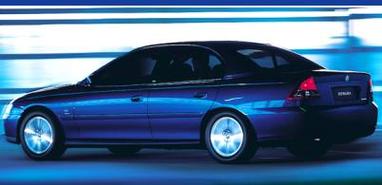
Holden Commodore 2003 Problems

Are you having problems with your 2003 Holden Commodore? Let our team of motoring experts keep you up to date with all of the latest 2003 Holden Commodore issues & faults. We have gathered all of the most frequently asked questions and problems relating to the 2003 Holden Commodore in one spot to help you decide if it's a smart buy.

Used Holden Commodore review: 2002-2003
By Graham Smith · 26 Mar 2005
If it ain't broke, don't fix it is a maxim Holden followed when it kept facelifting the runaway success Commodore for eight years.  The present VZ is the third major facelift of the VT. There were three minor updates as well.The VY launched in 2002 was the second major update of the VT and brought refinements to the body, powertrain and chassis that gave improved performance, ride, handling and safety.Model watchHolden served up the familiar model range with the VY.  The Executive was aimed at the fleet buyer, the Acclaim more at the private purchaser. The Berlina and Calais appealed to user-choosers who wanted more.There were the sporty models in the S and SS. A new sports sedan in the SV8 offered many of the SS features at less cost.  The proven 3.8-litre overhead valve Ecotec V6 engine carried over unchanged, while the power of the 5.7-litre overhead valve Gen III V8 jumped to 235kW.In the shopGenerally the Commodore is quite reliable. But debate continues over oil consumption and piston rattle in the Gen III V8.  New teflon-coated pistons and higher-tension rings appear to have fixed most problem engines.  The problem engines were rebuilt so it's unlikely you'll find one now, but check the history of any V8 with the owner.The auto transmissions are reliable, but need regular servicing, so check service records. Check the trans oil in any car with a tow bar, and look for signs it has been used for heavy towing.  Be warned, tyre wear is high. If you get 40,000km from a set of tyres you're doing well.Crunch timeFurther stiffening of the body shell aided primary crash protection with reduced risk of lower limb injury, while dual airbags were standard on all models, along with load-limiting seat belt retractors.Owner's views ROD KIDD says he is happy with his 2003 VY S pack Commodore which has done 38,000km without problems.  Rod chooses Aussie-built six-cylinder cars because of their perceived value for money.Margaret and John Rowe have had four Commodores, and their VY has done 41,000km of mostly country running.  They like the drivability, but don't like the LCD dash display, the boot hinges which eat into the boot space and lack of a boot key.  They say fuel consumption of 9 litres/100km in town is good.The bottom line16/20 EX-LEASE cars flooding on to the market now make the VY Commodore a good buy.Look forSHARP aggressive stylingRELIABLE and fuel-efficient V6POSSIBLE oil consumption of V8IMPROVED steering precisionCOMFORTABLE seats
Read the article
Used Holden Commodore review: 2002-2004
By Graham Smith · 19 Sep 2006
The VY, launched in 2002, was the second major update of the VT and brought with it refinements to the body, power train and chassis which reaped rewards in improved performance, ride and handling, and safety. Another minor update in 2003, the VY II, continued the evolutionary development of the series with a raft of more subtle refinements.The VY model range was familiar Holden fare. The Executive was aimed at the fleet buyer, the Acclaim more at the private buyer, with the Berlina and Calais appealing to user-choosers who wanted more.There were also sporty models in the form of the S and SS. But this time there was a new sports sedan in the SV8 which offered many of the SS features at a more affordable price.Styling changes were relatively minor, but brought a more aggressive look, with new grilles and headlamps, bumper treatments and tail lamps. The well-proven 3.8-litre overhead valve ECOTEC V6 was carried over unchanged, while the power of the 5.7-litre overhead valve Gen III V8 jumped to 235kW, courtesy of a retuned twin exhaust system.There was nothing much new on the transmission front, with a choice of four-speed auto or five-speed manual on the V6, and four-speed auto or six-speed manual on the V8. Underneath, Holden's chassis engineers made some big changes, mostly to the steering, which was adapted from the Monaro. The Monaro had won high praise for its steering feel and precision.In the 2003 VY II update, Holden gave the luxury Calais a more European personality with bolder styling inside and out, larger alloy wheels, and sportier suspension settings.The 5.7-litre Gen III V8 was offered in two forms, a dual exhaust version, which boasted 245kW at 5600 revs for the SS and SV8 models, and a 235kW single exhaust version for the rest of the range.Generally, the Commodore is quite reliable. Little seems to go wrong with the ECOTEC V6 engine which has proven to be a tough old unit, but the Gen III 5.7-litre V8 was affected by high oil consumption accompanied by piston rattle. Holden opted for piston rings that were a loose fit in the bore in the interests of fuel consumption, but that resulted in a light piston rattle along with high oil consumption on some V8s.New teflon-coated pistons and tighter rings were released and they seem to have fixed most problem engines. Holden rebuilt the problem engines so it's unlikely you'll find one in the field now, but it's worth checking the history of any V8 with the owner. Ask for any oil consumption history they might have, and check if it's been rebuilt.Both engines will run quite happily on LPG, which makes the VY an attractive proposition. It's one of the better cars to buy if you're prepared to convert to dual-fuel.The auto transmissions are generally reliable, but check the trans oil in any car fitted with a tow bar, and look for signs it has been used for heavy towing. Holden's engineers improved the ride and handling with the addition of a toe-link to the Commodore's IRS. That also improved tyre wear, which still is quite high.Further stiffening of the body shell aided primary crash protection with reduced risk of lower limb injury, while dual airbags were standard on all models, along with load-limiting seatbelt retractors.The recent used-car safety survey rated the Commodore above the average for occupant protection, but not so high when it came to impact on the occupants of the car you hit.2002-2004Check for rear tyre wearSafety of airbagsComfortable seatsStiffened body structureReliable and fuel efficient V6Improved steering precisionPossible oil consumption of V8Sharp aggressive stylingThere are lots of low mileage ex-lease cars on the market now making the VY a good buy.
Read the article
Used Holden Commodore review: 2002-2004
By Graham Smith · 23 Jan 2009
“If it ain’t broke, don’t fix it” is an old truth, one Holden faithfully followed when it facelifted the VT Commodore once it proved a runaway success. The current VZ is the third major facelift of the VT, there were three minor updates as well as Holden worked to keep the Commodore fresh through the eight years since the VT was launched.That it has been able to keep the Commodore selling so strongly for such a long time is testament to the original design, which has dated particularly well.The VY launched in 2002 was the second major update of the VT and brought with it further refinements to the body, powertrain and chassis which reaped rewards in improved performance, ride and handling, and safety.Another minor update in 2003, the VY II, continued the evolutionary development of the series with a raft of more subtle refinements.Holden served up the familiar model range with the VY. The Executive was aimed at the fleet buyer, the Acclaim more at the private buyer, with the Berlina and Calais appealing to user-choosers who wanted more.There were also the sporty models in the S and SS, but this time there was a new sports sedan in the SV8, which offered much of the SS features at a more affordable price.Styling changes brought a more aggressive look, with new grilles and headlamps, bumper treatments and tail lamps.The power choices were much the same, the well proven 3.8-litre overhead valve ECOTEC V6 was carried over unchanged, while the power of the 5.7-litre overhead valve Gen III V8 jumped to 235 kW with a retuned twin exhaust system.There was nothing much new on the transmission front, with a choice of four-speed auto or five-speed manual on the V6, and four-speed auto or six-speed manual on the V8.Under the sharp skin Holden’s chassis engineers made some major revisions, mostly to the steering which was adapted from the Monaro after it had been widely praised for its steering feel and precision.In the 2003 VY II update Holden gave the luxury Calais a more European personality with bolder styling inside and out, larger alloy wheels, and sportier suspension settings.The Gen III V8 was offered in two forms, a dual exhaust version, which boasted 245 kW at 5600 revs for the SS and SV8 models, and a 235 kW single exhaust version for the rest of the range.Generally the Commodore is quite reliable. Little seems to go wrong with the V6 engine, which has proven to be a tough old unit, but debate rages over the oil consumption and piston rattle problems that plagued the Gen III V8.The best explanation of the problem appears to be that Holden released piston rings that were a loose fit in the bore in the interests of fuel consumption. On some engines that resulted in an audible light piston rattle along with high oil consumption.New Teflon-coated pistons and tighter rings was released which appear to have fixed most problem engines. Problem engines were rebuilt so it’s unlikely you’ll find one in the field now, but it’s worth checking the history of any V8 with the owner. Ask for any oil consumption history they might have, and check if it’s been rebuilt.The Auto transmissions are generally reliable, but need regular servicing for reliability, so check for a service record. Check the trans oil in any car fitted with a tow bar, and look for signs it has been used for heavy towing.The introduction of the toe-link to the Commodore’s IRS in the VX model improved the handling precision and response. Importantly it also improved tyre wear, but be warned tyre wear is still quite high. If you get 40,000 km from a set of tyres you’re doing well.Further stiffening of the body shell aided primary crash protection with reduced risk of lower limb injury, while dual airbags were standard on all models, along with load-limiting seat belt retractors.The recent used car safety survey rated the Commodore above the average for occupant protection, but not so high when it came to impact on the occupants of the car you hit.Margaret and John Rowe have owned four Commodores and now own a VY which has done 41,000 km of mostly country running. On the plus side they like the road holding and drivability, the quiet comfortable ride, seats, safety, parking sensors, and used friendly cabin layout. On the other side they don’t like the LCD dash display, the boot hinges which eat into the boot space, the limited choice of trim colours, and the lack of a boot key. They say the fuel consumption, 9.0 L/100 km in town, eight L/100 km out, is good.Michael Fava owns a 2004 VY II Equipe, and says it’s a great car with heaps of power and good looks. His complaints are minor, the location of the radio tuning controls on the steering wheel, a broken storage compartment lid on the dash, and the rear parking sensors are too sensitive. The highway fuel consumption, 8.7-9.5 L/100 km, is good, but he’s not as happy about the 11.0-12.5 L/100 km he gets around town.Rod Kidd says he’s happy with his 2003 VY Commodore S pack Commodore, which has done 38,000 km without fault. Rod chooses Aussie-built six-cylinder cars because of their perceived value for money.Victor de Beer is happy with his 2003 VY II SS Commodore, which has done 19,000 km, but feels it needs better brakes and a more up-to-date auto transmission. The worst part of owning an SS Commodore is its high tyre wear.Stephen Matthews recently updated to a VY V6 auto Commodore, which now has 24,000 km on it. Since buying it he has noticed a slapping noise or dull lifter noise when the car is restarted after it is already warm. Holden has replaced the lifters without effect.• Sharp aggressive styling• reliable and fuel efficient V6• possible oil consumption of V8• improved steering precision• comfortable seats• safety of airbags• stiffened body structureBooming new car sales three years ago mean lots of low mileage ex-lease cars flooding on to the market now making the VY Commodore a good buy.
Read the article
Used Holden Ute One Tonner review: 2003-2004
By Graham Smith · 23 Jan 2009
The original Holden One Tonner was a runaway success so there was good reason for Holden to develop a new generation Commodore-based tray top. The original One Tonner was released with the HQ model in 1971 when it added a whole new dimension to the good old Aussie ute. At the time the traditional Aussie ute, basically a light three-quarter tonne workhorse, was under siege from a new wave of Japanese utes, which could all boast a full one tonne payload.They might have been rough and rugged compared to the car-based ute, but the new imports were competitively priced and got the job done when your priority was work biased. The Holden One Tonner redressed the balance somewhat by offering local tradies a tough-as-nails work ute that could carry a full one-tonne payload with much of the comfort of a passenger car.While it was a huge success there was no holding back the tidal wave that was the Japanese one-tonne utes, even Holden had one in the form of the Rodeo, and the Holden One Tonner was sent to the automotive graveyard in the mid-1980s.The regular Holden ute carried on with a Commodore-based model after a short hiatus, but over time became less of a hard-core worker and more of a dual purpose work and play model. There are those within Holden who call it Australia’s own two-door sports car.But there was always a demand from tradies who wanted a smart looking ute that was still capable of doing a hard day’s work.Holden was in a sentimental mood when it released the new One Tonner based on the VY Commodore ute in 2003. It came in the wake of the new Monaro, which was then proving a hit with the car buying public, and that must have given Holden the confidence to resurrect another of its treasured icons of the past.MODEL WATCHCreating the new One Tonner wasn’t a simple cut and shut job on the Commodore-based Ute. The Holden ute didn’t have a chassis so the engineering team had to design an entirely new chassis frame and graft it to the Ute’s cabin.The new One Tonner was part monocoque and part chassis frame. The frame was bolted on to the back of the cab rather than welded as is the more common practice, but Holden claimed its method of construction was a more robust one.With a wheelbase of 3200 mm the new One Tonner was the longest in its class, and it was wider and higher than its Ute cousin. Importantly it had a payload capacity in excess of one tonne once allowance was made for fuel, passengers and additional equipment like tray bodies and bull bars etc.The One Tonner lent itself to a broad range of body styles to suit the owner’s needs, from aluminium dropside trays to a stylish wooden flat top bed.Up front the cab was the familiar comfortable Ute cabin with all of the Commodore features like cloth-trimmed bucket seats, centre console and power mirrors in the base model, while the ‘S’ model had air-conditioning, power windows, a leather-wrapped steering wheel and alloy wheels.Buyers could choose from the 152 kW 3.8-litre Ecotec V6 with the Aisin 4L60 four-speed auto transmission, or the optional 225 kW 5.7-litre Gen III V8 which was available with the heavy-duty Aisin 4L65 four-speed auto or a six-speed manual gearbox.Underneath the front suspension was the familiar Commodore MacPherson Struts with coil springs and an anti-roll bar, but the rear suspension was an all-new live rear axle with leaf springs, which was rated to carry 1800 kg.A VZ update in 2004 brought the 175 kW Alloytec V6 engine, 10 kW more power for the V8, a six-speed manual transmission for the V6 and upgraded autos, and VZ styling.IN THE SHOPThe One Tonner hasn’t been without its problems, most notably with the rear axle, which has been a constant source of drama for many owners. Gear noise and clunking has been the subject of regular complaints from owners and Holden’s answer has been to replace offending axles. Sometimes it has provided a satisfactory fix, other times it hasn’t.One owner claims to have fixed the problem by increasing the oil capacity of the rear axle by fitting a larger hat available on the aftermarket.In addition there is also the ongoing noise and oil consumption problems of the Gen III V8, so it’s worth checking for oil consumption records for a V8 One Tonner and carefully listening for any light tapping noises coming from the engine at idle or as the throttle is blipped. A check when the engine is cold might be enlightening as well.Otherwise the One Tonner is a fairly robust unit, the economical ECOTEC 3.8-litre V6 stands up well and is probably the better buy if your priority is a workhorse. It’s quite economical with owners reporting fuel consumption numbers in the 10-12 L/100 km range.The new Alloytec V6 is causing some consternation with owners reporting high oil consumption and disappointingly high fuel consumption in the region of 12-14 L/100 km.Look for body damage caused by a hard life on the work site, One Tonners used for work purposes are exposed to a greater chance of accidental damage because they spend their time around moving equipment and carry tools and materials that can damage bodywork.IN A CRASHAll models had a driver’s airbag as standard with the option of a passenger’s airbag.Anti-skid brakes were standard on the ‘S’ model, optional on the base model.OWNERS SAYMark Williams wishes he hadn’t bought VZ One Tonner. It was the 18-year-old chippie’s first car and he reckons it should have been painted lemon yellow instead of the black he ordered. The window tinting bubbled shortly after he took delivery of it, and in less than 22,000 km from new the Alloytec V6 has used oil at an alarming rate, the exhaust has been replaced, the brake rotors have been machined at least twice to fix its squealing brakes which continue to howl, and the auto transmission sometimes slips in first.LOOK FOR• Economical ECOTEC V6 in VY models• high fuel consumption in Alloytec V6• oil consumption and piston rattle in V8s• full one-tonne payload• sporty Commodore looks• car-like comfort• rear axle whine a sign of impending failureTHE BOTTOM LINEGreat idea but the One Tonner has been plagued with problems, particularly the rear axle, and it seems the new Alloytec V6 engine uses excessive oil and fuel.RATING50/100
Read the article
Wagon wanted
Answered by Graham Smith · 07 Dec 2007

IT'S best to buy the newest model you can afford, so that means a VYII of 2003/04. The engine is the ECOTEC V6, which is a solid performer.

Holden Commodore 2003: Timing chain
Answered by Carsguide.com.au · 20 Sep 2007

YOUR Commodore has a V6 with a timing chain, so no need to service or replace it.

No premium for lpg falcon
Answered by Graham Smith · 01 Sep 2005

THE dedicated E-gas option on the Falcon costs $1400, which is what you need to recoup before you start saving money. My calculations, done after driving a dedicated LPG Falcon against a petrol one, suggest you will be in front after 20,000km, which I estimate to be a little more than a year's driving. That's a new Falcon, but it's going to be less with a used car because the market doesn't value the E-gas option, so you should be able to pick up a BA E-gas car for the same price as a petrol one. You're saving money from the start that way. Holden didn't have an LPG option in the VY, so any you find on theused-car market will be an aftermarket installation.

A gas convert
Answered by Carsguide.com.au · 21 Nov 2008

IT'S best to shop around when looking to convert so you get an accurate picture of the current state of play in the LPG arena. The old system will do the job and is much cheaper, but the newer injection system is better and will give you a better driving experience. But because it's 60 per cent more expensive it will take a similarly longer time to recoup your outlay.

First Car Dilemna
Answered by Graham Smith · 11 Dec 2009

YOU should be able to find a 2003 VY Acclaim or Lumina within your budget. You should get a tidy example with 100,000-125,000km on the odometer.

Holden Commodore: Diff ratios
Answered by Carsguide.com.au · 04 May 2006

MY INFORMATION is that this ute has a 3.46 diff ratio with the manual gearbox and a 3.08 with the auto. Going to a 3.73 would have made fuel consumption worse. I'm surprised you changed to this ratio. In any case, before you changed the ratio you should have had the car checked to determine why its fuel consumption was so poor. There is something wrong with it given the air-fuel ratio is so rich. By changing the ratio you have modified the vehicle, which I'm guessing is why Holden is refusing to cover it under warranty. Continue to talk to Holden to find a solution that is going to satisfy you. If you can't,, then think about resorting to legal action. But before you try the latter, have your car checked by an expert such as Mark Trounsen of Dynomotive to make sure it is as it should be.

Disclaimer: You acknowledge and agree that all answers are provided as a general guide only and should not be relied upon as bespoke advice. Carsguide is not liable for the accuracy of any information provided in the answers.
Have a new question for the CarsGuide team?
More than 9,000 questions asked and answered.
Complete guide to Holden Commodore 2003
Complete guide to Holden Commodore 2003 CarsGuide Logo
Reviews, price, specs and more