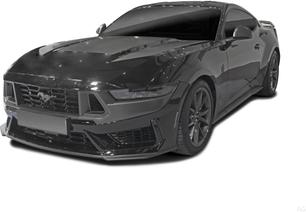
What's the difference?
The new Ford Mustang GT was not designed for Paris.
Fighting through the morning peak hour rush (which seems to extend through the middle of the day and the afternoon), the new Mustang feels like a caged animal. Which is appropriate, given the car’s namesake is a wild horse that exists to roam the American wilderness.
But once we finally break the shackles of Parasian traffic we find ourselves getting to let this Mustang gallop across the French countryside and unleash its full potential. But more on that later…
The reason we're driving the Mustang in France is because the American brand wanted to connect it to its new racing program at the famous Le Mans sports car race (you know, the one in the Matt Damon movie, Ford v Ferrari).
No less than Bill Ford, great-grandson of the company’s famous founder, was on-hand to see the Mustang at Le Mans, such is the passion for performance.
Ford (the man, not the company) took the opportunity to declare that the Blue Oval brand is not only committed to internal combustion engines for the foreseeable future, but it will retain the V8 under the bonnet of the Mustang GT for as long as it can legally do so.
Australians will have to wait a few more weeks (maybe months) before the seventh-generation Mustang arrives, but here’s what you can expect when it lands on local roads.
Yep, here comes another new brand.
The Australian new car market has been flooded with new car brands in recent years, not exclusively but predominantly from China. GAC is the latest, joining the likes of BYD, Deepal, Geely, GWM, Leapmotor, MG and Xpeng in an increasingly crowded market.
Quite simply, the market is now so crowded it means any new company with long-term aspirations will need to find a way to cut through. Being cheap alone won’t do it, nor will being stylish or nice to drive. No single trait will be enough, instead you will need to tick as many boxes as possible to secure any long-term security.
Which puts a lot of pressure on the Aion V, the brand’s mid-size, all-electric SUV that has just arrived in Australia. It will go head-to-head with the likes of the Geely EX5 and Leapmotor C10 at the more-affordable end of the electric SUV market. But does it tick enough boxes to make an impact? Read on to find out…
Having driven the latest example of the Mustang GT, I hope Bill Ford is true to his word and keeps the V8-powered Mustang for as long as possible. It isn’t the most razor-sharp sports car or the most powerful muscle car, but it offers the kind of driving thrills and enjoyment that have made the car an icon.
The price increase is steep but the new technology inside drags the Mustang into the modern era and will add more youth appeal to a car that is largely unchanged in concept for the past 60 years.
But now that I’ve driven it in the USA and France, I can’t wait for it to finally reach Australia.
Note: CarsGuide attended this event as a guest of the manufacturer, with travel, accommodation and meals provided.
Candidly, I questioned the logic behind GAC entering the Australian market, especially now given the seemingly non-stop influx of other brands. How could it really hope to stand a chance against so many similarly priced and similarly equipped rivals?
Well, the answer is by providing a better product. The Aion V is simply a better package than many of its rivals, Chinese and otherwise, at least based on our initial impressions.
It combines value and practicality but also adds a level of driving comfort and manners its Chinese rivals can’t match.
Is that enough to guarantee success? Not at all, but it’s a strong foundation to start with and at least gives GAC a fighting chance to not get lost in the crowd.
Note: CarsGuide attended this event as a guest of the manufacturer, with accommodation and meals provided.
While this is considered a ‘new generation’ Mustang, the reality is this is more of a major overhaul than a complete, blank sheet redesign. As such, there’s a lot of carry over to the design, but that’s not to say there aren’t some significant changes.
For example, it’s still clearly a Mustang in its silhouette, sharing that with the sixth-generation model it replaces, as well as the now-iconic 1960s Fastback models, but the details are noticeably different.
To try and create more differentiation between the GT and EcoBoost models, Ford has designed unique front ends for each. Both are characterised by a strong horizontal line across the front of the more angular grille that meets the new ‘tri-bar’ daytime running lights.
The EcoBoost has an upper grille similar in size to the out-going model, the GT is a much larger upper section which incorporates a pair of ‘nostrils’ as well as a bonnet vent - both of which are functional for cooling and aerodynamics.
Down the sides Ford has lowered the beltline and created a more defined rear fender ‘shoulder’ that helps create the impression of a wider car.
At the rear the famous ‘tri-bar’ lights remain and there are unique diffusers for each model, with the EcoBoost running two exhaust tips and the GT getting quad pipes.
But it’s inside where the biggest design changes have happened. The retro-inspired cabin of the sixth-generation - which features shiny silver plastic toggle-like switches and round air-con vents - has been overhauled.
The iconic ‘double brow’ design to the dashboard, which dates back to the original 1964 Mustang, has been dropped and replaced with a pair of digital screens. There’s a 12.3-inch display for the digital instrument cluster and a 13.2-inch multimedia touchscreen.
This change is designed to appeal to a younger audience but also allows for greater customisation and variety of displays, with Ford developing six different instrument panel options depending on the setting the driver chooses.
The primary three are the 'Normal', 'Sport' and 'Track' modes, which have been inspired by the GT supercar and the Mustang Mach-E electric SUV, while there’s also a 'Calm' setting, providing only the necessary data, such as speed, in a simplified format.
The final two have been created to tailor to fans of the brand’s 1980s ‘Fox Body’ Mustang, with digital versions of its round analogue dials in both a ‘Day’ and ‘Night’ mode, with the former using white graphics and the latter getting retro green dials.
One of the most notable elements of the Aion V design is the absence of a ‘GAC’ badge on the front. That’s because, while all GAC models in Australia will be sold under the one name, in its native China there are several different sub-brands. GAC Aion is the ‘new energy vehicles’ brand, focused on electric vehicles (EVs), while the smaller Emzoom SUV is part of the more mainstream Trumpchi brand that offers internal combustion engine models.
It means the three cars sold initially, and even as the brand moves forward with its expansion plans, there will likely be stark visual differences between models because they are effectively different brands. In the same way Holden ended up with a mixture of Opel, Chevrolet and GMC products in its final years.
Having said all that, the Aion V itself is an inoffensive design. It’s not as generic as some of its rivals, with some design character around the headlights and silhouette, so overall it cuts a likeable figure without being particularly memorable.
Like so many modern cars, the Aion V has a very simplistic layout inside, with more screens and less physical buttons and switches to reduce cost and complexity. There’s an 8.8-inch digital instrument display and a 14.6-inch multimedia touchscreen in the centre on the dashboard.
The sixth-generation Mustang copped a lot of criticism for its interior look and feel, and while it certainly wasn’t at European levels of quality it was more affordable than any European V8-powered coupe.
The introduction of the new digital displays certainly adds a more premium impression to the cabin when you get inside, but you can still see a lot of the previous generation in this model, in particular the doors and centre console.
It’s pretty practical, for a sports car, with a pair of cupholders and a lidded centre console box for small item storage.
One noticeable issue with the screens is the control virtually everything to do with the multimedia, including the air-conditioning, so trying to make small temperature adjustments is more complicated than just pressing a physical button.
Not surprisingly space feels very similar to the outgoing Mustang with supportive and comfortable seating up front that made long stretches behind the wheel feel easy, which is nice for a sports car.
As for the rear seats, they remain incredibly tight for space and are better for soft item storage rather than squeezing people into.
Despite the largely carried over body and interior, the boot is slightly smaller than the previous model, with the coupe measuring 376 litres compared to the 408 litres offered previously.
In terms of practicality there’s a handy space for a wireless smartphone charging pad, and that previously mentioned heated or cooled centre console box. Oddly, though, there is no traditional glove box. Instead there are just a pair of bag hooks ahead of the front seat passenger.
Space is good for a mid-size SUV, with a roomy front and respectable space in the second row. It would comfortably accommodate four adults, so would be a good option for families with older children.
As for the boot, it’s a generous 427 litres and has multiple adjustable floor heights available. Disappointingly, even though it has space for a spare, potentially even a full-size one, it only has a tyre repair kit. That might be fine in some markets around the world, but in the vastness of Australia, that is not the best option. Even a space-saver spare would be a better bet.
Ford Australia hasn’t confirmed the complete list of specifications for the seventh-generation Mustang range, but pricing has been locked in and we do know all three initial models - Dark Horse, GT and EcoBoost - will be offered here.
Having previously driven the Dark Horse in the USA in 2023, this time we sampled the GT and that’s the model we’ll focus on in this review.
We already know it will be priced from $77,002 for the six-speed manual and $80,902 for the 10-speed automatic coupe (both prices exclude on-road costs). The GT will be the only convertible option for Australians (and will only be available with the auto), priced from $86,102.
That’s a significant price rise from the out-going model, jumping up nearly $12,000 ($11,712 to be precise), which means it will be more expensive than the Nissan Z ($75,800) and closer to the BMW-based Toyota Supra (starting at $87,380).
On the plus side, this price increase is expected to come with a ramp up in standard equipment, including a new digital dashboard which features a pair of large screens, as well as the introduction of the line lock feature we missed on the previous model and the all-new 'Drift Brake'.
Starting with the basics, the Aion V is a five-seat electric SUV priced from just $42,590, before on-road costs, for the entry-level model.
Now, not too long ago an all-electric SUV for under $45K would be a revelation and would have made an impact on this market. But there are plenty of alternatives to choose from these days at similar money, including the Geely, Leapmotor and the BYD Atto 3.
Even so, at $42,590 for the entry-level Premium and $44,590 BOC for the more-premium-than-Premium Luxury variant, that’s still very competitive pricing.
For that money you get a well-appointed mid-size SUV, with even the base model equipped with LED headlights and tail-lights, 19-inch alloy wheels, a panoramic sunroof, heated and ventilated front seats, dual-zone climate control and a nine-speaker stereo.
Stepping up to the Luxury adds partial genuine leather seats, massaging front seats and a box in the centre console that can act as a fridge and a warmer, depending on your needs.
While neither the cheapest EV nor the best-appointed, the Aion V does a nice job of offering a compelling value proposition in its competitive set.
During the top secret development of this seventh-generation model there were plenty of rumours that Ford was considering a hybrid system for this Mustang. Fortunately for lovers of old-school V8 engines that proved not to be the case.
Instead it’s powered by a 5.0-litre V8 that's an evolution of the ‘Coyote’ unit from the previous ‘Stang but now featuring some technical changes, including dual throttle-bodies and separate airboxes to help improve performance. In the GT it’s tuned to make 345kW and 550Nm.
It can be paired with either a six-speed manual gearbox or 10-speed automatic transmission, both sending all the power to the road via the rear wheels.
Both the Aion V Premium and Luxury are powered by a 150kW/210Nm electric motor, which drives the front wheels.
Aion doesn’t claim a 0-100km/h time, but it wouldn’t be quick, at least not in EV terms. If you’re looking for a ludicrously powerful electric car - this ain’t it. It’s a perfectly fine powertrain for the job at hand, but it won’t blow your socks off with its performance and will take more than eight seconds to run 0-100km/h.
While it hasn’t been confirmed by Ford, the Federal Government's Green Vehicle Guide has the Mustang GT rated at 12.8L/100km. And while that’s quite a thirst for unleaded petrol, it shouldn’t come as a surprise given it’s a 345kW 5.0-litre V8 engine.
If you value efficiency in your American muscle car, the four-cylinder turbocharged EcoBoost is rated at 9.4L/100km. But based on previous evidence, Mustang buyers are likely to opt for power over saving petrol.
The claimed consumption figure translates to a driving range between fills of around 650km.
The battery is 75.2kWh lithium-phosphate type, which provides a claimed range of 510km. Importantly, that figure is on the WLTP cycle, not the more lenient Chinese (CLTC) test protocol, so you could reasonably expect close to that target in the real world.
GAC claims it can accept up to 180kW charging speeds, which will get the battery from 10-80 per cent in just 24 minutes.
It also has vehicle-to-load functionality, so you can draw power from the battery for tools or appliances if you need it.
As promised earlier, here’s how the Mustang GT felt powering through the French countryside…
But first, it’s worth acknowledging that, in truth, it wasn't hard work getting through the traffic even in the manual Mustang. While the clutch is on the heavier side, it’s got a smooth action and the engine's torque and flexibility make darting in and out of gaps in the traffic a breeze.
However, once out on the open roads the Mustang really could run free. The V8 engine sounded fantastic bellowing out across the fields and through the quaint little villages we passed through.
As you'd expect, the V8 provides plenty of grunt, it's an incredibly flexible engine pulling hard right across the rev range and makes us appreciate even more that this now remains the last of its kind since the demise of the V8-powered Chevrolet Camaro and Dodge Challenger.
Driving the Mustang in conditions like this makes you understand why it has been such a popular sports car not only in Australia but around the world for decades.
While the manual transmission has fallen out of favour with Aussie buyers, the truth is it's the pick for this GT. The fact it has less ratios to choose from than the 10-speed automatic means it feels more urgent and (again) the flexibility of the engine allows it to shine.
Not that the auto is bad, it does a fine job, it just lacks the buzz and engagement the manual ‘box provides.
What arguably impresses even more than the engine is the handling. Having driven the Dark Horse last year and being so impressed by its handling, particularly with the 'Performance Package', there was some concern prior to driving the GT that it would feel less impressive and, dare I say, duller.
But that's far from the case. Instead, the GT feels responsive and well sorted across a variety of road conditions. While it may lack the precise handling characteristics of a European sports car, it’s clear Ford has made this latest Mustang better suited for the rest of the world, not just America.
Not that Ford has made the Mustang too serious, as the introduction of the Drift Brake demonstrates. This rally-style electronic handbrake allows you to, as the name suggests, snap the car into a slide - when the circumstances allow.
Ford finally gave us our first (official) use of the Drift Brake when it paid us up with stunt driving expert, Paul Swift, who taught us how to slide the Mustang into a parallel park.
Obviously this is not designed for road use but for those who want to take their Mustang to the track it will no doubt lead to a lot of fun and some shredded tyres.
This is perhaps the area where the Aion V surprised the most. One of the most consistent qualities of these new Chinese-developed models is their incompatibility with Australia’s unique road conditions. They have a tendency to lack comfortable, controlled suspension and well-weighted and consistent steering.
That’s not the case with the Aion V, with GAC clearly taking the benefits from the partnerships it has with Toyota and Honda to learn what international markets prefer. Is this a clear standout, class-leading SUV dynamically? No. But it is above-average in the way it rides and handles.
The suspension is well resolved and feels comfortable to live with, while the steering is nice and direct, which will make navigating the cities, suburbs and open roads more easy and enjoyable.
There is still some fine-tuning that could make it better, but overall the Aion V leaves a positive first impression.
Full safety specifications haven’t been announced, but in the US, where it’s already on sale, all models are equipped with at least a reversing camera, rear parking sensors, auto high-beam headlights as well as front, side and driver’s knee airbags.
There’s also a decent level of active safety gear with pre-collision assist with autonomous emergency braking and lane departure warning all standard. But adaptive cruise control, lane centring assist and intelligent speed assist are all optional.
Frankly, after my French experience I’d be hoping the lane centring assist is an optional locally because the overly sensitive system drove us crazy on our French test drive.
Repeated warnings to ‘put our hands on the wheel’ when our hands were firmly affixed to the tiller moved from just frustrating to borderline dangerous as the only way to trigger the system to stop making its request was to quite violently tug on the wheel and jerk the car in the lane.
It’s another case of poorly calibrated safety systems that make you question the value of the technology in the first place, especially when you find yourself turning it off because it’s safer to just pay attention as a responsible driver.
It will be interesting to see if ANCAP crash tests this new generation Mustang, especially considering how closely related it is to the previous model.
ANCAP famously (or infamously, depending on your point-of-view) crash-tested the previous Mustang and awarded it two from a possible five-star rating.
Despite the public criticism it didn’t seem to impact Ford’s sales of the pony car, which remained a best-seller.
Since the Mustang, ANCAP has not tested any of its rivals, with sports cars including the Toyota Supra, Nissan Z and Subaru BRZ all unrated by the safety authority.
GAC is offering the same safety equipment across both models, which is a nice touch to avoid any need to compromise.
This includes full airbag protection for all occupants, front and rear parking sensors and a 360-degree camera system.
There’s also a lengthy list of driver assistance features, including adaptive cruise control, autonomous emergency braking, forward collision warning, traffic sign recognition, emergency lane keeping assist, rear cross-traffic alert and door opening warning.
These systems could benefit from some real-world testing and calibration, because while better than some, they were still intrusive and annoying at times - most notably the driver attention monitoring.
ANCAP has not yet tested the Aion V, but it has received a maximum five-star rating from Euro NCAP, which typically carries over to the local body.
There are no details confirmed at this stage but there’s no reason to believe the Mustang won’t be covered by Ford Australia’s usual five-year/unlimited kilometre warranty.
Similarly, service intervals are likely to be 12 months/15,000km.
For reference, capped price servicing on the out-going Mustang GT came in at $299 for each of the first four services, up to four years/60,000km. Not bad.
The Aion V is covered by an eight-year, unlimited kilometre warranty which is well ahead of the mainstream pack, typically sitting at five years, unlimited km. The drive battery is also covered for eight years, 200,000km and roadside assist is included for five years. Recommended service interval and costs are still to be confirmed.
But one of the biggest challenges for all these new car brands is finding space in the Australian market - literally. If you want to sell a lot of new cars you need a lot of new car showrooms and if you want to keep customers happy, you’ll need enough service centres to keep cars on the road as much as possible.
GAC has plans to have as many as 100 dealerships in the next five years, but right now it has reportedly less than a dozen. That will make servicing problematic if you do not live in close proximity to a service centre. This isn’t the work of a moment either, with so many new brands fighting for dealership real estate and staff there are only so many places GAC can set up shop.