What's the difference?
For many, Chevrolet’s repositioning of the engine in its Corvette from the nose to behind its passengers was a shock, although Chevy had seemingly been itching to make the shift since showing its XP-880 Astro II concept car close to 60 years ago.
But the idea of an electric motor in ‘America’s Sports Car’ was probably even more confronting.
However, when you add the critical detail that the petrol-electric hybrid E-Ray version of the current C8 Corvette puts out 488kW (655hp) and 806Nm, surely fears the end is nigh for muscle car enthusiasts ebb away.
The C8 ‘Vette has been with us for five years, blurring the line between traditional US-style performance and mid-engine Euro exotics, maintaining good ol' boy naturally aspirated V8 power but locating it between the axles, and in the E-Ray, hooking it up with a chunky electric drive unit up front.
There are potential changes on the horizon, with the even more thunderous Corvette Grand Sport X hybrid lurking in the wings. But right now, this is Chevrolet’s hybrid hero.
Could this cut-price supercar be your next four-wheeled piece of mechanical pride and joy?
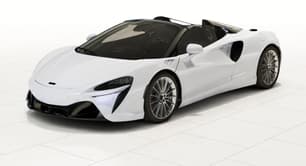
Obviously the headline item of the new McLaren Artura Spider is the ability to drop the top and feel the wind in your hair, or, should you live in Melbourne, at least the damp mist on your face.
But this new plug-in powerhouse has plenty more to offer than just its folding hardtop.
The coupe and convertible are more powerful, there’s a new and louder exhaust, faster gear shifts, a richer rev range, better suspension and better braking.
Oh, and there's a new feature designed to unlock your inner hooligan, but we’ll come back to that one in just a moment...
But at its core, the Artura Spider is a plug-in hybrid monster that goes someway to previewing the future of the supercar species.
Does electrification enhance the excitement? We strapped in to find out.
The Chevrolet Corvette E-Ray offers hypercar-level performance, aggressive design and brilliant dynamics at a bargain-price relative to similarly-configured Euro exotics. Blending raw V8 grunt with front-axle electric power it delivers an exhilarating drive experience.
While things like ingress and egress are a challenge and warranty coverage is modest, the car’s immense capability makes it an attractive option for anyone wanting a high-performance mid-engine machine without the astronomical price tag of a ‘traditional’ supercar.
McLaren’s most liveable offering proves hybrid heroes have a place in the supercar stable of tomorrow. Angry and affable in near-equal measure, it is utterly docile during the week and completely bonkers on the weekend.
Note: CarsGuide attended this event as a guest of the manufacturer, with travel, accommodation and meals provided.
If you asked primary school me to draw a ‘supercar’ I’d likely hand you a roughly hewn, multi-coloured wedge in Egyptian frieze-style 2D that could be interpreted as a prescient rendering of the current Corvette E-Ray.
GM has confessed that a big part of its motivation for going mid-engine with the current-gen Corvette is to help it appeal to a younger target market (maybe not under-10s) and Chevrolet has enthusiastically embraced the low nose, wide high-tail stance. You’re not going to miss it.
The E-Ray, like its track-focused Z06 sibling, is longer (+58mm) and wider (+92mm) than the standard Corvette Stingray, with huge air intakes in the nose and deep gills behind the doors.
Its distinctly angular design retains enough Corvette DNA to keep the C8 in the family. The headlights are reminiscent of the C7 that preceded it and the dual tail-light design is a neat reinterpretation of that signature element. A clear engine lid showcases the longitudinally mounted V8’s bright red engine cover.
Far from a clean or curvaceous shape, the E-Ray is all business with function driving its fighter jet form. And that carries over to the interior with the driver-focused cockpit making no apologies for concentrating almost exclusively on the person behind the wheel.
Multiple screens wrap around the instrument binnacle with the flat top and bottom steering wheel affording a clear view of them all.
The jagged lift-up gear selector controls would be right at home in an F-22 Raptor and despite the layout’s relatively fussy look it works super-well ergonomically, with clearly marked buttons (haptic and physical) easy to sight and operate.
As is pretty par for the course with McLarens, the Artura's design is more about aerodynamics than aesthetics, with everything you see outside designed to either help you slip through the air, or stick to the road.
There is, however, one important new part of the design, and that is the roof, which opens in 11 seconds and at speeds of up to 50km/h, meaning you should never be caught in sudden rain.
Elsewhere, you’ll find it is all angles and alloys outside, while inside, it is a pretty driver-focused experience. I particularly love the steering wheel, which is totally free of buttons – a refreshing change which means it has one job and one job only.
Then there’s the central screen, which looks a bit like it’s just been plonked in the cabin, but works seamlessly. One note, though. It's positioned a little too low, meaning you have to take your eyes right off the road to look at it when driving.
Practicality is a relative concept when you’re looking at a two-seat, mid-engine sports car, which means the Corvette E-Ray is not functional in the Kia Carnival sense. But there are some concessions to the need to store things inside it.
In terms of storing people, getting in and out of a C8 Corvette isn’t exactly straightforward. The car sits close to the ground, which despite decent door apertures, means to gain access you’re lowering yourself across and into the heavily bolstered seats using an ungainly, vaguely yoga-style technique. Same goes on exit with more than a little grunting required to hoick yourself out of the car. Not an easy proposition for a daily driver.
Once inside, headroom for me at 183cm is good and for storage there are slim pockets in the doors (with no scope for bottles), two cupholders in the centre console and an oddments tray ahead of them. The glove box is a good size, a lidded box between the seats houses USB-A and USB-C outlets and there’s an awkward-to-use upright wireless phone charging slot between the seat backrests.
Boot volume is 204 litres, unless you’ve removed the roof panel and clipped it into its storage position there. A surprisingly easy process, by the way. If that’s the case you’ll be leaning more heavily on the 142-litre frunk. Overall storage capacity of around 350L is pretty handy for a car of this type.
Not surprisingly, given the scale of this car’s wheel and tyre package, there’s no spare. The Michelin Pilot Sport 4S tyres are run-flats.
And substantial practicality points go to the front lift system which, via the press of a console button, rapidly raises the car’s nose by 50mm to help avoid driveway and speed bump scrapes.
Practical? Not really, but then, what were you expecting? There are two seats, some 124 litres of luggage space in its under-bonnet boot, phone connections and… well, that’s about it.
One design element I do love, which counts as a practicality perk, is the glass finish applied to the rear buttresses, which don’t just look cool, but help you see out the back when peering over your shoulder.
In the US the Corvette E-Ray is offered in three imaginatively titled trim levels - 1LZ, 2LZ and 3LZ in coupe and power-folding hardtop convertible form.
Australia takes the top-spec 3LZ coupe only, priced at $292,990, including GST and LCT but before on-road costs.
If your heart’s set on a full-convertible Corvette you’ll need to opt for the non-hybrid Stingray ($232,990, BOC), but the coupe’s targa-style, lift-out roof panel gets you most of the way there, anyway.
Aside from the safety tech we’ll get to shortly, that figure gets you a heap of standard fruit, the highlights including:
Other, similarly-configured ways to accelerate from 0-100km/h in less than three seconds cost twice as much as the E-Ray. Ferrari 296 GTB? Prepare to part with $604K. Lamborghini Temerario? You’ll need to cough up $534,169. Porsche 911 Turbo S Coupe? It’s $577,300.
On that basis, this Corvette is a supercar bargain.
Prepare to enter the rarefied air of the supercar world. The McLaren Artura Spider lists at $525,010, or about $50K more than the hardtop Artura, which has also been updated for 2025 and lists at $477,310.
Either way you’re staring down the barrel of around half a million to climb into the new Artura. But kudos to McLaren for offering the new model’s power upgrades, courtesy of a relatively straightforward software update, to owners of the current-gen Artura at no charge.
Anyway, for that spend you get a whole heap of power and performance, of course, but there’s also some new safety stuff and a new launch control designed to unleash your inner hooligan.
It’s called the 'Spinning Wheel Pull-Away' feature, which is essentially a burnout mode allowing you to light up the rear tyres, and even flick through the gears as they’re spinning, attracting the attention of passers-by and the local police in equal measure.
Add to that a redesigned exhaust that delivers a louder and more natural soundtrack, and it begins to become clear the Artura wants to leave any suggestion that it is somehow a mild supercar in its rear-view mirror.
Elsewhere, you’re riding on staggered alloys which are 19 inches up front and 20 inches at the rear, wrapped in Pirelli P-Zero rubber.
And then there’s the roof, which is a lightweight carbon-fibre and composite design operated by eight individual e-motors.
Also new in the cabin is a wireless charge pocket, while a digital dash is joined by a slightly off-looking but effective low-mounted central screen. Standard is a five-speaker McLaren-branded stereo, and rear glass screen is automatic and heated.
The Corvette E-Ray is powered by a mid-mounted 6.2-litre, naturally aspirated ‘LT2’ V8 featuring dry sump lubrication, a billet steel crank, forged conrods and variable valve timing for 369kW (at 6450rpm) and 637Nm (at 5150rpm).
It sends drive to the rear wheels via an eight-speed dual-clutch auto transmission with (carbon) paddles on the steering wheel for manual shifting.
A single 119kW/170Nm electric motor on the front axle contributes to total outputs of 488kW/806Nm and delivers ‘eAWD’.
Claimed 0-100km/h acceleration time is a sizzling 2.9 seconds.
The magic of the Artura’s powertrain isn’t the twin-turbocharged V6, but its dinner-plate-sized e-motor, which adds 70kW and 225Nm to the total outputs.
In EV mode, which lasts around 33km, that’s all the power you get. But when both power sources are in use, the e-motor essentially plugs any turbo lag or power holes, delivering smooth, constant and massively ample power.
How much power? Try 515kW and 720Nm — up some 15kW on the existing Artura — unlocking a sprint to 100km/h in 3.0 seconds, a run to 200km/h in 8.4 seconds and from a standstill to 300km/h in 21.6 seconds.
That power is fed through an eight-speed automatic and channelled to the rear tyres, with the help of an 'E-Diff', while pre-configured 'Electric', 'Comfort', 'Sport' and 'Track' modes arrive as standard, too.
There are also a heap of suspension and software enhancements, longer-laster braking, stiffer engine mounts to tighten the entire vehicle, faster damping, significantly quicker gearshifts and a broader rev range.
The Corvette E-Ray’s official fuel consumption figure for the combined (urban/extra-urban) cycle is 11.5L/100km.
The car’s Active Fuel Management system is able to subtly drop four cylinders under light loads, a small V4 (rather than V8) light on the dashboard the only clue this sleight-of-hand trick has been performed.
Auto stop-start is also standard, although we admit to switching it off (via a haptic button on the dash) most of the time. And purely in the name of science and fully exploring the car’s performance potential we may have leaned into the E-Ray’s dynamic abilities more than once.
Overall, across a week of mainly city and suburban running with some freeway sections thrown in, we recorded an on-test average of 13.5L/100km, which is still more than acceptable for this type of performance car.
Brim the 70-litre tank with minimum 95 RON premium fuel and using our real-world figure you can expect a driving range of around 520km.
The E-Ray features a 1.9kWh lithium-ion battery, self-replenished from coasting and braking, allowing an EV-only (and neighbour-friendly) ‘Stealth Mode’ for four to six kilometres at a maximum of 72km/h.
And there’s a ‘Shuttle Mode’ (not suitable for public roads) which also engages just the front axle on electric power for moving silently around a driveway or into a garage to a speed of 24km/h.
You can plug the Artura in, of course, and taking the 7.4kWh battery from zero to 80 per cent charged will take around 2.5 hours. McLaren reckons you can expect fuel use of around 4.8L/100km when both powertrains are in operation.
Be warned, though, there’s enough magic used to fill Hogwarts when it comes to calculating that number, and you can expect that figure to likely double if driving sedately, and skyrocket if you get on Tinder terms with the accelerator.
Let’s get the acceleration thing out of the way. The Corvette E-Ray is obscenely fast. If you’re determined to bend the space-time continuum, it’s keen to assist.
Claimed 0-100km/h time is just under three seconds but on a closed track using launch control we’ve previously recorded a time of 2.4sec, which is hypercar territory.
The big V8’s furious roar is amplified by the standard performance exhaust and the dual-clutch auto is a slick, positive, high-quality unit. Manual shifts via the wheel paddles are rapid-fire.
Suspension is by forged alloy double wishbones front and rear with magnetic adaptive damping standard, the latter allowing you to dial in Sport, Touring, Track and Weather modes as well as two customisable settings - MyMode for everyday driving and the performance-focused Z Mode.
Weather optimises the car’s systems for slippery conditions, as its name implies, and Track is best left for the circuit as it’s unbearably harsh on anything less than a billiard table smooth surface. Sport is more liveable but the pick is Touring which retains the car’s fundamental agility while providing excellent compliance.
Shudder over patched suburban roads in Sport then switch to Touring to illustrate an amazingly forgiving ride.
Despite its aluminium-rich space frame, the E-Ray still weighs in at 1800kg but it responds like a lightweight. The steering is brilliantly precise without being overly sharp and road feel is superb. In terms of cornering, the C8 Corvette is the quintessential apex predator.
Thanks in no small part to an electronic limited slip differential the E-Ray puts its power down on corner exit with impressive force and grip from the monster Michelin Pilot Sport 4S rubber is prodigious.
The tyres measure 275/30x20 at the front and no less than 345/25x21 at the rear, bearing in mind a current F1 car’s rear tyres are 375mm across the tread.
Brakes are also professional grade with carbon ceramic rotors (398mm fr / 391mm rr) clamped by Brembo six-piston alloy calipers at the front and four-piston units at the rear. While some carbon set-ups need to be at a high temperature for optimal performance there are no such worries here. The E-Ray washes off speed with prodigious yet satisfyingly progressive power.
Worth noting if you’re a track day demon, there’s an ‘Enhanced Performance Data Recorder’ and ‘Performance App’ that jointly provide everything from side-by-side video analysis and graphical data displays to tyre temp and pressures and even coaching tips.
‘Performance Traction Management’ also allows you to fine-tune traction and stability controls to suit specific track conditions.
Under the heading of miscellaneous observations; the GT2 seats are grippy yet supremely comfortable, an 11.1m turning circle is sizable and over-the-shoulder rear three-quarter vision is limited, although there’s enough camera coverage to minimise the problem for parking.
I know it sounds strange, given how knife-sharp and angular the McLaren Artura Spider looks, but perhaps this plug-in powerhouse's biggest party trick is not how it operates at its 8500rpm redline, but how it behaves at low speeds in town or cruising on the freeway.
This is a properly comfortable supercar, happily tootling around in near-silence in in EV mode, or just cruising around, the improved damping smoothing out the road below and the exhaust note barely noticeable.
Honestly, there was a moment on this test drive when I found myself in EV mode with the roof down while travelling at around 70km/h, and I could hear birds chirping as I passed them, such was the calm ambience of the cabin.
Supercars aren't designed as daily drivers, but the McLaren Artura Spider is so effortlessly easy to live with you could use it as your weekday runabout, before unleashing it on the weekends.
Open the taps a little more, though, and suddenly that nature changes, unlocking a darker and more dynamic side to the McLaren's personality, courtesy of the 3.0-litre twin-turbo V6, putting the entire 515kW and 720Nm at your disposal.
I don't think I've driven a car in which the distance between its twin personalities is so vast. Plant your right foot and the acceleration (0-100km/h in just 3.0 seconds) is properly violent, while the gearing has been set up in a way that it is near impossible to hit the redline on a public road – at least without obliterating the speed limit.
The steering is a predictable highlight – super direct, and near-telepathic in the way it responds to your inputs. The eight-speed auto goes about its work with seamless efficiency, too.
The biggest highlight, though, is the Artura's agility. McLaren is famed for taking an approach to removing weight from its vehicles that is so ruthless it's a miracle they don't make prospective owners step on a scale before handing over the keys. And while its true convertibles are heavier than their hardtop counterparts, you can't tell in the Artura Spider.
Instead, the brand has worked to remove weight and tighten the drive experience, mostly through new and stiffer engine mounts and that single piece carbon-fibre tub, which is why there is no additional body stiffening required in the convertible over the coupe.
As a result, the Spider feels light, lithe and super reactive, devouring corners with no jiggling or roll and no different (in that sense) to the hardtop version we drove last year.
One of the other big changes the brand made this time around is to retune the exhaust, making it louder and more natural-sounding, and you can take advantage of that in the Spider, with the rich bass filling the cabin as though your own personal orchestra is being conducted by your right foot.
So, if you're in the camp that says electrification has no place in the world of supercars, you're wrong. Electrification doesn't hamper excitement here, it enhances it.
No surprise, given the Corvette’s relatively low volume, it hasn’t been assessed by ANCAP but active (crash-avoidance) safety tech includes:
The airbag count is four, front and side for driver and passenger, which is fair enough for a two-door sports car.
For the record, no child seat top tether or ISOFIX anchor for the passenger seat.
There's new stuff in the world of safety, too. For one, there’s lane monitoring, which McLaren — ever keen to maintain the purity of its drive experience — is quick to point out you can switch off, and when you do, that it stays off until you switch it back on again.
That said, blind-spot monitoring and rear cross-traffic alert are optional, and you’re more chance of a Powerball win than seeing a Artura Spider crash-tested by ANCAP for an independent safety rating.
GMSV’s warranty cover for the Corvette sits at three years/100,000km which is woefully under-done, even in the context of high-dollar sports cars.
For example, Aston, Ferrari, Lambo, McLaren and Porsche, while still at three years, offer unlimited-kilometre cover.
Service is recommended every 12 months/12,000km, the average annual price for the Corvette coming in at around $1100 over the first few years, largely because the first and every second service thereafter is a major one, including things like a transmission fluid change.
That’s way lower than most mid-engine Euros and it’s important to note service price will vary according to the car's use, different state and territory labour rates and other factors.
There are around 55 GMSV dealers in Australia focused on capital cities as well as major regional and rural centres.
The Artura arrives with a five-year, unlimited-kilometre warranty as standard, while the battery is covered for six years or 75,000km. Five years of roadside assistance is thrown in, as are your first three years of services.