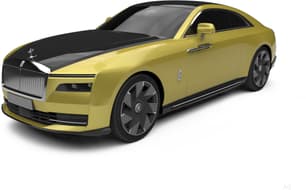
What's the difference?
Chevrolet’s Corvette Z06 supercar is an all-American answer to European rivals Lamborghini and Ferrari, but it’s not just this that makes it so appealing.
Spending a week with the most potent Corvette you can get in Australia has left me with a list of notes on this beast I want to hand over to you. Maybe it will help make your mind up about it or change your mind.
What makes the Z06 the flagship of the Australian Corvette range isn’t little luxuries, but seriously upgraded mechanical hardware, much of it track focussed.
Our test car was also fitted with the Z07 Performance package which adds a carbon-fibre aero kit to pin the Corvette down at high speed while also drawing everybody’s attention to it.
Oh, and then there’s the sound of the largest flatplane crank V8 ever to go into a production car… and look out for your ankles - let me explain…
Ask any opinionated car enthusiast why it is that they hate electric cars, and you’re going to hear the same word revving them up - “noise”.
Sure, EVs might be fast, and even the most old-world-loving petrol head (are we going to have to come up with a new term, soon? Power crazed? Amp-head? Copper top?) will grant you that they can be fun to drive, but the argument is that you just can’t love a car as much if it doesn’t make shouty sounds.
But there is one bunch of well-heeled car lovers who will demur on this topic, and for whom the idea of switching a big, stupidly powerful V12 engine for whispering electric motors seems to be no issue at all - Rolls-Royce fans.
They have, allegedly, been knocking down the doors at Goodwood, demanding that Rolls build them an EV, and finally it has arrived, in the stunning shape of the Spectre, and the orders are pouring in.
We flew to the Napa Valley in California to try it out.
The Chevrolet Corvette Z06 is truly a supercar offering outstanding dynamics for a lot less money being asked by European rivals - just make sure it's not your only car for those times when you're in a hurry.
Personally, I was very much taken with the looks, and the feels, of the new Rolls-Royce Spectre, which delivers everything you’d expect from this brand, and seems to have lost nothing by switching to electric propulsion. The trick, it seems, in turning your brand into an EV one is to have made your cars silent in the first place.
But the real verdict comes from the people hurling their Spectre orders at the company, which has received so many of them it’s being forced to ramp up production. And 40 per cent of pre-orders are from new customers. Honestly, it’s as if they were all just waiting for an EV to drop a million on.
We’re talking about the closest thing to a real-life Hot Wheels car here. See, while Ferraris look elegant to me like expensive jewellery, Lambourghinis like cheese graters and McLaren’s look like slippery alien spacecraft, the Corvette Z06 looks exactly like an American supercar should - an unapologetic, ludicrous beast. And I love that.
Dialing up the wild is that enormous carbon wing and front splitter with dive planes thanks to the Z07 package. Just a word of warning, though, the front splitter and dive planes stick out not just visually, but in the sense that I walked into them often and my ankles still have the scars.
I can’t recall the last time I drove a car with carbon-fibre wheels either - these are the biggest rims fitted to a Corvette and they’re wrapped in Michelin Pilot Sport Cup 2R ultra performance tyres (275/30ZR20 front and 345/25ZR21 rear) that they look like oil drums on their sides.
The best angle? The rear - straight on. Those headlights.
Wait, no, it’s from above - so you can see the V8 through the glass hatch.
Or it could be front-on looking like a giant shovel..
OK, there are no bad angles..
The Corvette Z06 is long at 4734mm end-to-end, broad at 2024mm wide and its height is a both a sitting-on-the-road-low and numerically pleasing 1234mm.
The plainness of the cabin might be a let down to some people after all the exterior wildness. Ferraris and Lambourghis offer extravagant and exotic interiors, but the Corvette’s innards are almost completely void of flare.
The media screen is small (8.0 inches), switches and controls for windows and air vents are basic, and the huge dividing ‘wall’ between the pilot and passenger might be a bit much for some.
That ‘wall’ is dotted with buttons and while it may look very 'fighter jet cockpit', they’re just climate control switches. Sitting in the passenger seat is a lonely place with no screen visibility nor easy access to controls - I'd actually call this out as a bit of a fail compared to the interiors from Porsche, Audi and Lamborghini with their screen-filled cabins offering co-pilots something to do.
Yes, it feels a bit premium with the Nappa leather and the sports seats, but it could feel more special.
All of this plainness, however, is saved from boredom by the glass window behind the seats allowing you to peer into the engine bay at the V8 like at a reptile enclosure at the zoo.
Making a vehicle as enormous as the Spectre look good is no mean feat, but Rolls has done a hell of a job, from most angles. The massive Pantheon Grille is something to behold in the metal, and because it doesn’t need to let air into an engine bay, it’s been designed for airflow, as has so much else. Rolls achieved a drag coefficient of 0.25, which is good for extending EV range, and they even spent more than 800 hours in a wind tunnel working on making the Spirt of Ecstasy hood ornament as aerodynamic as possible (she’s had her wings clipped, apparently).
The modern take on the classic grille combined with a chesty bonnet and very cool DRLs give the Spectre a look of classic modernity from the front, while the proportions over all give it a great side profile.
Apparently the design brief was based on some majestic cliffs, the Seven Sisters of Sussex, and the car definitely has that level of grandiosity.
The only weak point is the rear, which had to be sheer for aero reasons - and features the narrowest legally possible rear lights, which are supposed to look like “islands in a lake”, apparently. To me, driving behind one, the rear view is just a little dull.
The luscious interior is meant to be an example of “Automotive Haute Couture”, meaning hand made and stupidly expensive, and Rolls also humbly refers to it as a “cosseting art lounge”. It all sounds a bit over the top until you sit in it, and discover that it really does feel beyond special.
Supercars don’t tend to be built with practicality as a priority but this two-door, two-seat beastie is spacious enough even for me at 185cm tall with plenty of room in the footwell and loads of elbow-, knee-, and headroom.
Cabin storage is limited to a glove box, door pockets, two cupholders, and a wireless phone charger on the bulkhead behind the seats.
As you can see from the images there’s a boot at the rear which will fit smaller bags and a small boot in the front.
I did the school run in the Corvette a few times (I know, lucky kid) and I can tell you a bass guitar in its case and a school bag, plus my own large handbag make for a cramped cabin. A Kia Carnival the Corvette ain’t, but it’s not trying to be one and compared to its rivals it does well for practicality.
If you’re looking for the modern EV style interior, you can forget it, because Rolls says it didn’t want “any of that funky stuff” in the Spectre, so no giant screens in here. Indeed, I switched into a Rolls-Royce Ghost at one stage to be driven somewhere and the interior was almost exactly the same, although the new car gets a more modern fully digital dash.
There’s plenty of room for water bottles and oddment storage and the sense of space for the driver and front passenger is suitably grand, but the rear seats are really for spoilt teenagers rather than Rolls owners. They’re not uncomfortable, at all, but they just feel a bit squeezed, you wouldn’t ask to be chauffeured in a Spectre, clearly it’s a Rolls you’d choose to drive yourself.
The boot is wide, deep and long with a volume of 380 litres.
Almost never does a car with a list price of almost $400K get full marks, but here we are and I’ll tell you why. The Corvette Z06 in its standard form lists for $336,000 and this is outstanding value compared to its supercar rivals such as the Ferrari F8 Tributo for $484,888, or a McLaren 750S for $585,800 or even an entry-grade Lamborghini Huracan, the EVO, for $383,187.
Australia gets the top 3LZ trim, with the local standard features list for the Corvette Z06 including Nappa leather upholstery, GT2 bucket seats, a 12-inch digital instrument display, a 14-speaker Bose sound system, red seat belts, wireless phone charging, carbon-fibre and suede microfibre trimmed steering wheel, a media system with sat-nav plus wireless Apple CarsPlay and Android Auto, power seats, heated steering wheel, dual-zone climate control, heated and ventilated seats and a head-up display.
Our test car was fitted with plenty of options including the Z07 Performance Package that brings carbon-fibre everything. We’re talking the enormous carbon-fibre rear wing and aero kit with side skirts and a front splitter with dive planes –and there are the carbon-fibre wheels (20-inch at the front and 21-inch at the rear).
The Z07 package also brings a more hardcore suspension tune and carbon ceramic brakes for ridiculously good stopping power.
The Z06 has the most powerful V8 engine in the Corvette range, too, and we'll get to that soon.
Australian pricing for the Rolls-Royce Spectre starts from $770,000 before on-road costs, and on the point of whether that represents value, well not to me, but certainly the huge number of orders Rolls claims to have been hit by suggests otherwise.
You do get a lot of car for your money, because the Spectre is vast and weighs almost three tonnes, and there’s no doubt that the interior is nicer than most people’s houses, or even the nicest hotel you’ve ever seen, and that the top-notch umbrellas hidden in each door are a nice touch.
One of the nifty and unexpected features the Spectre offers is a “Rolls-Royce Sound”, which you can toggle on and off. With the fake noise off, the car is freakishly quiet - apparently during testing they achieved a level of EV silence so incredible that people found it “disturbing” and had to engineer some sound back in - but with it on you get just the most subtle of guttural sounds. Every other company so far has gotten fake noise wrong, but Rolls has nailed it with the Spectre; it’s just loud enough, but suitably restrained as well.
You also get the wondrous Starlight Headliner, which uses optic fibre cables to paint the night sky on the roof, complete with shooting stars, and in the Spectre you can now have the stars fitted to the inside of its massive coach doors as well.
The 5.5-litre naturally aspirated V8 in the Z06 makes 475kW and 595Nm. That’s a lot more power than the Corvette Stingray’s V8, which produces 369kW. The GT3 racecar version of the Z06 uses a derived version of the 5.5-litre V8, and actually it shares 70 per cent of the engineering components.
Revving to a high 8600rpm the Z06’s V8 lets out a high-pitched scream when pushed hard, much like a Ferrari because like many Ferraris the Z06 has a flatplane crank V8 - actually it’s one of the largest flatplane V8s to go into a production car.
Corvettes are now mid-engined cars and the Z06 has an eight-speed dual-clutch transmission that changes gears quicker than I can blink, sending all that mumbo straight to the rear wheels.
Acceleration comes hard, fast and loud with the Z06 able to boot itself from 0-100km/h in 2.9 seconds. That beautifully linear acceleration with no turbos will pull you all the way towards its top speed of 313km/h.
For the first time ever, this Rolls-Royce has no magnificent engine, no throbbing 12 cylinders, no, it has two separately excited synchronous motors, one on each axle for seamless all-wheel drive. The front motor makes 190kW and 365Nm while they’ve sensibly sent more grunt to the rear, which gets 360kW and 710Nm. Either motor on its own would be enough to power a normal car. The total figures are 430kW and 900Nm, which is supercar like.
The battery is made up 804 cells, weighs 700kg and has a net capacity of 102kWh, and the designers used it as a sound-deadening agent for road noise, because it’s so massive.
The Spectre can hit 100km/h in 4.5 seconds, which feels very fast indeed when you’re piloting something that weighs 2890kg and is 5.5m long.
As with practicality, fuel efficiency isn’t the Corvette’s priority and after driving it daily for a week in the suburbs, city and a few dashes out to more open country roads the Z06 was using an average of 23.8L/100km, according to the trip computer.
Luckily the fuel tank is pretty big at 70 litres and with an official combined fuel consumption of just under 16L/100km you have a range of 438km… in theory.
The Spectre is rated at 520km on the WLTP scale, but Rolls claims it can do a lot better (like 600km). Efficiency is claimed to be 21.5kWh per 100km.
We drove 210km and had 300km of indicated range left at the end, which is pretty close to the claim.
The Spectre can be charged at up to 200kW on a DC fast charger, on which it will take 35 minutes to go from 10 to 80 per cent charge.
On an 11kWh home system it will take 10 hours and 45 minutes to go from zero to 90 per cent charge.
What the Corvette Z06 is like to drive really depends where you drive it. Our suburb has a ridiculous number of speed humps, which are like the Corvette Z06’s Kryptonite thanks to its very limited ground clearance and a carbon front splitter that almost skims the road at the best of times.
This made the Z06 one of the slowest fast cars I’ve ever piloted. My son would beg me to drive him to school in it, but the journey would take twice as long as we slowly eased over each hump while holding our breath. A lift system does raise the front of the vehicle but even then, don't breathe out.
The width and poor visibility made inching down narrow streets of parked cars a stressful exercise, too.
The Corvette Z06 is almost too much of a racecar to live with and then you let it free on an open country road and its purpose is clear - it runs like you wouldn’t believe and screams in delight all the way, while clamping itself to the road with sticky tyres, perfectly set up suspension and proper downforce.
Steering feels mainlined though to your nervous system, the pedals under your feel like your actual feet, and it all feels like a dream until you wake up again when you reach the city limits and round abouts, and traffic and yes, speed humps.
The Corvette Z06 clearly is a car that needs to be joined by other cars in your driveway, ones that don’t even notice speed humps.
The short answer to this question is that the Spectre drives just like a Rolls-Royce, but that answer is deceptively simple, because, for an electric vehicle, that’s actually a hell of an achievement.
Most EVs do not feel like cars to drive - the electric Hyundai Kona is not much like a petrol one at all - but what Rolls set out to do with its first EV was to make a vehicle that feels, handles and accelerates just like one of its famous and fabulously over-powered combustion-engined Ghosts, Phantoms or Wraiths.
This meant it had to be “Silent”, which it nails with ease - and the important thing to remember here is that even its V12 cars were always incredibly quiet, unless you really misbehaved. And it had to be “Effortless”, another brand pillar. Again, nailed it, because a Roller has never bothered with things like shift paddles, Sports modes or even the option to do anything but stick it in D for Drive and go.
The sensation Rolls owners demand is endless, otiose acceleration, particularly off the line, and the Spectre delivers this in a typical EV fashion, but also one that’s very familiar to anyone who’s driven a Ghost, for example. It’s just a sense of overwhelming, prole-crushing progress, and it’s magnificent.
The third and final brand pillar is “Waftability” and despite all the weight that it’s carrying (imagine how far over three tonnes this thing would have gone if they didn’t build their cars out of aluminium), the Spectre rides with a kind of hovercraft air of being just above, or barely in touch with, the ground. Bumps are no longer your concern, sir.
As mentioned, Rolls could have chosen a limousine-style vehicle as its first EV, but it has made a driver’s car instead - no CEO will sit in the back of a coupe like the Spectre. So it had to deliver when it comes to being fun, or at least a little frisky at times, when driven.
Again, quite incredibly, despite its mass and weight, it does reward enthusiastic driving and can carve up even relatively narrow winding roads with aplomb, displaying very little body roll or pitching. The steering is almost absurdly light - because it must be “effortless” - but there’s still enough feedback to keep you interested.
Most of the time, of course, the essentially laid back aura of being in a Rolls-Royce will seep into your body and brain and you will simply cruise along, patting yourself on the back for being so rich and clever.
And now, with an EV option finally available, you can tell yourself you’re saving the planet as well (as long as you don’t think about the 28 other cars in your garage).
Along with four airbags, the Corvette Z06 has AEB, forward collision alert, lane-keeping assistance, rear cross-traffic alert, blind-spot monitoring, auto high beam headlights and adaptive cruise control.
An ANCAP safety rating doesn't exist for any member of the Corvette and will likely never due to low volume.
The Spectre has not been crash tested for ANCAP. Its safety offerings include adaptive cruise control, lane-change assist, lane departure with active steer, a reversing assistant - "to support with parking and long reverses, eg country lanes or driveways, Spectre will reverse the previous 200m driven" - and collision warning with active braking.
Rolls tell us the Spectre has "Four airbags (does not need more)". So that's good news.
GMSV covers the Corvette with a three-year/100,000km warranty which is short by current standards where carmakers typically offer a duration of five years/unlimited kilometres.
One of the appealing sides to the Corvette is that it’s made by a down-to-Earth American car company and a longer warranty offering peace of mind would seem more appropriate.
Service intervals are every 12 months or 12,000km, with capped-price servicing sadly unavailable.
Now, I would assume you'd get a lifetime warranty at Rolls prices, but apparently you get only four years, but it is unlimited mileage.
The Spectre's battery is covered by a 10-year warranty.
An extended service and warranty package is "TBC".
Rolls also offers 24/7 roadside assistance, and if your battery goes flat the company will take your Spectre to the nearest charging station.
A "regional flying doctor" is on standby 24/7 in extreme cases if Spectre “fails to proceed”.