What's the difference?
The lonely Cadillac Lyriq finally has some company, with the iconic US brand tripling its range down under with the launch of the much bigger Vistiq (which we've already tested) and this entry-level Optiq, which Cadillac describes as the gateway to its electric family.
It's a medium all-electric SUV with plenty of equipment and – depending on whether you see it as an established premium player or another newcomer brand – pretty sharp pricing.
Cadillac says it has the German big three in its sights with the Optiq, so how does it stack up?
General Motors Australia & New Zealand (GMANZ) has recently expanded its full-electric Cadillac SUV range in Australia from one to three models, with the new Optiq and Vistiq joining the pioneering Lyriq in the company's local line-up of luxurious US-sourced SUVs and pickups.
The five-seater Lyriq is now the happy medium of the Cadillac trio, as it’s positioned between the smaller Optiq and larger Vistiq; the latter with a unique seven-seat design.
We recently spent a week aboard the Lyriq to see if its opulence, practicality, performance, driving range and price provide a compelling alternative to full-electric or combustion-powered rivals for high-end luxury SUV buyers.
A taste test, but so far so good for the Cadillac Optiq, which is already my favourite model in the Caddy range. More space than you think meets a lovely cabin experience and a punchy powertrain.
Note: CarsGuide attended this event as a guest of the manufacturer, with accommodation and meals provided.
Note: The author, Andrew Chesterton, is a co-owner of Smart As Media, a content agency and media distribution service with a number of automotive brands among its clients. When producing content for CarsGuide, he does so in accordance with the CarsGuide Editorial Guidelines and Code of Ethics, and the views and opinions expressed in this article are solely those of the author.
The Lyriq Luxury combines handsome styling and luxurious appointments with responsive yet supple ride quality, the choice of relaxed driving or exhilarating performance as desired and a decent driving range. Its lack of towing ability may be a deal breaker for some, but it's certainly worthy of consideration by prestige SUV buyers with a penchant for electric power and (for now at least) sub-$100K drive-away pricing.
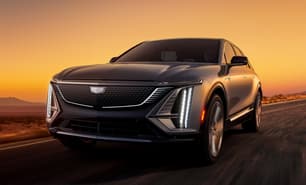
I really like the exterior of this Optiq, and especially the front-on view, with its vertical DRLs and that bold Cadillac grille delivering real medium SUV street presence.
You could argue the side profile is a little more vanilla (discounting the big wheels, of course), but it looks swept-back and sporty, and not as though it has been designed exclusively for aerodynamics above all else. That's a compliment, not an insult. Cadillac's engineers say every line and crease has been developed to help it slip through the air, but it does it without looking like a science experiment.
The material choices inside are lovely, too. The brand says it has focused on sustainable and recycled materials (the centre console is made from tulip wood and recycled newspaper, for example), but the highlight in my test car was the fabric derived from recycled polyester fabric that lined the door panels and much of the dash. It's a refreshing (and comfy) departure from the norm.
Less positive is the level of Mar-a-Lago bling dotted elsewhere in the cabin, like the chrome ringed centre console and silver-tipped vent controllers. They jar with the otherwise dark, calming and modern-feeling space.
There are physical buttons galore, controlling all your climate settings along with steering-wheel controls as shortcuts for key functions, but there is also still a bit of on-screen action for things like quick access to your driving modes.
The tech looks fab, though, with the curve through the screen looking intentional and elegant and way nicer than the tablets plonked in a lot of EVs these days.
The Lyriq has a generous 3095mm wheelbase, is more than five metres long (5005mm) and almost two metres wide (1977mm, including mirrors). Its 1620mm roof height is relatively low for a large SUV, resulting in a sleek and sporty profile combined with a muscular surefooted stance fronted by a finely-etched solid grille.
It rides on five-link independent suspension with GM’s ‘passive plus’ dampers, plus there’s electric power-assisted steering and big Brembo disc brakes in each corner featuring classy Cadillac scripts on the calipers. Turning circle is 12.1 metres, which is to be expected for a car of this size.
The interior design is an elegant blend of soft-touch materials and discreetly textured surface finishes with an emphasis on chrome and satin chrome highlights. It’s also spacious as you’d expect, with the panoramic sunroof creating a bright and airy feel.
We applaud Cadillac’s adherence to tradition with physical buttons and knurled dials and knobs for controlling key cabin and driving functions, in preference to annoying and distracting touchscreen menus. There’s also nice attention to detail with small jewel-like Cadillac emblems and scripts contributing to its prestige look and feel.
The Cadillac Optiq is around 4.8m long, 1.9m wide and 1.6m high, which is slightly longer than your average mid-size SUV. And I would argue most of that extra space is located in the back seat, where – at 175cm – I had no problem stretching out behind my own driving position. There was plenty of knee room and, thanks to a virtually flat floor, no bulky tunnel getting in the way for the middle-back rider, either.
Headroom could be a touch more challenging. It was no issue for me, but there wasn't a ton of clear air between the top of my head and the raked roofline, so six-foot-plus passengers might be stooping. Still, if your kids are six-foot-plus, get them into the NBA and have them buy you a car instead.
Elsewhere in the back there are cupholders in the pull-down seat dividers, ISOFIX attachment points in each window seat and twin USB-C ports. There are air vents but no temp controls for backseaters.
The boot is sizable, too, with Cadillac promising 744 litres of cargo space with the rear seats in place and 1603 litres with the rear seats stowed flat. And kudos for not just providing a neat charging cable space under the boot floor, but also giving you a little zip-up suitcase to store it in.
The Lyriq’s 2687kg kerb weight (largely due to its hefty propulsion battery) and 3200kg GVM results in a modest 513kg load capacity, which could easily be used up by five large adults before you could think about loading their luggage. It’s also not rated for towing in Australia which limits its appeal as a recreational vehicle.
Driver and front passenger enjoy palatial space and comfort plus ample storage with a bottle-holder and bin in each door. There's also a large glove box, pop-out drawer in the dash and a ‘floating’ centre console equipped with a lower tray, three USB-C ports, a 12V socket, wireless phone charging and a felt-lined box at the back with padded lid that doubles as an elbow rest.
The rear doors open wide for easy entry to the rear bench seat which even for tall people (I’m 186cm) offers ample room for knees and feet, enhanced by a flat floor with no transmission tunnel for centre passengers to straddle.
However, the top of my head brushes the roof lining and the unusually high floor height (we assume caused by the underfloor battery) results in raised thigh angles that concentrate more weight on the lower back.
Given the rounded lower backrest cushions, which integrate with the ISOFIX child seat anchorages in the outer seating positions, also protrude into a passenger's lower back region, the rear seat provides less than ideal comfort for tall passengers in contrast to the sublime luxury up front.
Even so, rear passenger storage is well catered for with a bottle-holder in each door, pockets on both front seat backrests and two cupholders in the fold-down centre armrest. The rear of the centre console offers two more USB-C ports, adjustable air vents and adjustments for numerous comfort settings.
The power tailgate provides access to the fully carpeted rear luggage area, which offers up to 793 litres (almost 0.8 cubic metres) of load volume with the rear seats upright and up to 1722 litres (almost 1.8 cubic metres) with the seats power-folded flat. This provides a versatile space for carrying everything from a mountain bike to flatpack furniture.
The luggage area also has four tie-down hooks, a 12V socket and a hinged floor section which when opened reveals an underfloor bin ideal for storing charging cables (see image).
The Cadillac range has undergone a pretty epic price repositioning recently. The Lyriq launched in Australia at around $117,000, before on-road costs, but it has been chopped back to $90,000, making room for the flagship Vistiq, which is $116,00, BOC. The Optiq then slots in beneath both, starting at $80K.
Depending on where you see the Cadillac, that can be pretty good value. The BMW iX3 will start at $89,900, the Genesis GV60 is $88,300 and the Lexus RZ – itself the recent recipient of a significant price adjustment – is $84,500.
So, cheaper than those. But the big dog in the fight is still the Tesla Model Y, and you can have an all-wheel drive version of that for less than $70K. Is the Tesla a bona fide premium car? Is the Cadillac? These are questions best left to the buyers of each.
Anyway, the Optiq ditches any single-motor powertrains to launch exclusively in dual-motor, all-wheel drive guise, called the Sport, and you want for little on the equipment list.
That starts outside with cool-looking LED lighting and DRLs, what the brand calls its '3D etched crystal shield' grille, significant 21-inch alloys and a sizeable glass roof with a powered sun shade.
Inside, there's a lovely mix of premium-feeling cabin materials, with seats that offer heating, cooling and a massage function up front, and heating for backseat riders.
There's also dual-zone climate control, ambient interior lighting, a heated steering wheel and wireless device charging.
Tech is a strong point here, with the Optiq's cabin dominated by a massive and curved 33-inch display that stretches from the centre of the cabin to the driver's door and does double duties as your multimedia and driving info screens.
There's wireless Apple CarPlay and Android Auto, too, but the brand is making the biggest deal of the Optiq's stereo, which Cadillac says is unrivalled, and is the result of a five-year partnership with Dolby.
The Optiq gets 19 AKG speakers with Dolby Atmos, effectively the same surround sound developed for theatres, and the brand says listening to Atmos-mastered music (which is most tracks on paid streaming services, apparently) gives you music studio-level audio. So much so, Cadillac says, that producers for Mariah Carey and Fleetwood Mac have purchased models in the Cadillac electric family.
The Lyriq is available in two trim levels comprising the Luxury from $122,000 and the Sport from $124,000 (both before on-road costs) but GMANZ is currently offering both for $95,000, drive-away.
These list and drive-away prices compare more than favourably when cross-shopping German luxury EV SUV alternatives like the Audi Q8 e-tron ($140,090), BMW iX ($142,900) or Mercedes-Benz EQE ($146,700).
The key differences between the Lyriq duo are visual, with the Luxury emphasising traditional elegance with lavish chrome detailing while the Sport is more performance oriented with greater use of dark trim elements.
Our test vehicle is the Luxury variant, finished in optional ‘Crystal White Tricoat’ paired with what GM describes as ‘Noir with Santorini Blue Accents’ interior trim.
Large and stylish in true Cadillac tradition, the Lyriq is built in right-hand drive form at GM’s Spring Hill manufacturing plant in Tennessee, instead of local RHD remanufacturing like its Chevrolet pick-up siblings.
Luxurious standard equipment includes big 21-inch multi-spoke alloy wheels and 275/45R21 self-sealing tyres (no spare), a full-length panoramic sunroof with power internal sunshade, power tailgate, rear roof spoiler, heated door mirrors with puddle lamps and more.
Concealed door handles discreetly extend to allow access to a sumptuous synthetic-leather interior with power adjustable/heated steering wheel, power front seats with heating/ventilation/massage/memory functions, outer rear seating also with heating/ventilation/massage, tri-zone climate control, five USB ports, 360-degree camera, wireless phone charging, a choice of 126 ambient interior lighting colours and more.
The driver is treated to a curved 33-inch colour LED instrument cluster/multimedia display which controls premium 19-speaker AKG Studio sound (including speakers in the front seat head restraints) and numerous multimedia functions including wireless Apple CarPlay/Android Auto connectivity.
There is only one trim level and powertrain on offer in the Optiq, called the Sport AWD, and with it comes dual electric motors – one on each axle – delivering a total 224kW and 480Nm.
That's enough, says Cadillac, to push the Optiq to 100km/h in a hot-hatch-feeling 6.3 seconds and on to a top speed of 210km/h.
The Lyriq features drive units with single-speed transmissions located at the front and rear which provide permanent all-wheel drive. Each is equipped with an electric motor, which combined produce 388kW of power and 610Nm of torque. There are also numerous selectable drive modes. Claimed 0-100km/h acceleration time is a rapid 5.3 seconds.
The downside of the Cadillac EV experience arrives here, with surprisingly slow charging speeds for a vehicle in this class. Remember, Australia's fastest DC chargers are rated to 400kW, and a vehicle like the BMW iX3 will accept it, taking you from 10 to 80 per cent charged in 21 minutes.
The Optiq, though, is rated to just 110kW, which feels a bit odd. The brand doesn't quote a 10 to 80 per cent time and instead says you'll accrue "up to 94 kilometres of range in 10 minutes".
Still, most people charge at home, and there the Optiq can be plugged into anything from a regular wall socket to a super-fast 22.1kW three-phase AC wallbox.
The brand is promising a total 425km WLTP driving range with a fully charged battery.
GMANZ claims official combined consumption of 22.5kWh/100km and up to 530km of driving range from the Lyriq’s 102kW lithium-ion propulsion battery.
When we collected our test vehicle the dash display was showing 100 per cent charge and an estimated driving range of 583km.
We drove 239km over five days and still had 52 per cent charge and 300km of range remaining when we did an overnight charge at home using the supplied AC charger with a domestic three-pin plug.
However, after 15 hours the charge only increased from 52 to 65 per cent for just 76km of extra driving range, so we would recommend installing a dedicated wall box for faster home charging.
In total we covered 297km across our usual mix of suburban, city and highway driving with average energy consumption just under the Cadillac's official figure, so based on our test results a driving range of around 500km per charge is credible.
GMANZ claims 7.4kW AC charging can add up to 43km of range per hour, which increases to 94km with 22.1kW charging. And up to 128km of range can be added in just 10 minutes using 190kW DC fast charging.
First things first, this was a limited test of the Optiq, mostly stop-start Sydney traffic, so you’ll have to wait 'til we get the Caddy through the CarsGuide garage for a full and thorough test for a detailed driving review. But on first impressions, the signs are good for the Optiq.
The power delivery is rich and plentiful, and while it’s not aggressively fast, there’s more than enough punch from the line to get you up and moving in traffic.
It rides well, only feeling a bit brittle over properly rubbish road surfaces, and it offers a refreshing sense of connection to what’s going on beneath the tyres.
The steering can feel a little vague on-centre, however beyond that it feels direct but not darty, with a nice weight to the movement.
The active noise cancellation and sound deadening appear to be doing their roles well, too. I drove past a roadworks site, and most of the drilling occurring outside was banished from entering the cabin. Impressive stuff.
Again, I want to spend more time with the Optiq before passing full judgement, but so far so good – it's my favourite of the Cadillac products to date.
The driving position is supportive and comfortable with multiple power-adjustment of the seat and steering wheel ensuring people of most heights and girths can enjoy luxurious travel.
The low dashboard height ensures vision to the front of the bonnet and its array of physical buttons, knurled dials and knobs minimise touchscreen use, which makes driving far less distracting than having to search through digital menus.
It’s very quiet given its electric drivetrain. Most noise emanates from the tyres but that is also minimised by the audio system’s noise cancellation technology and the cabin’s effective acoustic insulation.
Ride quality and handling are excellent thanks to the Lyriq’s suspension refinement and close to an ideal 50-50 weight distribution mostly influenced by the positioning of its drive battery.
This battery’s considerable heft (we reckon it weighs at least half a tonne) also creates ample sprung weight to assist the suspension in smoothing out bumps and its underfloor location ensures a low centre of gravity for surefooted cornering.
Standing start acceleration is more than impressive for a luxury car weighing almost 2.7 tonnes, with instantaneous torque from its two electric motors helping to propel the Lyriq to a neck-straining 100km/h in about five seconds.
This spirited response creates a sporty and engaging drive that belies the vehicle’s weight, particularly in Sport mode with its sharper throttle response and firmer steering feel.
We also like the choices for regenerative braking which include ‘One Pedal Driving’ mode with 'Normal' and 'High' settings, both of which make the quartet of disc brakes largely redundant (the High setting feels like heavy pedal braking) while optimising battery charge. There’s also a small paddle on the steering wheel which increases regenerative braking in response to the amount of finger pressure applied to it.
Our only criticism from a driver’s point of view is the absence of a head-up display (HUD) and traffic sign recognition (TSR), both of which are notable omissions for a prestige vehicle in this price range.
The Cadillac Optiq wears a maximum five-star Euro NCAP safety rating, which will likely translate to an Australian ANCAP five-star score.
The standard inclusions list is long, and probably too laborious to go into in detail here, but things like seven airbags, autonomous emergency braking (forward and reverse), lane centering and pedestrian and cyclist detection are all present and accounted for. The Optiq also has rumblers in the driver’s seat pad, rather than an annoying chime or alarm, which is a far more peaceful way of delivering a safety message.
The Lyriq does not come with an ANCAP rating (typical for small volume production) but has a suite of passive and active features like multiple airbags including dual head side-curtains, AEB with intersection/front pedestrian/cyclist detection, lane-keeping, a 360-degree camera, parking assist, tyre pressure monitoring, adaptive cruise control and lots more. The rear bench seat has ISOFIX child seat anchorages on the outer seating positions and top tethers across all three.
In this part of the market it's fair to expect a head-up display and traffic sign recognition as standard but both are missing in action.
The Cadillac Optiq is covered by the brand's five-year, unlimited-kilometre warranty, which lags the similarly sized and priced Hyundai Ioniq 9 and Kia EV9, but is on par with the Germans. There's also five years of roadside assistance, while the battery is co vered for eight years or 160,000km.
Service intervals are 12,000km or 12 months, and the brand says it is still finalising service pricing, so that’s something to ask about before you commit.
Rather than conventional dealers, Cadillacs are typically sold online with hands-on inspection at 'Experience Centres' - currently one in Sydney and one Melbourne. Service and test drive sites are also in place in Brisbane, Canberra, Adelaide, Perth and Hobart.
The Lyriq comes standard with a five-year/unlimited km warranty including five years' of roadside assist, while the propulsion battery is covered by a separate eight-year/160,000km warranty.
Scheduled servicing is every 12 months/12,000km whichever occurs first, with costs for the first five years of scheduled servicing or five scheduled services included in the vehicle’s purchase price. These servicing terms are generous for this segment, although some rivals offer similar enticements like Audi’s six-year ‘complimentary’ servicing for its Q8 e-tron.
GMANZ has a national network of 45-50 dealerships across most capital cities and some regional areas but not all offer vehicle servicing.