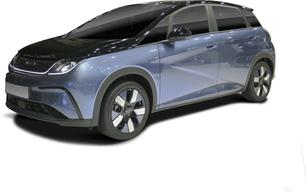
What's the difference?
It’s about time for a change. Since the beginning of the EV era, Tesla has been the dominant name, and not without good reason.
Tesla made electric cars popular, cool, and above all, accessible. To this day, the Model 3 and Model Y remain excellent purchases in their respective categories.
And yet, the tide seems to be turning. Many buyers haven't been thrilled by Elon Musk's antics, how popular the Tesla brand has become or maybe they never liked the look and feel of Tesla to begin with.
For those prospective EV buyers, it looks like BYD is set to be the next big thing in electric cars.
Offered at a far more accessible price-point, the Chinese brand still stands out with its distinctively styled vehicles and innovative features.
And the new car we’re looking at for this review, the Dolphin hatchback, could be the one to elevate the brand to the levels of popularity and recognition Tesla currently enjoys.
At the time of writing, it was also the most affordable electric car you can buy in Australia. But is it more than that? Read on to find out.
Chinese newcomer GAC couldn’t have timed the arrival of its Aion UT in Australia any better.
At the time of writing, we were in the midst of another Middle East-related fuel crisis, and more buyers than ever before were considering switching to their first electric car.
It’s a good thing there hasn’t ever been a better time to buy one, especially with price tags getting lower and lower thanks to keen new players like GAC.
The Aion UT, which is a vaguely Corolla-sized hatchback is now one of the most affordable new EVs on the market, and aims to outfox its primary rivals, like the BYD Dolphin and GWM Ora.
But, as you may have figured out by now, newcomer brands can come with their fair share of quirks. So, is the Aion UT the affordable hatchback it needs to be? We went to its Australian launch to find out.
Chinese manufacturers have been impressing us lately with the strides they’ve been making, and BYD is no exception with its Dolphin.
Not only does this hatch help bring the price down for prospective EV buyers, but it leaves a solid impression of a cohesive, well-built car, which is also quite a bit of fun to drive.
It’s not the fastest, nor is it the most practical, and there are a handful of downsides to its design and software, but when it comes down to it, this is simply a great value entry-level electric car.
The Aion UT is a cleverly-specified little hatchback and a great entry-point into electric motoring. The software needs a bit of work from a usability perspective, plus the spongy ride and cutesy styling might not be for everyone.
However, with strong points including driving range, cabin space and value, there’s even a pitch for it in some cases to be an only car compared to most of its price rivals, which are more likely to be thought of as a second car runabout in a two-car garage.
The pick of the range is definitely the entry-level Premium. It comes in at a headline-grabbing price with specs to blow rivals out of the water, while only missing out on a few luxuries.
Note: CarsGuide attended this event as a guest of the manufacturer, with accommodation and meals provided.
You wouldn’t know it in Australia, but BYD has a huge and diverse range of vehicles with lots of different styling approaches in its home market of China.
The cars we get here, though, consisting of this Dolphin hatch, the Atto 3 small SUV, and the upcoming Seal sedan all seem to share more or less the same curvy, futuristic theme.
Contemporary touches on the exterior of the Dolphin include the bar light and full ‘Build Your Dreams’ typeface embedded in the rear, the blocky gloss black alloy wheels (17-inch on the Premium we tested), the two-tone colour scheme, and of course, the grille-free face.
Short overhangs and a tall body seal the EV deal, with the Dolphin looking closest in its aesthetic to something like the Volkswagen ID.3 than anything else on the market. It perhaps won’t be for everyone - it’s a little more experimental than the more conventional look worn by the MG4 - but then, for others this distinctiveness may be a selling point.
The interior look and feel is the biggest surprise. Somehow, the Dolphin, despite being more affordable than its larger Atto 3 sibling, feels a cut above when it comes to its design theme and build quality.
The weirdly organic touches designed to mimic muscle fibres in the Atto 3 have been traded out in favour of something a bit slicker.
I really like the material choices here. The use of neoprene across the lower half of the dash, in the doors, and down the centre of the seats feels a lot less pretentious than the standard synthetic leathers you usually get at this price-point, and there’s an agreeable mix of plastics as well as gloss and matt finishes.
The nods to this car’s name which are present are a bit more toned down and fit with the design in a more subtle way.
The floating door handles, designed to resemble a fin, are a much nicer piece than the weird rotary ones in the Atto 3, and the wavy touches across the top of the dash aren’t too in-your-face and add an element of intrigue. I like it much more than I expected to.
It’s clear this space is designed around the giant multimedia panel, for better or worse. It looks spectacular, it’s nice and sharp, and the software, which looks as though it’s trying to emulate Tesla, does a pretty good job.
It’s quick, sharp, colourful, and has nice large iconography to jab at while you’re on the move, although some of the driving settings are ambiguously labelled and require clicking through to a sub-menu to alter. You’d get used to it, but it isn’t as slick as a Tesla operating system.
It also rotates, because of course it does, although one quirk I found with this is the polarised coating on the screen made it impossible to see when in portrait mode if you were also wearing polarised sunglasses.
Also, Apple CarPlay doesn't work in portrait mode. A gimmick? You decide.
The floating physical rotary controls jutting out below are a also a brilliant little piece of design. On one side you have your gear shifter, and on the other you’ve got your volume control, between them there are core functions, an on/off switch and an auto button for the climate, as well as the hazard light and drive mode controls.
It would be nice to also have a fan speed and temperature toggle, as these functions can only be used through the touchscreen, but there are worse offenders for clumsy climate controls on the market.
GAC tells us the UT hatch was designed in Milan, Italy, but it also isn’t ashamed of the Chinese influence on its overall appearance, like the ultra-short bonnet and Chinese city-car style face.
Along the side it has a modern, aerodynamic profile, and the ultra-short overhangs and long wheelbase maximise the amount of room for batteries under the floor and interior space.
The rear feels a lot like a modern Mini, with its bulbous tailgate and protruding light clusters, spiced up with a sporty spoiler piece jutting out.
It’s not a bad looking thing and it’s available in an array of fun colours.
On the inside it seems to follow the established rule-book of Chinese automakers, with plush trims, big screens with minimal physical buttons as well as a contemporary two-spoke steering wheel.
There’s a trendy floating console which hosts the cupholders and wireless charger on the Luxury grade, and an array of interesting patterns and textures through the doors and dash which you wouldn’t have once seen on a car at this price-point.
However, it is worth noting that while the seats are quite nice, and the steering wheel is a stand-out touchpoint, the trims on the doors and across the dash-top are hard plastics, more so than some of this car’s rivals.
The clever design bits don’t end with the controls and themed motifs, either. While the Dolphin’s cabin feels a bit smaller than many of its rivals (because, physically, it is), efforts have been made to make it a versatile space.
There are plenty of little storage areas throughout. There’s the floating one below the touchscreen, which suits wallets and sunglasses. There’s one with a roll-out cover set low below the controls which is good for smaller objects you don’t want moving around the cabin.
A large cubby is located underneath the armrest between the two seats for bigger objects and a slick wireless phone charger cut out from the top.
The two centre bottle holders are a little small, as are the cut-outs in the doors, so if you’re negotiating with an XL takeaway soft drink you might run into trouble.
The dark theme for the interior in our car doesn’t help the more closed-in feel, but the standard panoramic fixed sunroof (mercifully with a rolling shade) helps to keep the space airy.
I found it easy to set up my driving position, another clever touch being the little digital instrument panel perched on the steering column, so no matter how you adjust it you can always see it.
I was a little concerned the rear seat would be tiny, because this car doesn’t look big from the outside, but I was most definitely wrong.
Behind my own seating position, at 182cm tall, I had leagues of knee room and plenty of space for my feet thanks to the flat floor. I also had sufficient but not stellar headroom, and the soft-touch materials continue into the doors and seat trim.
I will say, the abundance of synthetic leather is much more evident for rear passengers, but it feels like a minor complaint.
Again, the bottle holders in the doors are tiny, but at least the ones in the drop-down armrest are generous. The middle seat is very useful thanks to the flat floor, although there are no adjustable air vents for rear passengers.
The backs of the front seats have a variety of pockets in different shapes and sizes, and there are USB-C and USB-A ports on the back of the centre console, alongside a bizarre centre bottle holder which is on an angle.
Boot space is 345 litres if you move the false floor to its lowest position. I was just able to squeeze in the three-piece CarsGuide luggage set with a bit of fiddling around.
With the second row down, room expands to 1310L, and you can bring the false floor up in the boot to make the load area flat.
The space underneath is quite good for storing charging cables and such, but keep in mind the Dolphin doesn’t offer additional frunk storage.
What it does offer is a vehicle-to-load adapter, which lets you power household appliances via its external charging port. Neat, and rare at this end of the EV market.
In terms of interior space, the Aion UT stands out with its spacious cabin. At 182cm tall, I am easily able to find a comfortable seating position, and visibility out the front sides and rear, while not as good as some small SUVs, isn’t bad.
There’s lots of headroom, and while I mentioned the hard plastic door cards before, there’s enough padding everywhere your elbows are going to touch to make it feel a bit nicer than perhaps it is.
The main drawback of this car for me is the lack of tactile buttons and the frustrating software.
The main screen isn’t particularly well utilised, being taken up by either a background or the navigation map, with an array of typically small shortcuts across the bottom for important features like the climate control or settings menus.
You can pre-set a few information panels which sit above the shortcut bar as in many rival cars and there’s also a shortcut tray which can be hosted on the driver’s side and configured with a variety of shortcuts and settings.
It’s just a bit clumsy to use, and the array of poorly-labelled settings menus for things like active safety equipment feel needlessly complicated.
I’d love to see this car with physical controls for climate and multimedia to make it easier to live with.
Up front the storage is decent. There are big pockets in the doors and a large storage tray between the driver and front passenger thanks to a flat floor. There’s also a slightly weird storage box under the touchscreen which has a net inside, good for more delicate objects you don’t want flying around the cabin.
On the floating console there are two cupholders which are a bit too shallow for my liking, and the wireless charger feels almost pointless because its made of a hard plastic, so your phone just slides right off in the corners. The cabled outlets are hidden beneath which allows for tidy cable management and the centre armrest console box is a healthy size.
The rear seat is comparatively basic, although touches on the key points. Its main advantage is how generous the space is. My frame was able to fit behind my own driving position with heaps of room for my knees, and just enough room for my head despite the dip in the roof for the sunroof shade in the Luxury-grade car we tested. There may be even more headroom in the base car.
The flat floor makes the space useful even for three across in a pinch and there’s a drop-down armrest with (again, shallow) cupholders. There are pockets on the back of both front seats and smallish pockets in each door. The array of soft trims continues, too, and the back of the centre console features a partially adjustable air vent. Luxury spec cars get a single USB rear power outlet.
As with many Chinese cars in this segment, the generous rear seat space comes at a cost to the boot. It measures just 321 litres, which is slightly smaller than its main opponents in this category, although larger than some hatchbacks like the Toyota Corolla, for example.
It has its advantages, though. The floor is two-tiered, and can offer a flat load area with the rear seats folded down, or a deeper boot in its lower position. Underneath there’s a cutaway good for charging equipment and the tyre repair kit (sorry, no spare wheel in here).
Unlike some EVs, the Aion UT doesn’t get a frunk (front boot) for additional storage.
Yep. This is the new cheapest electric car you can buy in Australia. This title is a frequently moving target, but again, at the time of writing, the entry-level Dolphin variant, at $38,890, before on-road costs and state-based incentives, undercut the MG4 by just $100, and the GWM Ora by $1100.
Importantly, its starting price is now in the realm of relevant combustion rivals. For similar money, you can hop into a high-spec Corolla (ZR Hybrid $39,100) for example, so this is the first time electric cars have become so affordable for the average consumer.
There are two Dolphin variants for now. The entry-level Dynamic, and the top-spec Premium. Both share more or less the same standard equipment levels, although they are differentiated by having different battery sizes and electric motor outputs.
You can’t talk electric car value without talking range, but thankfully, despite its low price, the Dolphin delivers on this front.
The base car scores a 44.9kWh battery, granting it a 340km WLTP-certified driving range, while the top-spec Premium ups this to a 60.5kWh unit, delivering a more substantial 427km range.
The entry battery is more than enough for city commuters, while the larger battery is enough to suit intercity freeway drives.
There are also plenty of longer-range EVs on the market, the Polestar 2 and Tesla Model 3 being chief among them, but for a vehicle at this price and in this market segment, the Dolphin is a huge improvement on some mainstream offerings, like the Mazda MX-30 and Nissan Leaf which can’t offer the same price-to-value ratio.
A lot of BYD’s ability to provide such an appealing price and driving range is down to its battery technology.
Unlike other automakers which need to buy batteries from suppliers, BYD designs and builds its own batteries, using an LFP chemistry which is cheaper and uses fewer scarce materials while offering economies of scale as well as the exact right size and form factor for its vehicles.
If this leaves you thinking the Dolphin must be sub-par when it comes to standard inclusions, you can think again, because this car also delivers with 16-inch alloys, LED headlights and tail-lights, a massive 12.8-inch multimedia touchscreen with built-in nav as well as Apple CarPlay and Android Auto connectivity, a wireless phone charger, electrical adjust and heating for the front seats, keyless entry with push-start ignition, climate control, and a comprehensive suite of active safety items.
Not bad at all, and the interior blend of neoprene and synthetic leather feels a bit nicer than the base MG4's cabin, for example.
The Dolphin might be as cheap as it gets when it comes to an electric car, but the value on offer here speaks for itself.
The GAC Aion UT starts from $31,990, before on-road costs, for the entry-level Premium grade, which makes it the third-most affordable EV you can buy in Australia after the city-sized BYD Atto 1 and the entry-level version of the BYD Dolphin.
It sits closer to price-parity with the GWM Ora, but is significantly more affordable than the rear-drive MG4 and more spec-competitive top-grade BYD Dolphin.
The bigger threat to the Aion UT is that a lot of buyers will be willing to spend slightly more to get into one of the most affordable electric small SUVs, like the BYD Atto 2 or Jaecoo J5.
Still, GAC makes a solid pitch for its hatch, which offers a higher spec level than its most direct price rivals.
For example, the Aion UT is more powerful than the entry-level Dolphin and Ora while offering a higher level of interior equipment.
Even the just-arrived front-drive MG4 Urban also starts at $31,990, but that’s for a version with significantly less driving range.
In fact, I’d go so far as to say the entry-level version of the Aion UT (the confusingly-named Premium) is probably the pick of the two variant range.
Standard equipment levels on this car include 17-inch alloy wheels, LED lighting all around, synthetic leather interior trim with heated and power adjust front seats, a 14.6-inch multimedia touchscreen with online connectivity and built-in nav as well as wireless Apple CarPlay and Android Auto.
There’s also an 8.88-inch digital instrument cluster, heated steering wheel and the full array of safety kit.
With the same power and battery size, this leaves only arguably unnecessary luxuries for the Luxury grade, like a wireless phone charger, ventilated driver’s seat, auto dimming rear vision mirror with auto power folding wing mirrors, a powered tailgate and of course, a panoramic sunroof (with shade!).
There’s the choice of two powertrains for the Dolphin. Both are single-motor front-wheel drive set-ups.
The base Dynamic can make use of 70kW/180Nm which sounds underpowered to me, but the car we tested for this launch review was the Premium which offers a much healthier 150kW/310Nm.
As well as the increase to battery capacity the Premium upgrades the suspension to a rear multi-link set-up.
While the base car seems like such a value buy, the increase in power, ride quality, and range seems to justify stretching to the Premium if your budget allows.
The Aion UT has a front-mounted electric motor producing 150kW/210Nm. That’s plenty punchy for any hatchback at this price, and I like the way the brand hasn’t messed around with a sub-100kW motor in the base variant to push prospects towards the top-spec car.
It’s more powerful than all of its closest rivals and at the time of writing you’ll have to spend four to six thousand dollars more to get into something equivalent from BYD, Chery, Jaecoo, Leapmotor or MG.
It even has a claimed 0-100km/h sprint time as low as 7.3 seconds.
As previously mentioned, each variant also gets its own battery capacity. The entry-level Dynamic offers a 44.9kWh battery and 340km of driving range, while the top-spec car offers a 60.5kWh unit with a driving range of 427km.
Charging on a fast DC unit maxes out on 60kW for the Dynamic or 80kW for the Premium.
This sounds slow, with many rivals offering in excess of 100kW charging at a minimum, but because the Dolphin’s battery sizes are so trim, it still means an 80 per cent charge will arrive in a little over half an hour.
On the slower AC charging standard, the max speed is a disappointing 7.0kW. For a fully electric car, we prefer to see at least 11kW as it makes it worthwhile to plug-in to an AC unit at a shopping centre to add roughly 70 - 100km of range an hour.
Because the Dophin is also quite efficient, though, you can still expect about 50km an hour to be added on this charging standard.
Official energy consumption for the Premium as-tested is 14.2kWh/100km, and we saw an impressive 14.1kWh/100km on our brief test program, making it one of the more efficient EVs I’ve ever driven.
The Aion UT has a 60kWh lithium-iron phosphate (LFP) battery pack, which grants it a WLTP-certified 430km of driving range.
That’s more than its closest rivals, like the entry-level Ora Standard Range (310km), BYD Dolphin Essential (410km) or BYD Atto 2 (345km).
Claimed efficiency is 16.4kWh/100km and the car I tested returned a consumption of 14.0kWh/100km over a 130km route of mixed conditions, which isn’t bad at all.
Charging speeds are less impressive, but realistically appropriate for the relatively small battery. The peak DC charging capacity of 87kW means a charge time which the brand quotes at 24 minutes, but this is from 30-80 per cent. Expect closer to 40 minutes for a 10-80 per cent charge.
AC charging is decent, at 11kW. This should have you charging from 10-80 per cent between four and five hours.
The Dolphin is immediately impressive. From the get-go I was greeted with a feeling of quality from the car in ways I didn’t expect. The steering feels nicely balanced and not too artificial like it can be on some EVs, while the interior is refreshingly ergonomic.
The ride might be the Dolphin’s most impressive trait, with a feeling of balance across both axles, and a spritely feel to the whole car.
It is trim for an EV, with a kerb weight of 1658kg, which no doubt helps the steering feel, and the efficiency.
As it is, I didn’t experience the kind of crashing and wallowing many EVs suffer from on larger bumps, and smaller bumps seemed to be filtered out with ease.
It even feels nicely balanced in the corners, pairing nicely with the great steering feel which is not something we’ve come to expect from Chinese cars.
The motor is also willing, with software tuning keeping power delivery on the right side of overwhelming, although the warm-hatch equivalent's seven second 0-100km/h sprint time is a hint at what it’s capable of.
Unfortunately, it is let down by a pretty sub-standard factory tyre package. The LingLong Comfort Masters are designed for the Dolphin, complete with little Dolphin markings on them, but are hardly inspiring for traction when you plant the accelerator or tip it into a corner with enthusiasm.
They are better than the pretty much no-name Atlas Batman A51 tyres which came on the Atto 3, but even MG has wised up to putting tyres from renowned manufacturers on its Australian-delivered cars.
The Dolphin is also easy to park, thanks to its excellent surround camera suite and tight footprint, but visibility out of the tiny rear window is limited and made worse by the huge headrests for the outboard back seats.
In terms of electric driving characteristics the Dolphin offers two levels of regen braking, one which is virtually non-existent, and another mild tune.
Surprisingly, there’s no single-pedal mode, and the Dolphin leans on blended braking more than some of its rivals. It feels a lot more traditional to drive in this sense, so may be well suited to someone hopping out of a combustion car.
The drive modes are quite dramatic, with 'Eco' mode limiting motor torque and even switching off the climate control, while 'Sport' will make bouts of wheelspin a bit too easy by upping the response time from the motor. I found it best to stick to the nicely-balanced 'Normal' setting.
Tl;dr? The Dolphin is impressive. It’s responsive, relatively light, and has a sense of quality to it through its great ride and decent handling. Not bad for the cheapest EV in Australia.
The drive experience can be where a lot of Chinese cars fall down but I walked away less frustrated by the Aion UT.
That’s not to say it will behave as you might expect a low-slung hatchback to. The suspension, for example, is extremely soft as it maintains its original Chinese-market state-of-tune.
This makes the car waft over imperfections on city roads. And in that sense it offers supreme ride comfort in the scenarios it was designed for. However, at the extremes, like some speed bumps, or particularly deep pot holes there can be a surprisingly violent re-bound sending a thud through the cabin.
The other trade-off for soft suspension is less body control. I was surprised to find that the Aion UT holds it together mostly well on a flat country B-road, but when undulations and big dips introduce themselves, the soft suspension can be too slow to react, making the car lose confidence in higher-speed open road scenarios we’re more used to in Australia.
The steering, like many electric cars in this category, is relatively heavily electrically assisted. This makes it light and easy to adjust at low speeds for easy park and maneuverability in the confines of a city. It loses a little bit of road-feel at higher speeds but the Aion UT’s steering is far from the least connected I’ve experienced recently.
One thing it can’t be criticised for is a lack of power. With 150kW instantaneously available the Aion UT has some serious poke and while the ChaoYang tyre package is tuned more for efficiency than grip, it’s again not one of the worst I’ve driven with.
One thing which helps the whole experience along is this car’s hatchback layout. With the weight of the battery low and squat and the wheels all the way out to the edges of the frame, the Aion UT inherently handles decently compared to an electric crossover or small SUV.
Like all Chinese cars, the UT has a host of occasionally frustrating driver aids, which you can read about in the Safety section below. While I was inclined to turn some of the features off after testing them, the alerts are relatively quiet and non-invasive.
Is the UT any good to drive? It’s not bad for the segment, I was largely pleased with how it handled and the power on offer, and while it still has its annoyances, they’re not big deal-breakers.
The MG4 rear-drive is a better allrounder, while the GWM Ora isn’t as good. I’d say it’s on par with the BYD Dolphin, but they excel in different areas. The Dolphin's a bit sharper in terms of handling but the Aion UT is more comfortable.
The Dolphin was recently awarded a maximum five-star ANCAP safety rating and is equipped with seven airbags and a robust list of active safety gear.
There’s auto emergency braking, lane keep assist, blind-spot monitoring, driver attention alert, rear cross-traffic alert, front cross-traffic alert, traffic sign recognition, and adaptive cruise control.
It’s one thing to have great active safety items, it’s quite another to calibrate them well so they don’t interfere with the driving experience.
The Dolphin does okay on this front. I found the lane keep system could occasionally be alarmingly heavy-handed, although it activates less than the very annoying system on my Haval Jolion long-termer.
The pre-collision alert also triggered several times due to parked cars on the side of the road, but turning down the sensitivity seemed to solve this problem.
Also included is an excellent 360-degree camera suite, ISOFIX points on the rear outboard seats, a ‘child presence detection’ system, which apparently sounds a warning if you leave a child in the back seat, and turns the air conditioning on if you ignore it, and there's even a tyre pressure monitoring system to top it off.
As with many Chinese cars the list of active safety equipment is long but that doesn’t mean it’s particularly well calibrated.
Standard gear includes the key stuff like auto emergency braking (AEB), lane keep assist, blind-spot monitoring, rear cross-traffic alert and adaptive cruise control. There are also rarer features for an affordable car like this including traffic sign recognition, door open warning, auto high beams and front cross-traffic alert.
On the parking front you get a 360-degree parking camera view as well as front and rear proximity sensors.
There's also an annoying driver monitoring system and one I haven’t seen much in the form of an occupant warning system, which seems to imagine you’re not wearing a seatbelt when you are.
It’s not the only safety system I found myself reaching to turn off. The lane keep assist could occasionally be a bit heavy-handed and the traffic sign alert was typically frustrating. This, sadly, is what we’ve come to expect from these types of systems from many Chinese automakers.
It’s not the most annoying system I’ve used, though, and the alerts are quiet enough and far enough apart that they aren't as intrusive as they can be in some rivals. You can also adjust the tolerance of some of the systems in the (needlessly complicated) menus to make them less annoying.
At the launch, the Aion UT was yet to be rated by ANCAP.
The Dolphin is covered by a six-year or 150,000km warranty, which beats a lot of mainstream rivals for its duration, but not its distance.
In the EV segment it plays in, though, things are a bit tougher, as its primary Chinese rivals, GWM and MG, are offering seven year and unlimited kilometre warranty promises.
Service pricing is available all the way out to 96 months or 160,000km, averaging $299 per year for the duration, which is pretty good.
Many rivals are offering free servicing for several years, and there are also many electric cars which only need to see a shop once every 24 months or 20,000km, compared to the Dolphin’s more traditional 12 month intervals.
GAC covers this electric hatch with an eight-year and unlimited kilometre warranty, while the brand’s “magazine battery 2.0” is covered by a separate eight-year and 200,000km warranty. Five years of roadside assistance is included.
The Aion UT needs to be serviced once a year or 15,000km. The service price schedule extends all the way out to 240,000km with yearly visits costing between $199 and $640 but for the life of the warranty the average yearly cost comes in at $352.
There are currently 19 GAC dealers in Australia, confined mainly to Melbourne, Sydney and Brisbane with a single store in Perth and an outlier in Cairns. No representation yet in Tassie, Canberra, the Northern Territory or SA.