What's the difference?
Back in 2010, Mitsubishi released Australia’s first mainstream electric vehicle (EV) in nearly a century.
That model, the i-MiEV, was a four-seater city-sized Kei car from Japan that cost $48,800, before on-road costs, or from roughly $70,000 in today's money. Little wonder it bombed. That was four times more than petrol-powered equivalents of the time.
Now, in 2026, the new BYD Atto 1 is the first EV sold here since the i-MiEV’s 2013 departure to be considered a four-seater city car.
It’s also the least-expensive EV money can buy, being even cheaper than many internal-combustion engine alternatives like the Mazda 2 and Toyota Yaris hybrid. The fact is, there’s nothing remotely near the Chinese supermini’s base price that’s electric.
But is the Atto 1 any good?
Andrew Chesterton road tests and reviews the updated Holden Spark LT with specs, fuel consumption and verdict.
The micro-car segment in Australia has driven off a cliff. We are shunning our smallest cars in a way we never have before, and nobody seems to be entirely sure why.
The strength of the second-hand market is one suspected culprit, while another is the tempting price point of vehicles that are one size bigger, with city-car shoppers able to upsize for relative peanuts.
Whatever the reason, the segment is stuck in neutral and halfway along Struggle Street. It needs a spark. And Holden's hoping theirs is just the ticket.
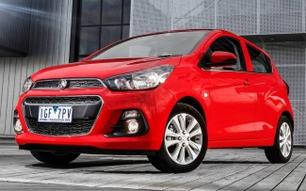
Now you might recognise it as a Barina, but Holden dropped that part of the moniker when this new model launched in March. It is now simply known as the Holden Spark, tested here in top-spec LT guise and wearing a sticker price of $18,990. It sits above only the entry-level, bargain-basement LS ($13,990 manual, $15,690 automatic) in the two-model Spark range.
Designed and built in Korea, the Spark seems to have little to do with our unique marketplace, but Holden promises us this new model couldn't be more dinky-di if it ran on vegemite. Australia had crucial input into its design in Korea, while Holden's Aussie engineers put the new model though its paces on the company's proving ground, tweaking the suspension and steering for Australia's road surfaces.
So the question now is, is the Spark bright enough to lure buyers back to the micro-car segment?
The BYD Atto 1 has already earned its place in history as the cheapest new EV ever sold in Australia. And the good news is that, on the strength of bigger-battery Premium version, it rarely puts a foot wrong as a city car, exceeding performance, efficiency, refinement and comfort expectations. The Atto 1 really delivers around town.
But the baby BYD’s price is too close to larger EVs with better range, while extended exposure reveals issues with seat comfort, touchscreen access/distraction, ADAS interference and nervous steering feel at speed. Australian road tuning is required to rectify these.
Still, as a cheap urban EV runabout, the Atto 1 Premium still (just) stands alone. A glimpse into the future, someday, all city cars will likely follow in the bold BYD’s footsteps.
The marvels of local engineering strike again: the Spark LT definitely feels a cut above some of its budget competition from behind the wheel. It is well-equipped, too, and packed with connectivity and technology features. In short, it could be just the spark Australia's city-car segment needs.
Fun fact. Designer Wolfgang Egger was responsible for the gorgeous Alfa Romeo 156 of 1997 among others, as well as some Audis and Lamborghinis later on. You can definitely see the latter’s influence in the Atto 1’s angular face.
Based on the Dolphin architecture and badged the Dolphin Surf elsewhere (as well as Seagull but that name wouldn’t fly here), the BYD’s boxy proportions are pure supermini and is about the size of the previous-generation Honda Jazz.
However, the designers have added some crossover cues to the styling, including plastic cladding around the wheel arches, to give it a pseudo SUV look.
Inside, though, the Atto 1 is unashamedly hatchback in layout and appearance, with a contemporary, minimalist dash, big central touchscreen with precious few buttons and loads of storage.
In other words, a typical modern small car from China.
There's only so much that can be done with a car in this bracket (there's hardly an abundance of surface metal to play with), but Holden's Korean design team have done an admirable job of inserting some excitement into what is traditionally a fairly bland category.
More youth appeal arrives courtesy of a huge array of personalisation options.
A powerful front end, with two fog lights sitting below the headlights, is dominated by a vaguely Kia-esque grille. And when viewed side on, the Spark looks to be sitting low, courtesy of standard 15-inch alloys that fill the wheel arches and tarmac-kissing side skirting that runs front to back. Two fairly heavy body creases also break up the metal monotony, running along the front and rear doors.
It's an energetic-looking package, and even more youth appeal arrives courtesy of a huge array of personalisation options, with Holden promising 33 different changes a buyer can make, including the wheel inserts, wing mirror caps and roof rails.
Inside, the focus is more on connectivity than luxury, so you can expect fake leather, hard plastics and fairly ordinary seat cushioning, but it's all nicely put together, and the basic feel is broken up by some well-placed style elements, like the coloured insert that runs the length of the dash.
The BYD’s boxiness sure pays dividends accessing the Atto 1's interior, aided by tall doors, a high roof and lofty seating.
Initial impressions are very positive.
Lots of space, a decent driving position (in the Premium at least; the Essential has rake-only steering adjustment), grippy little wheel and a solid look and feel impart a sense of quality. This does not seem built down to a price.
The elevated centre console/fixed armrest provides ample storage below and easy reach of USB ports, sturdy cupholders above and a raised smartphone rest that doubles as a charger (again, only on Premium), allowing for quick downward glances without having to touch the device. Helpful.
Further points are won due to the very clean and minimalist dash presentation, with an electronic instrument display ahead of the driver (not a given nowadays thanks to Tesla’s minimalism-gone-mad influence), offering all the information you need in a concise and notably colourful manner.
That 10.1-inch central touchscreen, meanwhile, is probably one of the better examples from China, possessing superficially logical operation, clear markings and a row of fast-access icons for climate, audio, vehicle function, home screen and other controls.
However, the more time you spend in the Atto 1, the more the cabin doesn’t stand up that well under scrutiny.
The shapely tombstone-style front seats, which look a million dollars, are comfortable on short journeys but disappoint during longer drives, revealing a lack of sufficient back and thigh support.
There are no regenerative braking paddle shifters for single-pedal driving, just an on/off tile requiring a distracting and time-consuming touchscreen-menu deep-dive.
In fact, most functions demand at least one or two eyes-off-the-road-ahead prods of the screen, which is annoying and potentially hazardous.
Using the climate control is a good (bad) example.
Infernally fiddly screen slide controllers that are hard to pin-point with a hovering finger while the car is moving, let alone modulate, leads to temperature-selection fury. And those vinyl seats are clammy regardless of humidity levels and their perforations don’t help. Setting the desired climate environment is an utter faff.
And why must BYD’s synthetic leather smell so pungent? The off-gas odour can be nauseating for some on warmer days.
Worse still, even a glance towards the touchscreen sets off the distraction nannies. Frustrating. So is the intrusive lane-keep assist tech, unless you keep the car perfectly centred, with its constant nudging of the wheel while it nags away. More like Aggro 1.
Inevitably, turning these and other ADAS warnings off requires several menu deep-dives, leading to more driver-distraction paranoia. It’s a circle of stupidity for tech that’s meant to protect. And every new drive defaults to ‘on’. It's an infuriating mess.
Meanwhile, the Atto 1’s (two-person-only, remember) rear seat area also starts off promisingly, with easy entry/egress, adequate space (even for long legs and big feet) and a backrest and cushion combo offering sufficient comfort and support.
Amenities include useful door storage, overhead grab handles and map pockets, while the back of the centre console provides a cubby area just wide enough hold a bottle or larger keep-cup. That’s necessary because there is no folding armrest or subsequent cupholders back there, nor reading lights or USB ports.
And while the upward sweep of the window line means the rear can seem dark, the shape of the front seats allows some vision around and even through them for rear occupants.
Further back, the boot area is larger than the BYD’s diminutive size suggests, at 308 litres with backrests erect and 1037L with them folded forward.
The deep floor hides an even deeper cavity that’s large enough for charger cables, laptops and other paraphernalia that should be out of sight. That almost negates the need for the AWOL luggage cover.
But there's also a tyre repair kit instead of a spare wheel in there, and regular readers will know how incorrect that is. Every vehicle sold in Australia should come with one. Even city cars.
Loading/unloading is easy and there are hooks to secure things to, but clearing the high lip may be an effort for some.
And, though an EV, the is no extra storage to be found under the bonnet. The Atto 1 has no front boot, or froot.
Nope. This is a pocket-sized car, namely because it has the same cargo capacity as your pocket.
Holden has stretched the space between the wheels to maximise passenger space, and as a result there's actually plenty of room in either row. But to add space somewhere, you need to take it from somewhere else, and that somewhere else is the boot, where you'll find a mere 185-litres of luggage space. The situation is improved by dropping the 60:40 split rear seats, but you'll be forever choosing between passengers and luggage.
Front seat passengers share a pair of cupholders, but rear seat passengers get none. They don't get room for bottles in their door pockets. Or door pockets at all, for that matter. The backseat does, however, get two ISOFIX attachment points, one in each window seat.
And… what a perfect time to release Australia's cheapest new EV!
Sat alongside the base Essential from $23,990 (all prices are before on-road costs unless otherwise stated) is the Premium as tested here, starting from $27,990 and representing a $4000 difference.
But oh, what a difference.
The cheaper Essential comes with a 30kWh battery, providing a WLTP range of just 220km. Usefully, the Premium’s battery is 44 per cent larger at 43.2kWh, boosting range to a more-comfortable 310km, while power jumps by 77 per cent.
Every Atto 1 includes synthetic leather-trimmed seats, a 10.1-inch central touchscreen, rear camera with sensors, adaptive cruise control as part of some Advanced Driver Assist Systems (ADAS) tech (more on safety later on), wireless Apple CarPlay and Android Auto and even Vehicle to Load (V2L) functionality, so you can use your hairdryer on the fly. Handy!
However, the Premium ups the ante with a surround-view monitor, powered and heated front seats, reach as well as rake adjustment for the steering wheel, a wireless charger, LEDs rather than halogen headlights and 16-inch alloy wheels instead of 15-inch steelies with hubcaps.
But… both are four-seaters only. And neither offers an exterior temperature gauge, remote keyless entry from the passenger side (you’ll always need to press a fob), a luggage cover or a spare wheel – just the totally-unsatisfactory tyre repair kit.
Plus, there’s no heat pump so, in winter, turning the temperature up will drag range down noticeably, while a lack of liquid cooling for the battery will do the same during a hot Aussie summer, since the AC has to work overtime doing that job instead.
And we’re not convinced the Atto 1 represents such great value.
Yes, that small-battery Essential undercuts every hybrid bar Suzuki’s (mild-hybrid) Swift, including the MG3 Hybrid+ and Toyota Yaris HEV, and even the ageing Mazda 2 petrol costs more, but its limited range means it’s better as an inner-urban, small-distance-only commuter proposition. Best as a second or even third car.
Meanwhile, the bigger-battery Premium is priced perilously close to significantly larger EVs with greater range, including BYD’s own Dolphin from $29,990, the MG4 Urban from $31,990 drive-away, GAC Aion UT from $32,990 drive-away and the coming Geely EX2.
And, alongside cheaper-still petrol-powered alternatives such as the Kia Picanto, MG3 and MG5 sedan, there are also smaller SUVs that slip beneath the bijou BYD, like the Chery Tiggo 4, Haval Jolion, Hyundai Venue, Mahindra XUV 3X0 and MG ZS.
What we’re saying is, unless the Atto 1’s sub-four-metre length and narrowness are paramount, it’s behind the eight-ball for value against an array of more-substantial alternatives costing not much more.
Still, we get this is that rare thing today, a truly-new city car and we’re here for that.
While the cheap and cheerful entry-level Spark, the $13,990 LS, plays smack-bang in the middle of the micro-car segment, the top-spec LT has bigger, and considerably more expensive, shoes to fill. At $18,990, the LT sails perilously close to its bigger and equally well-equipped competition.
For that money, the Spark needs to arrive wanting for little, and in most respects it does exactly that. For a start, a CVT automatic is standard, and is joined by some stand-out features in this segment, like cruise control, keyless entry with proximity unlocking, push-button start and a fake leather trim that Holden calls Sportec.
While navigation isn't standard, the Spark LT's seven-inch touchscreen is both Android Auto and Apple Car Play equipped, so phone maps fill the blank with ease.
The Atto 1's electric motor is offered in two output choices. Either way, it can be found under the bonnet and driving the front wheels via a single-speed transmission.
The Essential scores a low-power version making 65kW and 175Nm of torque, which is enough for a 0-100km/h sprint time of a still-decent 11.1 seconds, while the Premium’s high-power unit ups those to 115kW and 220Nm respectively, shaving two seconds off in the process. Top speed is said to be 135km/h.
Note that, while the latter grade’s 43.2kWh battery adds 96kg overall compared to the smaller 30kWh model, it still enjoys a way-superior power-to-weight ratio of 82.7kW/tonne versus just 50.2kW/tonne.
There's just the one engine available across the Spark range, and that's a 1.4-litre petrol unit that'll generate 73kW and 128Nm.
The official consumption average for the Essential is 15.5kWh/100km and its 30kWh 'Blade' LFP (Lithium Iron Phosphate) battery offers a WLTP range of 220km.
The 43.2kW Premium bumps the energy use figure up to 16kWh/100km but offers 310km WLTP.
We came close to latter claim, with 263km of mixed driving and still showing about 10 per cent of range left, while the car’s consumption readout averaged 13.7kWh/100km overall. That rose to 16.5kWh/100km during a stint of harder, highway-heavy driving.
Charging times vary. With an 11kW AC capability on both grades, the Essential needs up to 16 hours and the Premium 22 hours plugged into a regular socket, and five and seven hours respectively using an optional 7.0kW Wallbox.
Meanwhile, switching to DC fast charging, the Essential’s 65kW capability means a 10-80 per cent top-up can be achieved in under 40 minutes, against the 85kW Premium’s 30 to 50-minute requirement.
Spring for the LT, and that's paired with a CVT automatic transmission, with Holden promising that combination will sip a claimed/combined 5.5L/100km (though we recorded a less impressive 8.0 litres on our test).
Sadly, we cannot comment on how the 65kW/175Nm Essential drives, but with 77 per cent more power and 25 per cent more torque, the 115kW/220Nm Premium’s performance is one of its calling cards.
Lively off the mark, even in Eco, it thrives in inner urban environments, with instant throttle response for effortlessly zippy and smooth acceleration, as you’d expect of an EV.
And it just keeps on keeping on at speed, giving the Premium a terrific breadth of performance flexibility. We’re now very curious to see how the Essential goes.
Armed with light and alert steering, the Atto 1 can weave in and out of traffic gaps with confidence and precision, and is backed up by a super-tight turning circle to boot, so parking manoeuvres around town is a doddle.
BYD’s decision to set up the chassis for a soft, long-travel suspension is appreciated, since the Premium takes most bumps and humps in its stride, making this one of the comfier city cars around.
Road and tyre noises are omnipresent, but aren’t not too bad overall by supermini standards, while the Hankook 185/55R16 tyres deliver sufficient grip, even over some rain-soaked roads we endured.
Most of these Atto 1 attributes also translate well at freeway speeds, with the Premium offering ample muscle for overtaking, slick steering responses and a planted chassis feel.
But, once you hit some faster corners, the BYD’s reactive steering, lofty seating and cushy suspension conspire to create considerable body movement, especially through tighter bends, scrubbing the front wheels as it turns wide (understeer).
Yet, press on a bit harder, the Atto 1 can instantly change its attitude to oversteer, feeling darty as weight shifts from the rear, making the steering suddenly too sharp and the car too nervous, Even experienced drivers might hesitate to carry on. And this happened on dry roads.
Of course, the BYD is a city car so not designed for sports-car handling, but it does lack the confidence and control of a hard-driven Mazda 2 or Suzuki Swift. Strangely, it seems more SUV-like than supermini, dynamically.
Most owners won't care, but they will have to live with the infuriating ADAS tune, with inexplicably sudden braking when the adaptive cruise control is on, and lane-support systems that all-too-often tug and bleat endlessly like an agitated goat, becoming too distracting, and requiring far-too-fiddly touchscreen menu diving to silence, especially as they default back on with every restart.
The driver-attention warning is also in a semi-permanent state of nerves, squawking all-too-regularly unless the driver is sat perfectly still, and will easily escalate the danger level to “take-a-break” should you dare move about in your seat. Which would be regularly, due to the latter’s lack of enduring support. A literal and metaphorical pain.
Clearly, then, the Atto 1 can really do with some Australian road tuning and on a number of fronts at that. Until this happens, these are the dark clouds blighting the blue skies that this car’s otherwise sunny disposition delivers with every urban drive on a daily basis.
Or, in other words, stick to the urban jungle.
Holden's Aussie engineering team say they were able to get their hands all over the new Spark pre-launch, launching lap after lap of the company's proving ground as they tweaked the steering and suspension tune to better suit local conditions. And the results are very good.
The 1.4-litre engine doesn't generate a huge amount of power (though it is good for its class), but it's delivered in a way that makes the Spark feel like it's punching well above its weight, rarely feeling underpowered in everyday situations.
There is a certain skittishness to the way it drives at times.
The Aussie magic sprinkled over the suspension and steering transforms the way the Spark LT drives, both in the city and further afield. The ride nudges the firm side of the spectrum (but not enough to bother you over inner-city ruts and bumps) which translates to a low, flat feeling through corners.
All in all, the little Spark more than holds its own on more challenging roads. The steering, too, helps the Spark outshine the regular city commuters, with a naturally engaging set-up that always feels connected to the road below.
There is a certain skittishness to the way it drives at times, though, with the gearbox wanting to continue lurching forward for a split-second after you take your foot off the accelerator, which takes some getting used to.
The Atto 1 debuted in China back in 2023, but this is a facelifted, international-market version evolved mainly for European consumers, so crash-tested by Euro NCAP only last year, and scoring a maximum five-star ANCAP rating.
Note, though, that while the baby BYD includes Autonomous Emergency Braking (AEB) with forward collision warning, lane-departure assist and adaptive cruise control as standard, there is no blind-spot monitor or rear cross-traffic alert. Odd for a city slicker.
Six airbags are fitted, including curtain protection for all outboard occupants, while there are two rear-seat sited ISOFIX anchorage points and child-seat tether points behind each backrest.
Standard safety fare comes courtesy of six airbags, along with hill-hold assist, ABS and ESC, but it does miss out on more advanced technologies like autonomous brakes.
Springing for the LT will add rear parking sensors, a rear-view camera and cruise control as standard fare, though the lot can be added to the entry-level LS as part of Holden's Driver Assistance Pack.
The Spark range scored the maximum five-star ANCAP safety rating when tested early this year.
Here’s where the BYD slips up a bit.
Yes, it comes with a better-than-industry-standard six-year warranty, but many rivals offer between seven and 10-year coverages, while the Atto 1’s mileage warranty is capped at 150,000km when most others include unlimited mileage. And roadside assistance is only for one year, as well.
Service intervals are every 12 months or 20,000km. Capped-price servicing is available, but no precise figures were available at the time of publishing.
Estimates are from under $200 for the first and third annual services, and from $500 and $650 for the second and fourth yearly visits, respectively. Please check with BYD for updated figures.
Currently there are about 105 BYD service outlets throughout Australia, with 30 more expected by the middle of 2026. This should address one of this brand's biggest concerns – sufficient after-sales care.
The Spark range is covered by a three-year, 100,000km warranty and requires servicing every 15,000kms. The Spark range falls under Holden's lifetime capped price servicing scheme, with trips to the dealership capped at $1,145 total for the first five services.