What's the difference?
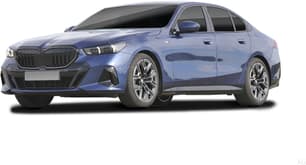
More than half a century of 5 Series pedigree has led BMW to this, the first electric version of its venerable sedan, the i5.
It's true that electric cars come with benefits that suit the realm of luxury (or at least executive) motoring like their effortless acceleration and near-silent operation, so this new G60 5 Series has the potential to be the best yet in its ‘i5’ form.
But there are rivals, well-liked ones at that, which BMW must contend with to snatch the spot at the top of the large premium sedan ladder technically held currently by the Porsche Taycan in terms of sales - though Mercedes’ E-Class would lead if its electric cousin EQE’s sales were combined.
So, with names like that to go up against, BMW better have brought its A-game.
Toyota Australia is on the record as saying it doesn't want to push one form of electrification over another, and to that end wants the market to choose whether it wants hybrids, plug-ins, full battery or hydrogen vehicles.
While hybrid options have well and truly arrived in models like the RAV4, Corolla and Camry, and we’re all still waiting for the full-electric and plug-in vehicles, Toyota has now brought in its second-generation Mirai hydrogen FCEV.
But with Toyota, and Hyundai with its Nexo, the only brands pushing hydrogen into the mainstream, is it good enough to hold its own against battery electric models like the Tesla Model 3 and Nissan Leaf?
There’s no getting around the i5 being a rather expensive offering. More than $150,000 to get into an electric sedan that’s not much faster than a hot hatch is a big ask, but there’s plenty to enjoy about the 5 Series.
Things like its heated leather seats shouldn’t be the reason you’re willing to spend so much on a sedan when a $50,000 hybrid SUV will score you the same, instead it’s the fact the 5 Series is a delight to drive and hasn’t lost the feeling of prestige the badge has earned over the last half a century.
In terms of value - if speed isn’t your focus and you’re less of a gadget-type-operator when looking at cars like this - the 520i has the style and comfort you’d need and at $100K less than the M60.
And in terms of large electric sedans, the i5 eDrive40 is cheaper than a Porsche Taycan (by a little) or an Audi e-Tron (by a lot). The Genesis G80 Electrified is the closest cheaper rival, by about $10K, or the less powerful Mercedes EQE is similarly priced at $154,900.
Essentially, if you’re looking at a 5 Series, it might be worth considering if you really need it to be electric, but if so, there aren’t many alternatives in its category for the price.
Note: CarsGuide attended this event as a guest of the manufacturer, with meals provided.
Believe it or not, the Mirai represents a pretty big gamble for Toyota, a company who has been known in the past for being relative conservative with its vehicles.
In recent years though, with models like the GR Yaris and even the RAV4 Hybrid, it seems like Toyota is more willing to go out and take a chance on something that would not be considered a safe bet.
The Mirai represents this willingness to experiment, but it is still too early to say whether it will a winner or a failure.
It drives well, looks good and its powertrain is a potential gamechanger for electric cars in Australia, but whether hydrogen takes off locally with customers is beyond Toyota’s control and up to those willing to invest in refuelling infrastructure.
If you’ve watched other members of the BMW family go into a new generation within the last few years - the 3, 4 and 7 Series particularly, you won’t be too surprised by what you see here. Especially with the latter, having seen the petrol variants look roughly the same as the electric ones.
BMW specifically made the petrol 520i and the i5 variants look similar for egalitarian purposes - to not disenfranchise 520i buyers who are still spending a fair chunk of cash but might not be ready to go EV.
That means all three variants score a mix of new and old. The kidney grille remains and isn’t as large as on the M3 or 4 Series, while the bonnet line following it and the ‘character line’ down the car’s side also remain. And yes, the Hoffmeister kink where the C-pillar meets the passenger window’s lower corner is still there.
On that C-pillar though is a ‘5’ stamped into the bodywork, new to this generation, while the front grille as mentioned has a glowing light surround - the brand’s ‘Iconic Glow’ already seen on the 7 Series.
Overall, thanks to being slightly larger in every dimension, the new 5 is starting to look bigger than a 7 Series from a little while ago. And that’s because it is - its body is overall longer than an E65 7 Series from the mid-2000s.
It’s 5060mm long 1900mm wide, 1515mm tall (97mm longer, 32mm wider, and 36mm taller). Its wheelbase is 20mm longer too at 2995mm.
Remember your awkward teenage years when you were still a little uneasy in your own skin and tried to find your way in terms of your own style? (I certainly do!).
Now remember bursting on the scene in your 20s with the confidence and swagger of a Calvin Klein model after working out your niche? (I’m still waiting for this to happen).
Well, the Mirai certainly remembers because the inelegance of the first-generation car has given way to a much more confident and handsome model.
From the outside, there is no denying its Toyota-ness and from certain angles the new Mirai even looks a bit like its Camry cousin, with a bit more flair.
The split front lighting signature and massive grille direct your eye to the blue-tinged Toyota badge, which the Mirai wears proudly, while the puffed-up bonnet and lower-bumper chrome accent add a touch of sportiness and class, respectively.
Move to the profile and you will see 19-inch wheels filling the arches, as well as a sloping rear roofline and silhouette that echoes the best of the premium German sedans.
From behind, the body-wide tail-light design and subtle spoiler adds to the Mirai’s strong road presence without looking over the top, but I especially like the way the lines of the former continue down the bumper to break up the body panels.
If you can’t tell already, I'm a fan of the exterior looks of the Mirai, and I bet if the Toyota badge was swapped out for a Lexus one, no one would think it looked out of place.
Step inside the Mirai and there are familiar Toyota appointments like the way the dashboard sweeps away from the driver, as well as a shifter design lifted from a Prius.
The surfaces are all soft-touch, though, and the mix of leather and gloss-black materials combine to elevate the interior ambience.
The interior of the Mirai might not be as stunning as the exterior, but it is certainly no drab and depressing place to spend some time.
A longer wheelbase means more space inside, where the 5 Series also still looks fairly familiar to those who have spent any significant time in a recent model BMW.
BMW has historically been pretty bang-on with ergonomics, and the new-gen 5 does a good job of sticking to that. Comfortable sports seats and quality feel for the materials on touch points mean the 5 Series feels nice to be in, and relatively restrained interior design for a somewhat luxurious car means it looks nice too.
It’s let down only by a couple of things - its multimedia screen and Operating System 8.5 is a little less simple to use now, and requires more touching the screen than previous iDrive systems, rendering the scroll wheel less useful.
The BMW Interaction Bar too is a little tricky to see controls on, as well as lacking physical feedback for using controls. Vent flow controls are digital sliders on the Bar, while vent direction is controlled by an unusual ‘joystick’ style control nearby.
The rear seat is plenty spacious, as you’d expect from a large sedan, with climate controls and ports for charging devices in the rear.
Measuring 4975mm long, 1885mm wide, 1470mm tall and with a 2920mm wheelbase, the second-generation Mirai is comparable in size to a mid-size sedan like the Camry and Mazda6.
However, it is a little longer, wider and lower, with an elongated wheelbase, and is in fact larger in all dimensions (save for height) than a Honda Odyssey people mover!
You’d think this would afford passengers heaps of room, but all the whizz-bang cutting-edge technology has to go somewhere.
Based on Toyota's new GA-L platform, the second-generation Mirai is fitted with three hydrogen tanks – two smaller ones positioned laterally behind the rear seats and one large one mounted longitudinally where a traditional transmission would sit.
What this means is that rear seat room is compromised, and the hydrogen tank eats into the middle seat’s legroom so much that the new Mirai might as well be a four-seater.
Leg- and shoulder-room in the second row are adequate, but the sloping roofline means it can be hard for taller passengers to get comfortable. I'm 184cm (6'0") and had trouble.
Move to the front seats though, and it’s a different story with comfortable and supportive seats offering plenty of adjustability for drivers/passengers of any size.
Storage options are also ample, with a door pockets, a centre storage bin, two cupholders and a tray for your phone/wallet.
Opening the boot reveals a cavity large enough for just 272 litres (VDA) of volume – less than the smaller-sized Corolla sedan (470L) and well-down on the similarly-sized Camry (524L).
Like the rear seats, boot space is compromised by powertrain components, the culprit being the battery and electric drive motor found above the rear axle.
The rear seats in the Mirai are also fixed, which means they won’t fold down to open up more volume.
There are three members of the new 5 Series family from launch, with a base 520i starting things off from $114,900 before on-road costs.
It’s the only petrol-powered (with mild-hybrid, we’ll come back to this) variant in the trio, but it does have a fairly extensive list of features as standard. In terms of tech and comfort, most of what comes with the 520i is available further up the range too, with the major differences being drivetrain related.
In the 520i, the interior upholstery is synthetic ‘Veganza’ leather with Alcantara, though optional Merino leather is a $4000 BMW Individual option. The front seats are heated as standard, however, and electrically adjustable with memory settings and lumbar support.
A 12.3-inch instrument display paired with a 14.9-inch multimedia display are standard across the range, running BMW’s Operating System 8.5, while a head-up display, ambient lighting, wireless phone charging tray and BMW’s ‘new’ Interaction Bar are included too - a crystalline-style strip across the dash with touch-sensitive ‘buttons’ like the climate controls.
A panoramic glass roof - unable to be opened - is standard too, while the 520i’s sound system is a Harman Kardon set-up with 12 speakers.
Exterior features are quite similar to the more expensive i5 variants, with Adaptive LED headlights, automatic boot opening, an M design kit with front and rear aprons, side sills, and BMW’s Iconic Glow kidney grille surround.
Optional in the 520i is an ‘Enhancement Package’ which adds a choice of aerodynamic 21- or 20-inch wheels, metallic paint, and a 655-watt 17-speaker Bowers & Wilkins surround sound system for $5400. One test car on the launch we attended was painted in a BMW Individual colour - Tanzanite Blue - which upped the price to $7800.
Moving up the range to the mid-tier i5 eDrive40, which starts from $155,900, adds Merino leather interior, metallic paint, Bowers & Wilkins surround sound and aerodynamic 20-inch wheels standard, but it also includes adaptive suspension and some other EV-related features.
BMW’s ‘Adaptive Suspension Professional’ comes with Integral Active Steering (rear-wheel steering) and is a step up over the M Sport suspension from the 520i, while its aero wheels function as a way to keep the electric car’s range being affected by resistance.
The eDrive40 also comes with an acoustic protection system to make ‘electric car noises’ to warn pedestrians, as well as BMW’s ‘Iconic Sounds’ for the occupants - basically a system that uses orchestral sounds composed by Hans Zimmer that are affected by acceleration intensity, speed, and drive mode.
It also comes with the standard kit for an electric car, a Mode 2 and Mode 3 charger, cable, and a five-year Chargefox subscription.
The top-spec i5 M60 xDrive ups the cost to $215,900 and the features list again slightly (as well as being far more powerful).
Its suspension is even more advanced, adding the brand’s Adaptive M Suspension Professional with active anti-roll, plus 21-inch aero wheels as a no-cost option. The M60 also gains an M rear boot lip spoiler.
Inside, BMW’s ‘Crafted Clarity Glass’ controls in the centre console are standard, as is ventilation for the front seats and a four-zone automatic air conditioning system.
With only 20 examples available in Australia, and none offered to the public to buy, it’s hard to judge exactly how much value you get with the car.
Toyota has released pricing, though, sort of.
The 20 units are available to organisations who might want to trial the hydrogen powertrain, costing $63,000 for a three-year lease.
The cost of refuelling over that period is included in the price, too, but Toyota is restricting the lease to Victorian organisations as its Altona refuelling station in Melbourne’s west.
The Mirai comes fitted with LED exterior lighting, rain-sensing wipers, auto-folding and heated exterior mirrors, 19-inch alloy wheels, rear privacy glass, synthetic leather interior, leather-wrapped multi-function steering wheel, power-adjustable front seats, dual-zone climate control, keyless entry and push-button start.
Handling multimedia duties is a 12.3-inch touchscreen system with satellite navigation, digital radio, Bluetooth connectivity, Apple CarPlay/Android Auto functionality and a 14-speaker JBL sound system.
There's no wireless smartphone charger, though, which is a big miss in our book for a car that is so future focused.
No doubt the bulk of the cost of the car is due to its cutting-edge powertrain (which we will cover further below), but the levels of equipment would be on par with high-end mid-size sedans like the $46,990 before on-road costs Camry SL Hybrid, $51,390 Mazda6 Atenza and $50,990 Hyundai Sonata N Line.
It's also hard to compare the Mirai against Hyundai's Nexo hydrogen SUV, which has no pricetag in Australia but its Korean price can be converted to around $A84,000.
Despite BMW calling it ‘electrified’, the base 520i is only a mild hybrid so most wouldn’t realise unless they were told.
Its turbocharged 2.0-litre four cylinder puts out a modest 153kW and 330Nm, with power and torque sent to the rear wheels via an eight-speed automatic transmission.
BMW claims it’ll knock over the 0-100km/h sprint in 7.5 seconds, a few seconds too slow to blow anyone’s socks off.
The mid-spec eDrive40 has a little more kick to it, its rear-mounted electric motor capable of 250kW/430Nm and able to cut that time to 6.0 seconds.
It’s fitted with an 84kWh battery to draw its power from, the same as the 442kW/820Nm M60 with its all-wheel drive dual-motor setup.
The M-tuned i5 can hit 100km/h in a claimed 3.8 seconds. Bye bye socks, perhaps.
What even is a hydrogen fuel-cell electric vehicle? Well, we're not scientists but the way we understand it is that there is a special component in FCEVs - the fuel cell - which combines incoming air with hydrogen to produce electricity, with the only bi-product being water.
The single electric motor driving the rear wheels of the Mirai outputs 134kW/300Nm, which enables a 0-100km/h acceleration time of 9.2 seconds in the 1900kg sedan.
Top speed is also pegged at 175km/h – or well and truly above the road-legal limit – and the electric motor is paired with a single-speed auto transmission.
Performance may seem underwhelming, especially when mainstream electric cars like the Nissan Leaf and Hyundai Kona Electric can hit triple digits in a much faster 7.9s time, but the Mirai is designed for efficiency and smoothness, not performance.
Hyundai's Nexo meanwhile, makes 120kW/395Nm from its electric motor.
BMW claims the petrol 520i sips 6.7 litres per 100km from its 60-litre fuel tank, though we were unable to independently test any of the claimed figures on the launch day.
The base car has a theoretical range of 896km if it was possible to achieve the claimed fuel consumption figure for the duration of the whole tank - but it isn’t and realistically you could knock about 20-30 per cent off that, depending on how enthusiastically you drive.
In the i5 variants, the same 84kWh battery provides slightly different ranges due to the eDrive40 using 16.56kWh per 100km, and the M60 using 18kWh.
The eDrive40 has a claimed 550km maximum range, while the M60 has a 506km figure thanks to its extra motor and weight.
Official consumption figures for the Mirai are published at a combined 0.7kg of hydrogen per 100km… which doesn’t really mean much without a frame of reference.
The 2021 Mirai is fitted with three hydrogen for a combined capacity of 5.6kg (or 141 litres) that enables a driving range of 650km when tested on the WLTP (Worldwide harmonized Light vehicles Test Procedure) standards.
Okay so a 650km range is pretty good and comparable to diesel SUVs of a similar size, but that’s moot if refuelling costs more.
Because hydrogen refuellers are not yet readily available, the cost of refuelling is still a little unclear, but Toyota has said it works out to be around $70-80 to fully refuel the second-generation Mirai, making it comparable to filling up a petrol or diesel car.
The new-generation car also features three hydrogen tanks instead of two, which means during range is up 30 per cent compared to the first-generation Mirai.
Meanwhile, the Hyundai Nexo features a 6.33kg hydrogen tank, enough to propel it around 666km before needing a refuel.
For some cars, the list of features is what really separates the variants, but that’s not the case for the 5 Series. As is a bit of a BMW tradition, the drivetrains dictate the different trim levels and prices, and there are three fairly distinct flavours of 5 Series.
Starting at ground level, the 520i might at first seem like a bit of boring vanilla. Except it’s actually quite smooth and light vanilla.
There’s not a lot to write about when it comes to its drivetrain, but the lightness of its engine and petrol tank combo when compared to EV batteries and motors is refreshing, and makes for a quite dynamic rear-drive sedan.
Its 153kW and 330Nm is delivered smoothly enough with the mild hybrid assistance doing a little in helping responsiveness, but without intervening in the gearshifts it doesn’t feel particularly keen.
It lacks the ride comfort of the i5’s adaptive suspension, but it’s able to be driven in a spirited manner that belies its size and even, to some extent its 1725kg kerb weight. Chocolate sprinkles on the vanilla, if you like.
It’s not fast, but it feels nimble compared to its electric siblings and can carry a fair bit more speed through corners, after which there’s room to notice its rear-drive characteristics.
It’s especially noticeable after getting out of the 2130kg eDrive40, though the extra power from its 250kW/430Nm motor makes for some more spirited acceleration and a little more excitement when exiting a corner, especially if you’re aiming to double-check if it really is rear-wheel drive. There’s a little more than choc-topped vanilla going on here.
The steering is, like in the 520i, direct and responsive, though in most cases is probably best set to ‘comfort’ rather than ‘sport’ in its settings.
The eDrive40 is rather comfortable and capable when barrelling through twisty backroads, and doesn’t feel out of hand for a five-metre-long sedan. It holds its weight well, and telegraphs when you might be approaching the limit quite sensibly.
When considering that, then, it’s impressive how brutally capable the 2305kg M60 is.
Here, we’re looking at a double-choc fudge with extra choc, and maybe some cookie dough in there for good measure. There’s a lot to like, but boy is it heavy.
It’s 580kg (or exactly half a Peugeot 208 GTi) heavier than the 520i, but it feels quick on its feet and its anti-roll seems to do a lot in terms of dynamics, the limiting factor really seems to be its tyres (which can and will squeal quite quickly to let you know when approaching said limit).
While you’ll need to take caution with how much speed you approach a corner with, you’re not going to lack acceleration on the other side, its all-wheel drive being less ‘fun’ but more efficient at getting you away from the bend than in the rear-drive eDrive40.
That adaptive suspension does also translate to a comfortable ride on relatively rough roads - only particularly bad bumps will reveal how much weight and pressure is being placed on each corner of the big sedan.
Toyota is positioning hydrogen as a potential future fuel source that is – crucially – sustainable and eco-friendly, which means the Mirai has a lot riding on its shoulders.
And behind the wheel the new-generation Mirai drives just fine.
The Mirai uses hydrogen to create electricity to drive its wheels, which means it feels very much like a battery electric car from the driver’s seat.
That’s not necessarily a bad thing, but keep in mind Toyota’s potentially revolutionary drivetrain won’t feel so revolutionary behind the wheel.
Like all EVs, torque is available instantaneously for a quick and peppy pick-up off the line, but the Mirai won’t demolish the 0-100km/h sprint like the Porsche Taycan or Telsa Model S.
Designed for efficiency rather than pace, the Mirai will accelerate briskly to 60km/h, but takes 9.2s to hit 100km/h – not that we got to test the latter in the extremely short drive loop in Melbourne’s West.
Despite tipping the scales at over 1900kg, the Mirai’s ride is soft, supple and extremely compliant, almost to a fault.
Steering feels light and effortless, while 19-inch wheels do nothing to upset the serene and comfortable interior ambience – it’s seriously good enough to be a Lexus.
What’s so striking about driving the Mirai though, is how much it could appeal to motorists who travel long distances (as is often the case in Australia) and can’t afford the sometimes 10 hours required to recharge a battery electric vehicle.
Refuelling the Mirai is as quick and easy as a conventional petrol or diesel car. Australia just needs more hydrogen stations to make use of the technology and open up electrification to those that may not have considered it (or deemed it unfeasible for their needs) in the past.
ANCAP hasn’t crash tested the new 5 Series. The last generation was a five-star car and it would be unusual to see that change with additional safety features - even with stricter testing.
The 5 Series comes with BMW Driving Assistant Professional as standard, with active cruise, lane assist and departure warning, front and rear cross traffic alert, collision prevention and intervention systems - in fact BMW says it has about 40 safety systems including an augmented reality dash display.
Its list of airbags includes front and side airbags for driver and passenger including one between the two occupants, as well as curtain airbags front and rear.
The 2021 Toyota Mirai has not been crash tested in Australia or in Europe, and as such does not carry an assessment rating from ANCAP or Euro NCAP.
However, Toyota has fitted its hydrogen-powered sedan with its 'Safety Sense' suite, which includes autonomous emergency braking (AEB) with pedestrian and cyclist detection, adaptive cruise control, lane-keep assist, lane departure warning, automatic high beam and traffic sign recognition.
Other features include blind-spot monitoring, rear cross-traffic alert, seven airbags, surround-view monitor and rear-seat ISOFIX anchorage points.
The Mirai’s hydrogen tanks are also stronger than before thanks to a new multi-layer construction.
BMW has a fairly industry-standard five-year/unlimited kilometre warranty on its new cars, while its electric car batteries are covered by an eight year/160,000km warranty.
For servicing, BMW offers numerous discounted packs and deals based on your preferences and desire to pay upfront.
For the 5 Series, a five-year/80,000km basic service package is $2400, though the i5 will have different needs and lower servicing costs not yet listed by the brand.
Unlike new Toyotas on sale now, the Mirai does not come with a warranty because is only available on a three-year/60,000km lease.
There are servicing costs though, with Toyota charging a one-off $2693 fee for maintenance of the Mirai over that lease period.
Scheduled service periods are every 12 months/15,000km, whichever occurs first, though it is unlikely every Toyota dealership will ultimately be able to service the Mirai.