What's the difference?
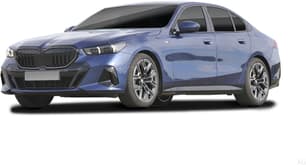
More than half a century of 5 Series pedigree has led BMW to this, the first electric version of its venerable sedan, the i5.
It's true that electric cars come with benefits that suit the realm of luxury (or at least executive) motoring like their effortless acceleration and near-silent operation, so this new G60 5 Series has the potential to be the best yet in its ‘i5’ form.
But there are rivals, well-liked ones at that, which BMW must contend with to snatch the spot at the top of the large premium sedan ladder technically held currently by the Porsche Taycan in terms of sales - though Mercedes’ E-Class would lead if its electric cousin EQE’s sales were combined.
So, with names like that to go up against, BMW better have brought its A-game.
It can be easy to dismiss electric cars as an imperfect solution to the world’s problems. But that would be missing one big point - they’re really, really fast.
Carmakers twigged that not everyone was enamoured with the environmental credentials of electric vehicles (EVs), especially luxury brands, and thus pivoted to the new sales tacit of performance and prestige.
Which is why Audi’s current performance flagship vehicle is not a mid-engined V10-powered replacement for the R8, but rather the all-electric RS e-tron GT. And for the new model year they have not only updated the range, bringing (you guessed it) more power, but also added a new hero model - the RS e-tron GT Performance.
It leads a new three-pronged line-up for the four rings brand, with the RS e-tron GT Performance sitting above the RS e-tron GT and the new S e-tron GT; the latter effectively replacing the previous ‘entry-grade’ model known only as the e-tron GT.
These arrive as part of a mid-life update for the model, with some minor styling tweaks (inside and out) along with enhancements to the battery and changes to the specifications.
The new range has just arrived in Australia and Audi will be hoping it can turn around the sales performance, which saw the outgoing e-tron GT and RS e-tron GT find just 84 customers in 2024. That was a decline of 75 per cent on 2023 sales, and nearly 200 less than the closely related Porsche Taycan.
There’s no getting around the i5 being a rather expensive offering. More than $150,000 to get into an electric sedan that’s not much faster than a hot hatch is a big ask, but there’s plenty to enjoy about the 5 Series.
Things like its heated leather seats shouldn’t be the reason you’re willing to spend so much on a sedan when a $50,000 hybrid SUV will score you the same, instead it’s the fact the 5 Series is a delight to drive and hasn’t lost the feeling of prestige the badge has earned over the last half a century.
In terms of value - if speed isn’t your focus and you’re less of a gadget-type-operator when looking at cars like this - the 520i has the style and comfort you’d need and at $100K less than the M60.
And in terms of large electric sedans, the i5 eDrive40 is cheaper than a Porsche Taycan (by a little) or an Audi e-Tron (by a lot). The Genesis G80 Electrified is the closest cheaper rival, by about $10K, or the less powerful Mercedes EQE is similarly priced at $154,900.
Essentially, if you’re looking at a 5 Series, it might be worth considering if you really need it to be electric, but if so, there aren’t many alternatives in its category for the price.
Note: CarsGuide attended this event as a guest of the manufacturer, with meals provided.
While it may be a very different beast to the R8 supercar, it’s hard to argue that the e-tron GT offers performance that isn’t equal to anything Audi has previously produced. The immense acceleration and power, coupled with the brilliant and clever handling make this updated range, especially the RS pair, feel like something special.The fact that it will save you visiting a petrol bowser and might help cut harmful emissions is just a bonus.
Note: CarsGuide attended this event as a guest of the manufacturer, with travel, accommodation and meals provided.