What's the difference?
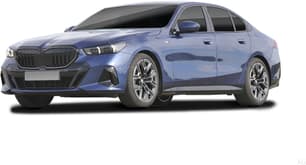
More than half a century of 5 Series pedigree has led BMW to this, the first electric version of its venerable sedan, the i5.
It's true that electric cars come with benefits that suit the realm of luxury (or at least executive) motoring like their effortless acceleration and near-silent operation, so this new G60 5 Series has the potential to be the best yet in its ‘i5’ form.
But there are rivals, well-liked ones at that, which BMW must contend with to snatch the spot at the top of the large premium sedan ladder technically held currently by the Porsche Taycan in terms of sales - though Mercedes’ E-Class would lead if its electric cousin EQE’s sales were combined.
So, with names like that to go up against, BMW better have brought its A-game.
It’s been in Australia since 2019 and despite the arrival of a comprehensively upgraded version in late 2023, the Tesla Model 3’s once gargantuan popularity has been declining in recent years.
A seemingly never-ending influx of pure-electric alternatives, primarily from China, has eroded the mid-size sedan’s positioning as the go-to, best-value EV choice.
But to its credit Tesla has again evolved the Model 3 proposition with the introduction of this Long Range Rear-Wheel Drive grade in October last year, at the time positioning it as “the longest-range EV in Australia”.
Since then, Tesla has adjusted the model grade name to Premium Long Range Rear-Wheel Drive.
Some additional tweaks, made in response to customer feedback, also illustrates the EV pioneer’s determination to step up in the face of increasingly fierce competition.
So, does this latest Model 3 do enough to earn a spot on your electric vehicle shopping list? We spent a week behind the wheel to find out.
There’s no getting around the i5 being a rather expensive offering. More than $150,000 to get into an electric sedan that’s not much faster than a hot hatch is a big ask, but there’s plenty to enjoy about the 5 Series.
Things like its heated leather seats shouldn’t be the reason you’re willing to spend so much on a sedan when a $50,000 hybrid SUV will score you the same, instead it’s the fact the 5 Series is a delight to drive and hasn’t lost the feeling of prestige the badge has earned over the last half a century.
In terms of value - if speed isn’t your focus and you’re less of a gadget-type-operator when looking at cars like this - the 520i has the style and comfort you’d need and at $100K less than the M60.
And in terms of large electric sedans, the i5 eDrive40 is cheaper than a Porsche Taycan (by a little) or an Audi e-Tron (by a lot). The Genesis G80 Electrified is the closest cheaper rival, by about $10K, or the less powerful Mercedes EQE is similarly priced at $154,900.
Essentially, if you’re looking at a 5 Series, it might be worth considering if you really need it to be electric, but if so, there aren’t many alternatives in its category for the price.
Note: CarsGuide attended this event as a guest of the manufacturer, with meals provided.
Tesla has done enough with the introduction of this Premium Long Range RWD variant to keep the Model 3’s head well and truly above water in an increasingly competitive segment. After more than six years it still looks good, with a pleasant cabin environment, plenty of performance and leading energy efficiency. Safety is top-shelf and it stands up well in terms of practicality and driving dynamics.
That said, the ownership proposition is average, the determination to make so many functions screen-based is frustrating and the optional Full Self-Driving system is unconvincing. With the Model S and Model Y now discontinued globally it will be interesting to see how the Model 3 continues to evolve.
If you’ve watched other members of the BMW family go into a new generation within the last few years - the 3, 4 and 7 Series particularly, you won’t be too surprised by what you see here. Especially with the latter, having seen the petrol variants look roughly the same as the electric ones.
BMW specifically made the petrol 520i and the i5 variants look similar for egalitarian purposes - to not disenfranchise 520i buyers who are still spending a fair chunk of cash but might not be ready to go EV.
That means all three variants score a mix of new and old. The kidney grille remains and isn’t as large as on the M3 or 4 Series, while the bonnet line following it and the ‘character line’ down the car’s side also remain. And yes, the Hoffmeister kink where the C-pillar meets the passenger window’s lower corner is still there.
On that C-pillar though is a ‘5’ stamped into the bodywork, new to this generation, while the front grille as mentioned has a glowing light surround - the brand’s ‘Iconic Glow’ already seen on the 7 Series.
Overall, thanks to being slightly larger in every dimension, the new 5 is starting to look bigger than a 7 Series from a little while ago. And that’s because it is - its body is overall longer than an E65 7 Series from the mid-2000s.
It’s 5060mm long 1900mm wide, 1515mm tall (97mm longer, 32mm wider, and 36mm taller). Its wheelbase is 20mm longer too at 2995mm.
After four years in market, a heavily upgraded version of the Model 3 arrived in Australia in 2023, the biggest visual changes being a reshaped bonnet, aero massaged overall profile and angular slimline headlights.
The boot lid now incorporates a lip spoiler and the tail-lights were remodelled to create a truncated, two-layer effect. And in true Tesla fashion, the standard 18-inch alloy rims are fitted with matt black-finish aero elements filling the gaps between the satin black wheel spokes. Two new body colours - ‘Stealth Grey’ and ‘Ultra Red’ - were recently added to the available palette. For reference, our test car's finish is 'Quicksilver'.
It’s still clearly recognisable as a Model 3, but these relatively minor design changes have helped the mid-sizer keep up with the slew of sleek newcomers it now faces.
The interior was also given a substantial makeover, the expansive 15.4-inch central display screen backgrounded by an all-new wrap-around dash and revised console treatment, the former featuring a raised insert and the latter a two-device wireless charging station.
Introduction of this Premium Long Range RWD model also brought the small but significant addition of a physical indicator stalk on the left-hand side of the steering column, replacing buttons on the steering wheel. Big ergonomic tick for that.
Customisable ambient lighting lifts the tone, soft materials look and feel good and the doorcards, bins and armrests have been reprofiled into a more sophisticated arrangement.
Our test car’s dark grey and white synthetic leather trim combination lifts the mood as does light from the huge, two-panel glass roof. But beware, while white trim looks dazzling on the showroom floor it takes some extra work to maintain its schmick appearance in the day-to-day grind.
After seven years in market the Model 3 has aged well and still looks sleek and contemporary.
A longer wheelbase means more space inside, where the 5 Series also still looks fairly familiar to those who have spent any significant time in a recent model BMW.
BMW has historically been pretty bang-on with ergonomics, and the new-gen 5 does a good job of sticking to that. Comfortable sports seats and quality feel for the materials on touch points mean the 5 Series feels nice to be in, and relatively restrained interior design for a somewhat luxurious car means it looks nice too.
It’s let down only by a couple of things - its multimedia screen and Operating System 8.5 is a little less simple to use now, and requires more touching the screen than previous iDrive systems, rendering the scroll wheel less useful.
The BMW Interaction Bar too is a little tricky to see controls on, as well as lacking physical feedback for using controls. Vent flow controls are digital sliders on the Bar, while vent direction is controlled by an unusual ‘joystick’ style control nearby.
The rear seat is plenty spacious, as you’d expect from a large sedan, with climate controls and ports for charging devices in the rear.
At just over 4.7m long, more than 1.8m wide and a bit over 1.4m tall (with a 2875mm wheelbase) the Tesla Model 3 is a low-slung medium-size sedan.
There’s plenty of space up front, a feeling enhanced by the standard panoramic glass roof and our test car’s white trim brightening up the cabin.
There are long, wide bins on the front doors with enough room for large bottles, a slim glove box (which opens only via an on-screen button, which is annoying) and a generous lidded storage box between the seats that doubles as a centre armrest.
The console houses two cupholders with another storage cubby ahead of them (both with sliding covers over the top) and the dual device wireless charging bay on the lower part of the dash under the media screen.
Switching to the rear, at 183cm I have a surprising amount of foot, leg and headroom when sitting behind the driver’s seat set to my position. The rear door aperture is surprisingly large which helps entry and egress.
Technically able to accommodate three passengers, the back seat is best for two full-size adults on anything other than a mid-length journey, although the flat rear floor helps ease pressure on the centre occupant.
There's a well-hidden fold-down centre armrest with cupholders, there are useful bins in the doors and hard shell map pockets on the front seatbacks.
The crisp 8.0-inch rear screen is a welcome entertainment option for back-seaters and there are adjustable air vents underneath it.
For power and connectivity there are two USB-C ports and a 12-volt socket in the front compartment, a USB-A in the glove box (mainly for dash cam and ‘Sentry Mode’ data storage) and two USB-C ports in the rear under the vents.
Boot space is a ample at 682 litres (the bootlid is adjustable for opening height) with an 88L ‘frunk’ in the nose. And if you need to tow a relatively light load like a box trailer or Jet Ski (or two) you can hook up a 1.0-tonne braked trailer (750kg unbraked).
While we understand it helps maximise battery space and reduce weight, we’re not on board with Tesla’s policy of providing a repair/inflator kit rather than a physical spare tyre. Even though this is likely to be a primarily urban cruiser, it’s not good enough.
Then, there’s the Tesla app, an electronic Swiss Army Knife that facilitates everything from remote vehicle access and cabin ‘preconditioning’ to planning your route (complete with charging stops) and monitoring Sentry Mode (checking the vehicle’s surroundings and receiving alerts of potential threats).
The list of functions goes on and on, but suffice it to say the app is hugely handy. For example, ‘Dog Mode’ keeps the air con on with the car locked for the benefit of your four-legged friend and lets passers by know the doggo is safe via a bold message on the central screen. An internal camera, accessible via the app, lets you check-in remotely, too. Nice.
Given its overall size and despite its conventional sedan configuration, the Tesla Model 3 offers efficient packaging and a heap of thoughtful features to enhance everyday practicality.
There are three members of the new 5 Series family from launch, with a base 520i starting things off from $114,900 before on-road costs.
It’s the only petrol-powered (with mild-hybrid, we’ll come back to this) variant in the trio, but it does have a fairly extensive list of features as standard. In terms of tech and comfort, most of what comes with the 520i is available further up the range too, with the major differences being drivetrain related.
In the 520i, the interior upholstery is synthetic ‘Veganza’ leather with Alcantara, though optional Merino leather is a $4000 BMW Individual option. The front seats are heated as standard, however, and electrically adjustable with memory settings and lumbar support.
A 12.3-inch instrument display paired with a 14.9-inch multimedia display are standard across the range, running BMW’s Operating System 8.5, while a head-up display, ambient lighting, wireless phone charging tray and BMW’s ‘new’ Interaction Bar are included too - a crystalline-style strip across the dash with touch-sensitive ‘buttons’ like the climate controls.
A panoramic glass roof - unable to be opened - is standard too, while the 520i’s sound system is a Harman Kardon set-up with 12 speakers.
Exterior features are quite similar to the more expensive i5 variants, with Adaptive LED headlights, automatic boot opening, an M design kit with front and rear aprons, side sills, and BMW’s Iconic Glow kidney grille surround.
Optional in the 520i is an ‘Enhancement Package’ which adds a choice of aerodynamic 21- or 20-inch wheels, metallic paint, and a 655-watt 17-speaker Bowers & Wilkins surround sound system for $5400. One test car on the launch we attended was painted in a BMW Individual colour - Tanzanite Blue - which upped the price to $7800.
Moving up the range to the mid-tier i5 eDrive40, which starts from $155,900, adds Merino leather interior, metallic paint, Bowers & Wilkins surround sound and aerodynamic 20-inch wheels standard, but it also includes adaptive suspension and some other EV-related features.
BMW’s ‘Adaptive Suspension Professional’ comes with Integral Active Steering (rear-wheel steering) and is a step up over the M Sport suspension from the 520i, while its aero wheels function as a way to keep the electric car’s range being affected by resistance.
The eDrive40 also comes with an acoustic protection system to make ‘electric car noises’ to warn pedestrians, as well as BMW’s ‘Iconic Sounds’ for the occupants - basically a system that uses orchestral sounds composed by Hans Zimmer that are affected by acceleration intensity, speed, and drive mode.
It also comes with the standard kit for an electric car, a Mode 2 and Mode 3 charger, cable, and a five-year Chargefox subscription.
The top-spec i5 M60 xDrive ups the cost to $215,900 and the features list again slightly (as well as being far more powerful).
Its suspension is even more advanced, adding the brand’s Adaptive M Suspension Professional with active anti-roll, plus 21-inch aero wheels as a no-cost option. The M60 also gains an M rear boot lip spoiler.
Inside, BMW’s ‘Crafted Clarity Glass’ controls in the centre console are standard, as is ventilation for the front seats and a four-zone automatic air conditioning system.
At $61,900, before on-road costs in NSW ($67,329, drive-away), the Tesla Model 3 Premium Long Range RWD sits in the same price ballpark as other pure-electric mid-size sedans like the BYD Seal Premium RWD ($58,798, BOC), Hyundai Ioniq 6 2WD ($67,300, BOC), MG IM5 Platinum RWD ($69,990, drive-away) and Polestar 2 Standard range Single motor ($62,400, BOC).
Broaden the consideration set to include medium EV SUVs and a dozen other options including the BYD Sealion 7, Kia EV5, Skoda Enyaq and Zeekr 7X enter the picture, many with a price-tag around $10K lower than the Model 3’s.
But price is one thing, value is another. Aside from the performance and safety tech we’ll get to shortly, let’s look at the Model 3 Premium Long Range RWD’s included features.
Standard spec highlights include LED exterior lighting, new design 18-inch alloy wheels, a 15.4-inch central display screen, synthetic leather seat trim, power-adjustable ventilated and heated front seats, tri-zone climate control, adaptive cruise control and nine-speaker audio.
There’s also ambient interior lighting, navigation (with real-time traffic updates), an 8.0-inch rear touchscreen for back seat climate and entertainment, a power boot lid, dual wireless phone chargers, surround parking sensors, keyless entry and start (plus a lot more through the Tesla app, which we’ll cover in the Practicality section) and 360-degree acoustic glass (including the standard glass roof). Still no Android Auto or Apple CarPlay, though.
Add in less obvious improvements like the extension of soft-touch materials throughout the cabin and this Model 3 stacks up well in terms of value relative to its cost-of-entry and direct competitors.
Despite BMW calling it ‘electrified’, the base 520i is only a mild hybrid so most wouldn’t realise unless they were told.
Its turbocharged 2.0-litre four cylinder puts out a modest 153kW and 330Nm, with power and torque sent to the rear wheels via an eight-speed automatic transmission.
BMW claims it’ll knock over the 0-100km/h sprint in 7.5 seconds, a few seconds too slow to blow anyone’s socks off.
The mid-spec eDrive40 has a little more kick to it, its rear-mounted electric motor capable of 250kW/430Nm and able to cut that time to 6.0 seconds.
It’s fitted with an 84kWh battery to draw its power from, the same as the 442kW/820Nm M60 with its all-wheel drive dual-motor setup.
The M-tuned i5 can hit 100km/h in a claimed 3.8 seconds. Bye bye socks, perhaps.
The Tesla Model 3 Premium Long Range RWD is powered by a single permanent magnet synchronous electric motor producing a handy 235kW and in excess of 400Nm.
It sends drive to the rear wheels only via a single-speed, direct-drive automatic transmission.
Kerb weight is 1747kg and Tesla claims 0-100km/h acceleration in a rapid 5.2 seconds.
BMW claims the petrol 520i sips 6.7 litres per 100km from its 60-litre fuel tank, though we were unable to independently test any of the claimed figures on the launch day.
The base car has a theoretical range of 896km if it was possible to achieve the claimed fuel consumption figure for the duration of the whole tank - but it isn’t and realistically you could knock about 20-30 per cent off that, depending on how enthusiastically you drive.
In the i5 variants, the same 84kWh battery provides slightly different ranges due to the eDrive40 using 16.56kWh per 100km, and the M60 using 18kWh.
The eDrive40 has a claimed 550km maximum range, while the M60 has a 506km figure thanks to its extra motor and weight.
Tesla claims a WLTP range of up to 750km for the Model 3 Premium Long Range RWD, the official EV term for which is… a lot.
As mentioned earlier, at the time of the car’s local launch in October last year Tesla claimed it as the longest-range EV in Australia and at the time of writing nothing had arrived to change that.
Unlike the standard Model 3, which is powered by a CATL-sourced LFP battery, the Long Range RWD is fitted with a lighter, more energy dense NMC pack from LG with a total capacity of 82kWh (78kWh usable).
In terms of energy consumption, Tesla claims 12.5kWh/100km on the combined (urban/extra-urban) cycle and on test we experimented with liberal use of the accelerator pedal, higher than average freeway running and keeping the car constantly chilled during extremely hot weather, which resulted in an average of 15.7kWh/100km.
Aside from that, more typical stop-start urban driving with occasional use of the ‘Chill’ (eco-focused) mode brings the number down to 13.1kWh/100km.
That’s an impressive performance, with even the upper test figure more than acceptable for a 1.75-tonne electric sedan.
Capable of accepting a 250kW fast charge, Tesla says the Model 3 Long Range RWD can take on 311km of range in 15 minutes, at that speed.
On a 150kW pylon we saw capacity go from 15-85 per cent (theoretically, 600km of range) in roughly 50min, although the charger fluctuated below peak output throughout.
For some cars, the list of features is what really separates the variants, but that’s not the case for the 5 Series. As is a bit of a BMW tradition, the drivetrains dictate the different trim levels and prices, and there are three fairly distinct flavours of 5 Series.
Starting at ground level, the 520i might at first seem like a bit of boring vanilla. Except it’s actually quite smooth and light vanilla.
There’s not a lot to write about when it comes to its drivetrain, but the lightness of its engine and petrol tank combo when compared to EV batteries and motors is refreshing, and makes for a quite dynamic rear-drive sedan.
Its 153kW and 330Nm is delivered smoothly enough with the mild hybrid assistance doing a little in helping responsiveness, but without intervening in the gearshifts it doesn’t feel particularly keen.
It lacks the ride comfort of the i5’s adaptive suspension, but it’s able to be driven in a spirited manner that belies its size and even, to some extent its 1725kg kerb weight. Chocolate sprinkles on the vanilla, if you like.
It’s not fast, but it feels nimble compared to its electric siblings and can carry a fair bit more speed through corners, after which there’s room to notice its rear-drive characteristics.
It’s especially noticeable after getting out of the 2130kg eDrive40, though the extra power from its 250kW/430Nm motor makes for some more spirited acceleration and a little more excitement when exiting a corner, especially if you’re aiming to double-check if it really is rear-wheel drive. There’s a little more than choc-topped vanilla going on here.
The steering is, like in the 520i, direct and responsive, though in most cases is probably best set to ‘comfort’ rather than ‘sport’ in its settings.
The eDrive40 is rather comfortable and capable when barrelling through twisty backroads, and doesn’t feel out of hand for a five-metre-long sedan. It holds its weight well, and telegraphs when you might be approaching the limit quite sensibly.
When considering that, then, it’s impressive how brutally capable the 2305kg M60 is.
Here, we’re looking at a double-choc fudge with extra choc, and maybe some cookie dough in there for good measure. There’s a lot to like, but boy is it heavy.
It’s 580kg (or exactly half a Peugeot 208 GTi) heavier than the 520i, but it feels quick on its feet and its anti-roll seems to do a lot in terms of dynamics, the limiting factor really seems to be its tyres (which can and will squeal quite quickly to let you know when approaching said limit).
While you’ll need to take caution with how much speed you approach a corner with, you’re not going to lack acceleration on the other side, its all-wheel drive being less ‘fun’ but more efficient at getting you away from the bend than in the rear-drive eDrive40.
That adaptive suspension does also translate to a comfortable ride on relatively rough roads - only particularly bad bumps will reveal how much weight and pressure is being placed on each corner of the big sedan.
So, surprise, surprise, the Tesla Model 3 Premium Long Range RWD is quiet. But it’s quiet, even in the context of other EVs in this part of the market.
That’s thanks in part to acoustic glass in the front, rear and side windows as well as the dual-pane glass roof and the Bridgestone Turanza T005 EV tyres (235/45x18) featuring ‘B-Silent’ technology. Corny, but it works.
A kerb weight under 1.8 tonnes is relatively lightweight for an EV of this size and the Model 3 RWD is quick with 0-100km/h acceleration in a fraction over five seconds. There’s always plenty of pulling power under your right foot.
Suspension is double wishbone front, multi-link rear and ride comfort is respectable rather than exceptional. Smaller bumps and irregularities find their way into the cabin but never to an alarming degree.
Steering sits in the middle-of-the-road between tactile and wooden, which is par for the EV course, although it's accurate and pleasingly progressive. Body roll, even in enthusiastic cornering, is modest.
The physical brakes are ventilated discs front and rear although they don’t come into play all that often because the Model 3’s regenerative braking system is so good. Single-pedal operation soon becomes the norm.
Our test car’s optional ‘Full Self-Driving (Supervised)’ will set you back $10,100 as a one-off payment, or $149 per month and Tesla says when using it, “Under your supervision, your car will be able to drive itself almost anywhere with minimal driver intervention”.
We engaged it for a 30km trip through suburbia, across the Sydney Harbour Bridge and into the city’s inner south.
A rainbow-coloured magic carpet in front of the car graphic on the nav map tells you the system is engaged and although things went smoothly at first we soon sliced a bit off the inner oncoming lane as we turned right at a T-intersection, which was alarming.
The system also has a consistent tendency to stick to the far right-hand side of the lane, stay five to 10km/h under the signposted speed limit and it continued to operate without my hands on the wheel, although I kept them there for 99.9 per cent of the drive (which is tiring when you’re not doing the steering).
Having been squeezed to the point where we couldn’t merge safely into a particular arterial road the nav took us on what’s known in the trade as a wild goose chase that had to be nipped in the bud. If I hadn’t known my way around it could have been a huge waste of time and (vehicle) energy. As much a nav issue as an FSD one, but overall, let’s just say, I’m not convinced.
Under the heading of miscellaneous observations, I’m not a fan of the on-screen gear position slider in place of a physical control. It’s needlessly fussy, although its ability to automatically switch between D to R (and back) during slow-speed manoeuvres is helpful.
The software behind the car’s multitude of functions is exceptionally good, as is the ability to swipe in the vicinity of the temp and audio volume screen sliders, rather than having to hit them bang on and the blind-spot camera view which pops up on the screen when indicating on either side is handy.
ANCAP hasn’t crash tested the new 5 Series. The last generation was a five-star car and it would be unusual to see that change with additional safety features - even with stricter testing.
The 5 Series comes with BMW Driving Assistant Professional as standard, with active cruise, lane assist and departure warning, front and rear cross traffic alert, collision prevention and intervention systems - in fact BMW says it has about 40 safety systems including an augmented reality dash display.
Its list of airbags includes front and side airbags for driver and passenger including one between the two occupants, as well as curtain airbags front and rear.
The Model 3 has a maximum five-star ANCAP rating from assessment in 2025, with outstanding scores across the independent body’s four key pillars: Adult Occupant Protection - 90 per cent, Child Occupant Protection - 95 per cent, Vulnerable Road User Protection - 89 per cent and Safety Assist - 88 per cent. Wow.
Active (crash avoidance) safety ticks a heap of boxes including AEB (operational from one to 150km/h with forward collision warning covering cars, cyclists, pedestrians and motorcycles) as well as rear AEB, lane keeping assist (car-to-car and car-to-motorcycle), lane departure warning, blind-spot monitoring, a 360-degree camera view, driver fatigue detection and more. None of them are overly intrusive in operation.
The airbag count runs to seven - front head and front side as well as full-length curtains, and a front centre bag to minimise head clash injuries between driver and co-pilot in a side collision. There’s also multi-collision brake (to reduce the chances of subsequent impacts after an initial crash).
For baby capsules or child seats there are three top-tether points across the second row with ISOFIX anchors on the two outer positions.
A super-impressive safety package that matches or betters anything in the category.
Worth noting our test car features Tesla’s ‘Full Self-Driving (Supervised)’ functionality which we’re positioning as a convenience feature rather than an outright safety factor. So, its performance is covered in the Driving section.
BMW has a fairly industry-standard five-year/unlimited kilometre warranty on its new cars, while its electric car batteries are covered by an eight year/160,000km warranty.
For servicing, BMW offers numerous discounted packs and deals based on your preferences and desire to pay upfront.
For the 5 Series, a five-year/80,000km basic service package is $2400, though the i5 will have different needs and lower servicing costs not yet listed by the brand.
From January 1, 2026 all new Teslas sold in Australia have been covered by a five-year, unlimited kilometre warranty (including roadside assistance for the duration), up from four years/80,000km, previously.
A big step forward, no doubt, but that just gets Tesla to a base, mainstream market level with a dozen brands now at seven years, several at eight and three at 10 years (conditional).
The drive battery is covered for eight years/192,000km, which is in line with the category norm. And a Body Rust Limited Warranty covers rust perforation for 12 years, unlimited kilometres, which is reassuring.
Tesla servicing is condition-based, so there’s no fixed schedule, with a summary on the car’s touchscreen providing a record of when vehicle maintenance was last carried out and prompts for when they should be performed next.
In the absence of a combustion powertrain the emphasis is on things like wheel rotation, balancing and alignment, brake fluid testing, air-con servicing, camera precision, radiator cleaning and high-voltage battery maintenance.
Theoretically, if a workshop visit is flagged in the car’s system, it could include actions like a ‘Vehicle Health Check’ ($270), ‘General Diagnosis’ (270 per hour), brake fluid flush ($240.80) and replacement of both cabin air filters ($106.60).
Things like air-con desiccant bag replacement ($89.18), tyre rotation ($81.00), a wheels check - if tyre wear is abnormal ($81) and a wheel alignment ($225) are also set inspection and service items. All prices exclusive of GST.
In the States, the brand provides a range of estimated annual service pricing of between US$257 - US$499 ($367-$712), based on data collected by car buying specialist CarEdge. The suggested service range is around 20,000km and the first five annual estimates are at US$300 ($430) or less.
Tesla has 25 stores in Australia, not surprisingly covering mainly urban and larger regional centres, including four each in Melbourne and Sydney, three in Canberra, two each in Adelaide, Brisbane and Perth as well as one in Hobart.