What's the difference?
The Audi Q7 has come in for its second facelift as it enters its ninth year of production while the younger Q8 is in for its first refresh.
But these two aren't like the Mitsubishi ASX and Eclipse Cross pair; Audi's MLB underpinnings were cutting edge at their launch 2015 and remain stand-out in the class with advanced suspension and chassis tech, connectivity and refinement.
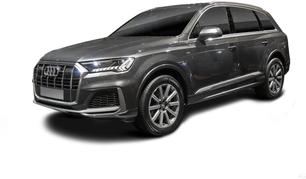
A host of small visual and performance tweaks aim to make the range-topping SQ7 we're driving even better. But should you make the sensible seven-seat decision or go a little rogue and choose the sloping-roofed SQ8?
There's a hell of a lot riding on the shoulders of the Hyundai Elexio, which is shaping as the brand's best shot to date at taking on Made In China models like the BYD Sealion 7 and Tesla Model Y.
While the Ioniq family sits atop the EV tree at Hyundai, the Elexio is a very different proposition. It's priced more sharply (the brand is quick to point out that it's only about $8 a week more expensive than a Sealion 7 on a novated lease), and it's the first Hyundai vehicle offered in Australia that's produced in the brand's Chinese factory through its Beijing Hyundai joint venture.
In short, it feels a lot like Hyundai is ready to take on BYD at their own game in Australia.
So, is the Elexio the pick of the Made In China bunch?
There are newer options than the current Audi SQ7 and SQ8, including those which use the same platform, but don't write these luxury large SUVs off just yet.
It's a rare thing that a vehicle costing $200,000 has an air of pragmatism about it, but the SQ7 does. Its sensible leather upholstery, decent practicality, towing capability and near-excess of interior space make it a great family wagon.
As a counterpoint, the sharper looking SQ8 has minimal trade-off in comfort and interior room (at least for five) and is the kind of statement piece you'd expect for the price — especially in one of its loud paint colours.
Whichever way you leap, it's true that while the SQ7 and SQ8 are ageing, they are doing so gracefully and remain a superb option in this segment.
Note: CarsGuide attended this event as a guest of the manufacturer, with accommodation and meals provided.
The Elexio doesn't really push any boundaries in terms of its exterior design, its powertrain, or its battery. It doesn't drive itself. It doesn't look like a spaceship. And apart from some interior quirks, it's all pretty familiar in the way it goes about its business.
And I think maybe that's the point. Maybe that's what people are really looking for. Because Hyundai says this will be its best-selling EV in the country. And on our short test, we can't find too many reasons to disagree.
Note: CarsGuide attended this event as a guest of the manufacturer, with accommodation and meals provided.
Note: The author, Andrew Chesterton, is a co-owner of Smart As Media, a content agency and media distribution service with a number of automotive brands among its clients. When producing content for CarsGuide, he does so in accordance with the CarsGuide Editorial Guidelines and Code of Ethics, and the views and opinions expressed in this article are solely those of the author.
If you're getting an SQ7, you'll want to tick the 'Black Pack' box because otherwise there are a lot of high-gloss silver details, especially at the rear that don't suit this tall and slightly awkward SUV.
The SQ8 is more convincing, appearing wider on the road with its new 'singleframe' grille design seemingly sucking it even closer to the tarmac like some kind of overgrown Audi RS3.
Both get an attractive new 2D design for the Audi rings and L-shaped grille details. These aid the SQ7's front end which is more muscular and purposeful than before.
The attractive lights have moved higher up the front end for enhanced presence, too. You get Matrix LEDs as standard but these candles are the hardcore HD Matrix items that feature laser light for further even longer light throw at night. They are simply awesome.
Fresh 22-inch alloy wheels and minor changes to badges finish off the exterior treatment for both cars.
The SQ8's bold specification — finished here in 'Sakhir Gold' — sets it apart from other SUVs as the metallic gold paint shimmers in the sunlight. The SQ8 is also available with whopping great 23-inch alloy wheels that you see here.
Inside, both cars share a similar architecture with 10.1-inch touchscreen for the multimedia and an 8.6-inch item below for heating and ventilation settings.
The SQ7 is a great example of a design ageing without dating, its confident horizontal lines and well-proportioned cabin features are as attractive as they were at launch, if less impressive than the related VW Touareg's whopping 15-inch screen or the minimalist Range Rover Sport.
Adding to the feeling of quality is that signature Audi smell — a combination of leather and the Sensory Package's perfume, no doubt. The SQ7 keeps a round-bottom steering wheel which remains one of the best in the business, it's just the right size and diameter trimmed with dimpled leather.
Final flourishes include the optional contrast red stitching and seatbelts as well as eye-catching turned aluminium trims.
I don't want to sound boring, but the thing I really like about the Elexio exterior package is there's nothing too challenging about it. Some of the Hyundai Ioniq cars can be a bit more polarising (and, in the case of the Ioniq 6, a lot more polarising) but there's none of that going on here.
It feels very clean, fairly timeless and like it's going to age pretty well. In short, it looks like a familiar family SUV with only really the full-width light bar, the cubed headlights and a bit of an architectural flourish at the rear three-quarter – which actually reminds me a bit of the Kia EV5 – giving it a more modern edge.
The wheels are 20 inches, there are only a handful of fairly predictable colours and it all just feels really familiar. But, as I mentioned, things do get a bit more out-there in the cabin.
Let's start with the good. I really like the fit and finish. It all feels very high quality and the materials used are lovely, including the velvet-like fabric in the door panels. I also like the square-edged steering wheel.
But the not so good? Now, the central screen looks great, but it controls everything – and I do mean everything. Apart from the steering-wheel controls, I couldn't locate a single physical button in the cabin.
The difference between aged and dated is best summed up, though, by the excellent usability of the SQ7's cabin controls.
The separate screen for ventilation, for example, makes it simple to adjust seat or vent temperatures without interrupting the main screen's navigation instruction or other media systems.
When using wireless Apple CarPlay and Android Auto the top screen is entirely devoted to the other software with no remnants of Audi's system. It runs smoothly at all times.
Switching back to Audi's system, and there's a lack of contrast to the dark main screen and navigation. The touch targets are huge, though, and the satisfying click of the haptic feedback is welcome when driving. It seems expensive and natural in a world of feel-free touch operation.
Audi's 12.3-inch digital driver's display remains one of the best in the business. Legible and customisable with bespoke sport modes and the ability to show a full-size map, if you wish.
You can keeping devices charged with a wireless pad or there are two USB-C ports under the cushy centre armrest. A 12-volt socket is also available, and two more charge points are found in the back.
If there's one criticism in the front, it's the fairly limited storage. The door bins are big enough for a 600mL bottle but not much more and beneath the armrest the tray is shallow. The only other storage spots are the two cupholders which are the perfect size for a small take-away coffee.
While on the critiques, the drive mode selector is awkwardly hidden near the passenger below the touchscreen.
The seats are amazingly comfortable with ample support and power adjust for everything, including under-thigh length and bolsters. Several massage programs can be accessed through the menus, too.
Continuing the comfortable seating, the SQ7's second row is capacious with plenty of head, leg and toe room even for those over 180cm.
The bench slides forwards and backwards manually and the backrest is adjustable. A fold-down armrest contains two more small cupholders, and there are two separate climate zones, two vents and heated outboard seats.
However, folding and unfolding the second row is a bit complex and quite heavy work with a strange mix between electric and manual movement to access the third row — a Nissan Pathfinder does this better.
Once back there, the third row is passable for adults providing the second row is slid forward.
There are ISOFIX ports and top tether anchors for both power-deployed third row seats, so you can fit up to five children's seats in an SQ7.
The SQ8's second row is still generous but you do lose a small amount of headroom owing to the sloping roof design.
You also sacrifice some boot space, at 608L with five seats and 1755L with the second row folded. That's still a lot but the spacious SQ7's 793L/1921L figures are even better and 295L with all seven seats up is respectable. Both have sturdy 40/20/40 split-fold rear seats.
As the vehicles are equipped with air suspension, owners can raise or lower the boot floor to make it easier to load bulky objects if needed. A power tailgate is standard on both models.
A retractable luggage cover, netted pocket, boot lights and some underfloor storage complete the boot, however both cars lack a spare tyre of any sort. A tyre inflation kit is included.
At just over 4.6m long, just under 1.9m wide, and just under 1.7m tall, the Elexio fits snuggly between the smaller Kona Electric and Bigger Ioniq 5 among Hyundai's electric family. In family vehicle terms, it's marginally shorter than the brand's petrol and hybrid-powered Tucson.
But owing to the magic of EVs and their flat floors, the Elexio feels massively spacious in the backseat. I'm 175cm, and had no trouble getting comfortable behind my own driving position, with plenty of leg and headroom.
Tech is pretty strong, too. There are twin wireless charging pads up front, a total five USB-C ports, and a household style plug (which car companies call Vehicle to Load) located in the boot.
There's storage in the doors and centre console, including a storage drawer, and cupholders up front and in the pulldown divider that deploys over the middle seat in the back.
But the weirdest thing is the driver screen, which is the only straight-ahead access the driver has to things like speed or navigation directions. It's a very cool 3D-effect display, but it utterly disappears if you're wearing polarised sunglasses.
That's actually pretty common with all head-up displays, but they usually are projected above a traditional driver's binnacle. In the Elexio, it's the disappearing screen or nothing.
To be fair, the central screen also displays speed and crucial information, but I hate having to turn my head to look at it. It's my least-favourite thing about Teslas, and if you're wearing polarised sunglasses, the Elexio ends up feeling a lot like that.
I do love that there is an actual control to select Drive, Reverse or Park, and I adore the addition of a physical stop/start button, too.
There's also an auto-opening boot which reveals a 506-litre space with the rear seats in place, and 1540 litres with the 60/40 split rear seats folded flat. Keep in mind there's no spare tyre taking up space, though. You'll be leaning on the repair kit should you get a flat.
Audi's range of Q7 and Q8 large SUVs starts at $117,284 for the 45TDI and there's a plug-in hybrid version from $152,284, both before on-road costs. The flagship SQ7 and SQ8 are $174,815 and $178,815, respectively.
The pair is a rare example of a discounted new car, albeit by a slim $585, so you'd expect these behemoths to offer comprehensive standard specification.
Features such as 22-inch alloy wheels, ambient interior lighting, soft close doors, power-adjust heated and ventilated seats, quad-zone climate control, 'Valcona' leather upholstery, a 17-speaker Bang & Olufsen sound system, full-length sunroof, navigation and a head-up display are included.
Naturally, options are available in packs and standalone choices with all vehicles we drove featuring at least one of the expensive box-ticks.
The 'Sensory Pack' seems a logical choice, bundling a 23-speaker, 1920-watt sound system with raising tweeters, 'Dinamica' headlining, massage seats, heated rear seats, Audi's air ioniser and interior perfume, extended leather upholstery and rear sun shades for $14,400.
Another major option is the $10,900 'Dynamic Package' with active roll stabilisation and Quattro Sport rear differential.
Stand-out stand-alone options include HD Matrix LED and Laser headlights combined with customisable OLED rear signatures ($3950) and the black exterior styling packages ($1850, or $2550 for the Plus version).
The as-tested price for the tow pack-equipped ($1500) 'Daytona Grey' car we spent most time in was rather high at $209,215 before on-road costs — that's over $30K worth of extras.
The Elexio arrives with just the one grade for now, the Elite, and the pricing is a bit weird. It lists at $61,990, but is actually being offered for significantly less than that at launch, with a special $59,990 drive-away deal in place until around the end of March.
There is a cheaper Elexio grade coming sometime in quarter two this year, and it will be $58,990. But I reckon you can expect a sharp drive-away deal there, too, at least at launch.
How does that stack up? I think we have to go on permanent pricing, rather than any special offers, and that puts the Elexio above its main rivals in the BYD Sealion 7 ($54,990 for the Premium), the Tesla Model Y ($58,900 for the Premium Rear-Wheel Drive) and the Xpeng G6 ($54,800 for the Standard Range). Though the cheaper Elexio variant will help to narrow that gap.
There are significantly cheaper electric SUVs that fall into the mid-size category, too. Like the Geely EX5 and Leapmotor C10, both of which are less than $50k on the road.
Anyway, for now the Elite arrives with 20-inch alloys, cube-style LED projector lights, an auto-opening boot and Hyundai’s Digital Key, which allows you and up to 14 other people to use their phone as the key.
Inside, there’s leather seating that’s powered for driver and passenger and heated and ventilated up front. There’s also dual-zone climate, twin wireless charging pads and a household-style power point to power your devices.
Where it gets really interesting, though, is with its cabin tech, which is seriously bleeding edge. The entire dash, from in front of the passenger to pretty much the edge of the steering wheel, is dominated by a 27-inch screen that actually gives the passenger more real estate than the driver.
It's impressive stuff, with high-res games for the passenger to play (including the super-sharp Space Invaders), but there's also wireless Apple CarPlay and Android Auto, twin wireless charging pads, and a relatively small head-up display (only located within the binnacle) for the driver.
The SQ7 and SQ8 both use a 4.0-litre twin-turbo 'hot vee' V8 petrol after the diesel SQ7 was abandoned in mid-2022.
It is the same engine you'll find in just about every application of this MLB platform, including the Porsche Cayenne, Bentley Bentayga and Lamborghini Urus — though it makes more power elsewhere.
In Audi's two medium-sporty SUVs it produces 373kW at 5500rpm and 770Nm between 2000-4000rpm.
In practice, it's a swelling, punchy engine without much top-end sparkle — though 4.1 seconds to 100km/h is nothing to scoff at.
The V8 also produces a rather splendid soundtrack, striking the right balance between Detroit burble and motorsport bark for this application.
An eight-speed torque converter auto transmission has been retuned for improved shift logic and it remains buttery smooth. It's pleasing enough just manoeuvring slowly around a car park, where you can feel just well calibrated the long travel throttle and transmission logic are.
There’s just the one powertrain on offer here — with a front-mounted electric motor, so front-wheel drive, that produces 160kW and 310Nm. That makes the Elexio feel spritely enough, but it’s no rocket ship.
With 2340kg to heave around, not even the 48-volt mild hybrid system can save the SQ7's fuel consumption — it's a thirsty beast.
The rated ADR combined cycle (urban, extra-urban) figure is 11.8L/100km and indulging in the ample performance resulted in 16.5L/100km on the trip computer. The SQ8 was much the same.
The SQ7 is certified to tow up to 3500kg (braked), equal to a Toyota LandCruiser or Nissan Patrol.
A fairly large 85L tank gives the SQ7 a theoretical driving range of around 720km from a fill-up. Naturally, 98 octane unleaded is required.
Delivering the driving power is an 88.1kWh LFP battery, which Hyundai says equates to a WLTP driving range of 546kms.
The Elexio’s E-GMP platform is a 400-volt architecture, which does limit DC fast charging to around 120kW – the Ioniq 5, for example, will charge in excess of 230kW.
Hyundai says you’ll go from 10 to 80 per cent in around 38 minutes plugged into our fastest chargers. AC home charging is capped at 10kW.
Our drive loop started in South-East Sydney where the SQ7's burbly V8 and air suspension fitted right in, easily soaking up the worst of the concrete expansion joints and sharp-edged potholes.
It is a joy to waft around in the refined SQ7 with its remarkably good vision out the front and back (with 360-degree cameras to help elsewhere). Standard rear-wheel steer allows the back tyres to rotate up to 5.0 degrees, giving the 5072mm long SQ7 a better turning circle (12.5m) than a Q3 small SUV.
Its driven home further by the excellent drive mode customisation. Along with the standard programs, you can set an 'Individual' mode up with various selections for the suspension, steering, powertrain response and exhaust noise.
Following the SQ7, our time in the SQ8 took in some more twisting roads and the combination of 23-inch alloys with firmer suspension settings meant that, even in 'Comfort', 'Auto' or 'Balanced' drive modes, the coupe-styled model had a busier ride.
Both SQ7 and SQ8 featured 'Sport' adaptive air suspension, sitting 15mm lower than normal with the ability to drop the ride height up to 40mm in 'Dynamic' mode or raise it 50mm in lift mode to get out of sticky situations.
Audi chose not to specify the Dynamic pack on the SQ8, though, and the difference is noticeable compared to the SQ7. The coupe SUV rolls a little more in hard cornering and doesn't engage the rear end in quite the same way.
Back in the SQ7, turn in may feel a little less sharp owing to the taller height but the active roll stabilisation and Quattro electronically-controlled limited-slip differential splitting power between the two rear wheels makes for a more confident vehicle with better punch out of corners.
Grip is prodigious and the SQ7 is always in control with 285/35R22 Bridgestone Turanza T005 tyres.
A 2.4-turn lock-to-lock steering system is well-judged, remaining light in Comfort but adding enough weight and precision in Dynamic.
The brakes — 400mm front rotors clamped by six-piston calipers with optional ceramics — are reassuring and feel Autobahn ready.
The Audi SQ7 with Dynamic Pack is like an Olympic swimmer that's put on some kilos and had a few kids but can still gap his teenage son in a 50-metre freestyle race.
This is perhaps the perfect expression of Audi's 'S' models USPs, being totally normal when pottering despite huge reserves of talent.
Ok, let's skip to the good part quickly. I really like the way the Elexio drives. Honestly, Hyundai (and, to be fair, Kia, Porsche, Polestar, Tesla, some German brands and Leapmotor with the new B10, amongst others I'm surely forgetting) are restoring my faith in how an EV can feel from behind the wheel.
It turns out they don't have to feel soft and saggy and come with a light sense of seasickness as standard. They can be engaging, connect you to the car and to the road below, and attack corners with some athleticism, too.
And so it is with the Elexio, which – to be fair – has a spec sheet that reads a bit like a bedtime story, such is the lack of excitement in the numbers. A two-tonne-plus, front-wheel-drive family SUV that produces less power than a Toyota Camry doesn't exactly quicken the pulse.
And it's true that the flat-footed acceleration on offer won't knock your cap off (though it feels perfectly perky enough to get you up and moving). But the numbers don't tell the whole story here.
A sports car this ain't, but its driving nature perfectly suits the ethos of the car. The ride can feel a little harsh at times, but irons out most road imperfections to the point that you notice them, but they're not uncomfortable.
The steering is direct without being overly aggressive –though I prefer the sportiest setting with the heavier feel – and the body roll is minimal, too.
In fact, you can push the Elexio harder than you might think along twister roads, with plenty of confidence-inspiring stability and without too much complaint from the tyres. Because there's not a huge amount of power underfoot, and this is going to sound absolutely crazy, but it gave me (much-heavier) Mazda MX-5 vibes, in the sense that you can really feel like you're driving it without feeling like you're going to get yourself in too much trouble.
The Audi SQ7 is currently unrated by local ANCAP safety authority but Euro NCAP awarded a Q7 50TDI a maximum five stars in 2019.
It features eight airbags, adaptive cruise control, lane-keep assist, blind-spot monitoring, rear cross-traffic alert, surround-view monitor and exit-warning system to stop occupants dooring cyclists.
The adaptive cruise control is smooth and natural, although we found the lane-keep and lane-trace programs to be a little overbearing. Both can be easily disabled by holding the button at the end of the indicator stalk for about five seconds.
There’s a long list of safety stuff aboard the Elexio, including nine airbags and just about every active safety system you can imagine.
They seem better tuned than some of Hyundai's competitors too, without being too overzealous. That said, overspeed warnings remain an auto industry scourge.
Particularly clever is a system Hyundai calls 'Forward Collision-avoidance Assist 2', which shows just how far modern AEB (or autonomous emergency braking) systems have come.
Once, and not so long ago, a vehicle could automatically apply the brakes if it sensed a collision ahead. Hyundai's system, though, not only works in both directions, but also detects pedestrians and cyclists as well as cars, and works when you're pulling out of a junction and it detects fast-moving oncoming traffic. It also detects traffic coming in either direction when you're travelling straight through an intersection, and when you're changing lanes.
The Hyundai Elexio wears a full five-star ANCAP safety rating, though one stamped 'tested in 2024'. The data was actually taken from the crash-test result of the related Kia EV5.
Audi recommends SQ7 and SQ8 owners bring their car in for a service every 12 months or 15,000km.
Service pricing is not cheap, with a five-year package costing $4600 for either model. For reference a basic service plan for a BMW X5 costs $3450 for five years.
Audi has moved to a five-year, unlimited kilometre warranty with owners able to extend that (for a fee) up to nine years with Audi Advantage. An extra two years of warranty and scheduled servicing costs $4360 for the SQ7 and $4160 for SQ8.
Additionally, customers get access to Audi's loyalty programs with event invitations, ambassador experiences and discounts offers from select partner companies.
The Elexio is covered by Hyundai’s new seven-year, unlimited-kilometre warranty, provided you service with Hyundai. If you don’t, then it's five years of coverage.
Service intervals are a pretty luxurious 24 months or 30,000kms, and Hyundai’s service plans will see you paying $779 at the two-year mark, and another $1118 at the four-year mark, which puts your annual cost at around $475.
I'd say that's about average, with the happily extended service intervals counterbalanced by slightly higher servicing costs than you might find with some competitors.