What's the difference?
Alfa Romeo. A brand with more re-boots than success stories. Yet one which driving enthusiasts the world over can’t seem to shake the allure of.
Of course, these are not cars for just everyone. Most mainstream buyers are scared away by what I like to call the three Rs. Rust. Reliability. Resale.
Alfa’s tumultuous (and often overstated) past is one it has trouble putting behind it. Reputations are hard earned and easily lost, and besides, the majority of the voting public aspire to own something German, which they see a lot more of on the road.
It doesn’t help that Alfa also dragged its feet on committing to a five-year warranty in Australia (in early 2022), hardly a statement of confidence in its product.
You’re probably wondering by now why anyone would buy one, and why it’s the car which most enthusiasts wish they were brave enough to own.
Well the Giulia is the Alfa Romeo. The low-slung, sporty, sexy car which a few of us out there still use as a reference-point for how to make a sedan in 2023 good-looking, and how to make one drive like it has heart.
The brand can throw all the SUVs at us it wants, but for those who see Alfa Romeo for the brand it should be, this car is it.
Parting sorrow, perhaps, the version we’re looking at for this review may be one of the last - under its new Stellantis management, Alfa has said it will leave this fantastic, promising Giorgio platform behind it in a move to be more electrified.
Travel with me, dear reader, as we celebrate a car which is the culmination of Alfa’s past, at a moment before it steps into the future.
The entry-point into one of Australia's most popular brands has been around for almost 10 years in its current generation, but the Mazda2 has had a refresh.
Possibly for the last time in its current lifespan, the small hatchback gets a facelift to remain appealing, Mazda hopes, to first-car-buyers.
Mazda's up against not only direct rivals, like the Suzuki Swift and Toyota Yaris, but also the shifting market.
Mazda has sold just over 3500 Mazda2s so far this year, but almost 11,000 CX-3 small SUVs, the latter based on our friend here's platform.
It's a name with a little over two decades behind it, but can it be a first-car-favourite in an increasingly difficult small car market?
The Giulia is a love letter to the increasingly lost art of the sporty executive sedan. As refined as it is beautiful and oh-so elegant to drive, it’s a reminder of why we always love Alfa Romeo, even when the odds are against it.
Emotional cars like this are hard to come by and they will soon be gone, replaced by something new. The future is not necessarily worse, but it will be different, so if a sporty European sedan with a combustion engine is calling out to you don’t miss your opportunity to drive the Giulia while it still exists in this form.
While Mazda's insistence that the Mazda2 is a 'first-car' could be very limited by the incomes of most teenagers or early-20s city-dwellers, the starting price being close enough to $20,000 for a dynamically enjoyable and convenient small car isn't to be scoffed at.
The new styling of the Mazda2 is well executed, and as an alternative to small SUVs (which continue to become more popular) it's a sensible option, especially considering its efficiency and ease of use.
The lower specifications in the range are probably the best in terms of value, as even the features on the higher grades aren't groundbreaking, and the Pure SP definitely exudes the most style cred.
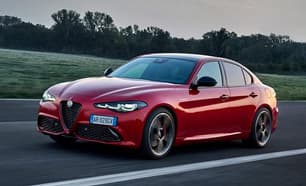
Like any good Alfa Romeo should be, the Giulia is a work of art. It’s sleek, sharp, and immaculately proportioned.
This most recent update has artfully refined a formula too good-looking to mess with. The increasingly dorky headlamps from the previous car have been swapped out for a more contemporary all-LED set, with a three-bar DRL pattern.
The grille has also been tweaked for this update for a more modern style, and the Veloce is now graced with the iconic and more aggressive sport two-tone alloy wheels in the traditional five-hole 'tele-dial' style.
It’s effortlessly attractive, and instantly recognisable as an Alfa on the road. I can’t think of a better way to stand out in today’s executive sedan landscape.
The interior has received less of an upgrade for the 2024 model year, with the same core parts. The major change is the old-school analogue instrument cluster being swapped out for a slick 12.3-inch digital unit.
The puzzling thing about this is the 8.8-inch central multimedia screen hasn’t been upgraded in-kind, making a strange contrast between the sharp and fast digital instruments, and the laggy and dull multimedia panel.
At least it effortlessly sits behind the curvaceous design of the dash as to not interrupt a good shape.
There are of course plenty of other touches which I love. The leather seats look and feel the part, as do the real metal paddle shifters which float behind the simple yet refined and sporty steering wheel.
The push-to-start button on the wheel is reminiscent of other Italian sports machines, while the tasteful smattering of leather, gloss plastic, and textured surfaces keep the premium feel on-track.
Some areas I’m not so keen about: Some of the interior plastics, particularly for buttons and toggles, feel cheaper than they should, and the door cards are oddly basic considering how much attention has been given to every other part of this car’s look and feel.
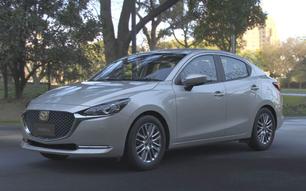
Aside from the Pure SP, the Mazda2's styling changes are subtle. Mazda's design team aimed to move the model's looks slightly away from the previous ‘premium' chrome-adorned look to a sportier and more ‘aggressive' style.
A redesigned front bumper and mesh grille, with the rear's nip and tuck being more subtle, don't need to do much to keep the hatchback looking fresh. Despite being almost a decade old, the Mazda2 looks, to some extent, like it could be a new generation.
The Pure SP in particular is a highlight, with the blocked grille evoking some ‘electrification' vibes, while the coloured-accent treatment at the front and rear of most variants is a welcome addition for something different.
The range of differing wheels is also a plus point for the Mazda2 range, with each model having its own distinct characteristics.
Inside, the Pure SP also gets a stand-out panel across the dash in a lighter colour like mint, while others get different seat trims and colour accents in places like the vent surrounds.
New colours for the range are 'Aero Grey Metallic' and 'Air Stream Blue Metallic'.
The Giulia is an old-school low-slung sports sedan. Many will prefer the SUV sensibilities of the Stelvio, with its bigger hatch-opening boot, and its higher ride height can better accommodate less mobile passengers, and makes it easier to fit child seats and the like.
For those willing to trade those things away for a superior drive experience, the Giulia is still solid to live with every day, but has a few drawbacks.
For example, those strangely basic door cards offer only a tiny map pocket with a nook I’d hardly describe as a bottle holder.
The centre console offers two larger bottle holders with variable edges, but there’s also not much else in the way of storage in the cabin aside from a smaller-than-average glove box and armrest console box.
The big win for me is the physical dial set and shortcut buttons for all the key climate functions, making it easy to operate while you’re concentrating on driving.
At least the seats are well bolstered, and front passengers are treated to plenty of adjustability. Visibility is okay, and it was easy for me to find a comfortable driving position at 182cm tall.
The rear seat is a similar story. It’s tighter, and you have to duck down below the roofline to get into it.
Once inside, I was pleasantly surprised to find enough room for my knees and somewhere for my feet to slide behind my own driving position, although the centre position is all but useless thanks to an enormous raise for the driveshaft.
Headroom is passable, but you wouldn’t want to be much taller than me.
There are, again, tiny bottle holders in the doors, and a further two in the drop-down armrest. Rear seat passengers get dual adjustable air vents on the back of the centre console, one USB 2.0 outlet, and elastic nets on the backs of the front seats.
The boot measures 480 litres which is up there with a lot of mid-size SUVs, but because it’s a sedan, access is more limited, and it won’t accommodate as many awkwardly-shaped objects.
The Mazda2's interior is mostly unchanged through the facelift, with the car's overall dimensions unchanged and not affecting space for its occupants.
Up front, the two seats are comfortable for adults and arm, shoulder, and head room is ample.
Storage space for drinks, phones, or small bags and wallets is sufficient, though not quite road-trip-worthy.
In the rear seats, adults will find enough space to be comfortable for short trips but might get a little restless after a while.
Headroom when sitting upright is tight for anyone around 182cm (six-feet) tall, and a lack of armrest and little storage save for the doors means loose items will be joining occupants on the seat or sitting on the floor.
The Mazda2 has a claimed 250 litres of luggage space in the boot, which is fine for a small hatchback, but short of rivals like the Toyota Yaris' 270L.
The Giulia we’re looking at for this review is the mid-spec Veloce, which costs $74,950 before on-road costs, sitting above the base Ti ($68,450) and below the top-spec Quadrifoglio ($153,700).
Natural rivals from Germany include the Audi A4 45 TFSI ($77,869), BMW 320i M Sport ($80,200) and Mercedes-Benz C200 ($89,900) all of which suddenly make the attractive Alfa look like a not-half-bad deal.
But then there’s always the Genesis G70 (from $63,000 in equivalent turbo 2.0L form) to bring the value equation back to reality.
Standard stuff at this grade includes 19-inch alloys, an 8.8-inch multimedia touchscreen and a 12.3-inch digital instrument cluster (new for the 2024 model year), dark contrast exterior highlights, leather seat trim with heated front seats and steering wheel, aluminium interior detailing and shift paddles with extended leather trim on the dash, updated LED headlights and DRLs, dual-zone climate, push-start ignition and keyless entry, tinted rear windows, and a 14-speaker Harman Kardon audio system.
Performance-wise, the Veloce also scores a limited-slip rear differential to match its punchy engine.
The tech feels a bit old, and the interior has a dated ambiance to it compared to the more open and digitised spaces of its rivals, but there’s something to be said for how organic the Alfa feels. More on this later.
Mazda has managed to keep pricing for its entry model relatively low for the segment. In fact, the base Pure in manual form starts from $22,410, before on-roads, and the auto is only $2000 more.
That means at a time when the Toyota Yaris is starting to look more expensive than its historic ‘cheap and cheerful' image allows, Mazda is pushing the Mazda2 to be slightly more premium while keeping its price competitive.
Standard features for the range, which start in the Pure variant, include a 7.0-inch touchscreen with Apple CarPlay and Android Auto capability, plus auto headlights and windscreen wipers.
The Pure SP, which starts at $25,210, gains a different styling kit that adds a body-coloured front panel to the grille, plus a carbon-look roof in vinyl. It also gains the ‘shark-fin' roof aerial.
The Evolve, which starts from $25,910, gains LED DRLs, with the mesh grille replacing the SP's block colour panel.
Its upholstery gets red stitching, plus it's also got a couple more tech additions with Mazda's active head-up driver display, traffic sign recognition and satellite navigation.
Finally, there's the top-spec GT, from $27,610, which gains unique aero-inspired 16-inch alloy wheels, and a set of black leather-upholstered seats with synthetic suede and red trim.
A sedan is available in Pure or GT specification at the same prices and with the same features as the hatch, though you can't get a Pure sedan in manual - that's available in the hatch only.
The Veloce might not pack a Ferrari-derived six-cylinder engine like the Quadrofoglio, but its smaller 2.0-litre four-cylinder turbocharged petrol engine hardly wants for power.
Packing 206kW/400Nm it outpunches six cylinders of old easily, and is still capable of sprinting to 100km/h in a hot-hatch baiting 5.7 seconds to a Vmax of 240km/h.
It even sounds fantastic, as it flies up the rev-range living up to every bit of the Alfa promise. Peak power arrives at 5250rpm, but peak torque hits at 2250rpm.
Smooth shifts are provided courtesy of an eight-speed traditional torque converter automatic transmission.
Mazda's ‘SkyActiv-G' 1.5 litre four-cylinder petrol engine is the unit used for six-speed manual and automatic models, but outputs vary slightly.
Manual cars produce 82kW and 144Nm, while autos deliver a slightly lower 81kW and 142Nm, both driving the front wheels only.
It's pretty much the same engine you used to find in an entry-grade MX-5, just with less power.
The 2.0L turbocharged engine has an official combined cycle fuel consumption figure of just 6.1L/100km, although I saw 9.0L/100km in my time with it.
I’ll admit it was being enthusiastically driven, and treated to lots of urban commuting.
The Giulia has a 58-litre fuel tank and requires mid-shelf 95 RON premium unleaded fuel. Its approximate range on a full tank at the official consumption is 951km.
Improved fuel efficiency and lower CO2 emissions come thanks to the automatic's slight drop in power and torque.
Mazda claims a 5.0L/100 km rating for the automatic Mazda2, which is down by 0.3L/100km over the previous version, but the manual's unchanged engine tune burns through the petrol at 5.4L/100km.
Filling the 44-litre tank with at least 91RON or even E10 is fine, and with its auto variant's efficiency rating means the Mazda2 technically has a theoretical range of 880km.
Comparatively the Mazda2 scores well here, the more expensive Toyota Yaris comes with a 4.8L/100km consumption claim with its CVT auto. A Suzuki Swift, with a smaller 1.2-litre engine, also has a 4.8L/100km rating.
Put simply: The Giulia is a celebration of Alfa Romeo. Yes. Even with a humble 2.0-litre turbocharged engine and an automatic transmission, this is a deeply emotional car. A riveting experience from behind the wheel.
Fly round corners, your eyes wide, exclaiming ‘magnifico!’ as the Giulia gracefully leans in, the rear LSD, sporty tyres, and wonderfully tight steering working together in harmony as you eke out just a smidge of tyre roar.
Laugh out loud to yourself, as you plant the accelerator, hear the muted rumble of the surprisingly angry little engine, and feel the turbocharger kick in half a second later as you power out.
‘Eccezionale!’ You’ll think, as you feel the click of the immensely satisfying metal paddle-shifters, and the transmission responds in-kind, the engine roaring up the revolutions with enthusiasm.
Sure, the Veloce grade is not as raw, or as wild, or near as fast as the top-grade Quadrofoglio, but all of the exciting spirit of that car is still here, and at a little over half the price, too. The Veloce is an absolute delight to drive.
It has such poise, makes such a fine sound, and does it all so gracefully. This is how you make a car feel as one with the driver.
Even the ride is deeply impressive. It’s not too harsh or noisy, while gifting the chassis just the right amount of lean in the corners and allowing enough play for it to remain controlled over bumps.
Not only does it work well when you’re driving as it's clearly intended to be driven, but around town it’s quiet and refined inside, living up to the promise of a luxury sedan.
The seats and bolstering are great, the visibility isn’t too bad, and while I’ll complain about the slightly laggy software on the multimedia screen, the digital dash is responsive and the physical climate controls are welcome.
It’s not all perfect. If it were, I think it might cease to be an Alfa Romeo and start sprouting BMW badges.
For example, our test car, with less than 2000km on the odometer, had various inconsistent rattles emanating from the plastic garnish around the digital dash, and somewhere behind the back seat.
Regardless, driving this car has made me a little sad Alfa will be putting this wonderful platform behind it in pursuit of more electrified goals.
I can only hope wherever the Giulia nameplate goes next, it retains the spirit of this version.
Our drive loop for the Mazda2's launch included a mix of urban, highway, and rural driving, with varying road quality and conditions.
Fortunately for the little hatchback, it handled everything well or at least at a passing mark, with only a couple of small shortcomings that are common in the segment.
The Mazda2 is a joy to drive in most circumstances, with a lively but confidence-inspiring chassis and controls that give a connected feel to the road.
At low speeds, the Mazda2's relatively low power isn't noticeable, with the gearbox getting things moving at a reasonable pace and the engine is responsive enough with the traditional gearbox helping it along.
It's worth noting that for ultimate control over the drivetrain, Mazda still offers a six-speed manual transmission in the entry-grade Pure, and it's a gem.
Smooth, sporty shifts and well thought out gear ratios mean the manual is easy to handle even in traffic, and the clutch has a forgiving bite point. The 'i-Stop' stop/start system works with the three-pedal car, too, as does cruise control.
In terms of handling and comfort, the Mazda2 is a little shaken by large bumps, though some of the rough surfaces on our test loop were particularly brutal.
Similarly, when pushed hard to conquer steep hills the 1.5-litre engine becomes a little harsh.
On twisty sections the Mazda2 (especially in manual form) provides ample fun while remaining predictable in its steering and chassis feedback, rather than feeling loose.
The same safety equipment suite is standard on every Giulia variant.
Advanced active gear includes auto emergency braking, lane keep tech, blind-spot monitoring with rear cross-traffic alert, driver attention alert, and adaptive cruise control.
It also scores front and rear parking sensors, and a reversing camera with guidelines.
The Giulia’s maximum five-star ANCAP safety rating expired at the end of last year, as it was originally rated back in 2016. The facelifted model is ‘unrated’ relative to ANCAP’s current standards.
The updated Mazda2 is equipped with the brand's suite of 'i-Activsense' safety tech, which includes 'Smart City Brake Support' for operating forward and reverse, blind-spot monitoring and rear cross-traffic alert.
The Evolve and GT model grades are fitted with traffic sign recognition.
The GT model grade comes fitted with front parking sensors and a set of surround-view parking cameras.
The Mazda2 also features six SRS airbags to cover the driver and front passenger, side airbags, and curtain airbags front and rear. It also has ISOFIX anchor points and top tethers for child seats in the rear.
Mazda isn't going to put the Mazda2 up for a new crash test rating by ANCAP, with the brand telling us the new safety additions bring the car's safety up to date, though its original rating from 2015 was a maximum five stars.
Alfa finally updated its warranty to a more industry-standard five-years and unlimited kilometres in 2022.
Service intervals occur at 12 monthly or 15,000km intervals for the 2.0-litre turbocharged variants. Pricing was not available for the model year 2024 version yet in the brand’s online calculator, but to give you an idea for the pre-facelift version, pricing came in between $345 and $1065 per visit, averaging $573 per year for the first five years of ownership. Not cheap, but not as expensive to run as you might expect.
One thing you might want to keep in mind is depreciation. Boring, I know, but even late model examples of the Giulia and Stelvio have been hit particularly hard by the depreciation stick according to residual values we searched up on Autotrader.
For reference, the Genesis G70 and BMW 3 Series have both fared much better in equivalent 2.0-litre turbo forms.
Mazda offers a five-year/unlimited-kilometre warranty across the range, under which the Mazda2 will be covered. That's on par for the market, although some rivals, like the MG3, come with a seven-year term.
Scheduled servicing costs for the first seven workshop visits range from $334 to $587, and are undertaken every 12 months or 15,000km (whichever comes first).