What's the difference?
The Volkswagen T-Cross is the smallest SUV in the brand’s entire range, but it’s incredibly practical, great to drive and has an excellent level of safety.
It’s just been updated with some new features and it’s probably more affordable than you think.
So if you are thinking of a Mazda CX-3 or a Toyota Yaris Cross, then put the T-Cross on your list to check out, too.
Well into its second generation, the Mercedes-Benz GLE remains a key player in the luxury large SUV space.
Though it lags well behind the BMW X5 in terms of sales, by about half in fact, the GLE still aims to exude status and luxury, helped by a facelift in 2023.
In its category, there are however plenty of badges with the power to lure buyers away: Audi, Porsche and Range Rover. Even non-Euros like Genesis and Lexus.
Despite the facelift, the category is moving on with big screens and more tech, where the GLE still has to rely on some traditional charm to win over wallets - especially in our big diesel ‘450d’ guise.
A week behind the wheel around and out of the city should reveal whether the GLE still has a strong-enough USP in 2025.
There are so many new little SUVs out there and it might be easy to think they’re all the same - a tiny cheap SUV is just a tiny cheap SUV. But I’m convinced the Volkswagen T-Cross isn’t like the others.
Yes, it’s tiny and relatively cheap, but it can do more than most of the others from the storage and space it offers to the value-for-money and its level of refinement. Then there’s the way it drives - which can’t in my books be matched by any of its rivals.
The sweet spot in the range is the entry grade Life. At $35K drive-away the value is best and with no difference in engines between the grades there are no huge reasons to step up higher in the range unless you have the money.
Note: CarsGuide attended this event as a guest of the manufacturer, with travel, accommodation and meals provided.
If you can get past the relatively steep asking price, the design appeals to you, and its slightly last-gen ergonomics work for you, then there’s a lot to like about the GLE. It’s a big, capable and comfortable cruiser, but given there are cheaper and more efficient options around, it would be a decision of the heart rather than the head.
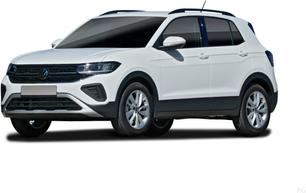
The T-Cross is Volkswagen’s smallest SUV at 4.1m long and even though it’s closely related to the little Polo hatchback it looks more like a mini version of the Tiguan.
It might be tiny and relatively affordable but it has Volkswagen’s premium looks and sharp styling, with creases in the panels so crisp it looks like somebody just ironed it.
This update has brought new front and rear bumper designs, and new styling to the LED running lights and tail-lights. That’s typically how car companies do exterior design updates, inside the styling changes are pretty minimal, too.
There’s new dashboard design and new media screen, but again the design and quality feels refined and high quality, which I can't say goes for a lot of this car's rivals.
The entry-grade Life misses out on the cross design tail-lights of the Style and R-Line, and gets hubcaps rather than alloy wheels like the other two grades.
The GLE hasn’t changed massively since 2019, but sleeker lights and some tweaks around the face have helped it age relatively gracefully. As much as a 2.4-tonne SUV can be graceful.
There are still references to the original ML-Class the GLE succeeded, like the ‘coupe’ shape of the C-pillar that betrays the true SUV shape of the GLE.
The reshaped front-end has less black plastic on show, and its grille stays true to the pre-facelift design.
Inside, it’s just the steering wheel that’s new, everything else holds up well in terms of a design that’s also practical, though some would say it looks outdated given the many physical controls.
You really should take a look at my video to get an idea of how good space and storage is in the T-Cross. I’m tall at 189cm but I can drive with plenty of elbow room and legroom. The front seats also have really long bases which offer great under-thigh support, too.
Legroom in the back is great for the class and I can sit behind my driving position without my knees touching the seatback, while headroom is excellent, too. The second row also slides on rails to increase the boot side which is enormous for the class at 455L.
The second row doors also have large apertures making entry and exit easier.
Cabin storage is great with giant door pockets in the front and back, a wireless phone charger with four USB-C ports (two in the front and two in the second row).
The GLE is very easy to use because of those physical controls.
Save for the trackpad in the centre console that can be used like a laptop’s control mat - it’s a little fiddly - everything is easy to locate and adjust and the controls feel nice. The switches along the climate control row all feel nice and clicky, buttons in the centre console are big and obvious, and even the steering wheel’s haptic buttons are laid out sensibly.
The touchscreen’s software has been updated since launch during the facelift and it’s easy to navigate, but wireless Android Auto or Apple CarPlay are a good workaround.
The front seats, as well as being comfortable, are adjustable to an impressive degree for finding your driving position and there’s plenty of room and light to make the cockpit feel airy.
Storage isn’t at a premium, there’s plenty of space in door cards, the central storage bin, and the cupholders and phone charger can be hidden away.
Behind the front row, rear seat space is ample, though if you opt for seven seats the second row can be moved to accommodate a third row of passengers when needed.
In our test car, that isn’t the case, so the GLE’s cavernous 630 litres of boot storage is available. The second row can split 40/20/40, which is convenient for loading long items while four passengers are present.
Oh, but under the boot floor, despite some extra room for bits and pieces, no spare tyre. Big marks down for a car that absolutely has the space for one.
There are three grades in the T-Cross line up, the entry level Life which lists for $33,990, the Style for $37,490 and at the top of the range is the R-Line for $40,990.
At the time of the launch of this updated T-Cross, Volkswagen was doing drive-away pricing of $34,990 for the Life, $39,990 for the Style and $43,990 for the R-Line.
Compared to rivals like the Mazda CX-3 and Toyota Yaris Cross, a drive-away price of $35K for the Life is excellent and $40K for the Style is also a good deal, especially when you look at the healthy standard features list.
Coming standard on the Life are LED headlights, black roof rails and power folding mirrors, there’s a leather steering wheel, a digital driver display (which is new, too), there’s an 8.0-inch media screen, wireless phone charging, air con, digital radio, Apple CarPlay and Android Auto.
Stepping up into the Style grade adds 17-inch alloys wheels, matrix LED headlights - those are new - chrome-look roof rails, an LED grille strip, proximity unlocking, dual-zone climate control, sat nav, and a new, larger digital driver display. The Style also gets the fancy 'cross' LED tail-lights like the R-Line grade above it.
The R-line is a new model sitting at the top of the line-up and it comes with sporty R-Line exterior styling plus 18-inch alloy wheels and dark tinted rear windows. Inside there’s R-line interior styling, 'Drive Modes' and a Beats sound system.
It’s not a strong start for the GLE. Our top-spec (non-AMG) GLE 450d 4Matic variant starts from $154,900, before on-road costs, while our test car has $3800 of option boxes ticked.
So, $158,700 before on-roads as-tested, the GLE is this borderline prohibitively expensive for what it offers.
If the car you’re after must be diesel, the options are still many in terms of rivals… especially if you’d like to save a few dollars.
Moving on from the big Mazdas and VW Touaregs to the proper premium badges, and there’s the $136,815 Audi Q7 50 TDI (if we exclude the $120,530 base Q7 TDI) or the BMW X5 30d for $138,600. Even a Range Rover Sport D300 comes in under the GLE at $159,481.
For a seven-ish year old luxury SUV, the GLE does a decent job of hiding its age in some ways, but there are gaps.
The twin 12.3-inch screens for multimedia and driver display have aged well, plus there’s electrically adjustable leather front seats with heating, though the leather in our new test car needs some softening up. Perhaps over time.
The new steering wheel comes thanks to newer models in Merc’s line-up, though haptic controls can be accidentally bumped (as opposed to buttons).
Wireless phone charging, wireless Android Auto and Apple CarPlay, a head-up display, a huge sunroof, LED interior lighting, adaptive high beam headlights, a power tailgate and surround-view parking cameras are all standard.
Optionally, there’s a set of 21-inch wheels as pictured on our test car. They’re $2400 and you’d probably be better off with standard 20-inch wheels for the extra comfort.
The illuminated running boards are a $1400 option, and they’re also probably not necessary. But I’m not your mum, go for it if you want.
Oh, and you can also have the GLE in seven-seat form, but our test car is a luxuriously spacious five-seater.
The T-Cross has a 1.0-litre three-cylinder engine which sounds tiny and it is, but it's turbo-charged and the 85kW/200Nm it produces is plenty of grunt to move this little SUV which at just under 1.3 tonnes is relatively light.
All grades in the T-Cross line-up have this same engine and there’s no high-performance variant, although the R-Line has selectable drive modes. Every T-Cross is front-wheel drive with a seven-speed dual-clutch auto transmission.
This three-cylinder is a mighty little beastie with a growly tone to it. There is some turbo lag during stop-start city driving, but it’s so eager to play that if it was a dog it’d be a Jack Russell with every intention to chase anything it sees but no idea how small it is.
The GLE 450d’s 3.0-litre inline six-cylinder diesel engine is turbocharged, with a healthy 270kW and a brawny 750Nm to its name. That torque peaks all the way from 1350rpm to 2800rpm, by the way. Handy.
A nine-speed automatic transmission sends drive to all four wheels ('4Matic' in Merc-talk), while a 48-volt ‘mild-hybrid' system ('EQ Boost' in Merc-talk) means take-offs and shifts are aided by a bit of electric power.
Mercedes says the GLE can dispatch the 0-100km/h sprint in just 5.6 seconds, and that feels about right.
Smaller engines use less fuel than larger ones and the 1.0-litre three-cylinder in the T-Cross is little and Volkswagen says over a combination of open and urban roads it uses 5.6L/100km.
That’s fuel efficient but these days larger SUVs with hybrid systems are achieving the same low consumption. Toyota’s Yaris Cross is available with a hybrid system and will use about 3.8L/100km.
Volkswagen doesn’t have a hybrid version of the T-Cross, but it should, especially given these little cars will spend more time in urban environments where fuel consumption will generally be higher.
That said, most tiny SUVs don’t have hybrid systems so that makes the Yaris Cross exceptional while the T-Cross is about average.
Mercedes claims a 7.4L/100km combined cycle (urban/extra-urban) fuel consumption figure for the big lug, but achieving that and making the most of its large 85-litre tank is a challenge.
We averaged 8.7L/100km on test but the trip computer showed as low as 8.0L/100km at one point. Get the GLE on the highway and fuel use plummets.
Theoretically you should be able to get about 1150km from a single tank, but realistically we wouldn’t plan trips any longer than 900km between fuel stations.
Still impressive, given that’s about the distance between Melbourne and Sydney, or Sydney and Brisbane. Roughly.
Quite possibly the best little SUV to drive for this price and size, the only drawback is that there’s a touch of lag in the time it takes the power to arrive at low speeds in stop-start traffic, but that can be remedied by putting the transmission in 'Sport' mode.
The steering is light and accurate, the visibility is excellent thanks to the big windows and raised ride height, the pedal feel under your feet is great and the brakes are responsive.
The car feels stable, planted and secure whether it's on a motorway, or a winding country road, while the little 1.0-litre engine is a champion that keeps punching with a throaty growl that matches its enthusiasm.
The seven-speed transmission is superb and changes gears fast, while the paddle shifter lets you take control to keep the revs high.
These little SUVs aren't sports cars but some are so underwhelming to drive it feels like performance was never thought about while developing the vehicle.
But the T-Cross made me grin until my face hurt on the steep winding hairpin filled roads we tested it on at its launch.
A trip in the GLE feels like a welcome step back in time. Sure, coming in close to five metres long and two-and-a-half tonnes means it’s not a nimble steer, but the GLE strikes a nice balance of comfort and tactility that’s getting rarer.
None of it feels particularly sharp in terms of inputs or feedback, but it’s easy and predictable to a point where even winding back-roads are effortless to flow through.
The big diesel engine feels almost lazy, but it’s just so effortless in getting things moving as it strives to sit close to idle whenever possible. Because of that, there’s little noise from the engine bay even under reasonable acceleration, and the powertrain is helped by that 48-volt system which makes stop-starts from the lights super-smooth.
The mild-hybrid also helps smooth out power delivery, to the point where the only time the GLE feels clunky is the occasional lag when shifting from Drive to Reverse or vice versa.
The test car’s suspension isn’t the optional airbag set-up, but the non-adaptive steel does fine in terms of comfort and soaking up harsh surfaces. And even the big 21-inch wheels aren’t too bad over sharp bumps.
With smaller wheels (more tyre cushioning) and the air suspension, it feels like the GLE would ride gorgeously.
Its body control is predictable on smooth roads, and if you’re careful you steer the hefty SUV through tight, winding roads easily, but consistently rough surfaces can make the GLE feel unsettled for a short period of time.
There’s an overall softness to it that means gentle off-roading is possible, and the tyres are thick enough to make it comfortable. You won’t find yourself being tossed around on a flat enough gravel road.
The T-Cross was given the maximum five-star ANCAP rating in 2019. What is truly great is that on every grade you’ve got AEB, adaptive cruise control, lane keeping assistance, rear cross-traffic alert, manoeuvre braking, plus front and rear and parking sensors.
For child seats there are three top tether anchor points and two ISOFIX points in the second row.
A space saver spare wheel can be found under the boot floor.
There’s a lot under the skin in the GLE in terms of safety, and it doesn’t always make itself known. This is a compliment.
The GLE scored a maximum five stars in its ANCAP assessment in 2019, and though the criteria has changed significantly since then, it feels like it should still score well.
The GLE doesn’t intervene unless it needs to, but the ability is there for the big Merc to avoid incidents and employ many means to protect passengers and pedestrians alike.
A warning for the driver and a gentle seatbelt tension comes in before the car slams on the brakes, though if no action is taken before an expected collision the GLE will drop its AEB anchors.
There are nine airbags if it all goes pear-shaped, plus some well-tuned adaptive cruise control with lane keep assist and departure alert, there’s traffic sign recognition with that, too.
Blind spot warnings, front- and rear cross-traffic alert, front and rear parking sensors and driver monitoring are joined by Mercedes’ plethora of other little safety features that minimise impact and damage in a crash.
The T-Cross is covered by Volkswagen’s five-year unlimited kilometre warranty.
Servicing is recommended every 15,000km or yearly and while there’s no capped price servicing you can buy a five-year plan for $2800, which equates to $560 per workshop visit.
Servicing isn’t cheap at Mercedes, even in the context of this market segment. A three-year service plan for the GLE costs $4045, while five years is $8055. That’s $1348 or $1611 per service respectively. The later services in those five years will of course be much more expensive and bring the average up.
Intervals are every 12 months or 25,000km, but Mercedes’ five-year/unlimited-kilometre warranty means anything major that goes wrong in that time should be covered - always read the fine print.
The brand’s Australian website lists 67 Mercedes-Benz dealers that can service your car.