What's the difference?
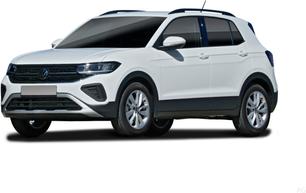
The Volkswagen T-Cross is the smallest SUV in the brand’s entire range, but it’s incredibly practical, great to drive and has an excellent level of safety.
It’s just been updated with some new features and it’s probably more affordable than you think.
So if you are thinking of a Mazda CX-3 or a Toyota Yaris Cross, then put the T-Cross on your list to check out, too.
The Suzuki Jimny is back with a tech refresh and very minor update after a year-long pause in production.
The line-up now has an updated autonomous emergency braking (AEB) system – so that system is now compliant with Australian Design Rules standards – as well as adaptive cruise control, lane departure prevention, and front and rear parking sensors.
My test vehicle – the entry-level Jimny Lite – also gets a new 7.0-inch touchscreen with Apple CarPlay and Android Auto as part of this latest line-up refresh.
So, does the updated base-spec Jimny – which now costs $1500 more than it did before – represent best value for money in this Zook range?
Read on.
There are so many new little SUVs out there and it might be easy to think they’re all the same - a tiny cheap SUV is just a tiny cheap SUV. But I’m convinced the Volkswagen T-Cross isn’t like the others.
Yes, it’s tiny and relatively cheap, but it can do more than most of the others from the storage and space it offers to the value-for-money and its level of refinement. Then there’s the way it drives - which can’t in my books be matched by any of its rivals.
The sweet spot in the range is the entry grade Life. At $35K drive-away the value is best and with no difference in engines between the grades there are no huge reasons to step up higher in the range unless you have the money.
Note: CarsGuide attended this event as a guest of the manufacturer, with travel, accommodation and meals provided.
The Suzuki Jimny Lite is the most basic of the Suzuki Jimny line-up but that’s not a bad thing.
It’s ordinary on-road, it’s on the wrong side of small – especially in terms of cargo-carrying ability – and it’s still an exercise in driver-adaptability because it’s basic, bouncy and requires a lot of effort to keep it driving in a straight line.
But the Jimny is a lot of fun off road and even on sealed surfaces. It is go-kart-like in terms of everyday suitability and comfort, but its day-to-day drivability has received a healthy boost by way of those new driver-assist technologies and the updated AEB.
If you’re willing to give into the fun and cop a few compromises along the way, then you won’t be disappointed, because the Jimny is a tonne of fun.
The T-Cross is Volkswagen’s smallest SUV at 4.1m long and even though it’s closely related to the little Polo hatchback it looks more like a mini version of the Tiguan.
It might be tiny and relatively affordable but it has Volkswagen’s premium looks and sharp styling, with creases in the panels so crisp it looks like somebody just ironed it.
This update has brought new front and rear bumper designs, and new styling to the LED running lights and tail-lights. That’s typically how car companies do exterior design updates, inside the styling changes are pretty minimal, too.
There’s new dashboard design and new media screen, but again the design and quality feels refined and high quality, which I can't say goes for a lot of this car's rivals.
The entry-grade Life misses out on the cross design tail-lights of the Style and R-Line, and gets hubcaps rather than alloy wheels like the other two grades.
The Lite is, like the rest of the Jimny line-up, retro-cool and classic with a striking straight-up-and-down appearance sure to draw more admiring glances than sneering ‘WTF?!’ looks.
The three-door Suzuki Jimny is 3650mm long (with a 2250mm wheelbase), 1645mm wide, 1720mm high, and it has a kerb weight of 1100kg.
The Jimny has it over any rivals in this category when it comes to exterior design.
The Jimny’s interior is plain and practical. It has cloth seats, expanses of durable plastic and an overall utilitarian look and feel.
It is spartan inside, but this all-pervasive no-frills approach best suits the Jimny's simple spirit.
You really should take a look at my video to get an idea of how good space and storage is in the T-Cross. I’m tall at 189cm but I can drive with plenty of elbow room and legroom. The front seats also have really long bases which offer great under-thigh support, too.
Legroom in the back is great for the class and I can sit behind my driving position without my knees touching the seatback, while headroom is excellent, too. The second row also slides on rails to increase the boot side which is enormous for the class at 455L.
The second row doors also have large apertures making entry and exit easier.
Cabin storage is great with giant door pockets in the front and back, a wireless phone charger with four USB-C ports (two in the front and two in the second row).
Functionality is highest on the agenda with the Jimny rather than any attempt at a semblance of plushness.
Having said that, it is comfortable inside, but it is very basic, which is actually part of its charm though some people may rapidly grow weary of its bare-bones interior.
The big news in this small 4WD is the fact it now has a new 7.0-inch touchscreen with wireless Apple CarPlay and Android Auto. That screen is too small but the hands-on controls everywhere else remain one of the refreshingly simple aspects that is easy to like about the Jimny.
There’s also now a 4.2-inch digital driver display between the analogue dials and that includes a speedo, as well as fuel-consumption and driving range details.
With the three-door Jimny's second-row seats in use, boot space is listed as 85L. With the second row stowed away, there’s a claimed 377L of cargo space.
Payload is a claimed 350kg and gross vehicle mass is 1450kg (the Jimny is 1100kg) so there’s not a lot of flexibility in terms of how much camping gear, dogs, or Abba CDs you can pack into this diminutive 4WD.
While others may offer more in terms of comfort and general amenities, the Jimny still wins out for day-to-day durability.
There are three grades in the T-Cross line up, the entry level Life which lists for $33,990, the Style for $37,490 and at the top of the range is the R-Line for $40,990.
At the time of the launch of this updated T-Cross, Volkswagen was doing drive-away pricing of $34,990 for the Life, $39,990 for the Style and $43,990 for the R-Line.
Compared to rivals like the Mazda CX-3 and Toyota Yaris Cross, a drive-away price of $35K for the Life is excellent and $40K for the Style is also a good deal, especially when you look at the healthy standard features list.
Coming standard on the Life are LED headlights, black roof rails and power folding mirrors, there’s a leather steering wheel, a digital driver display (which is new, too), there’s an 8.0-inch media screen, wireless phone charging, air con, digital radio, Apple CarPlay and Android Auto.
Stepping up into the Style grade adds 17-inch alloys wheels, matrix LED headlights - those are new - chrome-look roof rails, an LED grille strip, proximity unlocking, dual-zone climate control, sat nav, and a new, larger digital driver display. The Style also gets the fancy 'cross' LED tail-lights like the R-Line grade above it.
The R-line is a new model sitting at the top of the line-up and it comes with sporty R-Line exterior styling plus 18-inch alloy wheels and dark tinted rear windows. Inside there’s R-line interior styling, 'Drive Modes' and a Beats sound system.
The Lite is the entry-level Jimny and as such has a manufacturer recommended retail price of $31,990 (excluding on-road costs).
Standard features in the Lite include a 7.0-inch multimedia touchscreen, Apple CarPlay and Android Auto, updated AEB (with 'Dual Sensor Brake Support II' so the system now complies with the mandatory ADR 98/00 regulation), as well as the inclusion of lane departure prevention, adaptive cruise control, front and rear parking sensors, and traffic sign recognition.
It also has the usual Jimny gear: 15-inch steel wheels, halogen headlights and a rear-view camera.
Exterior paint choices include white as standard and jungle green (on this test vehicle) which is a premium/metallic paint and comes at an additional cost of $745.
The Jimny represents decent enough value against potential rivals, such as the Renault Duster 4x4, Mahindra Scorpio, and the GWM Tank 300, although you're buying a vibe more than any substantial amount of gear or comfort.
The T-Cross has a 1.0-litre three-cylinder engine which sounds tiny and it is, but it's turbo-charged and the 85kW/200Nm it produces is plenty of grunt to move this little SUV which at just under 1.3 tonnes is relatively light.
All grades in the T-Cross line-up have this same engine and there’s no high-performance variant, although the R-Line has selectable drive modes. Every T-Cross is front-wheel drive with a seven-speed dual-clutch auto transmission.
This three-cylinder is a mighty little beastie with a growly tone to it. There is some turbo lag during stop-start city driving, but it’s so eager to play that if it was a dog it’d be a Jack Russell with every intention to chase anything it sees but no idea how small it is.
This entry-level Suzuki Jimny has the same 1.5-litre four-cylinder petrol engine as the rest of the line-up, producing 75kW at 6000rpm and 130Nm at 4000rpm, and it has a five-speed manual transmission.
The Jimny is always zippy, manoeuvrable and punchy off the mark simply because it is so small and light, however, it feels underpowered on the open road and strained at highway speeds.
It has a part-time four-wheel drive system with high- and low-range, and off-road traction control.
While it’s far from offering the best power and torque outputs, even in the small 4WD realm, the Jimny is so light that there’s enough here to work with.
Smaller engines use less fuel than larger ones and the 1.0-litre three-cylinder in the T-Cross is little and Volkswagen says over a combination of open and urban roads it uses 5.6L/100km.
That’s fuel efficient but these days larger SUVs with hybrid systems are achieving the same low consumption. Toyota’s Yaris Cross is available with a hybrid system and will use about 3.8L/100km.
Volkswagen doesn’t have a hybrid version of the T-Cross, but it should, especially given these little cars will spend more time in urban environments where fuel consumption will generally be higher.
That said, most tiny SUVs don’t have hybrid systems so that makes the Yaris Cross exceptional while the T-Cross is about average.
The Suzuki Jimny has official fuel consumption of 6.4L/100km (on a combined cycle).
I recorded 7.2L/100km on this test but, as always, I did a lot of high- and low-range 4WDing.
The Jimny has a 40L fuel tank so, going by my fuel figures, a full tank should give you a driving range of about 550km.
Quite possibly the best little SUV to drive for this price and size, the only drawback is that there’s a touch of lag in the time it takes the power to arrive at low speeds in stop-start traffic, but that can be remedied by putting the transmission in 'Sport' mode.
The steering is light and accurate, the visibility is excellent thanks to the big windows and raised ride height, the pedal feel under your feet is great and the brakes are responsive.
The car feels stable, planted and secure whether it's on a motorway, or a winding country road, while the little 1.0-litre engine is a champion that keeps punching with a throaty growl that matches its enthusiasm.
The seven-speed transmission is superb and changes gears fast, while the paddle shifter lets you take control to keep the revs high.
These little SUVs aren't sports cars but some are so underwhelming to drive it feels like performance was never thought about while developing the vehicle.
But the T-Cross made me grin until my face hurt on the steep winding hairpin filled roads we tested it on at its launch.
It may come as no surprise to any of you who have actually driven a Jimny but it is rather ordinary on road.
It's a small vehicle and quite light so it does get buffeted by passing traffic, thrown around by any wind stronger than a mild breeze, and this Zook’s ride and handling are barely the right side of atrocious.
But – and it’s a big BUT – the Jimny is still a lot of fun to drive, even as wild as it is on-road, and it absolutely comes alive when you hit the dirt.
Being light and nimble may detract from the Jimny's performance on sealed surfaces, but those characteristics help immensely when you go 4WDing in this little car.
It is highly manoeuvrable – it is very agile around the bush through tight tracks and up tight wheel-rutted hills – and it’s incredibly easy to find and maintain the correct driving line in the Jimny because it is so small and there's a tyre at each corner so you know where your wheels are positioned at any one time.
Low-range gearing is good and there's a nice spread of torque across a decent rev range. Traction control is reasonably well calibrated, although it is a little choppy in application now and then.
Basic but crucial physical aspects, such as the Jimny’s off-road angles, are well suited to off-roading with approach, rampover and departure angles clocking in at 37, 28 and 49 degrees respectively. Those help to make this little vehicle a champion in the dirty stuff.
Ground clearance is listed as 210mm but feels like more and while wading depth is not listed, it’s fair to say it’s about the 300mm mark.
Warning: the three-door Jimny is bouncy because it's so small, light and quite tall for its size, and has a narrow wheel-track.
It is very tippy and bouncy and you do get bumped around a lot but that's kind of the point of off-roading in the Jimny. It’s a barrel of laughs purely because it is such a dialled-in and driver-focused experience.
But those characteristics may rapidly become tiresome and tiring for some people who have grown accustomed and attached to more comfort and cushioning in modern vehicles.
This is a very capable off roader and it’s one of the few vehicles you can drive straight out of the showroom and have a tonne of fun in, in the dirt, but it is somewhat let down by its showroom-standard tyres (Dunlop Grandtrek AT20 195/80R15). Replace those with some more aggressive all-terrain rubber and Roberto’s your uncle.
As mentioned earlier, payload is 350kg, GVM is 1450kg.
Towing capacity is 350kg (unbraked) and 1300kg (braked) so you’re limited in how much you can drag with the Jimny, but that's okay because I don’t think too many people are buying a Jimny because they have to tow a caravan, horse float or boat. They’re buying it because it’s a shedload of fun off-road and the Jimny has that factor in abundance.
The T-Cross was given the maximum five-star ANCAP rating in 2019. What is truly great is that on every grade you’ve got AEB, adaptive cruise control, lane keeping assistance, rear cross-traffic alert, manoeuvre braking, plus front and rear and parking sensors.
For child seats there are three top tether anchor points and two ISOFIX points in the second row.
A space saver spare wheel can be found under the boot floor.
The current Suzuki Jimny does not have an ANCAP safety rating, because its three-star rating expired in December 2024.
It has six airbags (dual frontal, side chest-protecting and side head-protecting (curtain) airbags), AEB, lane departure prevention, adaptive cruise control, and front and rear parking sensors.
Other small 4WDs have the maximum ANCAP rating and offer more comprehensive driver-assist and safety gear suites than the Jimny.
The T-Cross is covered by Volkswagen’s five-year unlimited kilometre warranty.
Servicing is recommended every 15,000km or yearly and while there’s no capped price servicing you can buy a five-year plan for $2800, which equates to $560 per workshop visit.
The Suzuki Jimny has a five-year/unlimited-kilometre warranty.
Suzuki offers the first service at two months/2000km for free, then under the capped-price servicing program, your Jimny is scheduled for a service every 12 months/15,000km at an average cost of $453.
Those costs are okay for something in the small 4WD realm.