What's the difference?
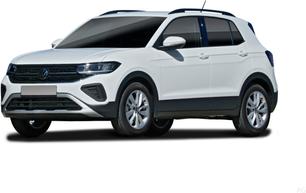
The Volkswagen T-Cross is the smallest SUV in the brand’s entire range, but it’s incredibly practical, great to drive and has an excellent level of safety.
It’s just been updated with some new features and it’s probably more affordable than you think.
So if you are thinking of a Mazda CX-3 or a Toyota Yaris Cross, then put the T-Cross on your list to check out, too.
We live in a strange time, where cars are going the way of the dinosaur and SUVs will take their place as the primary offerings of the worlds oldest and biggest car companies.
Look at Ford, the brand that literally wrote the book on automotive mass-production will soon no longer sell cars in its home market of America (apart from the Mustang, of course…) There’s a story your grandpa won’t believe.
It makes SUVs, especially small ones like the EcoSport all the more important. Customers who once would have considered the Fiesta small hatch (on which the EcoSport is based) would now rather hop into one of these. At least, that’s what the data says.
So, is the EcoSport a worthy successor to the hatchback mantle? Is it even economical or sporty? And what happened to the spare wheel on the rear door? Read on to find out.
There are so many new little SUVs out there and it might be easy to think they’re all the same - a tiny cheap SUV is just a tiny cheap SUV. But I’m convinced the Volkswagen T-Cross isn’t like the others.
Yes, it’s tiny and relatively cheap, but it can do more than most of the others from the storage and space it offers to the value-for-money and its level of refinement. Then there’s the way it drives - which can’t in my books be matched by any of its rivals.
The sweet spot in the range is the entry grade Life. At $35K drive-away the value is best and with no difference in engines between the grades there are no huge reasons to step up higher in the range unless you have the money.
Note: CarsGuide attended this event as a guest of the manufacturer, with travel, accommodation and meals provided.
So, should you buy a base-model Ford EcoSport Ambiente?
For the money it’s a great little daily commuter with an odd mix of dated trim and a great multimedia, but it’s definitely worth making room in your budget to investigate the Trend or Titanium grades.
Plus, it’s worth keeping in mind that many competitors now offer more comprehensive safety or more powerful drivetrains for not much more money.
The T-Cross is Volkswagen’s smallest SUV at 4.1m long and even though it’s closely related to the little Polo hatchback it looks more like a mini version of the Tiguan.
It might be tiny and relatively affordable but it has Volkswagen’s premium looks and sharp styling, with creases in the panels so crisp it looks like somebody just ironed it.
This update has brought new front and rear bumper designs, and new styling to the LED running lights and tail-lights. That’s typically how car companies do exterior design updates, inside the styling changes are pretty minimal, too.
There’s new dashboard design and new media screen, but again the design and quality feels refined and high quality, which I can't say goes for a lot of this car's rivals.
The entry-grade Life misses out on the cross design tail-lights of the Style and R-Line, and gets hubcaps rather than alloy wheels like the other two grades.
The EcoSport has had a second refresh this year, simply removing the spare wheel from the back. According to Ford, this was due to consumers not liking the extra 12kg it added to the rear hatch. Fair enough.
Personally though, I think it detracts from the EcoSport’s look, the rear spare was a cheeky stab at small soft-roaders of the ‘90s.
The lack of a spare also makes the side-swinging door a bit pointless now (it also swings the wrong way, toward the kerb instead of away from it, due to its European design origins) and just gives the rear three-quarter another anonymous SUV look.
Aside from that the EcoSport has come a long way styling-wise.
It has ditched the weird hatchback grille it used to have, instead employing a tough-looking single plastic grille insert, bringing it stylistically in line with larger Ford SUVs like the Everest and Escape. Plus, the plastic guards on the underside give it a fun off-roader look.
Importantly, it strays far enough from its Fiesta underpinnings to look like something new entirely, unlike the Holden Trax, which simply looks like a Holden Cruze on stilts…
Inside, it maintains a little too much of that last-generation Fiesta look. The dash juts too far into the cabin, feeling as though it reduces space, and there is an abundance of terrible plastics and hardly aesthetic textures across the entire cockpit.
The seat trim is some el-cheapo nylon material, but at least it will be easy to clean.
A saving grace is the slick-looking multimedia interface, but it looks so much newer than its surroundings its obvious Ford has simply tacked this on as part of a facelift. Thankfully, unlike some other current Fords, the volume, fan-speed and temperature controls are all dials instead of buttons.
The touchscreen itself, as with most new Ford products, is a pleasure to use and not difficult to navigate. The Apple CarPlay connectivity didn’t throw me any lag or problems.
In terms of interior trim, the Honda HR-V is still the target to beat in this segment, but the EcoSport shapes up pretty well compared to the Trax and ASX with their tiny media screens and equally average interior materials.
You really should take a look at my video to get an idea of how good space and storage is in the T-Cross. I’m tall at 189cm but I can drive with plenty of elbow room and legroom. The front seats also have really long bases which offer great under-thigh support, too.
Legroom in the back is great for the class and I can sit behind my driving position without my knees touching the seatback, while headroom is excellent, too. The second row also slides on rails to increase the boot side which is enormous for the class at 455L.
The second row doors also have large apertures making entry and exit easier.
Cabin storage is great with giant door pockets in the front and back, a wireless phone charger with four USB-C ports (two in the front and two in the second row).
Despite being based on a car as compact as the Fiesta (complete with aforementioned dash design that feels like it detracts from space), the EcoSport has a good amount of head and legroom in both seating rows.
In terms of storage, there’s a little trench under the air conditioning controls, two decently-sized cupholders in the centre console and what has to be one of the smallest storage boxes I’ve ever used under the armrest.
Rear passengers get… um… not much. There are no storage areas in the doors, no drop-down centre armrest and no air vents in the back of the centre console. They do get two ISOFIX points on the outer seats, though. At least in terms of dimensions, space is decent back there.
The EcoSport’s boot is large. As Ford provides measurements in SAE rather than VDA, it’s hard to compare number for number, but the boot is deep and tall with the seats up, and with them down there’s a nifty variable boot floor so you can level it out or take advantage of the extra depth.
CarsGuide colleague Matt Campbell points out in his latest range review, that one of the EcoSport's main selling points in other markets is that it can fit a whole washing machine in the boot.
The HR-V still aces this segment in terms of flexibility, but the EcoSport possesses one of the most useful boots in its class.
Oh, and the missing full-size spare wheel on the back? That's now gone entirely, replaced with an inflation kit under the boot floor. Don't blame Ford, blame the consumers.
There are three grades in the T-Cross line up, the entry level Life which lists for $33,990, the Style for $37,490 and at the top of the range is the R-Line for $40,990.
At the time of the launch of this updated T-Cross, Volkswagen was doing drive-away pricing of $34,990 for the Life, $39,990 for the Style and $43,990 for the R-Line.
Compared to rivals like the Mazda CX-3 and Toyota Yaris Cross, a drive-away price of $35K for the Life is excellent and $40K for the Style is also a good deal, especially when you look at the healthy standard features list.
Coming standard on the Life are LED headlights, black roof rails and power folding mirrors, there’s a leather steering wheel, a digital driver display (which is new, too), there’s an 8.0-inch media screen, wireless phone charging, air con, digital radio, Apple CarPlay and Android Auto.
Stepping up into the Style grade adds 17-inch alloys wheels, matrix LED headlights - those are new - chrome-look roof rails, an LED grille strip, proximity unlocking, dual-zone climate control, sat nav, and a new, larger digital driver display. The Style also gets the fancy 'cross' LED tail-lights like the R-Line grade above it.
The R-line is a new model sitting at the top of the line-up and it comes with sporty R-Line exterior styling plus 18-inch alloy wheels and dark tinted rear windows. Inside there’s R-line interior styling, 'Drive Modes' and a Beats sound system.
We’ll start with one of the most appealing points of the EcoSport, and that’s price. Our Ambiente is the base-model and comes in at a total of $22,790 before on-roads.
That’s cheap. Especially when lined up against competitors, like the base automatic Holden Trax LS ($26,490), the automatic Mitsubishi ASX ES ($25,490), and the Honda HR-V VTi ($24,990).
It comes closest to the base-model Suzuki Vitara RT-S, which can be had in automatic form from $23,990.
Obviously cheapest doesn’t always mean best, and you’ll notice right off the bat items like the dorky 16-inch steel wheels with plastic hubcaps, cheap black plastic finishes on the door handles and wing-mirrors and bargain halogen headlamp fittings.
Better features for the price are the wing-mirror mounted indicators, new 6.5-inch multimedia touchscreen with DAB+, two USB ports, Apple CarPlay and Android Auto as well as a very welcome reversing camera and rear parking sensors.
Frustratingly, auto headlights are missing… a let down in any 2019 car.
The new touchscreen with Ford’s 'Sync 3' software is the most important value add for the base EcoSport, It’s way better than similar offerings in more expensive base-model competitors, although, unlike the Suzuki Vitara, does not offer sat-nav at this price.
One thing I’m not entirely sure of is why you wouldn’t simply stretch the extra $1700 to upgrade the EcoSport to the mid-spec Trend grade, as it scores a better turbocharged engine, alloy wheels, bigger 8.0-inch multimedia screen with sat-nav, ditches the dorky black plastic finish and adds a leather-trimmed steering wheel. Worth the money for sure.
The T-Cross has a 1.0-litre three-cylinder engine which sounds tiny and it is, but it's turbo-charged and the 85kW/200Nm it produces is plenty of grunt to move this little SUV which at just under 1.3 tonnes is relatively light.
All grades in the T-Cross line-up have this same engine and there’s no high-performance variant, although the R-Line has selectable drive modes. Every T-Cross is front-wheel drive with a seven-speed dual-clutch auto transmission.
This three-cylinder is a mighty little beastie with a growly tone to it. There is some turbo lag during stop-start city driving, but it’s so eager to play that if it was a dog it’d be a Jack Russell with every intention to chase anything it sees but no idea how small it is.
The EcoSport Ambiente is the only EcoSport in the range powered by a 1.5-litre non-turbo three-cylinder engine.
The Trend and Titanium levels get a more advanced 1.0-litre three-cylinder turbo engine bearing Ford’s 'EcoBoost' branding.
On paper the 1.5-litre in our car is underpowered. It produces just 90kW/150Nm, comparing poorly to four-cylinder competitors like the Holden Trax with its 1.4-litre turbo (103kW/200Nm), the Mitsubishi ASX with its 2.0-litre non-turbo (110kW/197Nm) and Honda HR-V with its 1.8-litre non-turbo (105kW/172Nm).
In practice though, it’s not too bad. Quite a bit of the available torque arrives early, letting the EcoSport zip around city surroundings with ease. It’s only really out on open roads where you’ll feel the power fade away at higher revs.
All EcoSports have a six-speed torque converter automatic transmission and are front-wheel drive only in Australia.
Smaller engines use less fuel than larger ones and the 1.0-litre three-cylinder in the T-Cross is little and Volkswagen says over a combination of open and urban roads it uses 5.6L/100km.
That’s fuel efficient but these days larger SUVs with hybrid systems are achieving the same low consumption. Toyota’s Yaris Cross is available with a hybrid system and will use about 3.8L/100km.
Volkswagen doesn’t have a hybrid version of the T-Cross, but it should, especially given these little cars will spend more time in urban environments where fuel consumption will generally be higher.
That said, most tiny SUVs don’t have hybrid systems so that makes the Yaris Cross exceptional while the T-Cross is about average.
The bad news for the 1.5-litre three-cylinder is clearly in this department.
Ford claims a not-great combined figure of 6.9L/100km, and after my mixed drive (freeways on the weekend, traffic during the week) I managed to add another 2.1 litres to that total, bringing my final number to 9.0L/100km.
An average score, considering you can extract better fuel figures from much bigger and more engaging engines. For comparison, I recently scored 8.0L/100km in the 1.4-litre four-cylinder turbo Suzuki Vitara.
All EcoSports have a 52-litre fuel tank, and happily drink base-grade 91 RON petrol.
Quite possibly the best little SUV to drive for this price and size, the only drawback is that there’s a touch of lag in the time it takes the power to arrive at low speeds in stop-start traffic, but that can be remedied by putting the transmission in 'Sport' mode.
The steering is light and accurate, the visibility is excellent thanks to the big windows and raised ride height, the pedal feel under your feet is great and the brakes are responsive.
The car feels stable, planted and secure whether it's on a motorway, or a winding country road, while the little 1.0-litre engine is a champion that keeps punching with a throaty growl that matches its enthusiasm.
The seven-speed transmission is superb and changes gears fast, while the paddle shifter lets you take control to keep the revs high.
These little SUVs aren't sports cars but some are so underwhelming to drive it feels like performance was never thought about while developing the vehicle.
But the T-Cross made me grin until my face hurt on the steep winding hairpin filled roads we tested it on at its launch.
The EcoSport is a great city companion. With long suspension travel that’s comfortable and compliant, neglected infrastructure didn’t bother the ride much at all, and it was surprisingly quiet during our week.
Prodding the accelerator too far will only lead to disappointment, the engine starts to make a bit more noise, but doesn’t propel the car with an equal amount of gusto. It’s hardly the most entertaining car to drive, even in the small SUV segment.
The steering is great, if a little light and the transmission makes itself largely unknown. Ford’s choice to stick with a torque converter rather than a CVT has probably saved this little engine from being a major let down.
All those features combine with a high seating position and great visibility for a little SUV that’s simply easy to pilot in urban surroundings.
More can be had from competitors like the HR-V with its excellent ride, and the Suzuki Vitara with its fun-packed engine, but Ford has nailed the experience for daily commuters.
The T-Cross was given the maximum five-star ANCAP rating in 2019. What is truly great is that on every grade you’ve got AEB, adaptive cruise control, lane keeping assistance, rear cross-traffic alert, manoeuvre braking, plus front and rear and parking sensors.
For child seats there are three top tether anchor points and two ISOFIX points in the second row.
A space saver spare wheel can be found under the boot floor.
The EcoSport carries a maximum five-star ANCAP safety rating as of December 2017, although it has not been rated to the more stringent standards introduced in 2018 that place a higher importance on autonomous systems.
No EcoSport grade has auto emergency braking (AEB), Lane Keep Assist (LKAS) or active cruise, but Blind Spot Monitoring (BSM) does become available on the top Titanium grade.
It’s a letdown given most competitors are now at least offering low-speed AEB.
Our understanding is that Ford doesn’t even plan to add those more recent active safety features to the EcoSport for the foreseeable future, unlike the Suzuki Vitara which is set to get features like AEB soon.
The Ambiente still has seven airbags, the standard suite of stability systems and hill decent control, as well as the aforementioned reversing camera and rear parking sensors.
The T-Cross is covered by Volkswagen’s five-year unlimited kilometre warranty.
Servicing is recommended every 15,000km or yearly and while there’s no capped price servicing you can buy a five-year plan for $2800, which equates to $560 per workshop visit.
Just like Mazda, Honda and Holden, Ford has updated its warranty recently to five-years/unlimited km coverage. Kia doesn’t operate in the small SUV segment (unless you count the quirky Soul) so five years is the bar to beat.
The 1.5-litre non-turbo three-cylinder engine option was not available in Ford’s service calculator tool at the time of writing but expect it to cost between $230-270 per regular service, jumping to somewhere just under $500 every four years (assuming it keeps a similar pricing structure to the previous engine options).
Ford offers a free loan car while your car is down for servicing, which needs to happen once a year or every 15,000km.