What's the difference?
You might call it six degrees of Kombi separation. Somewhere, somehow just about all of us have a VW bus lurking in our family and friends' back story. And this is the latest version of that familiar box on wheels to hit the Aussie market.
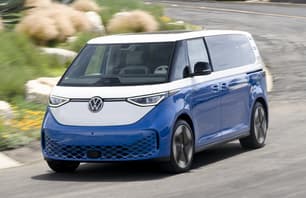
It’s the premium, sportier, AWD GTX version of the pure-electric Volkswagen ID.Buzz.
This one-box wonder hits the retro-futurist ball out of the park and we attended its local launch to explore whether what’s under the skin supports the promise of its stunning exterior.
SUVs have become the default choice of families on the hunt for a seven-seater, but BYD’s plug-in hybrid M9 now makes that a harder choice.
People movers are having a renaissance after the segment contracted so hard it left the Kia Carnival as the only valuable option.
Now a wave of plug-in hybrid and electric Chinese machines, including the BYD M9, Denza D9, GAC M8, Xpeng X9 and Zeekr 009 are striving to bring the big van back as the default choice of big families like it’s the glory days of the Toyota Tarago.
None have managed to nudge the Kia Carnival off its lofty perch, but BYD has the mettle to take the fight to the biggest name in the game.
The only way to make this car cooler would be to add a split fold-out windscreen and a tube steel luggage rack on the roof.
It’s fast, super practical, comfortable and guaranteed to put a smile on the face of premium family buyers ready to go for something different. And that smile will extend to just about everyone who lays eyes on it. I love it.
Note: CarsGuide attended this event as a guest of the manufacturer, with travel, accommodation and meals provided.
The BYD M9 offers power, pampering and a premium living space, but at a price.
Surprisingly nimble and agile around town the M9 is fuel-efficient if operated properly. It's backed by a solid warranty but servicing is relatively expensive.
The M9 won’t win any beauty contests, but in the battle of substance over style it triumphs.
Note: CarsGuide attended this event as a guest of the manufacturer with accommodation and meals provided.
The ID.Buzz GTX is characterised by a unique front bumper with new integrated daytime running lights near its outer edges and a narrower black honeycomb grille.
GTX badging and the exterior mirror housings are finished in high-gloss black, and 21-inch alloy wheels are standard.
The rich ‘Cherry Red’ solid paint finish of the launch test car is exclusive to the GTX and it’s a fair bet many buyers will stump up the extra $4K required for a two-tone treatment, in this case with ‘Mono Silver’ as the highlight colour.
The interior is familiar ID.Buzz territory, with the long, broad dashtop pushing the windscreen and small front windows beside it into a quintessentially Kombi ‘bay window’-style design.
A 12-inch central multimedia screen sits proud of the multi-layered dash, and a slick 5.3-inch LCD instrument and car data display is fixed in front of the driver.
A black headliner dials up the sporty feel, the electric front seats are a GTX-specific design and the synthetic diamond pattern microfleece trim is highlighted by red contrast stitching and piping.
The red cross-stitching extends to the steering wheel and smile-inducing stainless steel ‘play’ and ‘pause’ symbols on the accelerator and brake pedals are retained.
The sub-zero cool exterior design manages to merge with a more restrained and practical interior perfectly. VW has solid retro form with the ‘New Beetle’ from the 1990s and this primo ID.Buzz looks amazing. It drew an instant crowd of curious onlookers every time we stopped.
The M9 isn’t winning any beauty contests. Substance it has in spades but style it is sorely lacking.
To be fair, this is a trait of most people movers. It is hard to make a brick look chic.
The front is a big slab of grille, with some slim headlights and side air intakes. But 18-inch alloy wheels and a floating roof and lights that run the length of the rear add a bit of pop.
It’s a big beast, measuring 5145mm long, 1970mm wide and 1805mm high with a 3045mm wheelbase (the distance between front and rear axles).
The ID.Buzz GTX is offered in shorter wheelbase variants with five- and six-seat configurations for other markets, but here it’s seven seats and long-wheelbase only.
At close to five metres long and just under two metres wide, it’s road-trip ready with heaps of breathing room for all seven occupants.
Placement of the gearshift on the right-hand side of the steering column frees up extra space in the front and there’s heaps of storage including a moveable (and removable) centre console unit between the front seats with pull-out drawers at either end, two trays in each door (the lower one offering room for multiple large bottles), a decent glove box and a fold-out dual cupholder unit.
There’s also an oddments shelf in front of the passenger, a wireless device charging slot in the dash and adjustable fold-down armrests on both sides of the front seats.
Pull the handle on the power-opening sliding side doors and the second row opens up with three seating positions offering hectares of room in all directions.
This row can be moved 200mm longitudinally if a turf war erupts with those in the third row. And storage is great with two pockets and a fold out table on each front seatback as well as huge door bins with waste baskets included. There are also adjustable vents with temperature control in the roof.
There’s enough head and legroom for adults in the third row although the backrest is relatively upright. Even access is straightforward and there are numerous storage trays, cupholders, air vents and storage slots back there.
Power across the cabin runs to two USB-C ports in the dash, another in the front passenger area and four USB-C charging sockets in the rear.
Boot space increases from a handy 306 litres with all seats up to 1340 litres with the 50/50 split-folding third row down, and 2469L with it and the 60/40 split second row lowered. That’s plenty.
And that 1.6-tonne braked trailer towing capacity means a jet ski, even a mid-size camper trailer, is within hauling range.
The power tailgate is welcome and the rear of the boot’s load platform sits above two storage boxes. But you won’t find a spare of any description back there; a repair-inflator kit is your only option. So beware, a flat could really suck the air out of this mobile family room.
If the brief for your next car is space for days and moving your family around in peace and comfort, this M9 hits it out of the park.
The front row is roomy and has great forward vision.
Auto sliding side doors grant access to the second and third row with just the push of a button or by pulling the handle. My kids loved this, all they wanted to do was open and close the doors, which then became a bit annoying.
Crucially, getting into the vehicle is so much easier than an SUV, with a giant opening and modest step up that’ll make loading kids and grandparents a stress-free experience.
There is a mini hallway between the two captain’s chairs to get into the third row. It’s tight for adults but kids can scramble in easily.
The captain’s chairs give you a lot of flexibility in the cabin layout. They have plenty of back and forth movement, which means you can expand the third row legroom if needed or give second row passengers some more space. You can also split it in case you have one longer-legged passenger in the back and one shorter.
Child seats can be fixed to the captain’s chairs and the left-most seat in the third row with ISOFIX and top-tether anchor points.
The back of the front seats have tray tables where you could put tablets, colouring books or anything to occupy the kids.
Every row has air con vents and USB charging ports, with an additional wireless device charger up front.
A huge panoramic sunroof lets the light in, and also has a proper cover to keep the heat out in Australia’s scorching summer.
With all seven seats deployed there is still decent boot space. Its 470-litre capacity is less than the Carnival’s 627 litres, but we fitted all we needed for a weekend away with two young children, including a travel cot, travel pram and a few overnight bags.
Fold down the third row and it balloons out to 2036-litres. The captain’s chairs can not be stowed away.
Payload is just 624kg, so a family with all the accoutrements will probably push it to the max. Towing is just 1500kg for a braked trailer and don’t take it off the road, with just 140mm of ground clearance it won’t handle more than a gravel driveway.
There is no spare tyre, with only a fiddly tyre repair kit, which is a bad result for owners.
There are no physical buttons on the dashboard, with everything controlled via the 15.6-inch touchscreen.
The new ID.Buzz GTX 4Motion is priced at $109,990, before on-road costs, which puts it in the same price zone as a diverse range of large, primo people haulers.
On price, it competes with three-row EVs like the Kia EV9, LDV Mifa 9, and if you stretch the price equation a little further, the Zeekr 009. But in terms of style and personality, this machine lives in a world of its own.
Maybe its VW California Beach sibling comes closest, however that van’s traditional turbo-diesel powertrain stands in stark contrast to the ID.Buzz’s pure-electric vibe.
Once you’ve crested the $100K mark, it’s fair to expect a healthy list of included features and the ID.Buzz GTX doesn’t disappoint.
Aside from the performance and safety tech we’ll get to shortly, the highlights include adaptive cruise control, auto LED matrix headlights, 13-speaker (plus sub-woofer) Harman Kardon audio with digital radio, wireless Android Auto and Apple CarPlay, three-zone climate control, a panoramic (dimmable) glass roof, 30-colour ambient lighting, power-adjustable heated front seats, heated (outer) rear seats and 21-inch alloy rims.
There’s also a head-up display, a heated steering wheel, rain-sensing wipers, microfleece seat trim, keyless entry and start, electric side doors and tailgate (the latter with hands-free functionality), ‘Ask IDA’ voice control and dark tinted windows.
That’s a strong, class-competitive value equation. Metallic or pearl effect paint will set you back $1890, the two-tone treatment is $4090 and black 21-inch alloys add $380.
For now the M9 is available in a single Premium grade starting at $72,990, before on-road costs, which is a fair chunk of change compared to the base Kia Carnival hybrid ($56,310). Albeit the M9 gets plug-in hybrid power compared to the Carnival’s self-charging hybrid.
It is competitively priced against the GAC M8 plug-in hybrid ($76,590) and electric XPeng X9 ($89,900).
BYD said it will have a cheaper Dynamic grade in showrooms before the end of the year, which will drop the price of entry into the M9 range to $61,990.
That cheaper grade changes the game, but for now we can only judge the Premium.
It has a 2+2+3 layout and is packed to the rafters with standard kit.
Seats are wrapped in real leather, with the front pair power adjustable, heated and ventilated with a memory function. The driver’s has a massage function.
The second row ditches the usual bench seat for a pair of captain’s chairs that have the same features as the driver’s seat with the addition of an adjustable leg rest.
The Dynamic will revert to a bench pew for the second row, giving it a 2+3+3 seat configuration.
Other standard features include:
The GTX is a twin-motor AWD, the front unit generating 80kW/134Nm and the rear 210kW/560Nm. Total output is 250kW/590Nm which boosts towing capacity from 1.0-tonne in the single-motor ID.Buzz to 1600kg.
A single-speed transmission sends drive primarily to the rear wheels to maximise efficiency, the dual-motor set-up able to direct power to the front axle as required during acceleration or to manage available traction.
The M9 uses a 110kW 1.5-litre turbo-petrol engine paired with a 200kW/315Nm single electric motor that combine for 218kW. The Dynamic will make 191kW from the same set-up. Both are front-wheel drive only.
BYD claims it can hit 100km/h from a standstill in 8.5 seconds.
The ID.Buzz GTX’s 86kWh lithium-ion battery delivers a claimed (WLTP) range of 473km and the car uses a CCS Type 3 socket. VW includes a Mode 2 and Mode 3 cable as standard.
The claimed 10-80 per cent 200kW DC fast charge time is 26 minutes, while the same top-up takes nine hours at a maximum 11.0kW AC capacity.
Claimed energy consumption on the combined (urban/extra-urban) cycle is 20.2kWh/100km (WLTP) and over several hundred kilometres of mainly B-road and freeway running on the launch we saw an average of 24.5kWh/100km, which isn’t out of order given the type of driving involved.
The M9 Premium uses a 36.6kWh LFP battery that delivers a WLTP-verified driving range of up to 145km. The cheaper Dynamic will use a 20kWh battery that allows for an electric range of up to 80km.
The battery can absorb up to 73kW via a DC charger and 7.0kW when plugged into an AC connector.
BYD claims the M9 will drink 0.4L of 91RON fuel per 100km when its battery is holding sufficient charge. This jumps to 7.3L/100km when the battery dips below about 20 per cent.
Total combined range reaches 790km and 850km, respectively.
Realistically, if you are diligent with charging the battery you’ll likely only need to fill the 50-litre fuel tank every few months. But if you are a more relaxed charger, or do longer trips you’re better off with a diesel.
Despite the fact that it weighs in at around 2.8 tonnes (2780kg), Volkswagen Australia says this dual-motor ID.Buzz accelerates from 0-100km/h in 6.4 seconds and on to a 160km/h maximum velocity, if you dare.
And there is always some serious oomph lurking under your right foot. Trundle along at 65km/h, pin the accelerator, and in roughly two blinks of an eye you’re doing 95km/h.
Proportionally, this car is like a loaf of bread on wheels - about as high as it is wide. And on the windy launch drive we were buffeted a bit, the car moving sideways slightly when hit with a gust. But overall, it remains stable despite its proportions. That said, some wind noise comes over the bluff nose on the freeway, but never to an alarming degree.
The ID. Buzz rides on VW’s Modular Electric Drive (MEB) platform and there’s been past criticism of the short-wheelbase versions' ride quality, but there are no such issues here.
Suspension is by struts at the front and semi-trailing arms at the rear and this GTX has had a suspension retune with particular attention paid to key components, including the dampers.
On rural roads that have seen better days, dotted with potholes, bumps and thumps, a combination of that suspension retune and the longer wheelbase helped the GTX handle it well.
There are five drive modes with Comfort the default. Eco smooths out acceleration, tapers the climate control and reduces overall power, while Sport dials up the powertrain, suspension and steering. Traction optimises the AWD system for loose or slippery surfaces and Individual allows you to cherry pick various attributes for a custom set-up.
Steering is progressive rate and you can feel it loading up nicely as you head into a corner. Not the last word in terms of road feel, but the car points accurately and turn-in is nice and progressive.
At the same time you’ve got the electric motors constantly shuffling drive between the front and rear axles, helping you out if you decide to explore the car’s sporty nature and have a crack in the corners.
Tyres are Hankook Ventus S1 Evo3 EV specials (235/45 fr - 265/40 rr) and in long, sweeping bends, taken at pretty decent speed, they grip hard. Even on coarse-chip B-road surfaces there’s a bit of rumble but it’s far from a roar.
Braking is by large (358mm) ventilated discs in the front and, believe it or not, drums at the back. A well-designed, modern drum brake can work effectively and the regenerative braking in an EV like this is a big factor in terms of washing off speed.
In terms of lower speed manoeuvres, you’ve got a 360-degree camera view as well as a reversing camera and front and rear parking sensors. If you really need some help, Park Assist Plus will get the job done for you.
In terms of ergonomics, we spent hours behind the wheel and the front seats remained comfortable and supportive in terms of lateral grip.
Speaking of grip, the steering wheel is nice to hold. And the cool little 5.3-inch instrument and car data display is clear as a bell, and the large 12-inch media screen is easy to use and working through the different screens is largely intuitive.
Climb into the driver’s seat and you are met by well bolstered seats that are supportive and have plenty of adjustment. This is paired with a steering that moves up, down, in and out so you can find a seating position to fit all shapes and sizes.
BYD’s petrol-electric combo can be driven in three different modes.
EV mode uses the 200kW/315Nm motor only to drive the front wheels.
Two hybrid modes include Series and Parallel operations. In Series mode the engine is used to charge the battery only, but in Parallel it blends power with the electric motor to drive the wheels.
The driver doesn’t need to choose the mode, the vehicle will select the best option for driving conditions and the level of battery charge.
The Premium grade has a combined 218kW on tap, which is about right for a 2.6-plus tonne vehicle. It’s perky but not express.
Smooth is one word I’d use to describe the M9’s drive experience. The linear power delivery in all drive modes makes for a comfortable commute.
It was adept in all conditions, whether that was driving through the city, along motorways and up to the Blue Mountains outside of Sydney.
Steering was well balanced but the M9 wasn’t the most dynamic through the corners, which is expected when piloting something shaped like a barge or a brick.
It did have a tendency to want to push wide through bends at moderate speed limits.
The suspension did a great job of controlling the M9’s heft. McPherson strut suspension up front paired with a sophisticated multi-link rear set-up helped reduce lean through corners and iron out bumps and lumps along the way. That said, small consistent road imperfections weren’t its friend, with it jiggling over them at speed.
It was quiet inside, with minimal road noise and wind shear. Even when the engine was working it was a dull rumble rather than an overpowering assault on the senses. Both kids had a nap on longer trips, no problem.
What surprised me the most was how easy the M9 was to park and generally navigate tighter streets. I can’t recall a seven-seat SUV that was this easy to park, and it didn’t feel that big on the road despite its more than five metre length.
Safety tech was properly calibrated, too, with minimal beeps and bongs. There were plenty of warnings on the screen but with no accompanying noises, which is important not to wake kids nodding off.
The current ID. Buzz range hasn’t been assessed by ANCAP although its sister organisation, Euro NCAP, awarded it a maximum five-star rating in 2022.
As you’d expect, a full suite of driver-assistance tech is onboard including highway-speed AEB with pedestrian and cyclist monitoring, adaptive cruise, lane-keeping assist, lane-change assist, blind-spot monitoring, rear cross-traffic alert, driver fatigue monitoring and tyre pressure monitoring.
There’s also a 360-degree view and reversing camera, plus Park Distance Control incorporating front and rear proximity sensors.
The airbag count runs to seven - front, front side, curtains covering the second and third rows, as well as a front centre bag. And multi-collision brake minimises the chances of subsequent impacts after an initial crash
There are five top tethers for child restraints; three across the second row and two in the back row, with four ISOFIX anchors across both rows.
BYD has ticked all the safety boxes with the following standard equipment:
The ID.Buzz GTX is covered by Volkswagen Australia’s five-year/unlimited-km warranty with two years’ roadside assistance included. On top of that, there’s an eight-year/160,000km warranty on the drive battery.
That general warranty is in line with the mainstream market, although it’s worth noting an increasing number are stepping up to longer terms, including 10 years.
There’s a 12-year corrosion perforation warranty and keep servicing with an authorised VW dealer and that roadside assistance support will be rolled over for another two years each time.
The recommended maintenance interval is two years/30,000km. Standard scheduled service pricing is $687 for each of the first five workshop visits, while pre-paid plans covering six, eight or 10 years represent savings of between 30 and 35 per cent on that figure, which is pretty handy.
BYD backs the M9 with a six-year/150,000km guarantee. The battery is covered by an eight year/160,000-km warranty and the drive unit an eight year/150,000km agreement.
A five-year capped price servicing program will cost $2880, which is on the pricier side. Beware the fourth service. That’ll set you back $1145.
The frequency of your workshop visits will depend how often you use the petrol engine, which is not ideal. You’ll need to front up every 12 months or 20,000km (total odometer reading) or 10,000km (hybrid usage reading), whichever occurs first.
There are currently 126 BYD dealers across the country with three 'pop-up' locations - Box Hill, Chadstone and Melton in Victoria - on top of that.