What's the difference?
Long before a hash-tag was anything more than a confusing symbol on a typewriter, vanlife was already a thing.
And you can largely thank Volkswagen for that because its Kombi models from the 1950s, '60s and '70s help cement the idea of roaming around the planet in a self-contained car-cum-house as a counter-culture favourite. More than that, the affordable, rugged Kombi made it actually possible.
Back then, there were a couple of paths to tread. You could take a second-hand butcher’s or florist’s Kombi van (windows optional) and trick it out with a bed, a table and whatever gear you needed to survive on the road.
Or, if the cash was around in sufficient quantities, you could buy a Kombi brand-new and have it converted to camper spec. And of all those brand-new conversion options, Volkswagen’s own, in-house conversion supplier, Westfalia was (and is) regarded as the pick of the crop.
So, when VW announces a 21st Century take on the concept of a factory campervan, those who like the idea of a lap of Australia but don’t like caravans or towing, are suddenly all ears.
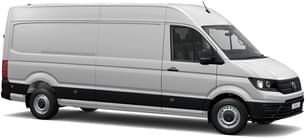
Like most things, the latter-day VW camper has grown a size or two over the last six or seven decades. Which is why the factory Kampervan TD1410 4 Motion (to give it its full name) is based on the long-wheelbase, high-roof version of the Crafter van rather than the original Transporter layout. (There’s still the VW Multivan-based California if the Kampervan is too big.)
But just as commercial vehicles have become bigger and more sophisticated, and glamping has grown out of actual camping, does the modern take on a hippy legend make the grade in 2024? And does the Volkswagen offering retain any of the charm of the original campervan?
Oh, and forget about Westfalia. This conversion is the work of none other than Aussie caravan specialist Jayco.
The deal between Jayco and VW locally, means this variant of the Crafter Kampervan is an Australia-only deal.
There are currently 14 rivals competing for customers in the Light Duty or LD (3501-8000kg GVM) segment of Australia’s heavy commercial vehicle market. Business buyers and fleet operators are thick on the ground here and competition for their business is fierce.
Chinese brand LDV, a division of the huge SAIC Motor conglomerate which is now the seventh largest automotive company in the world, recently joined this battle with its new Deliver 9 van range that’s priced to entice. We spent a week aboard one to see how LDV’s claim of superior value stacks up when there’s work to be done.
This is not the vehicle for somebody looking for the odd weekend away. That’s mainly because it will take up a lot of real estate when you’re not using it (it may not even fit in a lot of car-ports or garages) and it’s far from a daily driver for the school run or shopping trips.
If you’re looking for a getaway machine that will also work at home for the other 48 weeks of the year, a conventional caravan and four-wheel-drive is likely to be a better bet, purely because the tow-vehicle can be your day-to-day transport
But if your plans include longer getaways and you have the storage space to keep the Kampervan stashed away safely, it starts to emerge as a functional alternative.
Talk to long-term travellers, and even the best camper trailer needs to be set up each night and folded away next morning, and as for tents, don’t even start us…
But like a full-sized caravan, the VW simply pulls up to where ever it is you want to stay for the night and is ready to feed, entertain and rest its occupants within seconds of stopping.
But unlike a big, heavy caravan, the Volkswagen imposes far fewer driving caveats (including fuel consumption) and is a vastly more enjoyable and simple thing to drive in pretty much any circumstance.
It's not for everybody, but for those whose lifestyle it matches, the VW Kampervan is an alternative to a caravan that deserves short-listing. Let’s face it, 50 million hippies can’t be wrong.
Note: CarsGuide attended this event as a guest of the manufacturer, with accommodation and meals provided.
It has its flaws, like any vehicle, but it’s not as far away from segment leaders in terms of refinement and performance that its bargain-basement pricing might suggest. Whichever way you look at it, this is a lot of van for not a lot of money.
Given that the design of the camper conversion was partly the work of Jayco, there’s every reason to suspect that the end result should work for recreational users. That is, of course, provided Jayco’s caravan-building experience translates to a campervan layout.
That’s because this is not as simple as plonking a wheel-less caravan onto a Crafter cab-chassis; integration in the key here.
The various zones – driving, entertaining, sleeping, bathroom and cooking – need to work with each other with as many components having more than one job.
The off-grid capability is also a highlight and, in the case of the All-Terrain model with its off-road tyres, bash plates and 30mm higher ground clearance, makes getting farther off the beaten track more of a reality.
A lot of people will wonder why VW didn’t simply import a batch of the campervan conversions it already builds in Europe.
The fact is, however, that the left-hand drive layout means the sliding side door would be on the wrong side for Australia, and the integrated gas system would not have met ADR standards. So was born the idea of a local conversions which is where Jayco came in.
If imitation is the greatest form of flattery then Ford should be blushing, because the Deliver 9 appears to draw a lot of exterior design inspiration from the Transit van. It’s a substantial vehicle, as they tend to be in this weight division, with a 3750mm wheelbase and 14.2 metre turning circle, length of almost 6.0 metres (5940mm) and width of 2466mm. Its 2535mm height excludes it from underground and shopping centre carparks with typical height limits of 2.2 metres.
The rear-wheel drive chassis construction is simple and robust, with MacPherson strut front suspension, multi-leaf live axle rear suspension with supplementary rubber cones to boost support of heavy loads, rack and pinion steering and four-wheel disc brakes. There’s also ample use of hard-wearing black plastic on lower body sections where most scrapes and dents appear.
The cargo bay is accessed by one kerbside sliding door and dual rear-barn doors with 180-degree opening. The walls are lined to mid-height and there’s no roof lining. Bright LEDs provide ample lighting and even though our test vehicle was not the high-roof model, there was enough headroom for tall adults to stand without stooping.
The cabin has a spacious and airy feel, even with a crew of three aboard, thanks largely to a banana-shaped dashboard with ends that curve towards the windscreen providing wide entry access and passenger legroom which is unusually generous for a commercial van.
The cabin has higher-grade look than you would expect at this price, with a tasteful two-tone blend of light/dark grey plastics and faux carbon fibre inserts on the dash along with comfortable, supportive seats with quality-feel fabrics.
However, there is room for improvement, as there’s no cargo protection for driver and passengers, no driver’s left footrest, crackly AM radio reception (too bad if you like talkback) and a poor-quality image projected by the reversing camera.
The Crafter’s phone mirroring system seems to work pretty well, although it’s menu-driven layout can be a bit frustrating (it’s hardly alone there) and Android phones sometimes didn’t want to connect as simply as they should have (potential user-error here, folks).
But the rest of the interior is typically Crafter-smart including lots and lots of cupholders, USB ports and cubby-holes dotted around the front seat area.
Doubtless, a few months on the road will show up design issues according to the individual, but for now, our main comment would be the proximity of the bathroom to the food preparation area (although, to be fair, most owners will cook outside the vehicle).
The mattress is a split queen unit (rather than a single mattress) and it occupies the full width of the rearmost part of the vehicle, so making the bed might be a bit more difficult.
The location and width of the bathroom (although it feels pretty tiny once you’re in there and operates as a wet-room) also means there’s just half the rear view that the vehicle might otherwise have.
The thick pillar between the two rear barn-doors also adds to that blind spot. At least the mirrors are good; nice and wide and very clear.
It’s when the Kampervan is not being used to survey this wide, brown land that its practicality starts to come into question. Unlike a conventional four-wheel drive and caravan rig, the accommodation section of the Crafter can’t simply be unhooked and parked in the driveway.
Which means it’s not really suburb or city-friendly. Underground car-parks will soon detach the air-conditioning unit in a pretty violent way, and the almost-seven-metre length will have you looking for adjacent empty parking spaces (or the car-and-trailer section at Bunnings).
Put simply, this is the touring solution for those who want to tackle the Big Trip in one go, staying on the road for weeks or perhaps even months. Obviously, that’s an observation rather than a criticism, but it remains something to think about.
Its 2358kg kerb weight and 4000kg GVM leaves a competitive maximum payload of 1642kg. It’s also rated to tow up to 2800kg of braked trailer but given the GCM figure (or how much you can legally carry and tow at the same time) is not published, we can’t tell you how much payload it can legally carry while towing that weight.
We struck a similar problem testing a G10 LDV van as far back as 2017, when LDV could not provide the GCM despite a direct approach to the factory in China. Why such a fundamental figure must remain secret is a mystery to us and could be a deal-breaker if you need to tow and carry.
The cargo bay offers a competitive 10.97 cubic metres of load volume. Its load floor’s 3413mm length, 1800mm width and 1366mm between wheel housings means it can easily carry two 1165mm-square Aussie pallets or up to four 1200 x 800mm Euro pallets, held in place by a choice of eight sturdy load anchorage points. There’s also a small cave above the cabin which is ideal for carrying straps, ropes, load padding, tarps etc.
There’s more than ample cabin storage too, with large-bottle holders and two levels of storage in each front door, numerous nooks of different shapes and sizes across the dashboard including a driver’s cup holder, plus a single glove-box and large overhead storage shelf with central sunglasses holder.
Pivoting the two passenger seat base cushions forward reveals another big storage area beneath them. The centre seat backrest also folds down to reveal a handy work desk on the back if it, which includes two cup holders. Overall, there’s smart use of space here.
Based on the top-shelf Crafter van, the Kampervan then goes on a mission to be both a car and a holiday house.
So, pull up a comfy chair, because there’s a fair bit to discuss here. This isn’t just a tent on wheels, it’s a fully functional tiny home that just happens to be relocatable on a daily basis. As such, the vehicle needs to be able to manage energy, water, gas and waste.
VW’s aim was to elevate the quality standards of the caravan industry to that of the car-making world, as well as address its customers’ main agendas, including storage, the ability to go off-grid and the management of light and ventilation for sleeping.
That utility starts with the walk-through layout where the front seats swivel to form the other half of the dining table seating. From there, the layout runs to a full bathroom, a kitchen and then back again to a fixed queen-size bed.
The bathroom combines a shower and a lavatory with a cassette system for black-water storage and disposal.
The kitchen features a 90-litre fridge with a freezer drawer that is accessible form both inside and outside the vehicle. There’s a dual gas-hob and a 9.0kg gas bottle stored in the rear compartment (under the bed, but accessed from outside) that also includes a huge slide-out drawer for an extra fridge or whatever else needs to be carted around.
There’s also a sink with a mixer tap and the vehicle carries 120 litres of fresh water, not to mention gas-powered on-demand hot water.
A wind-out awning runs the full length of the van, extending the living space and forming a space for the VW-branded camping table and chairs.
The bedroom includes a pair of swivelling fans for cross-ventilation, USB and 240-volt ports, a swivelling TV and blinds and screens on all windows. The standard air-conditioning system will also run for about seven hours before the vehicle runs out of power.
Speaking of power, the electrical system is a force of nature. Aside from the standard Crafter battery (which remains the start battery and can’t be depleted by the equipment on board) the standard smart-alternator function has been disabled so the engine can help charge the batteries whenever possible.
That power storage array incorporates a 400Ah lithium-ion battery with a 3000-watt inverter to run the 240-volt system even when off-grid. There’s a 60A DC-to-DC charging system and, all up, VW reckons the vehicle can stay off grid for about three days straight based on normal power consumption. A multi-screen control panel tracks power usage and issues alerts when required.
So, what’s missing from the Kampervan? Climate-control air-conditioning for the cabin, mainly (the Crafter starts life as a commercial van, after all). Oh, and beds for the third and fourth passenger. Cue hippy-free-love jokes.
The Kampervan starts at $157,990 for the on-road biased Style model and $165,490 for the All-Terrain version.
As the more off-road capable variant, the All-Terrain gets 16-inch steel wheels with all-terrain tyres, bash plates, a higher ride height and a snorkel.
In either case, the accommodation fittings and fixtures are identical, that sounds pretty steep, but go out and price a full-sized four-wheel drive and a full-sized caravan with a bathroom and then see how it all stacks up.
Our test vehicle is the long wheelbase mid-roof, which is part of a three-model Deliver 9 range offering mixed wheelbase and roof height combinations. According to local distributor Ateco, the van’s unusual name has no real significance beyond the fact that in China it’s sold as the V90, so given Volvo’s existing V90 nomenclature, LDV changed the name to Deliver 9 in export markets.
Available only with a 2.0 litre turbo-diesel engine, the standard transmission is a six-speed manual or there’s the optional six-speed automatic like our test vehicle, which has an RRP of $44,726. Needless to say, that’s a massive saving compared to top-selling van rivals like the Ford Transit 350L LWB RWD auto at $54,090 and Mercedes-Benz Sprinter 314 CDI LWB RWD auto at $66,240.
Colour choice is limited to Blanc White or Pacific Blue. It comes equipped with 16-inch steel wheels and 235/65R16C tyres with a full-size spare, plus checker-plate-pattern rubber flooring throughout, LED cargo bay lighting, big truck-style power adjustable and heated side mirrors with indicators, seating for three including an eight-way adjustable driver’s seat with fold-down inboard armrest and an multimedia system with big 10.1-inch touchscreen, two USB ports and Apple CarPlay (but no Android Auto) to name a few. There’s even a rare and endangered cigarette lighter and ashtray.
LDV also offers a $1500 options pack which adds 236-degree rear door opening (except mid-wheelbase model), blind-spot monitoring, lane-change assist and remote keyless entry with push button start.
The Crafter is powered by VW’s now-familiar 2.0-litre turbo-diesel four-cylinder engine which produces 130kW of power and 410Nm of torque thanks to a pair of turbochargers.
Driving through an eight-speed automatic transmission, the torque is then sent to all four wheels via VW’s '4Motion' permanent all-wheel-drive system.
It’s worth mentioning the automatic transmission is a conventional torque-converter unit, rather that the dual-clutch layout VW has championed for years now.
The Crafter also uses ventilated disc brakes front and rear and the however you look at it, the modern driveline of the Kampervan makes an old air-cooled Kombi look even more antiquated (which is saying something).
And while the Crafter in commercial-vehicle trim has the option of an electronic locking rear differential, the Kampervan adds this as standard.
LDV’s Euro 5-compliant 2.0-litre four-cylinder turbo-diesel produces 110kW at 3500rpm and 375Nm between 1500-2400rpm, which is adequate but not class-leading. It also offers a choice of Eco and Power driving modes and auto stop/start.
The six-speed torque converter automatic is smooth-shifting and easy to use. It also has the option of sequential manual-shifting which can be handy at times when hauling heavy loads, particularly in hilly terrain to save the transmission from continually hunting for gears.
Although the Crafter’s driveline boasts energy recuperation, it’s not a hybrid system. Instead, the vehicle’s alternator is able to generate electricity during braking and store that in the vehicle’s batteries for later use, rather than storing that power in a dedicated hybrid battery.
This also helps ensure the main battery is always fully charged to power the stop-start system that is also standard on the Crafter.
Because it’s a commercial vehicle, there’s no compulsion to offer an official fuel consumption figure and, indeed, Volkswagen doesn’t.
But our real world drive including some winding roads and a bit of freeway thrown in, gave us an average figure of between nine and 10 litres per 100km. This is likely to be a bit lower on a purely highway run, but is a good indicator of general use consumption.
The 75 litre fuel tank should, then, give an easy 700km of range, but don’t forget the Crafter’s engine uses AdBlue, so that extra cost needs to be factored into running costs.
The dash display was showing an average combined figure of 11.0L/100km at the end of our 290km test, with the auto start/stop function disabled and about a third of that distance hauling maximum payload. Our figure crunched from fuel bowser and tripmeter came in at 12L/100km, so you could expect a real-world driving range of around 660km from its 80-litre tank.
You can see the appeal of a high driving position the moment you step into (or climb into, really) the Kampervan. The view out is fabulous and even though the vehicle is just shy of seven metres long, you soon develop a bit of a sixth sense for where the back wheels are, based on what the front wheels have just done.
The glass area is huge with the exception of the view to the rear thanks to that bathroom placement.
The front seats are big and comfy, although the two rear seats are pretty flat and place the occupants quite close together. There’s enough adjustability in the seat and steering column to make anybody feel at home and the exterior mirrors are big and clear.
There’s enough performance, to be sure, but the sheer mass of the Kampervan and the fact that it’s moving a lot of air means you’ll be giving the rather long-travel accelerator a decent workout.
Taking off into traffic is the only time the VW will feel a bit sluggish, but once the engine has a few revs on board it all gets going fairly smartly.
Unlike a lot of modern cars that can feel as though they're travelling a lot slower than they really are, the Kampervan is the opposite. Not that it’s spooky to drive, but there will be times you’ll be in a 100km/h zone, look down and discover you’re doing 90.
In the context of a leisure vehicle, this shouldn’t bother anybody apart from a highway patrol officer down on his or her monthly quota.
The engine is smooth and the transmission is refined and possesses enough smarts to make a better job of shifting itself than the driver ever will.
It’s not exactly silent inside, though, with a smattering of clicks and clatters from some of the less-automotive furniture, but it’s a fair bet even a brand-new house would likewise rattle a bit if you hurled it down a bumpy road at 100km/h.
The biggest source of noise pollution, though, is in the All-Terrain model and consists of a chorus of sucking, sobbing, choking and burping noises from the snorkel which is placed right near the driver’s right ear. Obviously, it’s worse with the window open.
Ride quality is very good. Clearly, having a bit of weight on board doesn’t hurt, but even so, the Kampervan refuses to pitch or wallow despite that ride compliance. In fact, it’s very composed for such a big unit that was originally designed to carry parcels and pallets.
It’s pleasantly civilised to drive unladen, even on bumpy roads. With rock-hard tyre pressures (front 51psi, rear 71psi) recommended for load-carrying, the unladen ride remained disciplined and relatively smooth, so LDV has done a good job with the suspension tuning.
We were also pleasantly surprised by the low internal noise levels, not only in city and suburban driving but also at highway speeds. We can only assume that the load floor’s thick rubber flooring, which also covers the rear wheel housings, is effective in reducing the higher noise levels typically experienced in vans without cabin bulkheads like this one.
There are clear eye-lines to the door mirrors and the view through the rear doors using the central mirror is also uncluttered. There’s evenly-balanced elbow support for the driver between the fold-down inboard armrest and door moulding. However, we did miss having a left footrest.
With maximum torque available across a broad band between 1600-2400rpm, the engine displays good flexibility in city and suburban driving, even though it lacks the instant punch of rivals like the Transit’s stellar 2.0 litre EcoBoost engine when operating in its peak torque zone. The engine only needs 2000rpm at 100km/h and 2250rpm at 110km/h, but the degree of push required on the accelerator pedal to maintain it feels like it’s punching above its weight a little in either drive mode.
Our only major gripe is the adaptive cruise control. Usually these systems will automatically resume their pre-set speed, after being given clear road ahead following a lane change from behind a slower vehicle. However, our test vehicle required tapping the accelerator each time a lane change was made to resume the set speed. It also required this reset technique after downhill braking, so some refinement here would be welcome.
The Crafter, on which the Kampervan is based, is typical of the emerging breed of commercial vehicles that try not to give anything away to passenger cars in safety terms.
Well, in the front seats anyway, because the two seats in the rear are formed by a bench seat that doubles as a kitchen-table seat, so lacks the contouring of most car seats.
More importantly, the rear seats miss out on side-curtain airbags. This is understandable given the vehicle’s origins. Both rear seats do, however, feature top-tethers for child restraints.
Up front, meantime, the two front passengers get both front and side-curtain airbags with a full array of driver aids to help with safety.
They start with stability control, anti-lock brakes, brake-assist, traction-control, multi-collision braking and hill-holding function.
There’s also autonomous emergency braking that works at speeds up to 60km/h, driver-fatigue detection, a rear view camera, adaptive cruise-control, rear cross-traffic alert, blind-spot monitoring and lane-keeping assistance.
What’s missing? Apart from the side airbags for all passengers, we’d like to see tyre-pressure monitoring on such a large, heavy vehicle and AEB that works beyond 60km/h.
The Kampervan has not been ANCAP tested.
There’s no ANCAP required in the 3501-800kg GVM class but it comes well equipped for the money with AEB, lane-departure warning, reverse parking sensors and wide-view reversing camera, hill-hold assist, adaptive cruise control and stability control. There’s also driver and passenger front, side and curtain airbags. No cross-traffic alert but blind-spot monitoring and lane-change assist are available as part of the previously mentioned options pack.
The Kampervan carries Volkswagen Australia’s full five-year/unlimited-kilometre warranty. That extends to not just the base vehicle, but the whole conversion including all of Jayco’s additions and other aftermarket fittings.
VW offers a version of capped price servicing called its 'Service Care Plan' that covers scheduled maintenance for the first five years and can be purchased at the time the vehicle is ordered.
No price for this was available as we went to press, but for reference, the same five-year service plan for the Amarok dual-cab ute costs $1900.
Standard service intervals are every 12 months or 20,000km, whichever comes first.
LDV’s national network of 82 dealers inspires more confidence than the three years/160,000km warranty, which is less than the major players – but then its purchase price is much lower too. Scheduled servicing is six months/5000km then 12 months/35,000km whichever occurs first and 12 months/30,000km after that. Capped-price servicing program of $1895 covers the first three years or 95,000km whichever occurs first.