What's the difference?
Long before a hash-tag was anything more than a confusing symbol on a typewriter, vanlife was already a thing.
And you can largely thank Volkswagen for that because its Kombi models from the 1950s, '60s and '70s help cement the idea of roaming around the planet in a self-contained car-cum-house as a counter-culture favourite. More than that, the affordable, rugged Kombi made it actually possible.
Back then, there were a couple of paths to tread. You could take a second-hand butcher’s or florist’s Kombi van (windows optional) and trick it out with a bed, a table and whatever gear you needed to survive on the road.
Or, if the cash was around in sufficient quantities, you could buy a Kombi brand-new and have it converted to camper spec. And of all those brand-new conversion options, Volkswagen’s own, in-house conversion supplier, Westfalia was (and is) regarded as the pick of the crop.
So, when VW announces a 21st Century take on the concept of a factory campervan, those who like the idea of a lap of Australia but don’t like caravans or towing, are suddenly all ears.
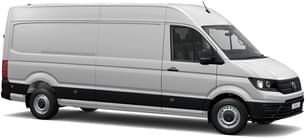
Like most things, the latter-day VW camper has grown a size or two over the last six or seven decades. Which is why the factory Kampervan TD1410 4 Motion (to give it its full name) is based on the long-wheelbase, high-roof version of the Crafter van rather than the original Transporter layout. (There’s still the VW Multivan-based California if the Kampervan is too big.)
But just as commercial vehicles have become bigger and more sophisticated, and glamping has grown out of actual camping, does the modern take on a hippy legend make the grade in 2024? And does the Volkswagen offering retain any of the charm of the original campervan?
Oh, and forget about Westfalia. This conversion is the work of none other than Aussie caravan specialist Jayco.
The deal between Jayco and VW locally, means this variant of the Crafter Kampervan is an Australia-only deal.
There was a time when utes were bought purely for work but some these days look more like high-riding prestige cars with their sparkling pearlescent paint, sumptuous leather seats that heat, cool and massage, high-tech hybrid drivetrains, independent rear suspensions and 0-100km/h times that were once the sole domain of supercars.
However, traditional ute buyers like tradies, farmers and fleets are still well catered for by some brands when seeking a utilitarian turbo-diesel workhorse designed primarily for hard yakka.
Mitsubishi has recently added 4x2 and 4x4 cab-chassis variants to its local Triton line-up comprising single-cab, club-cab and dual-cab body style across most model grades to broaden the Triton’s appeal for either working roles or adventuring.
We recently spent a week aboard one of these new cab-chassis variants in base GLX specification, to see from a tradie’s perspective if it has what it takes to cut it in the rough-and-tough world of working utes.
This is not the vehicle for somebody looking for the odd weekend away. That’s mainly because it will take up a lot of real estate when you’re not using it (it may not even fit in a lot of car-ports or garages) and it’s far from a daily driver for the school run or shopping trips.
If you’re looking for a getaway machine that will also work at home for the other 48 weeks of the year, a conventional caravan and four-wheel-drive is likely to be a better bet, purely because the tow-vehicle can be your day-to-day transport
But if your plans include longer getaways and you have the storage space to keep the Kampervan stashed away safely, it starts to emerge as a functional alternative.
Talk to long-term travellers, and even the best camper trailer needs to be set up each night and folded away next morning, and as for tents, don’t even start us…
But like a full-sized caravan, the VW simply pulls up to where ever it is you want to stay for the night and is ready to feed, entertain and rest its occupants within seconds of stopping.
But unlike a big, heavy caravan, the Volkswagen imposes far fewer driving caveats (including fuel consumption) and is a vastly more enjoyable and simple thing to drive in pretty much any circumstance.
It's not for everybody, but for those whose lifestyle it matches, the VW Kampervan is an alternative to a caravan that deserves short-listing. Let’s face it, 50 million hippies can’t be wrong.
Note: CarsGuide attended this event as a guest of the manufacturer, with accommodation and meals provided.
Apart from its distracting driver attention monitor, we can't see any major flaws that would detract from this vehicle’s comfort, practicality and performance when serving as either a utilitarian 4x4 workhorse or back-to-basics 4x4 dual cab for adventures off the beaten track.