What's the difference?
Car companies don’t normally overhaul a vehicle so rapidly and comprehensively. But the updated Subaru Solterra EV is an exception. It had to be done and this isn’t just an update, it’s an act of survival for Subaru… and Toyota.
You knew the Solterra’s identical twin is the Toyota bZ4X, right? Together Subaru and Toyota developed an electric SUV. Subaru’s is the Solterra, Toyota’s is the bZ4X - same car, different styling, mostly.
The problem was the vehicle couldn’t compete with rivals like the Zeekr 7X and Tesla Model Y on price, driving range, power or charging speed.
Subaru and Toyota knew this had to be fixed ASAP. And so we now have the new Solterra. But is this revised version good enough? Read on to find out.
The Mitsubishi Pajero Sport is one of the quiet-achieving top-sellers in the Australian 4WD market and now 2WD five- and seven-seater variants have been added to further expand the popular SUV wagon line-up.
With sub-$50,000 price-tags being touted, is a 2WD Pajero Sport worth your consideration?
We had a seven-seater variant for a week to see how it stacks up against its 2WD rivals and its own 4WD stablemates.
Read on.
The updated Subaru Solterra is now good enough to compete with rivals such as the Tesla Model Y and Zeekr 7X. The price is right as are the driving range and motor outputs.
There's room for improvement in terms of cabin packaging. The car doesn’t cater for taller, larger people up front, with the steering wheel placement and wide centre console. Cabin storage could also be much better.
Still, the Solterra is superb to drive. One of the best EVs I’ve piloted at this price.
The Mitsubishi Pajero Sport GLS 2WD seven-seater is a well-built and well-priced family-friendly wagon.
It's nice to drive, has a rather comfortable interior and – bonus – the vehicle on which it's based has proven credibility as a no-nonsense and highly functional touring vehicle.
But in 2WD guise it's missing something: namely Super Select II, which accounts for a considerable chunk of the 4WD Pajero Sport’s appeal – so the absence of that in this 2WD version is a significant negative, in my books.
The not-so-subtle point I’m trying to make? Sure, the 2WD Pajero Sport is a few grand cheaper than its 4WD stablemate and it's a solid value-for-money buy as is, but I reckon paying the extra cash to get your hands on a Pajero Sport that's equipped with Super-Select II is the better bet.
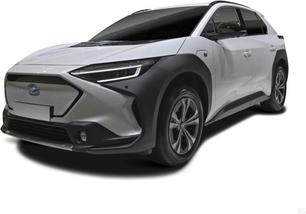
The Solterra is a mid-sized SUV with sporty coupe-like styling and this update has seen the front of the car receive a new look which to my eyes is better than the previous face.
The rest of the car’s exterior remains mainly unchanged in the design.
If you aren’t a fan of the Solterra’s look then check out Toyota’s bZ4X, which is its twin and has slightly more conservative styling, and while I do like the Subaru’s face, I think Toyota’s tail-light treatment is cleaner.
The cabin is modern with a large central media screen, a high-placed instrument display and a wide centre console with dual phone chargers. But the squareish steering wheel steals the show, completing the futuristic vibe.
This update has seen the centre console re-designed with the dual chargers added and the gear-shifter moved backwards away from the media display.
The cabin doesn’t have much in the way of glitzy touches, with dark materials dominating throughout. Hard plastics abound, but the interior still looks and feels premium.
The Pajero Sport is 4825mm long (with a 2800mm wheelbase), 1815mm wide and 1835mm high. It has an official kerb weight of 1980kg.
I don’t mind the styling of the Pajero Sport. It doesn’t look as bulky as many of its rivals and it manages to have a rather contemporary, but comfortably middle of the road, presence.
If you’re that concerned about keeping up appearances, perhaps take a look at a Pajero Sport in the metal, drive it, imagine yourself living with it day to day, then make up your own mind whether you think it suits you or not.
Easy.
The steering wheel’s square design is like that for a reason - it’s designed to provide the driver with a clearer view of the instrument cluster. But as noted in the past with other vehicles that choose this set up, the ergonomics don’t work for everybody - especially if you’re tall like me (I’m 189cm).
In my case the top of the steering wheel obstructs my visibility of the display, which shows vehicle speed among other crucial info.
There’s also a problem with the clearance of the steering wheel and my legs. This is caused by a combination of my height, the low steering wheel and the limitations of how much it can be raised, the low-hip point in the seating position and the shape of the wheel.
Add an overly wide centre console and space for larger and taller drives becomes even more cramped.
Moving the shifter back in this update also makes it more difficult to use for me and the mechanism is quite clunky.
Second row space is a much better story, with a flat floor, good headroom and lots of legroom even for me behind my driving position. The rear door aperture isn’t great and this has made installing child car seats and the corresponding child difficult.
Cabin storage could also be better. There’s no glove box, but there is space under the centre console, although this is now where the large driver’s manual lives. There’s a large centre console bin, big door pockets and four cupholders (two up front and two in the second row).
The second row has directional air vents and USB ports. There are USB ports up front, too.
Boot capacity isn't enormous at 421 litres in the entry-grade and 410 litres in the Touring. There’s no front boot, either. Under the bonnet is the Solterra’s front motor and electrical hardware.
The Solterra is a five seater SUV, so no third row here.
The interior has a practical and familiar feel about it. Sure, it’s a bit on the basic side of things – with cloth seats and rubber floor mats – and it certainly lacks the plethora of soft-touch surfaces some of its more expensive rivals may have, but this interior’s life-friendly sense is a bigger positive for it than any posh addition could be.
The front seats are rather supportive, with a real snug feel to them, and are manually adjustable, which is fine with me.
The reach- and height-adjustable steering wheel has paddle shifters for when your driving takes on more of a sense of urgency.
The dash and 8.0-inch touchscreen media unit has an integrated sense to it. And this cabin’s all-pervasive sense of familiarity continues here with all of the buttons and dials easy to spot on the fly and, more importantly, operate without fumbling around for them.
Driver and front passenger have access to media and aircon controls, among others, as well as cup-holders in between the front seats, a bottle holder in each of the doors, and small spots here and there for your wallet, keys etc.
The second row is suitably comfortable and I sat behind my driving position and there was plenty of head and leg room. It’d be much squeezier for those of us who stand at six-feet (182cm) or beyond.
Second-row passengers have access to a fold-down arm-rest with cup holders, air vents and there are USB charge points and a power socket in the rear of the centre-console.
The seat-backs have map pockets and the doors each have a bottle holder.
The second row is equipped with three child-seat top-tether points, and two ISOFIX points. It is a 60:40 split-fold configuration.
Passengers in the third-row seat have access to cup-holders and air vents, but that’s little compensation because the space back here is on the wrong side of tight.
The third row is a 50:50 split-fold configuration.
In terms of packability, the rear cargo area’s volume is listed as 131 litres when all three rows are being used as seating; 502 litres when two rows are in use; and 1488 when the second and third rows are stowed away.
Annoyingly, the third row is a real bugger to stow away and doesn’t fold flat into the floor. Maybe I’m missing a trick but this third-row strife was a source of more than a bit of frustration for the photographer and I – and we’re both experienced vehicle-based travellers.
The rear cargo area is equipped with power sockets and tie-down points. There is a shallow underfloor storage box back there as well.
The updated Solterra is offered in two grades. An entry-grade model, simply called Solterra, lists for $63,990 and above that is the Solterra Touring for $69,990. That’s up to seven thousand dollars more affordable than pre-update.
We tested the top-of-the-range Touring, which comes loaded with standard features, the only option being leather seats.
If you were wondering if you needed to spend the extra money on the Touring you might be pleased to know both grades have exactly the same powertrain and the entry-grade comes with plenty of standard features.
Coming standard on the entry grade Solterra are 18-inch alloy wheels, LED headlights and LED tail-lights, power mirrors, puddle lamps, a powered tailgate with kick-sensor (new with the update) and roof rails.
There’s also synthetic leather seat trim, heated and eight-way power-adjustable front seats, a heated leather steering wheel, heated second row seats, dual-zone climate control, a 14-inch multimedia touchscreen (new) and 7.0-inch driver display, wireless Android Auto and Apple CarPlay, dual wireless phone chargers (new) and a six-speaker sound system.
The Solterra Touring comes standard with all this but adds 20-inch alloy wheels, a panoramic sun roof, ventilated front seats (new) and a 10-speaker Harman Kardon sound system.
The Touring also features a 220V vehicle-to-load (V2L) power outlet.
Our test vehicle – a Mitsubishi Pajero Sport GLS 2WD seven-seater – has a manufacturer suggested retail price of $49,190 (before on-road costs).
But our wagon had a stack of accessories, which included alloy front protection bar ($3879), towbar kit ($1386), towball cover ($7), rear cargo liner ($205), and carpet mat set ($230). That total accessories cost of $5707 (price includes recommended dealer fitment cost) brings this vehicle’s as-tested price to $54,897.
There is a 2WD GLX spec, a five-seater, which is slightly cheaper than our test vehicle, with an MSRP of $44,440.
The standard features list on the GLS is generous and includes an 8.0-inch touchscreen multimedia unit (with Apple CarPlay, Android Auto, and satellite navigation), dual-zone climate control air conditioning, a power tailgate, privacy glass, automatic rain-sensing wipers and dusk-sensing headlights and, of course, seven seats.
I’ve mentioned the accessories above – and there are lot more of a variety of those available from Mitsubishi as well as from Australia’s bloody awesome aftermarket industry – so let’s get cracking with the yarn proper.
The Solterra has two electric motors and as before there is one driving the front wheels, and one driving the rear wheels for all-wheel drive. Toyota’s bZ4X twin can be had in two-wheel drive and AWD.
The big news is the motors are now more powerful. Much more powerful. Combined output is 252KW (up from 160kW). That’s a huge increase but power is still less than the output of a Model Y or Zeekr 7X.
The front motor now makes 167kW/268Nm, while the rear motor produces 88kW/169Nm. Acceleration from 0-100km/h is about five seconds and that’s almost two seconds faster than the old version.
The Pajero Sport has a 2.4-litre, four-cylinder turbo-diesel engine, which produces 133kW at 3500rpm and 430Nm at 2500rpm, and it has an eight-speed automatic transmission.
This 2WD variant does not have Mitsubishi’s impressive Super-Select II 4WD system, of which I’m a big fan, and that absence is a substantial negative against it, I reckon. But more about that very soon…
The updated Soltera’s battery size has increased to 74.7kWh. That’s up from 71.4kWh and means driving range has increased.
The new, larger lithium ion battery delivers a range of 566km (WLTP) in the entry-grade Solterra (up from 414km). That addresses a big concern about the old car. The Touring has a range of 517km and any range above 500km is acceptable in my book.
Also big news is the increase in maximum AC charging capacity from 11kW to 22kW. DC charging capacity is the same at 150kW with 0-80 per cent charge in about 30 minutes.
Consumption officially ranges from about 14.6kWh/100km in the entry-grade Solterra to 16.0kW/100km in the Touring. The Touring we tested was reporting 17.0kW/100km according to the trip computer after 163km of testing in mainly urban conditions.
The 2WD Pajero Sport has an offical fuel consumption of 8.0L/100km on a combined cycle.
On our test, which included a stint of dirt-road driving, we recorded fuel consumption from fill to fill of 9.2L/100km.
It has a 68-litre fuel tank so, with that sort of fuel-consumption figure, you can reasonably expect a driving range of approximately 690km from a full tank, but that’s factoring in a safe-distance buffer of 50km.
The Solterra may slightly lag behind rivals in some areas such as range and power output, but where most rivals can barely touch it is when it comes to driving.
Currently there aren’t many electric vehicles that are good to drive, except for more prestige offerings from brands such as BMW, Mercedes-Benz and Porsche.
The Solterra is one of the best electric vehicles I have driven at this price point and it’s down to the outstanding platform it shares with the Toyota bZ4X which provides superb ride comfort, great handling and excellent steering.
Acceleration is strong and traction from the all-wheel drive is good.
Sure, while the driving position needs improvement, the car itself is excellent to drive.
Visibility is also good and sound intrusion is minimal. We noticed some materials making noises in the cabin. Although this is common, with no engine to mask it, it becomes more noticeable in EVs.
This is mostly a smooth driving wagon while tackling daily duties on the blacktop and with some highway stretches thrown into the mix.
Steering has a nice weight to it and the Pajero Sport is a nimble, highly manoeuvrable SUV, with a turning circle of 11.2m, even if it does start to reveal more than a bit of body-roll through more aggressive driving. No surprise and no worries – this is an SUV after all, not a sports car.
Also, worth noting is the fact that our test vehicle’s alloy bullbar made it heavier at the front end thus affecting its handling somewhat.
Throttle response is sharp and the 2WD Pajero Sport retains the line-up’s punchy turbo-diesel engine and teamed with the eight-speed auto it makes for a quietly effective, rarely stressed working partnership, rather than an energetic match-up.
The suspension set-up here – double wishbones with coil springs and stabiliser bar at the front, and three-link, coil springs and stabiliser bar at the rear – yields a very firm ride and one which can tend towards jarring if you’re traversing chopped-up back-country bitumen or really anything beyond bitumen that's in good nick.
The tyres – Toyo Open Country A32 (265/60R18) – are well-suited to bitumen, not so much to off-roading, which is perfectly reasonable for this 2WD vehicle. Also, this rubber is on the correct side of quiet.
As mentioned earlier, Mitsubishi’s Super-Select II 4WD system is missing from this variant, obviously, as this is a 2WD. And that’s a crying shame because even if you never venture off the road, Super-Select II is very handy. In Pajero Sports equipped with it, you can drive in 4H (4WD high range) even on bitumen or any high-traction surface because 4H in this vehicle means that – and I’m directly quoting Mitsubishi’s offical system explanation here – “all wheels are driven via the transfer case with an open centre differential, this means all four wheels will send power to the ground while still operating independently of one another”.
If you drove like that in most other 4WDs – at speed in 4H on bitumen or the like – you’d risk transmission wind-up, but there’s no danger of that in a 4WD Pajero Sport because its centre diff is open, not locked, when 4H is engaged.
This gives the driver increased traction and so better control and that means it’s a safer all-round driving experience for everyone involved.
Unfortunately, none of those benefits are available in this 2WD variant.
Having said all of that, this Pajero Sport is very drivable, functional and still manages to retain respectable, if not high, levels of refinement.
The Solterra has been awarded the maximum five-star ANCAP rating - but that was given under 2022 testing criteria and the bar has been raised quite a lot higher since then.
Still, the level of safety technology is high with AEB, lane keeping assistance, blind spot warning and rear cross traffic alert onboard.
Front and rear parking sensors are standard on both grades, as is a 360 degree camera view. Auto parking is standard on the Touring.
A digital rear vision mirror is also standard on both grades providing a clear and unobstructed view.
There are seven airbags present, including a front centre bag. And there are three child seat top tether points across the second row with ISOFIX anchors in the two outer positions.
The Pajero Sport has a five-star ANCAP safety rating based on testing in October, 2015.
Safety gear includes seven airbags (driver’s knee, driver and passenger front, driver and passenger front sides, and curtains) and this Pajero Sport’s suite of active safety and driver-assist tech includes AEB, adaptive cruise control, trailer stability assist, rear view camera and rear parking sensors, but it somehow misses out on blind spot warning and rear cross-traffic alert.
The Solterra is covered by Subaru’s five-year, unlimited-kilometre warranty which is falling behind the seven-year warranty offered by many now. The battery is covered by an eight-year, 160,000km warranty.
There is also five years of capped price servicing with each yearly/15,000km service costing between $130-$300. That’s a very reasonable price.
Pajero Sport 2WD is eligible for Mitsubishi's so-called "10/10 Diamond Advantage" package, which includes a 10-year/200,000km warranty and 10 year/150,000km capped price servicing. But you need to ensure you get the vehicle serviced at an authorised Mitsubishi dealer to take advantage of the 10-year warranty plan.
Each capped price servicing extends free roadside assistance by another 12 months.
The servicing schedule and costs per service are: $399 (at 12months/15,000), $399 (24 months/30,000km), $499 (36 months/45,000km), $699 (48 months/60,000km), $499 (60 months/75,000km), $699 (72 months/90,000km), $499 (84 months/105,000km), $999 (96 months/120,000km), $599 (108 months/135,000km), and $699 (120 months/150,000km).