What's the difference?
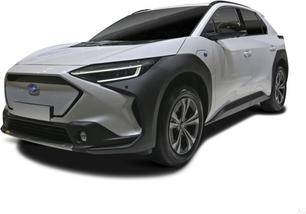
Car companies don’t normally overhaul a vehicle so rapidly and comprehensively. But the updated Subaru Solterra EV is an exception. It had to be done and this isn’t just an update, it’s an act of survival for Subaru… and Toyota.
You knew the Solterra’s identical twin is the Toyota bZ4X, right? Together Subaru and Toyota developed an electric SUV. Subaru’s is the Solterra, Toyota’s is the bZ4X - same car, different styling, mostly.
The problem was the vehicle couldn’t compete with rivals like the Zeekr 7X and Tesla Model Y on price, driving range, power or charging speed.
Subaru and Toyota knew this had to be fixed ASAP. And so we now have the new Solterra. But is this revised version good enough? Read on to find out.
Segment-bender, model-mash-up, mold breaker, franken-ute: there are many odd ways to describe the new electric Deepal E07 large 'SUV'.
I prefer to think of it as the mullet haircut of cars — business up front but a party at the back — but Deepal has settled on Multitruck to describe its new SUV-ute mash-up.
There isn’t anything like this vehicle on sale in Australia right now. The most similar vehicle on the global stage would be the Tesla Cybertruck, but the E07 is smaller and much less gaudy.
We got to have our first taste of the new adventure ready machine on Australian roads, and this is what you need to know.
The updated Subaru Solterra is now good enough to compete with rivals such as the Tesla Model Y and Zeekr 7X. The price is right as are the driving range and motor outputs.
There's room for improvement in terms of cabin packaging. The car doesn’t cater for taller, larger people up front, with the steering wheel placement and wide centre console. Cabin storage could also be much better.
Still, the Solterra is superb to drive. One of the best EVs I’ve piloted at this price.
The Deepal E07 is a breath of fresh air. It’s exciting to see a vehicle zig when others zag.
It’s not just a conversation-starter, it is well priced, stacked with gear and has some potent performance. Not to mention that rear end has some real-world practicality, even if it isn’t quite a ute.
That is bolstered by a long warranty and a capped-price servicing program to take the risk out of trying a new brand.
It isn’t the sharpest driving machine out there, the safety tech is still annoying and having all the controls in the multimedia screen is infuriating.
Also, there are question marks on if buyers really want or need that fraken-ute rear end.
Time will tell if this car is fad like the mullet haircut or a real-world game changer.
Note: CarsGuide attended this event as a guest of the manufacturer, with meals provided.
The Solterra is a mid-sized SUV with sporty coupe-like styling and this update has seen the front of the car receive a new look which to my eyes is better than the previous face.
The rest of the car’s exterior remains mainly unchanged in the design.
If you aren’t a fan of the Solterra’s look then check out Toyota’s bZ4X, which is its twin and has slightly more conservative styling, and while I do like the Subaru’s face, I think Toyota’s tail-light treatment is cleaner.
The cabin is modern with a large central media screen, a high-placed instrument display and a wide centre console with dual phone chargers. But the squareish steering wheel steals the show, completing the futuristic vibe.
This update has seen the centre console re-designed with the dual chargers added and the gear-shifter moved backwards away from the media display.
The cabin doesn’t have much in the way of glitzy touches, with dark materials dominating throughout. Hard plastics abound, but the interior still looks and feels premium.
The E07 stands out from the crowd. It’s design will turn heads and you’ll have strangers coming over for a sticky beak at all times.
It’s a big beast at more than five metres long and close to two metres wide. That puts it in Toyota LandCruiser territory.
The biggest talking point is the rear. What looks like a liftback is actually a retractable roof that converts it to an open tray at the touch of a button.
You can have it open with the rear seats folded flat or the rear seats up and the glass divider still in place to keep the world at bay.
Outside of the rear end, it's a futuristic-looking car with squished LED headlights, flush door handles and a closed-off front end typical of modern electric cars from China.
Inside it borrowed cues from Tesla with its minimalist design with next to no buttons and only a big central screen.
The interior quality feels good, with premium materials covering all surfaces.
The steering wheel’s square design is like that for a reason - it’s designed to provide the driver with a clearer view of the instrument cluster. But as noted in the past with other vehicles that choose this set up, the ergonomics don’t work for everybody - especially if you’re tall like me (I’m 189cm).
In my case the top of the steering wheel obstructs my visibility of the display, which shows vehicle speed among other crucial info.
There’s also a problem with the clearance of the steering wheel and my legs. This is caused by a combination of my height, the low steering wheel and the limitations of how much it can be raised, the low-hip point in the seating position and the shape of the wheel.
Add an overly wide centre console and space for larger and taller drives becomes even more cramped.
Moving the shifter back in this update also makes it more difficult to use for me and the mechanism is quite clunky.
Second row space is a much better story, with a flat floor, good headroom and lots of legroom even for me behind my driving position. The rear door aperture isn’t great and this has made installing child car seats and the corresponding child difficult.
Cabin storage could also be better. There’s no glove box, but there is space under the centre console, although this is now where the large driver’s manual lives. There’s a large centre console bin, big door pockets and four cupholders (two up front and two in the second row).
The second row has directional air vents and USB ports. There are USB ports up front, too.
Boot capacity isn't enormous at 421 litres in the entry-grade and 410 litres in the Touring. There’s no front boot, either. Under the bonnet is the Solterra’s front motor and electrical hardware.
The Solterra is a five seater SUV, so no third row here.
There are two sides to this story.
The convertible back makes it one of the only true dual-purpose vehicles, but let’s not oversell its capabilities.
It only has a payload of 300kg and only has a 1500kg braked towing capacity, so it's not tradie spec.
It is probably best suited for throwing a few surfboards in the back or mountain bikes and heading off to a remote spot where you can sleep in the car in relative comfort.
There is no rugged ladder frame underneath, but it can do a bit of light off-roading in all-wheel-drive guise.
Ground clearance of 223mm is good and it can wade up to depths of 600mm.
It has a vehicle-to-load function that allows you to power appliances, which boosts its potential as a campsite companion.
Inside it has spacious cabins with oodles of head, leg and shoulder room in both rows. That is thanks to its more than three-metre wheelbase — the distance between the front and rear axle that determines how spacious a cabin is.
There are rear air-con vents and USB charging ports for both rows, and the rear seats can tilt backwards for sleepy young-uns.
The boot capacity is 524L, or 1654L with the rear seats folded. A front boot under the bonnet is 131L.
One of my biggest gripes is that nearly every function of the car is controlled through the big multimedia screen.
There are shortcuts and app-like tiles that make it easier to navigate, but it’s still a hassle to dive into the menu to change side mirrors and other functions usually controlled via physical buttons.
Tesla set the precedent by moving all its functions into the screen and other tech-focused EVs have followed suit, but it smacks of cost savings rather than improving the user experience.
The updated Solterra is offered in two grades. An entry-grade model, simply called Solterra, lists for $63,990 and above that is the Solterra Touring for $69,990. That’s up to seven thousand dollars more affordable than pre-update.
We tested the top-of-the-range Touring, which comes loaded with standard features, the only option being leather seats.
If you were wondering if you needed to spend the extra money on the Touring you might be pleased to know both grades have exactly the same powertrain and the entry-grade comes with plenty of standard features.
Coming standard on the entry grade Solterra are 18-inch alloy wheels, LED headlights and LED tail-lights, power mirrors, puddle lamps, a powered tailgate with kick-sensor (new with the update) and roof rails.
There’s also synthetic leather seat trim, heated and eight-way power-adjustable front seats, a heated leather steering wheel, heated second row seats, dual-zone climate control, a 14-inch multimedia touchscreen (new) and 7.0-inch driver display, wireless Android Auto and Apple CarPlay, dual wireless phone chargers (new) and a six-speaker sound system.
The Solterra Touring comes standard with all this but adds 20-inch alloy wheels, a panoramic sun roof, ventilated front seats (new) and a 10-speaker Harman Kardon sound system.
The Touring also features a 220V vehicle-to-load (V2L) power outlet.
The E07 is available in two grades: a single-motor rear-wheel-drive version and a dual-motor all-wheel-drive variant.
Prices start at $64,900 plus on-road costs for the rear-wheel-drive variant and jump to $73,900 for the dual-motor version.
That’s a very reasonable price for a large electric vehicle, but as it has no real competitors it has the segment and price point to itself.
The only difference between the two variants is the addition of the second motor that brings some serious potent performance.
Both are fully loaded with a laundry list of standard gear.
The E07 rides on monster 21-inch alloy wheels, has LED lighting front and back, a hands-free power tailgate and auto folding side mirrors.
Inside there is a 15.4-inch multimedia screen that is incompatible with wireless Apple CarPlay and Android Auto, and there is a wireless device charger and USB-A and -C ports front and back.
A monster head-up display — which projects information on the windscreen in front of the driver — replaces the driver display, with no instruments in front of the driver.
This is joined by power-adjustable front seats that are wrapped in supple Nappa leather. The front seats are heated, ventilated and have a massage function.
This is topped off with 256-colour ambient lighting and an 18-speaker stereo.
There is self-levelling air suspension that has three height levels, with the tallest providing a healthy 223mmm of ground clearance.
There is some cool tech such as camping mode and a relax mode. The latter fully reclines the front seats, closes the panoramic roof blind and plays some sleep-inducing sounds such as rain noise. Camping mode is similar and allows for you to sleep in the car overnight.
The Solterra has two electric motors and as before there is one driving the front wheels, and one driving the rear wheels for all-wheel drive. Toyota’s bZ4X twin can be had in two-wheel drive and AWD.
The big news is the motors are now more powerful. Much more powerful. Combined output is 252KW (up from 160kW). That’s a huge increase but power is still less than the output of a Model Y or Zeekr 7X.
The front motor now makes 167kW/268Nm, while the rear motor produces 88kW/169Nm. Acceleration from 0-100km/h is about five seconds and that’s almost two seconds faster than the old version.
Both versions can be called potent, but the all-wheel-drive is express.
The rear-wheel-drive version uses a single electric motor to make 242kW and 365Nm, and the all-wheel-drive variant adds a second motor to make a combined 440kW and 645Nm.
That extra grunt drops the E07’s 0-100km/h time from 6.7 seconds to about four seconds.
The updated Soltera’s battery size has increased to 74.7kWh. That’s up from 71.4kWh and means driving range has increased.
The new, larger lithium ion battery delivers a range of 566km (WLTP) in the entry-grade Solterra (up from 414km). That addresses a big concern about the old car. The Touring has a range of 517km and any range above 500km is acceptable in my book.
Also big news is the increase in maximum AC charging capacity from 11kW to 22kW. DC charging capacity is the same at 150kW with 0-80 per cent charge in about 30 minutes.
Consumption officially ranges from about 14.6kWh/100km in the entry-grade Solterra to 16.0kW/100km in the Touring. The Touring we tested was reporting 17.0kW/100km according to the trip computer after 163km of testing in mainly urban conditions.
Both variants use a circa-90kWh Nickel-Manganese-Cobalt (NMC) battery, which is a big unit by EV standards.
It delivers a WLTP-verified driving range of 550km in the RWD version and 510km in the AWD.
The E07’s charging speed is also at the top end of the spectrum.
It has a max DC charge rate of 240kW, which Deepal said can replenish the battery from 30 to 80 per cent in 15 minutes.
AC charging is capped at 7kW, which is below other EVs that can max out at 11kW.
Our test was too limited to conduct a proper real-world test.
The Solterra may slightly lag behind rivals in some areas such as range and power output, but where most rivals can barely touch it is when it comes to driving.
Currently there aren’t many electric vehicles that are good to drive, except for more prestige offerings from brands such as BMW, Mercedes-Benz and Porsche.
The Solterra is one of the best electric vehicles I have driven at this price point and it’s down to the outstanding platform it shares with the Toyota bZ4X which provides superb ride comfort, great handling and excellent steering.
Acceleration is strong and traction from the all-wheel drive is good.
Sure, while the driving position needs improvement, the car itself is excellent to drive.
Visibility is also good and sound intrusion is minimal. We noticed some materials making noises in the cabin. Although this is common, with no engine to mask it, it becomes more noticeable in EVs.
The E07 is a big beast, weighing in at 2440kg for the AWD, and the RWD is about 100kg lighter.
Even that fancy air suspension can't hide that bulk. On smooth city streets and well-maintained motorways, the E07 is very pleasant and comfortable. But on pockmarked and undulating country roads travelling at the sign-posted 80km/h or 100km/h, it rocks and rolls considerably.
The monster 21-inch wheels are likely part of the problem, too.
After looking at my phone in the passenger seat for 20 seconds I started to get car sick… I wasn’t the only person who had that feedback.
Switching to sports mode sharpened it up a little, but the comfort mode was far too soft.
There is a custom mode where drivers can find a happy medium.
The E07 did recover much better over small imperfections, though.
The steering was well-weighted and direct, and the brake and accelerator pedal had a good feel to them with sharp responses that inspire confidence.
We spent most of our time in the all-wheel-drive variant.
It’s fast and brutally quick off the mark, but it doesn't suplex you back into your seat like some electric cars do. Instead the power delivery was more linear, with excellent traction control and no wheel slip.
Deepal has gone the extra mile and added quality Michelin EV tyres that improve grip through corners and reduce noise into the cabin.
The E07 was remarkably quiet inside, even by EV standards, with noise and tyre roar kept to a minimum.
The Solterra has been awarded the maximum five-star ANCAP rating - but that was given under 2022 testing criteria and the bar has been raised quite a lot higher since then.
Still, the level of safety technology is high with AEB, lane keeping assistance, blind spot warning and rear cross traffic alert onboard.
Front and rear parking sensors are standard on both grades, as is a 360 degree camera view. Auto parking is standard on the Touring.
A digital rear vision mirror is also standard on both grades providing a clear and unobstructed view.
There are seven airbags present, including a front centre bag. And there are three child seat top tether points across the second row with ISOFIX anchors in the two outer positions.
Deepal has packed the E07 with safety gear and driver aids.
It has eight airbags, ISOFIX anchor points for the two rear window seats, and a top-tether anchor for all three back seats.
There are front and rear parking sensors, a 360-degree camera and a transparent chassis view that allows you to see underneath the vehicle.
Deepal has ticked all the driver aid boxes with autonomous emergency braking with cyclist and pedestrian detection, lane departure warning and lane-keep assist, rear cross traffic alert with auto braking function, blind-spot detection, speed sign recognition and over speed alert, door open warning, rear passenger alert, safe distance alert and adaptive cruise control.
It’s nice to have all that tech, but it is over-sensitive and you end up just turning it off, which defeats the purpose of having them in the first place.
The E07 hasn’t been crash tested yet, so there's no ANCAP safety rating to report at this stage.
The Solterra is covered by Subaru’s five-year, unlimited-kilometre warranty which is falling behind the seven-year warranty offered by many now. The battery is covered by an eight-year, 160,000km warranty.
There is also five years of capped price servicing with each yearly/15,000km service costing between $130-$300. That’s a very reasonable price.
Deepal covers the E07 with a strong but not market-leading seven-year/160,000km warranty, and the battery is guaranteed for eight years/240,000km.
It also has a tempting seven-year/140,000km capped-price servicing program that requires visits every 12 months or 20,000km, with the former on the shorter side for an EV. The RWD costs $2954.59 over the full term, compared to the AWD's $3143.90. Both outlays are competitive.