What's the difference?
There’s no shortage of models to choose from if you’re after a family-friendly medium SUV. The problem is, it might take a while to get your hands on one, with lengthy wait times for some of the best sellers due to current delays caused by a global parts shortage and supply chain dramas.
But there are a handful of models with healthy stock in dealerships right now and available for immediate delivery. One of them is the Renault Koleos.
It's coming to the end of its life cycle and lacks the shine of some of its fresher rivals, but it’s a lot of car for the money.
We spent a week with the limited edition Koleos Black Edition to see if it is worth a trip to your Renault dealer, or if you should sit tight and wait for one of its newer rivals.
Among the many strange new car brands and names we're increasingly confronted with Subaru is an established and trusted beacon along with Honda, Hyundai, Mazda and Toyota. And Subaru’s Crosstrek SUV competes against rivals such as the Honda HR-V, Hyundai Kona, Mazda CX-30 and Toyota Corolla Cross.
So, what does the Crosstrek give you for your money and what’s different or better about the Crosstrek compared to those rivals?
We tested the mid-grade Crosstrek 2.0S and rediscovered what this small SUV does so well and what could probably be improved.
To be fair to Renault, when the second-generation Koleos launched in 2016, it was a competitive offering. The problem is, a bunch of medium SUV rivals have been replaced in that time and some of them - Toyota RAV4, Kia Sportage, Mazda CX-5 and Hyundai Tucson, to name a few - are high-quality offerings with an engaging drive and the latest tech and in-car features.
Unfortunately, that leaves the Koleos towards the rear of the medium SUV pack.
It offers solid value-for-money, handles reasonably well and is still one the best-looking SUVs on the road. But beyond that, the Koleos can’t keep pace with those top-notch rivals.
The Crosstrek is good to drive with great ground clearance and an excellent all-wheel drive system for light off-road adventures. I’m also a fan of the styling and features for the money. But The letdowns comes in the form of limited boot space and cabin storage, a short warranty and pricey servicing. Still, it’s great to see Subaru has updated the car's safety systems, the most important part of any car.
An area that Renault has excelled at in the past decade has been exterior design. Under the stewardship of design chief Laurens van den Acker, Renault has transformed from somewhat quirky to modern and sleek.
The Koleos is getting on in years, having arrived in 2016, but it’s still a handsome SUV. A 2020 facelift sharpened its looks further and we reckon it’s one of the best-looking models in the medium-SUV segment.
Piano black inserts around the gear shifter are a nice touch, but the fake carbon-fibre inserts look and feel cheap. It’s all a bit generic.
But the appealing contrast yellow stitching on the seats, gear shifter housing, doors, centre armrest and more breaks up the grey with a little pop of colour.
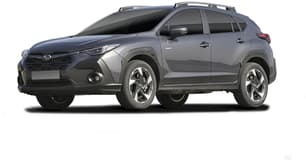
While SUVs tend to come in either a tall and boxy or coupe-like shape, the Crosstrek has a uniquely sleek and sporty wagon look that has stayed much the same over three generations.
Also while the Crosstrek competes with the Honda HR-V, Hyundai Kona, Mazda CX-30 and Toyota Corolla Cross the Subaru is the most off-road suitable thanks in part to its high 220mm ground clearance
As if to signal those adventurous aspirations the Crosstrek has a more rugged appearance with robust-looking plastic guards and chunky roof rails.
Inside the Crosstrek looks so much the same as most other new Subarus it's hard to work out which one you’re in. The materials are dark and soft, there is not much in the way of glitzy trimmings but there’s a high quality feeling throughout.
It might lack the up-to-date styling of those rivals, but the Koleos is practical and spacious inside and great for family duties.
As with the outgoing fourth-generation Nissan X-Trail, the Koleos is one of the larger offerings in the medium SUV segment, and it’s evident when sitting in the front or rear seating row.
Rearward visibility could be better, with a small rear screen and thick C- and D-pillars impeding vision and creating a blind spot.
The front seats are well supported and comfortable and while the driver’s side is power adjustable, the front passenger seat is manually adjustable.
It has a deep central storage bin with a hidden shelf for coins and more. The Koleos features a sizeable glovebox and good bottle storage in the doors, with room for other items.
There’s a weird fixed cup holder in the centre console. It’s not adjustable and there’s room for two very narrow cups and two larger, but not wide, cups. It’s strange. Interior designers could have used that space better.
The CVT's position indicators are located to the left of the shifter and are thus obscured, so you have to rely on the instrument cluster display to confirm what gear you want.
The steering wheel looks and feels good, but the controls aren’t super logical. There are old school switches in the console to activate the cruise control and speed limiter, but then to adjust and reset the speed you have to hit buttons on the wheel that are not clearly marked.
The audio controls are housed on a panel-like stalk to the right side of the steering column, which isn’t ideal. These make more sense if they’re housed on the wheel itself.
Along with a number of cars we have sampled recently, the Koleos has split analogue and digital controls for the air conditioning. Just integrate it in the screen or have traditional controls - not both!
It has a part-digital instrument cluster which is fine, but there’s no head-up display.
Renault’s 'R-Link' multimedia set-up in the Koleos is old, with dated graphics and a small screen, but the menu layout is clear and logical.
The Koleos lacks wireless phone charging and it makes do with wired Apple CarPlay and Android Auto. The quality of the Bluetooth and CarPlay phone audio is poor and sounds tinny.
The proximity key that locks and unlocks the vehicle remotely when you walk towards or away from it works every single time. Many of these systems from other brands are patchy at best but the Renault system is faultless.
The rear seats recline and fold manually 60/40. They’re also surprisingly comfortable. There’s enough bucketing to sink in a bit, and the seats are set high up so kids can easily see out windows.
Space is ample in the second row, with loads of head, leg, toe and knee room, even behind my six-foot (183cm) driving position.
The rear pew has ISOFIX points on the outboard seats, lower air vents, a 12-volt outlet, map pockets, a centre folding armrest with two cupholders, but no USB ports. You have to make do with the two ports at the front.
Open the power tailgate and you’ll find a decent 458-litre boot with all seats in place (maximum 1690L), which is off the pace of its cousin, the Nissan X-Trail (565L), as well as the Toyota RAV4 (580L) and Hyundai Tucson (539L).
A 17-inch steel spare wheel is housed under the boot floor which might explain the lower boot capacity, and there are handy tie-down hooks, a couple of smaller storage nooks and a solid cargo blind.
The Crosstrek is a small SUV but its low and sleek shape doesn’t do it any practicality favours in terms of exiting and entering or storage in the boot.
Boot capacity is 291 litres which is very small compared to its rivals which have capacities closer to 350 or 400 litres.
People space inside, however, is good, and even for a tall (189cm) person like me there’s plenty of space up front and behind my driving position.
Storage space is passable with three cupholders and thin door pockets and a decent-size console bin.
Given the Crosstrek’s adventurous intent, the cabin should be more reflective of that rugged aspiration.
A European badge doesn’t always mean you pay more than say, Korean or Japanese offerings, and Renault is an example of that.
The Koleos line-up, for now, starts from $33,590, before on-road costs, for the two-wheel drive Life and tops out at $46,390 for the Intens all-wheel drive.
But after July 1, 2022, prices will increase across the Renault line-up, with the Koleos set to range from $35,000 to $47,500.
There’s only one petrol engine option since the diesel was dropped in 2019 and each variant is paired with a continuously variable transmission (CVT) driving either the front or all four wheels.
That pre-July pricing is competitive against its rivals, undercutting the opening price of automatic versions of the Hyundai Tucson, Kia Sportage, Mazda CX-5, Mitsubishi Outlander, Subaru Forester, Toyota RAV4, and more.
Our test car, the Koleos Black Edition, is priced at $40,090 (rising to $40,500 from July 1) and is based on the specification of the mid-range Zen front-wheel drive (FWD). It is limited to 400 units in Australia.
Renault is one of a number of car makers to offer a black-themed model in recent times, alongside Kia, Mitsubishi, Toyota, SsangYong, and others.
The Black Edition adds dark flourishes like 19-inch dark-grey alloy wheels, gloss black roof rails and door mirrors, sidesteps, French flags on the B-pillar (even though it’s built in South Korea) and a choice of three exterior metallic paint colours including black (of course), grey or white.
It also gets a hands-free powered tailgate, black synthetic leather upholstery with yellow stitching, matt carbon-look inserts, an 8.7-inch multimedia portrait touchscreen and ‘Limited’ badging on the chrome door sills.
That’s on top of features that are standard on the Zen, like a proximity key, push-button start, dusk-sensing headlights, rain-sensing wipers, auto-dimming rear-view mirror, auto-folding exterior mirrors, an electrically adjustable driver’s seat, heated front seats, a reclining rear seat, dual-zone air-conditioning, and heated and cooled front cupholder.
The multimedia system houses sat nav and comes with wired Apple CarPlay and Android Auto, Bluetooth, digital radio and an eight-speaker audio system.
There’s more details on the safety front below, and many rivals come with more modern in-car tech but there’s no question the Koleos offers very good value-for-money.
The Crosstrek range is divided into three petrol variants and two hybrids. With a list price of $43,990, our test Crosstrek 2.0S sits at the top of the petrols and second from the top of the line-up under the Crosstrek AWD Hybrid S flagship.
Standard features on our 2.0S include 18-in alloy wheels, roof rails, LED headlights and tail-lights, dual-zone climate control, push-button start, proximity unlocking , 10-speaker audio, wireless phone charging, Apple CarPlay and Android Auto, an 11.6-inch media touchscreen and leather-trimmed seats.
If you’re looking to save a few thousand dollars the 2.0R is almost as well equipped.
Is it worth stepping up to the hybrid? Not in my opinion. The hybrid is the 'mild' kind and doesn't offer a great deal in terms of real-world fuel savings. You can read more on fuel efficiency below.
The Koleos shares its powertrain with the X-Trail. That means it uses a Euro 5-rated 2.5-litre four-cylinder, naturally aspirated petrol engine delivering 126kW of power at 6000rpm and 226Nm of torque at 4400rpm.
It is paired with a CVT and drives with the front, or all four wheels, depending on the grade.
The Koleos has a braked towing capacity of 2000kg.
The Crosstrek 2.0S uses a 2.0-litre, four-cylinder, horizontally-opposed 'boxer' petrol engine which makes 115kW and 196Nm. A continuously variable transmission (CVT) with eight 'speeds’ isn’t the most exhilarating automatic but all Subaru now use CVTs.
The boxer engine has advantageous in terms of a lower centre of mass and helps deliver better driving feel thanks to more adept handling. Boxer engines also sound better to my ears with their throaty burble.
According to Renault, the combined fuel consumption figure for the FWD Koleos is 8.1 litres per 100 kilometres. The AWD Koleos sips 8.3L.
After a week of mixed urban, freeway and semi-rural driving, we recorded 11.3L/100km.
Koleos uses 91 RON petrol, has a 60-litre fuel tank and emits 188g/km of CO2 emissions.
The Crosstrek 2.0S's combined cycle (urban/extra-urban) fuel consumption is 7.2L/100km which aligns closely with our real-world test average of 8.7L/100km returned over mainly urban and city driving. That’s not bad, but given the price of fuel as well as the availability of EVs and excellent hybrids from other brands the Crosstrek is seriously behind the times.
Yes, yes, there is a hybrid Crosstrek, but it’s a mild-hybrid and the electric motor doesn't drive the wheels and doesn’t save much fuel. The hybrid Crosstrek has a claimed combined cycle consumption figure of 6.5L/100km, so there’s not much difference between the efficiency of the two. When you consider the price premium you need to pay it’s not worth stepping up into the hybrid.
The drive experience is a mixed bag with some highlights and lowlights.
The ageing 2.5-litre engine is responsive enough from a standing start - it has a 0-100km/h time of 9.5 seconds - but it lacks any real punch and becomes breathless the second you encounter a hill.
It is noisy and revs hard when pushed, with the CVT drone not making for a particularly pleasant aural experience. You’ll hear a fair bit of road and tyre noise in the cabin, too.
The steering is dull and feels quite artificial, but the brakes feel strong.
Unless you’re on a perfectly smooth road surface, the ride is a little busy and the damper tune fails to adequately soften corrugations, potholes and speed bumps.
It is, however, a more capable handler than expected. The chassis is well sorted, and aside from feeling top heavy with body roll when cornering, it has decent grip and displayed impressive roadholding characteristics, even on a sweeping bend with a loose shoulder surface.
There was a little understeer detected turning into a particularly tight bend.
It can’t match the dynamism of the Kia Sportage or Mazda CX-5, but it does engage the driver to some extent.
I’ve never met a new Subaru that wasn’t good to drive, apart from that time a friend sent me his 30-year old Brumby minus brakes. But even that was fun, until it was time to stop… Anyway, in my view the Crosstrek is better than its rivals in multiple areas except one, which I’ll get to in a moment.
The Crosstrek 2.0S is comfortable to sit in and its ride and handling balance is exceptional for a vehicle in this class. Honestly, the ride quality, body control and steering outshines the HR-V, Kona, CX-30 and Corolla Cross in my view.
A big call out has to go to the Crosstrek's all-wheel drive system, which is exceptional. I have tested this vehicle in some pretty adventurous settings and the kind of terrain it can devour would frighten its rivals.
But the one area that lets the experience down is the CVT auto. I feel this way about this type of transmission in any car and I’m not alone. CVTs provide smooth acceleration and deceleration but if you’re hoping for an engaging, sporty experience you’ll be left wanting.
That said, my wife also drove the car and thought it was perfect for city traffic. And I agree, it’s just on the motorway where you might notice the lack of oomph when overtaking.
Visibility is good and you sit quite high for a little SUV. That small size makes it easy to park and manage in the city’s tighter spaces.
The Koleos was awarded a five-star ANCAP crash safety rating back in 2017.
It comes as standard with six airbags, auto emergency braking, forward collision warning, lane departure warning, blind spot monitoring, cruise control, a reversing camera, front and rear parking sensors, and a tyre pressure monitor.
It lacks some of the more modern active driver aids that are offered as standard in rivals, like an active lane-keeping system that helps ensure the vehicle doesn’t cross line markings. The Koleos makes do with an audible warning that, oddly, sounds like a whoopie cushion when activated.
The cruise control is not adaptive, instead it’s the old school version that doesn’t detect vehicles ahead and lower its speed accordingly.
Having more up-to-date safety gear would improve the Koleos’ appeal.
Part of the reason we're testing the Crosstrek is because it was updated with more safety tech and equipment towards the end of last year. This safety boost means the Crosstrek continues to boast a maximum five-star ANCAP rating.
The big change was to the 'Eyesight' sensor system with better traffic sign recognition and enhanced AEB systems. An emergency vehicle stop system has also been added to bring the car to a halt if the driver becomes unresponsive.
The rest of the Crosstrek’s features carry over including AEB, lane-keeping assistance, front and rear cross-traffic alert (with braking) and blind-spot warning.
For child seats there are two ISOFIX points and three top tether anchor mounts across the second row.
There is a spare where but it's a temporary type which will get you to a repair place.
The Koleos is covered by Renault’s five-year/unlimited kilometre warranty, which is stadatd in the meainstream market, now.
It is available with a five-year capped-price servicing plan, with each service costing $429, except year four which will set you back $999.
The servicing schedule is every 12 months or 30,000km, whichever occurs first.
Subaru’s five year united kilometre warranty is becoming less appealing as other brands offer seven or even 10 years of coverage.
Servicing is recommended every 12 months/15,000km and a capped schedule is pricey relative to its competitors at more than $2400 over five years or about $400 on average per service.
The brand is represented by a long-established and stable network of close to 130 dealers covering metro, rural and regional locations across every state and territory.