What's the difference?
Australia hasn't had what you'd call a love affair with the Porsche Panamera. Especially compared to the on-going romance with its iconic sibling, the 911 and even its SUV stablemates.
The Panamera straddles the fence between high-performance sports car and family sedan and it's a position rivals like the BMW 740i, Maserati Quattroporte and Mercedes-Benz S450 have sometimes found difficult to balance.
This new-generation 'base' Panamera model is on test to see if this sedan's 2025 redesign will launch an arrow from Cupid's bow for Australian families?
While there are plenty of things that somehow improve with age (art, wine, the seemingly ageless Will Smith, to name but a few), the Hyundai Accent is sadly not one of them.
But then, neither does almost any new cars. With new technology, entertainment and safety features launching daily, and with engines that are getting cleaner, more efficient and smoother all the time, a once all-new model can be left looking positively antique in just a handful of years.
But it’s definitely even worse than normal over at Hyundai; the Korean manufacturer that continues to make great forward strides with every new model. From the members of its fast and frantic N Division to its polished SUVs, to the all-new i30 small car, Hyundai is going from strength to strength with neck-breaking speed.
All of which creates a little problem for the pint-sized Accent, which - having launched back in 2011 - is now starting to feel its age. And unlike the Fresh Prince, it isn’t holding up quite so well.
So in lieu of an all new version, Hyundai streamlined the existing Accent family into one value-packed model in 2017, taking the axe to the Active and SR models and replacing both with a single, Sport trim level, which is available in sedan and hatchback guise.
And in creating the Sport, Hyundai aims to blend the best of the Accent range into one handy package. So have they taught this old dog new tricks?
The Panamera is the ‘have your Porsche and drive it too’ model.
It encompasses the fun of the 911 while still being a comfortable daily driver that can easily fit a family of four. The cabin is sumptuously styled and not hurting for features, either.
Could the ownership costs and storage be better? Probably, but if you’re looking at this model, those items will probably be lower priorities for you.
For my little family of three, the base model Panamera is a win.
It might be getting harder and harder to hide its age, but there is still plenty to like about Hyundai's cheapest car. Those who really love to drive need not apply, and nor should long-distance travellers, but the Accent Sport's alloy wheels, true smartphone integration and plenty of power and USB points will thrill its younger owners, while its long-range warranty and cheap servicing costs don't hurt either.
Still, if you think you can stretch to an i30, you should definitely drive one first.
This is more than just a new Panamera - it’s a new generation Panamera.
The outgoing model was sort of a mix between the 911 and Macan but didn’t really hit the mark with any of its borrowed elements.
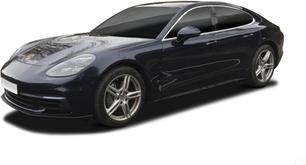
Beauty is in the eye of the beholder but the redesign sees this model get an outward appearance that looks far more aggressive with a distinct profile that now sets it apart for all of the right reasons.
On the outside, the biggest changes include larger matrix LED headlights and a new front fascia that sits a bit higher with more pronounced curving in the bonnet.
The front gets extra air intakes but there are also larger 'air blade' vents behind the front wheel arches which help smooth the air flow around the wheels and add some extra sculpted sportiness to the car's sides.
The rear has been reshaped to look more like the 911 and isn't as pillowy as the outgoing model. There is a new long LED strip light running the width of the rear and an extra brake light for added dazzlement at night. The rear window now spreads to the width of the liftback lid which makes it appear frameless.
The optioned 21-inch alloy wheels look gorgeous in their painted bronze (or Neodyme) glory and feature the Porsche crest in full colour for added pizzazz. The bronze accent is also carried across to the quad exhausts.
All these factors make the exterior design look more cohesive than the previous model.
The interior has been reworked, too, and the dashboard now sports upgraded tech panels that makes the cabin feel cinematic. The optioned passenger display screen only adds to this effect.
Purists will pout, but like the new 911 the analogue cluster and turn-key operation have died a quiet death. You now get a 12.3-inch digital instrument panel and push-button starter. Plus, the gearshift has been repositioned from the centre console to the dash.
The optioned Sports Chrono and Neodyme accent packages of our test model means the dashboard gets a race clock (superfluous for every day driving but fun to look at) and the door handles, steering wheel and dashboard feature the same bronze highlights.
The only elements that don't look the part are the shiny piano black panels mainly found in the centre console. They're too easily scratched/marked for a car at this price point.
The cabin may not be as flashy as its competitors but it's still sumptuous.
It looks good, the Accent, just not quite as good as its bigger Hyundai brothers. And that’s got to sting, if only a little bit.
Words like "subtle", "restyled” and “enhanced design” pepper the Accent’s media information, and so we’re not talking massive changes. But the exterior of the Sport looks sharp, especially in the 'Pulse Red' of our test car. Other colours include 'Chalk White', 'Lake Silver', 'Phantom Black', 'Sunflower' (yellow), and 'Blue Lagoon', but there’s no green, orange or grey paint available.
First, though, don’t let the whole 'sport' thing fool you. You’ll find no Fast and Furious body kit, nor is there much in terms of a rear spoiler, side skirts or a rear diffuser. Instead, a silver-framed mesh grille (a smaller version of the one that adorns the i30) blends into the headlights that then sweep back into the body, while subtle power lines create a little dome in the bonnet, starting at the edges of the Hyundai badge and getting wider as they sweep back across the bonnet.
Side on, the alloys are clean and simple, and a single style crease runs the length of the body, intersecting both door handles on each side. At the rear, though, the concave body styling doesn’t quite work so well, ending up looking busier than the rest of the car, and leaving it with too much body and not enough rear window.
Inside, as you can see from our interior photos, there is plenty of hard plastic, but there have been some design flourishes that give them a nicer texture and go some way to disguising the fact they’re hard enough to be used as a weapon in a roadside road rage dispute.
But it’s a simple and clean design, with patterned cloth (what, you were expecting leather seats at this price point?) seats, an uncluttered centre cluster and a sparing use of silver highlights that break up the black of the dash and doors.
You can also option everything from tailored floor mats to interior lighting, forming a kind of personalised premium package for the Accent Sport.
The cabin feels spacious in both rows and the rear row can comfortably fit those who are above six foot (182cm) with a caveat.
Despite being optioned with the '4+1' seating, don't be fooled; the middle rear seat is nothing more than extra room for the out-boarders as the rear centre console takes up all legroom a middle seater might need. Not even a kid will be happy in the middle for long.
Amenities in both rows are good. The heating/cooling and massage functions on the front seats are great and the four-zone climate control means everyone can get comfortable.
Access to both rows is surprisingly good with doors that open widely but the rear footwell lip is high and the well narrow. So, if you have clunky boots on you may feel clumsy getting into position.
My seven-year old found the doors heavy to open and it took him a while to realise he didn’t have to slam the doors shut thanks to the soft-close feature.
Individual storage is better than you usually get in a sports car but all cubbies still fall on the shallower side. There are four cupholders, four drink bottle holders, a glove box, a middle console and two small net map pockets. There is also a dedicated phone cubby housing the wireless charging pad.
The boot aperture is wide and it’s super easy to reach things in the back thanks to the liftback lid but that sloping roofline means you lose out on height for larger items.
Stack bigger things right behind the back seat if you want to fit them. Capacity is below average compared to its rivals at 460L.
The rear row has a 40/20/40 split to open up storage options and there is a very deep cubby underneath the floor with the tyre compressor/repair kit.
Device charging options are great with a total of four USB-C ports, a wireless charging pad and three 12-volt sockets to choose from.
The upgraded multimedia system looks fantastic and is user-friendly. The built-in satellite navigation is simple to use and the multimedia system, head-up display and instrument cluster can be highly customised.
The base Panamera model now comes standard with wireless Apple CarPlay and Android Auto. Connecting to the CarPlay is easy and the connection remains seamless.
The optional passenger display panel allows the front passenger to control their climate and seat comfort, see a duplicate of the instrument panel or just watch a movie on a long trip.
The screen has a privacy filter, which means the driver can’t see what’s on it and is thus not a distraction. However, no one in my family bothered to use it.
It’s every bit as practical as you might expect, the Accent Sport, given that you’re unlikely to be using something this size as a pseudo moving van anytime soon.
The 4155mm long, 1700mm wide and 1450mm high (the sedan is 4370mm long) Accent Sport's interior dimensions feel spacious up front, and while the front seats are a little too flat, the cabin feels airy and light. There are two cupholders up front, too, and there’s room in the front doors for extra bottles.
Like all Hyundais, the little Accent boasts most of the technology options favoured by younger buyers, like a USB point, an aux connection and two 12-volt power outlets all housed in a tiny storage bin underneath the centre console. There’s a sunglass holder, too, integrated into the roof.
The backseat is sparse but spacious enough, with enough room for adults to sit behind adults in comfort - at least in the two window seats. That’s about it back there, though, with no technology options, vents or air-con controls.
Boot space is a useable 370 litres in hatch guise, but luggage capacity grows to 465 litres should you opt for the sedan, with both of those figures measured in VDA. Optional roof racks and rails (and other offical accessories like a rubber cargo liner, mud flaps or dedicated bike, snowboard and surfboard carriers) help increase the pint-size Accent’s load-lugging ability.
As does a handy (and optional) cargo liner that helps separate your groceries, sitting neatly under the cargo cover that shields you luggage from prying eyes outside. Perhaps unsurprisingly, you can’t get a factory-offered bull bar.
There are two ISOFIX attachment points, one in each window seat, as well as three top-tether points across the back row.
There are four grades of Panamera on offer for the Australian market and the model on test is the entry-grade sedan, simply titled Panamera.
It feels silly calling a car priced at $236,990, before on-road costs, a 'base' model but here we are.
Our test model has $45,810 worth of optional extras but compared to its rivals the base price positions it towards the middle of the market with the Maserati Quattroporte GT being the most affordable at $219,000, then the Mercedes-Benz S450 at $241,275 and BMW 740i at $272,900. All prices before on-road costs.
As you’d expect, the standard equipment for the Panamera is long-winded and includes matrix LED headlights, four-point DRLs, ambient lighting, four-zone climate control, a dual sunroof, upgraded 12.3-inch touchscreen multimedia system, a new 12.65-inch digital instrument panel, wireless Apple CarPlay/Android Auto and built-in satellite navigation.
Comfort items include 14-way powered front seats with heating/cooling, as well as three-position memory functions. There is also a powered tailgate, front and rear parking sensors, a 360-degree view camera system and soft-close doors with a 'door brake' function.
The latter means the door holds the position you push it out too, minimising the chance of your kids hitting the neighbouring car, which is an awesome feature in a family car!
Other technology includes a total of four USB-C ports, three 12-volt sockets, a wireless charging pad, digital radio, the Porsche app and over-the-air updates.
As for the optioned extras... there is Burmester high-end sound ($11,200), full-grade leather upholstery ($7470), dark bronze accents on the quad exhausts ($6470), 21-inch alloy wheels ($3400), the 'Sport Chrono Package' ($3340), 10.9-inch passenger display screen ($3140), wheels finished in 'Neodyme' bronze ($2500), a massage function on the front seats ($2200), a middle rear seat ($1750), an interior Neodyme accent package ($1190), a heated steering wheel ($1140), an air quality system ($890), an interior black trim package ($760) and comfort pillow accessories ($450). Phew!
The price list for the Hyundai Accent range - available only in single, Sport trim - starts at $15,490 for the six-speed manual version, and will cost $2k more ($17,490) for the six-speed auto version, with those prices identical for hatch and sedan versions. So, not much of a walk through a valley of trim levels, then.
Yes, you could be forgiven for asking “how much!?”, given that’s a little more than we’ve grown accustomed to paying for the cheapest - and on perennial runout - Hyundai model, but there are enough standard features on offer to sweeten the deal. Besides, the inevitable drive-away pricing deals will almost certainly improve the value equation, too.
Outside, expect 16-inch alloy wheels and LED indicators integrated into the side mirrors - though there aren't projector headlights, daytime running lights or any of the other, more high-end appointments.
Inside, you’ll find cloth seats, cruise control, air-conditioning, a power window for everyone, powered mirrors, steering wheel controls and a digital clock.
Finally, the tech stuff is covered by an Apple CarPlay-equipped (meaning you can use your iPhone’s GPS as your navigation system) 5.0-inch touchscreen that pairs with a stereo with four speakers. Android Auto is also available, via a 15-minute software upgrade done through the dealer. The screen is too small to use for in-depth stuff, like searching for a phone number, but it mostly does the job just fine.
It also means that, as well as a CD player, you’ll get radio, Bluetooth, MP3, podcast and Spotify access, all played through the car’s sound system. You can forget a subwoofer or DVD player, though, unless you opt for an aftermarket multimedia system.
Sure, that’s not the most comprehensive list of goodies - there aren’t deeply tinted windows, no sunroof and the touchscreen is rather small, and while there’s central locking that allows keyless entry, there's no push-button start.
But then, $15,490 isn’t much in the world of new cars, and so to score alloy rims, powered everything and genuine phone integration (all things that will attract your future buyers - and protect your resale value - should you sell it second hand) is not to be sneezed at.
The base Panamera doesn’t have a hybrid powertrain like its siblings and sports the 2.9L V6 twin-turbo petrol engine of the outgoing model. But it’s been retuned and now produces 260kW and 500Nm – both figures up from the previous model.
The Sport Chrono Package means the 0-100km/h sprint improves from 5.1-seconds to a tummy-sucking 4.8-seconds and my son gave a whoop of delight whenever we had to get up to speed.
The Panamera has an eight-speed, dual-clutch auto transmission and is the only RWD for the Panamera line-up. It also sports a top speed of 272km/h. So, suffice it to say, the engine has the sports cred you expect from a Porsche.
The one Accent on offer is powered by a single engine; a petrol-sipping (there’s no diesel, LPG or turbo), 1.6-litre motor that will produce a solid-sounding 103kW (138 horsepower) at 6300rpm and 167Nm of torque at 4850rpm. They are good specs, and it stands up to most competitors in an engine vs engine models comparison. It pairs with a choice of six-speed manual transmission or six-speed automatic transmission.
There used to be a fairly underwhelming 1.4-litre engine size paired with a CVT auto in the now-axed Accent variant, but this bigger engine is much, much better, and makes for much happier reading on the specifications sheet.
The Accent is front-wheel drive only, with no 4x4, AWD or rear-wheel drive options available. It will serve up a 900kg braked and 450kg unbraked towing capacity, with an optional tow bar/ball fitted. Kerb weight is listed as between 1070kg and 1170kg.
The Accent Sport uses MacPherson strut front and torsion beam rear suspension (no sophisticated air systems on offer), and Hyundai doesn’t quote any 0-100km/h, acceleration or speed figures.
The official combined (urban/extra-urban) fuel-cycle consumption figure is 9.5L/100km, which is pretty low for a high-performance vehicle (and a big one at that) but after a lot of open road and urban driving my real-world usage came out at 10.9L/100km.
That's the result after not being skimpy with using the power, either, so it's not as thirsty as you might expect.
When it comes to times between fills, the Panamera might surprise you. Based on the official combined fuel cycle and large 90L fuel tank, expect a theoretical driving range of up to 947km (825km using our on-test figure) – which is a great driving range for a performance vehicle, let alone a family one.
The Porsche Panamera only drinks the best, so while the driving range is great you won't be able to fill 'er up with anything but premium 98 RON unleaded petrol.
For fuel consumption, Hyundai claims 6.3 litres (6.6 litres for the sedan) per hundred kilometres on the combined cycle. But as with all of these manufacturer-supplied figures, there’s always a some sort of variation in the real world km/l fuel economy.
Just how much variation is dependent on how heavy your right foot is, but after my (admittedly city-based) week with the car, the trip computer had my mileage at 11.0L/100km. If you were to adopt an eco mode driving style, that would surely improve, though.
The Accent’s fuel tank size is fairly small, with a fuel capacity of just 43 litres - perfect for the city, less so for long-distance cruising. Emissions are a claimed 146g (154g in the hatch) per kilometre of C02.
Some people might not understand the obsession or loyalty Porsche owners have towards their cars but if you’re a fence sitter, get in the Panamera. It will make you understand because after driving one... you'll hear yourself say 'I get it'.
The base model has the goods with the engine outputs to ensure the driving experience remains fun and responsive.
The Panamera is no wild bronco, it's a cool customer. The composure for power delivery is unlike other performance sedans you may have driven. Acceleration is effortless without any twitchiness. You never feel out of control.
The air suspension means you hear the bumps more than you feel them but you still get excellent road feedback as a driver.
Passenger comfort is high, despite the cabin being quite loud with road and engine noise, because the seat and ride comfort remains well-cushioned. Fatigue and jostling are at a minimum.
The handling of the Panamera when it comes to cornering and steering feels dynamic and agile. I made a point of doing multiple mini roadies this week, simply for the joy of driving it.
While the Panamera is the most fun on a winding mountain road, it's a pleasant open-road cruiser as well.
The base Panamera has three driving modes - 'Normal', 'Sport' or 'Sport Plus' with a 20-second power booster available when you need extra oomph.
The Normal mode is sufficient for daily driving and the Sport Plus offers stiffer suspension and handling but the preference is to keep it in Sport mode.
Mainly because in this mode you get an awesome throatiness from the exhaust as well as the dynamics you expect from a sports car.
It’s a bit deceptive but the Panamera is massive and sits at 5052mm long and 2165mm wide - so, it definitely fills out a parking space!
However, the 360-degree view camera system is one of the best in the segment but you may still get choosy with where you park it.
With its sharp design and gleaming alloys, the Accent Sport doesn’t look like an entry-level model, and nor is it immediately obvious that it’s the cheapest way into the Hyundai family. The downside, though, is it does feel that way from behind the wheel.
A little harsher, a little more road noise and a little more gruff than Hyundai’s more expensive models (including the very good i30), it’s the unfair victim of the brand’s staggering success, which has left the Accent feeling a bit old-school by comparison.
That said, it's perfectly suited to inner-city life, and if you’re cruising around using minimal inputs, it does it all smoothly and quietly. The steering feels a little slack at slow speeds, with plenty of dead air when you first start turning the wheel, but none of that bothers you much in the city.
With its sharp design and gleaming alloys, the Accent Sport doesn’t look like an entry-level model.
The grunt from that engine is refreshingly ample for a small car, and provides plenty of punch to get you moving from traffic lights, while the seating position is high enough that vision is great out of every window (except the rear - you’ll be using the reversing camera for that one).
Take it out of town, though, and the refinement begins to vanish. The engine sounds harsh under heavy acceleration, the transmission can be confused - especially around 80km/h, where moving your foot a fraction can force continual changes up or down, like it's wrestling with a big life decision.
The only other question mark is over the suspension set-up, which for some reason favours sporty firmness in a car unlikely to be asked to achieve anything more dynamic than sitting at 50km/h. The result is a ride that can feel noticeably firm over bad road surfaces.
The Accent’s 140mm ground clearance (not to mention the fact it’s a front-wheel drive city car) should be enough to persuade you not to test its off-road performance. And its turning radius is 10.4m.
No Porsche is rated with ANCAP and the Panamera is no exception but the base model still has an extensive safety list that includes 10 airbags, which is more than some people movers!
The standard safety kit includes AEB, forward collision warning, blind spot monitoring, driver attention alert, safe exit warning, rear occupant alert, tyre pressure monitoring, an active bonnet and a side impact protection system.
There's also rear cross-traffic alert, lane departure alert, lane keeping aid, a head-up display, adaptive cruise control, a 360-degree view camera system, front and rear parking sensors, park assist, an engine immobiliser and an alarm system with radar-based interior surveillance.
The base Panamera misses out on traffic sign recognition and rear collision warning, though.
The rear row has two ISOFIX mounts and three top tethers but only two seats will be able to fit across the row.
It’s a pretty straightforward offering here, with six airbags (dual front, front-side and curtain), a reverse camera and the usual suite of driving, traction and braking aids, like power steering, ESP and EBD, headlining a pretty short list of safety stuff.
There are no parking sensors as standard, though, nor will you find AEB, lane departure warning or any other, more advanced features.
The Accent was awarded the maximum five-star ANCAP rating, but the organisation’s demands for safety rating features were less comprehensive when it was crash tested back in 2011.
If you're one who cares about where cars are manufactured, and were wondering where is Hyundai's Accent built, the answer is Ulsan, South Korea. And that’s no bad thing.
Porsche offers the Panamera with a three-year/unlimited km warranty, which is less than its competitors. It's more typical to see a five-year/unlimited km warranty in this segment.
Servicing intervals are reasonable at every 12-months or 15,000km, whichever occurs first and pricing varies per dealership.
The one I contacted (in Sydney) confirmed the first four years of servicing costs $8605 for an average of $2151.25 per workshop visit.
Worth noting the fourth year is a biggie at $4875, this major service including everything from an air-conditioning clean and transmission oil change to spark plug check/replacement and safety checks.
The Panamera is up there for service costs, even for the class but this kind of outlay comes with the territory when you're considering a car worth almost $300K.
It’s a very strong ownership picture, with the Accent Sport covered by Hyundai’s five-year/unlimited-kilometre warranty, and requiring a trip to the service centre every 12 months or 15,000km.
A capped-price servicing plan helps take the guesswork out of your service cost, too, with guide prices at between $245 and $345 per year for the first five years.
For known Hyundai Accent issues and common problems, complaints and faults - including any known clutch, suspension, gearbox, engine, battery or automatic transmission problems - head to CarsGuide's dedicated Hyundai Problems page.
One of the most common mechanical questions asked is whether the Accent uses a timing belt or chain, and the Sport uses a timing belt. Check your owners manual for recommended durations between changing it.
Hyundais traditionally score very well in international reliability rating surveys, which helps protect its second-hand ratings.