What's the difference?
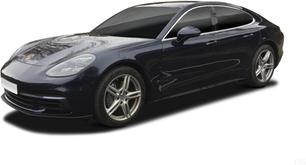
Australia hasn't had what you'd call a love affair with the Porsche Panamera. Especially compared to the on-going romance with its iconic sibling, the 911 and even its SUV stablemates.
The Panamera straddles the fence between high-performance sports car and family sedan and it's a position rivals like the BMW 740i, Maserati Quattroporte and Mercedes-Benz S450 have sometimes found difficult to balance.
This new-generation 'base' Panamera model is on test to see if this sedan's 2025 redesign will launch an arrow from Cupid's bow for Australian families?
The e-tron S was inevitable.
The marriage of the latest automotive trends – sporty electrified SUVs with specific performance bits, the e-tron S is as much rooted in Audi’s future as it is in the present.
Having been one of the earliest fully electric German cars in the space, and now with a few years of age on it. Can the e-tron S shine as one of the best? Read on to find out.
The Panamera is the ‘have your Porsche and drive it too’ model.
It encompasses the fun of the 911 while still being a comfortable daily driver that can easily fit a family of four. The cabin is sumptuously styled and not hurting for features, either.
Could the ownership costs and storage be better? Probably, but if you’re looking at this model, those items will probably be lower priorities for you.
For my little family of three, the base model Panamera is a win.
The e-tron S looks mean, feels premium, and blends serious power with surprising grace under pressure. I still can’t shake the feeling I had with the standard e-tron, though, that this car is an Audi sports SUV first and an electric car second, and its weight holds it back from being as fun to drive as I think some rivals are.
If you love Audi and you want to go electric without stepping into something too unfamiliar it’s a great option. If you want an electric car which takes full advantage of what the next generation of technology can offer, keep an eye out, there’s plenty of fresh metal on the way.
This is more than just a new Panamera - it’s a new generation Panamera.
The outgoing model was sort of a mix between the 911 and Macan but didn’t really hit the mark with any of its borrowed elements.
Beauty is in the eye of the beholder but the redesign sees this model get an outward appearance that looks far more aggressive with a distinct profile that now sets it apart for all of the right reasons.
On the outside, the biggest changes include larger matrix LED headlights and a new front fascia that sits a bit higher with more pronounced curving in the bonnet.
The front gets extra air intakes but there are also larger 'air blade' vents behind the front wheel arches which help smooth the air flow around the wheels and add some extra sculpted sportiness to the car's sides.
The rear has been reshaped to look more like the 911 and isn't as pillowy as the outgoing model. There is a new long LED strip light running the width of the rear and an extra brake light for added dazzlement at night. The rear window now spreads to the width of the liftback lid which makes it appear frameless.
The optioned 21-inch alloy wheels look gorgeous in their painted bronze (or Neodyme) glory and feature the Porsche crest in full colour for added pizzazz. The bronze accent is also carried across to the quad exhausts.
All these factors make the exterior design look more cohesive than the previous model.
The interior has been reworked, too, and the dashboard now sports upgraded tech panels that makes the cabin feel cinematic. The optioned passenger display screen only adds to this effect.
Purists will pout, but like the new 911 the analogue cluster and turn-key operation have died a quiet death. You now get a 12.3-inch digital instrument panel and push-button starter. Plus, the gearshift has been repositioned from the centre console to the dash.
The optioned Sports Chrono and Neodyme accent packages of our test model means the dashboard gets a race clock (superfluous for every day driving but fun to look at) and the door handles, steering wheel and dashboard feature the same bronze highlights.
The only elements that don't look the part are the shiny piano black panels mainly found in the centre console. They're too easily scratched/marked for a car at this price point.
The cabin may not be as flashy as its competitors but it's still sumptuous.
The e-tron S looks properly mean, with its adjustable ride-height suspension and enormous wheels combining nicely with the extra subtle sporty highlights to make for a squat SUV which clearly means business.
The width is especially evident with those accentuated wheelarches and the lines set by the lower wing to draw your eyes out to its edges. In profile it's easy to see its long wheelbase and tapered rear roofline, giving even the SUV a slinkier frame than you may be used to when looking at the comparatively boxy Q5.
The thing that strikes me about Audi’s e-tron range, though, is how little a departure it is. It ambiguously slots somewhere above the Q5 and below the Q7, but sticks very closely to the German brand’s styling script.
Sure, it looks a bit lower to the ground, and a bit meaner than you might expect for an EV, but it’s not as much of a departure as Jaguar’s I-Pace or BMW’s iX.
I suppose the biggest advantage here is nobody is going to say the e-tron’s overall visage is controversial, and certainly, it will appeal to existing fans of Audi’s design.
Inside it follows much the same theme, with all the key touchpoints and styling elements nearly identical to other Audis in the range, if not very similar.
It feels like a sensible, refined place in the cabin, with the only whacky pieces being the extra touchscreen for the climate unit and the strange thumb-operated shifter mounted on a floating piece which looks and feels like it could be the throttle control for a jet engine.
The dash is a bit more integrated and modern than in the conservative Q5 or Q7, with the air vents leading to the digital instrument cluster as part of an aesthetic three-terrace design which runs across the entire dash and into the doors.
The screens which appear in place of wing mirrors take a bit of getting used to. Aside from those notable departures, the interior continues the theme of sticking closely to the Audi formula, providing a more modern space which will still be familiar to existing fans of the brand.
The cabin feels spacious in both rows and the rear row can comfortably fit those who are above six foot (182cm) with a caveat.
Despite being optioned with the '4+1' seating, don't be fooled; the middle rear seat is nothing more than extra room for the out-boarders as the rear centre console takes up all legroom a middle seater might need. Not even a kid will be happy in the middle for long.
Amenities in both rows are good. The heating/cooling and massage functions on the front seats are great and the four-zone climate control means everyone can get comfortable.
Access to both rows is surprisingly good with doors that open widely but the rear footwell lip is high and the well narrow. So, if you have clunky boots on you may feel clumsy getting into position.
My seven-year old found the doors heavy to open and it took him a while to realise he didn’t have to slam the doors shut thanks to the soft-close feature.
Individual storage is better than you usually get in a sports car but all cubbies still fall on the shallower side. There are four cupholders, four drink bottle holders, a glove box, a middle console and two small net map pockets. There is also a dedicated phone cubby housing the wireless charging pad.
The boot aperture is wide and it’s super easy to reach things in the back thanks to the liftback lid but that sloping roofline means you lose out on height for larger items.
Stack bigger things right behind the back seat if you want to fit them. Capacity is below average compared to its rivals at 460L.
The rear row has a 40/20/40 split to open up storage options and there is a very deep cubby underneath the floor with the tyre compressor/repair kit.
Device charging options are great with a total of four USB-C ports, a wireless charging pad and three 12-volt sockets to choose from.
The upgraded multimedia system looks fantastic and is user-friendly. The built-in satellite navigation is simple to use and the multimedia system, head-up display and instrument cluster can be highly customised.
The base Panamera model now comes standard with wireless Apple CarPlay and Android Auto. Connecting to the CarPlay is easy and the connection remains seamless.
The optional passenger display panel allows the front passenger to control their climate and seat comfort, see a duplicate of the instrument panel or just watch a movie on a long trip.
The screen has a privacy filter, which means the driver can’t see what’s on it and is thus not a distraction. However, no one in my family bothered to use it.
As an electric vehicle, the e-tron has certain advantages over its combustion equivalents, and overall makes for an accomplished family-sized SUV. But there are areas where more could be done to take advantage of its high-voltage features and abundant footprint.
Up front in the cabin is a good place, with both occupants treated to lavish seats with plenty of head and legroom, great adjustability, and plenty of width in the cabin.
The finishes are beyond premium with thick chunks of well-padded leather meeting your elbows, hands, and knees at every point. As always the lovely Audi switchgear exists in most places, but the removal of solid toggles and buttons in favour of an extra touch panel feels unnecessary.
There’s still a physical volume knob, and while the climate touchscreen is plenty large enough to have a shortcut button for every function without needing a sub-menu, it feels like you have to move your eyes too far from the road to know you’re going to jab it in the right spot.
Even the main touch panel has an interesting haptic feedback effect for each press, designed to mimic the solidly-sprung button hardware the brand has used in the past.
The screen looks amazing and is fast and sharp, key hallmarks of computer hardware that's up to the task, although the resolution is so high the touch elements when using Apple CarPlay end up being a little small and hard to stab at while you’re trying to keep your eyes on the road.
For storage there’s a big bottle holder and bin in the doors, a large cutaway with a storage tray, dual bottle holders, and power outlets in the centre, with a further smallish storage area under the armrest console.
Unlike some EVs there’s no huge cutaway under what was traditionally considered the transmission tunnel, although there is a small bay with the USB-C ports.
The rear seat feels good for space, with an almost flat floor and decent legroom and width, although headroom could be better.
There are netted pockets on the backs of the front seats and decently-sized bottle holders in the doors, with a further set in the drop-down armrest.
The quad-zone climate with its own touch panel and adjustable centre vents is a nice touch in the rear, as is the set of USB-C ports below. The hard backings to the front seats and built-in sun blinds our car had will even be great for kids.
The boot measures in at 660 litres, which is high for the segment. It fit our three-piece CarsGuide demo luggage set with room to spare, and that's despite the massive battery pack under the floor.
There’s auxiliary storage, too, with a further bay under the boot floor and a second small tray situated under the bonnet, both useful for keeping your charging paraphernalia.
There are four grades of Panamera on offer for the Australian market and the model on test is the entry-grade sedan, simply titled Panamera.
It feels silly calling a car priced at $236,990, before on-road costs, a 'base' model but here we are.
Our test model has $45,810 worth of optional extras but compared to its rivals the base price positions it towards the middle of the market with the Maserati Quattroporte GT being the most affordable at $219,000, then the Mercedes-Benz S450 at $241,275 and BMW 740i at $272,900. All prices before on-road costs.
As you’d expect, the standard equipment for the Panamera is long-winded and includes matrix LED headlights, four-point DRLs, ambient lighting, four-zone climate control, a dual sunroof, upgraded 12.3-inch touchscreen multimedia system, a new 12.65-inch digital instrument panel, wireless Apple CarPlay/Android Auto and built-in satellite navigation.
Comfort items include 14-way powered front seats with heating/cooling, as well as three-position memory functions. There is also a powered tailgate, front and rear parking sensors, a 360-degree view camera system and soft-close doors with a 'door brake' function.
The latter means the door holds the position you push it out too, minimising the chance of your kids hitting the neighbouring car, which is an awesome feature in a family car!
Other technology includes a total of four USB-C ports, three 12-volt sockets, a wireless charging pad, digital radio, the Porsche app and over-the-air updates.
As for the optioned extras... there is Burmester high-end sound ($11,200), full-grade leather upholstery ($7470), dark bronze accents on the quad exhausts ($6470), 21-inch alloy wheels ($3400), the 'Sport Chrono Package' ($3340), 10.9-inch passenger display screen ($3140), wheels finished in 'Neodyme' bronze ($2500), a massage function on the front seats ($2200), a middle rear seat ($1750), an interior Neodyme accent package ($1190), a heated steering wheel ($1140), an air quality system ($890), an interior black trim package ($760) and comfort pillow accessories ($450). Phew!
A base, before-on-road costs asking price (MSRP) of $168,400 for the e-tron S in SUV form puts this sporty model a step above two of its most notable rivals, the Mercedes-Benz EQC (currently tops out at $141,300), and Jaguar I-Pace (currently tops out at $155,550), but below the menacing, full-fat BMW iX M60 (at $222,900), or the incoming updated Tesla Model X Plaid ($206,449).
To be fair here, only the iX M60 and Model X are pitched as performance variants in their respective ranges, with the Mercedes and Jaguar lacking either an AMG or SVR model respectively to represent their performance line-ups.
To that end, the e-tron S ups the ante when it comes to its power output with an impressive 370kW/973Nm across three motors, two at the rear, and one at the front. More on this in the Drivetrain part of this review.
Suffice it to say, it’s a lot of power. The e-tron is high-spec across the range, too, with the S scoring massive 21-inch alloy wheels, ‘Valcona’ leather interior trim, a heavily digitised cabin consisting of a 12.3-inch digital instrument cluster, 10.1-inch multimedia touchscreen, and a second 8.6-inch touch panel for the car’s climate functions.
The e-tron S also gets wireless Apple CarPlay and Android Auto connectivity, with matching wireless phone charger, built-in navigation, a 16-speaker Bang and Olufsen sound system, full LED lighting for the head and tail-lights and throughout the cabin, quad-zone climate control, heated front seats with power adjust, and a panoramic sunroof.
Finally, the S also has performance enhancing features like progressive (variable ratio) steering and adaptive air suspension.
Obviously, with the high level of standard gear, there’s not as much to put on the options list, although our car also had the weird $3500 ‘Virtual Exterior Mirrors’ which grant it concept-car like cameras with adjustable touch-panels inside the car in place of standard wing mirrors.
I don’t like these, but Audi says nearly half of all e-tron buyers are choosing them. More on this later.
There’s also the option to upgrade the car’s AC charger from 11kW to 22kW which could be very appealing if you have a public station nearby capable of putting out such power. This option will set you back a further $6900.
The last item on the list is the 'Sensory Package' ($9600) which bundles improved Matrix LED headlights in with soft close doors complete with puddle lamps, extended Nappa leather trim in the cabin, rear sunshades and heated rear seats. Our car had this option pack, too.
The base Panamera doesn’t have a hybrid powertrain like its siblings and sports the 2.9L V6 twin-turbo petrol engine of the outgoing model. But it’s been retuned and now produces 260kW and 500Nm – both figures up from the previous model.
The Sport Chrono Package means the 0-100km/h sprint improves from 5.1-seconds to a tummy-sucking 4.8-seconds and my son gave a whoop of delight whenever we had to get up to speed.
The Panamera has an eight-speed, dual-clutch auto transmission and is the only RWD for the Panamera line-up. It also sports a top speed of 272km/h. So, suffice it to say, the engine has the sports cred you expect from a Porsche.
The S-branded e-tron sets itself apart from the rest of the range with a seriously powerful set of three motors. There are two on the rear axle, and one on the front axle.
The total combined output of this collection is 370kW/973Nm, which for a combustion car, would be unprecedented.
To be fair, these figures are under a ‘boost’ mode, with the car generating a still strong 300kW/800Nm in most situations.
The three motor drivetrain allows for an electric version of Audi’s ‘quattro’ all-wheel drive system which the brand says can react to changes in 30 milliseconds and move torque appropriately.
The system is rear-biased, and in the name of efficiency the front motor is only used when required under acceleration or cornering.
The official combined (urban/extra-urban) fuel-cycle consumption figure is 9.5L/100km, which is pretty low for a high-performance vehicle (and a big one at that) but after a lot of open road and urban driving my real-world usage came out at 10.9L/100km.
That's the result after not being skimpy with using the power, either, so it's not as thirsty as you might expect.
When it comes to times between fills, the Panamera might surprise you. Based on the official combined fuel cycle and large 90L fuel tank, expect a theoretical driving range of up to 947km (825km using our on-test figure) – which is a great driving range for a performance vehicle, let alone a family one.
The Porsche Panamera only drinks the best, so while the driving range is great you won't be able to fill 'er up with anything but premium 98 RON unleaded petrol.
The e-tron may be electric, but it’s also a performance car. To that end, its energy consumption, relative to the field, is behind the pace.
In fact, at a whopping 27.8kWh/100km, driving the e-tron around feels like the electric equivalent of steering a big V8.
It produced one of the highest consumption numbers I have seen from any EV during my time with it. Considering this number is even below the WLTP consumption number, which is 28.4kWh/100km, that's not great.
For comparison, the Mercedes-Benz EQC's official number is just 20.8kWh/100km, while the Jaguar I-Pace consumes 21.2kWh/100km according to the WLTP procedure.
Yes, they aren’t performance cars in the same sense, but it’s still a big difference.
I made sure to take it out and stretch the e-tron’s legs to assess its performance in its more sporty driving modes, but the majority of my time with the car was spent in a more comfort-oriented setting and with the regenerative braking set to maximum.
Possibly as a result of its real-world consumption, my car was showing about 350km of range on a full charge, a little below the official WLTP number of 364km, although it is worth noting the enormous 21-inch alloys do their part to reduce the range. The car ships with 20-inch wheels in Europe.
The good news is the e-tron is capable of charging fast, with its max DC charging speed set at 150kW (allowing for a 5.0-80 per cent charge time for its 95kWh battery of 30 minutes), and its AC charging speed set at 11kW, which allows a slow-charging time of around seven hours.
If you intend to park on the street or live in a unit where installing charge infrastructure is impossible, I would strongly recommend you consider the 22kW AC charging upgrade which will cut the AC charge time in half.
While there are few public stations currently capable of the full 22kW in Australia, it will future-proof your car for ideal convenience charging for when they're more commonplace.
Some people might not understand the obsession or loyalty Porsche owners have towards their cars but if you’re a fence sitter, get in the Panamera. It will make you understand because after driving one... you'll hear yourself say 'I get it'.
The base model has the goods with the engine outputs to ensure the driving experience remains fun and responsive.
The Panamera is no wild bronco, it's a cool customer. The composure for power delivery is unlike other performance sedans you may have driven. Acceleration is effortless without any twitchiness. You never feel out of control.
The air suspension means you hear the bumps more than you feel them but you still get excellent road feedback as a driver.
Passenger comfort is high, despite the cabin being quite loud with road and engine noise, because the seat and ride comfort remains well-cushioned. Fatigue and jostling are at a minimum.
The handling of the Panamera when it comes to cornering and steering feels dynamic and agile. I made a point of doing multiple mini roadies this week, simply for the joy of driving it.
While the Panamera is the most fun on a winding mountain road, it's a pleasant open-road cruiser as well.
The base Panamera has three driving modes - 'Normal', 'Sport' or 'Sport Plus' with a 20-second power booster available when you need extra oomph.
The Normal mode is sufficient for daily driving and the Sport Plus offers stiffer suspension and handling but the preference is to keep it in Sport mode.
Mainly because in this mode you get an awesome throatiness from the exhaust as well as the dynamics you expect from a sports car.
It’s a bit deceptive but the Panamera is massive and sits at 5052mm long and 2165mm wide - so, it definitely fills out a parking space!
However, the 360-degree view camera system is one of the best in the segment but you may still get choosy with where you park it.
Does the e-tron live up to the promise set by sporty Audis which have come before it? The answer is interesting.
There is no doubt the e-tron S is rapid, at times absurdly so. If you stick it in the required S mode and hunker the suspension down, planting the accelerator makes its claimed 0-100km/h sprint time of 4.5 seconds suddenly very real.
It lurches ahead without so much as a squeak from its enormous tyres, grabbing the road with its front axle as it warps you forward.
So yes, this electric performance car is no doubt quick. It is also heavy. Weighing in at a tare mass of 2830kg, the e-tron S is quite literally massive.
The trouble is, while its powerful electric motors are great at overcoming this gravitational obstacle in a straight line, it’s in the corners and at low speeds where you feel every bit of it.
The e-tron crashes over larger bumps, it’s suspension struggling to deal with the combination of its weight and low-profile tyres, while it can also feel cumbersome in the corners around town.
The suspension is better at levelling things out once you gain a bit of pace, and the tyres work with the all-wheel drive system to put in a Herculean effort when carving up bends at speed, but there’s the ever-present lurch of weight always working against you.
This feeling isn’t helped by the steering tune, which even in its most comfort-oriented setting feels hefty and slow to turn. In the default sport mode, ‘dynamic’, it takes effort to push this car around corners.
Despite the unsettling feeling of it, though, the car holds on for dear life, and I never once felt as though the tyres were remotely in danger of breaking traction when put under pressure.
Is it a performer, then? Absolutely, there’s something mind bending about a vehicle so heavy going so quickly.
Does it feel fun to drive? Less so. I enjoyed the connectivity of the Porsche Taycan offers at speed more than I enjoyed the e-tron S, and its weight and girth demand a nice wide piece of tarmac for you to really wring it.
It’s far from a darty and engaging car like the Q5 can be despite its mammoth power outputs.
Elsewhere, the drive experience feels very Audi, though. The touchpoints and feedback are mostly familiar, as are the software and ergonomics.
The virtual wing mirrors are more of an inconvenience than anything else. This car is already hard to see out of, with big C-pillars and a tall belt line, and the digital exterior mirrors offer what feels like a limited angle of vision and make it extra hard to see out at night.
Some things fall to the wayside a little. The e-tron’s drive system almost hides the regenerative braking setting several menus deep, which, once activated, allows you to set it using the paddle-shifters on the wheel.
Audi says the regen will account for nearly 30 per cent of the car’s range, which is odd because even at the highest setting it feels a bit mild, relying on the user to manually operate the brake for a ‘blended braking’ mode to make up the difference.
It’s a bit of a stretch from the single-pedal driving modes offered on some rival cars.
My theory here, as with this car’s look and feel, is the e-tron is primarily designed to be familiar to an existing Audi customer, or someone coming out of a purely combustion premium rival.
No Porsche is rated with ANCAP and the Panamera is no exception but the base model still has an extensive safety list that includes 10 airbags, which is more than some people movers!
The standard safety kit includes AEB, forward collision warning, blind spot monitoring, driver attention alert, safe exit warning, rear occupant alert, tyre pressure monitoring, an active bonnet and a side impact protection system.
There's also rear cross-traffic alert, lane departure alert, lane keeping aid, a head-up display, adaptive cruise control, a 360-degree view camera system, front and rear parking sensors, park assist, an engine immobiliser and an alarm system with radar-based interior surveillance.
The base Panamera misses out on traffic sign recognition and rear collision warning, though.
The rear row has two ISOFIX mounts and three top tethers but only two seats will be able to fit across the row.
The regular e-tron range is considered very safe by ANCAP which awarded it a maximum five stars with strong scores across all categories in 2019, although it does exclude the S which was not released at the time of testing.
The S has the same suite of active safety features as the rest of the range, though, which includes freeway-speed auto emergency braking (up to 250km/h) with pedestrian, cyclist detection, and intersection assist, lane departure warning with lane keep assist, blind-spot monitoring with rear cross-traffic alert, adaptive high-beams, adaptive cruise control (with eco-assist and stop-and-go functions), as well as a clear exit warning.
The 360-degree camera suite is welcome, as is airbag coverage for the front, side for both front and rear rows, as well as curtains.
ISOFIX points feature on the rear outboard seats, and there are top tethers across all three rear seats.
Porsche offers the Panamera with a three-year/unlimited km warranty, which is less than its competitors. It's more typical to see a five-year/unlimited km warranty in this segment.
Servicing intervals are reasonable at every 12-months or 15,000km, whichever occurs first and pricing varies per dealership.
The one I contacted (in Sydney) confirmed the first four years of servicing costs $8605 for an average of $2151.25 per workshop visit.
Worth noting the fourth year is a biggie at $4875, this major service including everything from an air-conditioning clean and transmission oil change to spark plug check/replacement and safety checks.
The Panamera is up there for service costs, even for the class but this kind of outlay comes with the territory when you're considering a car worth almost $300K.
Audi has followed its Volkswagen parent in upgrading its warranty to five years and unlimited kilometres, finally leaving BMW and its three-year warranty behind.
The e-tron’s high-voltage battery components are covered by a separate eight-year and 160,000km warranty, but the big win, especially in this premium segment, is the first six years of servicing (covering three 24 monthly or 30,000km visits) is free.
Oh, and your public charging is largely free for the same period too, as Audi throws in a six-year ChargeFox subscription.
Six years pretty much cost-free? Audi, how far you’ve come.