What's the difference?
In a world of cheap, popular and well-specified Japanese and Korean small hatchbacks, it’s easy to forget the humble French cars that once helped define the segment.
They’re still around, though. You’ve probably seen a few Renault Clios, you might not have seen the tragically underrated new Citroen C3, and there’s at least a chance you’ve seen one of these – the Peugeot 208.
This iteration of the 208 has been around in one form or another since 2012 and is due to be replaced by a second-generation model in the near future.
So, should you consider the aging 208 in a busy market segment? I spent a week behind the wheel of the second-from-the-top GT-Line to find out.
Spoilt. That's what we are. If you're in the market for a hot hatch, you can have your pick of German-built and French ones from as little as $27,000. There isn't a dud among them now that the VW Polo GTI has had a bit of an update and you can pick and choose your style. Audi's S1 is aiming to be king of the kids with its stiffly-priced S1.
Set the finances aside and consider for a moment what's on offer. As it turns out, a lot.
The 208 GT-Line is hardly a car purchased on its value offering; it’s an emotional purchase. Fans of the brand know it, even Peugeot knows it.
Here’s the thing, though, the GT-Line looks the part, is true-to-its-roots in how fun it is to drive, and will surprise most with its spacious dimensions and decent spec level. So, while it might be an emotional buy, it’s not necessarily a bad one.
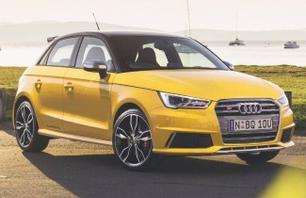
Cars this small shouldn't be this fast and useable at the same time, but the Audi S1 is. It isn't without its problems - the ride is harder even than the Fiesta ST which might weary some prospective buyers.
It's also a bit difficult to justify the price - in its basic form it's missing a few creature comforts that you'd expect in a $50,000 car - reversing camera, high-res screen, that sort of thing.
However, in the hot hatch world, those things don't matter. It has the bragging rights, the tech and the outright blinding speed to take on the bonkers Focus ST and equally zany Megane RS. And even the Audi S3.
It might not be for you, but I had come around to the 208’s design by the time I handed the keys back. It’s a bit more upright and frumpy than the slick, conservative design of the Volkswagen Polo, or the swish, cutting-edge lines of the Mazda2.
It’s undeniably a European city car in its short and upright stance, but blazes its own path, even compared to French competitors. I grew quite fond of its weird, slopey bonnet, unconventional face and tough rear wheel arches. The way the rear light clusters clasp the rear to bring the design together is quite satisfying, as are the aluminium-brush alloys, recessed lights and the single chrome tailpipe.
It could be argued that this is a path well-travelled, with this 208 mirroring the design cues of the 207 that came before it, but I’d argue it holds its own, even in 2019. If you’re after something radically different, the styling on its replacement, due next year, is one to look out for.
On the inside, things are… unique.
There are cushy, deep seats for front occupants, with a super vertical dash design, leading up from the deep-set shifter (an older look) to the top-mounted media screen, which is slick, with its chrome bezel and lack of buttons.
The steering wheel is awesome. It’s tiny, strongly contoured and covered in nice leather trim. Its small, almost oval shape is super satisfying to wrangle, and enhances the way you interact with the front wheels.
What is extra strange about it is how far separated it is from the dash cluster. The dials are perched way atop the dash in a layout Peugeot refers to as the ‘iCockpit’. This is all very cool and aesthetic and French if you’re my height (182cm), but if you’re particularly short or particularly tall, the wheel begins to obscure vital information.
Other strange things about the cabin mainly involve little bits of plastic of varying quality strewn about the place. While the overall look is very cool, there are some odd bits of chrome trim and hollow black plastics about that probably don’t need to be there.
The A1 is so small it starts to strain Audi's design language. When you cram on the S-style bumpers and raccoon-eyed trim on the hatchback, it's starts to look a bit busy.
It isn't quite a shrink-wrapped A3 - Ingolstadt's designers know better than that - but it's full of Audi design cues, such as the strong, light-catching character lines, distinctive LED daytime running lights and fondness for big wheels.
Inside is along the themes of the A3, with what are becoming Audi's trademark; round eyeball air-con vents, the manual fold-down screen familiar to Q3 owners (but smaller) and a good clear dash. The handbrake jars slightly as it feels cheap to hold and wobbles a bit.
The S Sport seats are big and comfortable, and the top half of the backs are capped in plastic, which was colour-coded on our car. The rear passengers will certainly get an eyeful of whatever terrifying hue you've chosen, so choose wisely.
Despite the five doors, the back seats are occasionals, like the Mini the A1 is gunning for, and the boot is very small, but okay for shopping for couples or singles.
This Peugeot is never going to be as cheap as a Mazda2 or Suzuki Swift. The current range spans from $21,990 for the base Active to $26,990 for the GT-Line, and that’s all before on-road costs.
Safe to say you’re looking at a $30k hatch then. For the same money you could be hopping into a decently specified Hyundai i30, Toyota Corolla or Mazda3, but Peugeot bank on the fact that this car appeals to a special kind of customer; the emotional buyer.
Perhaps they had a Peugeot in the past. Perhaps the quirky styling calls out to them. But they aren’t interested in value… per se.
So do you at least get a decent standard spec? The GT-Line comes with a 7.0-inch multimedia touchscreen with Apple CarPlay and Android Auto support, built-in sat-nav, 17-inch alloy wheels wrapped in some seriously low-profile Michelin Pilot Sport rubber, panoramic fixed glass roof, dual-zone climate control, self-parking function, front and rear parking sensors with a reversing camera, rain sensing wipers, sports bucket seats, auto folding mirrors and GT-Line specific chrome styling touches.
Not bad. The styling is certainly turned up a notch over the regular 208 range and the spec list makes it one of the better-equipped cars in the segment. However, there are some notable omissions which hurt on a car at this price. For example, there’s no option for push-start or LED headlamps.
Safety is okay, but it could use update. More on that in the safety section.
Starting at $49,900, Audi S1 is by far the priciest of the small-hatch based hotties, at least until Mini's madcap JCW arrives. This price is just almost double that of VW stablemate's forthcoming 2015 Polo GTI.
Standard on the manual-and-five-door-only S1 is a ten speaker stereo, climate control, ambient lighting, remote central locking, cruise control, satnav, headlight washers, auto headlights with xenon low beams, partial leather seats, leather-bound steering wheel, auto wipers and rear parking sensors.
Our Misano Red ($990 option) came with two extra packs. The Quattro Exterior Package ($3990) adds bi-xenon headlights with red trim, red brake calipers, spoiler, quattro logos on rear doors (ahem!) and five-spoke 18-inch alloys that are part matt black, part polished.
The Quattro Interior Package ($2490) adds S Sport front seats with Nappa leather and red backrest capping with quattro logo (ugh), more nappa around the cabin with contrast stitching, flat bottom steering wheel and red rings on the air vents.
There's an S Performance Package that brings the best of these two packs together for $4990, saving about $1500 and the embarrassment of the quattro logos.
Our test car also had aluminium air vents ($220), black contrasting boot lid ($300) and black roof ($720).
The A1 is so small it starts to strain Audi's design language
The grand total is a sobering $58,610. There's a couple more options that'll easily pop you over $60,000.
Audi's MMI is dash-mounted in the A1 as there's no room on the narrow centre console. As ever, it works well and doesn't take much getting used to. The satnav is a bit grainy on the smaller screen but is otherwise a competent unit.
Sound is from a ten-speaker stereo and you can stream across Bluetooth or plug in a memory card. The sound was good but the system did take a while to find the phone whenever we came back to the car.
The regular (that’s non-GTi) 208s are offered with just one engine now. A 1.2-litre turbo petrol three-cylinder, which produces 81kW/205Nm. While that doesn’t sound like an awful lot, it turns out to be plenty for the little 1070kg hatch.
Unlike some notable French manufacturers, Peugeot has seen the light and dumped single-clutch automatics (aka automated manuals) in favour of a six-speed torque converter auto, which does its best to have you not notice it.
It also has a stop-start system, which might save fuel (I couldn’t objectively prove that it did) but will definitely annoy you at the lights.
This is where the action is. The S1's tiny body packs a 2.0-litre turbocharged four-cylinder producing 170kW and 370Nm of torque. The S1 will streak to 100km/h in 5.9 seconds thank to the traction aid of quattro all-wheel drive.
All Audi S1s come with a six-speed manual
Despite a pretty solid hammering during its week with us, including more time than we'd have liked in Sydney traffic, the stop-start function helped deliver a pretty reasonable 10.2L/100km, however that's a long way over claimed 7.1L/100km.
All Audi S1s come with a six-speed manual, so dual-clutch haters can save the whining. The only downside from not having a self-shifter is the ECU can't deliver the boy racer farts, parps and crackles of the other S cars.
The 208 is good fun, and lives up to its heritage of making the most of its lightweight dimensions and small figure to make for an agile city-slicker. The engine outputs might look like just any other hatch in this class, but the turbo comes on nice and strong in an impressively linear fashion.
It makes for reliable and strong acceleration, with the peak 205Nm of torque available at 1500rpm.
A featherweight at 1070kg, you’ll find no complaints from me about its performance. It’s no GTi, but it will still be warm enough for most.
Despite its upright figure, handling is fantastic, too. The low-profile Michelins feel planted at the front and back, and, unlike the GTi, you never really feel at risk of understeer or wheelspin.
This is all enhanced by the intense helm, with the small steering wheel giving it a thoroughly engaging feel. You can chuck this car into corners and down alleyways with enthusiasm, and it feels like it loves it as much as you do.
The suspension is stiff, especially at the rear, and the low-profile rubber makes it noisy on coarse-chip surfaces, but you’ll barely hear a peep out of the little engine. Other notable downsides include the slow-to-react stop-start system (which you can turn off) and the lack of active cruise, which would be nice at this price.
If you're buying the S1 as a comfortable urban runabout with a cool badge, you're half right. While the seating for front passengers is certainly supportive, the hard suspension tune will ensure you're well aware of road surface imperfections.
The S1 is a rocket
Thankfully, what it missed out on in the ride department it makes up for in every other way - the S1 is a rocket. The 2.0-litre turbo jammed under the bonnet has almost no lag and is paired with a slick six-speed manual that is terrific fun to manhandle through the gears.
The way the S1 picks up speed when it's on boost is addictive and licence-endangering. A flattened accelerator in second or third will obliterate just about anything this side of $100,000 and you'll be having more fun in this than big brother S3 because the chassis is more adjustable and there's a bit more life.
You can hear the turbo sing to accompany the bassy exhaust growl. Hit the massive brakes hard and the car remains stable even over rutted roads. Turning the wheel brings almost-instant turn-in, mashing the throttle again a fun little wriggle. It's superb.
It's tremendous fun point-to-point on a twisty road
You'll have to be a bit patient with the throttle to get the wriggle, though - give it too much too early and it will want to push wide, the quattro system shuffling power around to try and quell understeer while the electronic diff fiddles with the braking system to do the same thing. It gets there in the end, but you're better off meting out the power with your right foot for maximum rewards.
It's tremendous fun point-to-point on a twisty road - despite being a bit heavy for its size (1415kg), it's as chuckable as the next best thing, the Fiesta ST.
On the topic of active cruise, this car is showing its age in the safety department. Available active safety is limited to a camera-based city-speed auto emergency braking system (AEB). The lack of a radar, even optionally, means no active cruise or freeway-speed AEB. There’s also no option for blind-spot monitoring (BSM), lane-departure warning (LDW) or lane-keep assist (LKAS).
Sure, we’re talking about a car which largely dates back to 2012, but you can get cars a full size up with all those features for close to the same money from Korea and Japan.
On the more impressive side, you get an above-average set of six airbags, seatbelt pre-tensioners and rear ISOFIX child-seat mounting points, as well as the expected set of electronic braking and stability aids. A reversing camera is also now standard.
The 208 previously held a maximum five-star ANCAP safety rating from 2012, but that rating is limited to four-cylinder variants, which have since been phased out. Three-cylinder cars remain un-rated.
Six airbags, stability and traction control, ABS, brake assist and distribution all add up to a five star ANCAP rating.